Selenium vs Cypress: Which Automation Tool Should You Learn in 2026?
You just decided to learn automation testing. You open a job listing for a QA Engineer at a Kathmandu IT company. The requirements say: "Experience with Selenium or Cypress." You search both tools online. You find dozens of comparison articles that say "it depends on your use case" and close the tab none the wiser.
Here is the reality: Selenium and Cypress are both legitimate automation tools used by real companies in Nepal. They solve the same core problem, automating web browser interactions, but they do it in fundamentally different ways. Those differences matter for how fast you can learn them, how much you can earn with each one, and which companies will call you in for an interview when you list them on your CV.
If you are working through the decision as part of building a QA career, the QA career guide maps the full learning path from manual testing through to automation and beyond. And if you want hands-on practice with both Selenium and Cypress on real projects with mentorship, the Quality Assurance course at Skill Shikshya covers both tools in one structured program built for Nepal's IT job market.
This guide gives you a straight, specific answer on which tool to learn first, and exactly why.
What is Selenium?
Selenium is an open-source framework for automating web browser interactions. It was first released in 2004 and remains the most widely used automation tool in enterprise software testing globally. The Selenium project, maintained under the Software Freedom Conservancy, supports automation across every major browser and programming language in use today.
Selenium works through a protocol called WebDriver. The test script sends commands to the WebDriver API, which passes those commands to a browser-specific driver (ChromeDriver for Chrome, GeckoDriver for Firefox), and the driver executes the commands inside the browser. This external control architecture is what gives Selenium its flexibility: it works with any browser, any language, and any machine configuration.
Selenium supports Java, Python, C#, JavaScript, Ruby, and Kotlin. It runs on Chrome, Firefox, Safari, Edge, and legacy browsers. Selenium Grid extends this further by allowing parallel test execution across multiple machines and browsers simultaneously, which makes it practical for large enterprise test suites.
What Selenium is Best For
- Cross-browser testing across Chrome, Firefox, Safari, Edge, and legacy browsers
- Multi-language teams where different developers work in Java, Python, or C#
- Enterprise-scale test suites with hundreds of test cases running in parallel via Selenium Grid
- Mobile automation when combined with Appium
- Long-term automation frameworks that need to support multiple technology stacks
- Projects that require testing across browsers that Cypress does not support natively
Where Selenium Struggles
- Setup is complex: you need WebDriver, browser-specific drivers, a test framework (TestNG or JUnit for Java, pytest for Python), and a reporting tool configured before you write a single test
- The external WebDriver architecture introduces timing issues that require explicit and implicit waits, which can make tests flaky if not handled carefully
- No built-in debugging interface: you have to add your own logging, screenshots, and error reporting
- Modern JavaScript-heavy single-page applications (SPAs) can be harder to test reliably because of asynchronous content loading
What is Cypress?
Cypress is a modern, JavaScript-based end-to-end testing framework released in 2017 by Cypress.io. Unlike Selenium, Cypress does not use WebDriver. It runs directly inside the browser, in the same JavaScript execution context as the application being tested. This architecture difference is the root cause of almost every other difference between the two tools.
Cypress supports JavaScript and TypeScript only. Browser support covers Chrome, Edge, Firefox, and Electron-based browsers. As of June 2026, Cypress does not natively support Safari, which limits its use for teams that need cross-browser testing on Apple's browser.
Cypress comes with its own test runner, built-in assertion library (Chai), network request interception tools, and time-travel debugging in a single installation. This all-in-one setup removes most of the configuration overhead that makes Selenium slow to get started with.
What Cypress is Best For
- Modern web applications built with React, Vue, Angular, or Next.js
- JavaScript or TypeScript teams where developers write tests alongside the application code
- Smaller to medium test suites where fast local feedback matters more than cross-browser reach
- Rapid test authoring: automatic waits eliminate most flakiness that Selenium testers deal with manual
- Component testing alongside end-to-end testing in a single framework
- Developer-led testing workflows where QA and development work closely together on the same JavaScript codebase
Where Cypress Struggles
- JavaScript and TypeScript only: teams using Java, Python, or C# cannot adopt Cypress without adding a new language to their stack
- No native Safari support as of June 2026
- No native mobile testing: Cypress cannot be used with Appium for Android or iOS automation
- Multi-tab and cross-origin testing require workarounds rather than first-class support
- Large test suites beyond roughly 500 tests require Cypress Cloud for parallel execution, which carries a subscription cost
Selenium vs Cypress: How Their Architecture Actually Differs
Understanding why Selenium and Cypress behave differently requires understanding how each one communicates with the browser. This is the most important technical concept in the comparison, and it drives every other difference.
Selenium's Architecture: External Control
Test Script (Java / Python / C#) → Selenium WebDriver → Browser Driver → Browser
The test script sends a command, that command travels to WebDriver, WebDriver translates it for the specific browser driver (ChromeDriver, GeckoDriver), and the driver executes it inside the browser. Each command makes a round trip across this chain before the next one can start.
This external control layer gives Selenium enormous flexibility: any language, any browser, any remote machine. The trade-off is latency between commands, which requires testers to add wait conditions manually to prevent scripts from failing because the browser has not finished the previous action yet.
Cypress's Architecture: In-Browser Execution
Test Script (JavaScript) → Cypress Test Runner (runs inside the browser, same JS runtime as the app)
Cypress runs inside the same JavaScript environment as the application itself. When your Cypress test clicks a button, it executes that action from inside the browser's own JavaScript engine, with direct access to the DOM, network requests, and browser events. There is no driver layer, no round-trip delay, and no translation step.
This direct access is why Cypress handles asynchronous operations, network requests, and DOM changes more reliably out of the box.
A simple analogy that makes this concrete: Selenium is like calling a driver on the phone and describing where to turn (the command has to travel before it is executed, and something can always get lost in the process). Cypress is like sitting in the driver's seat yourself (the command executes immediately and you see everything in real time).
Selenium vs Cypress: Full Feature Comparison
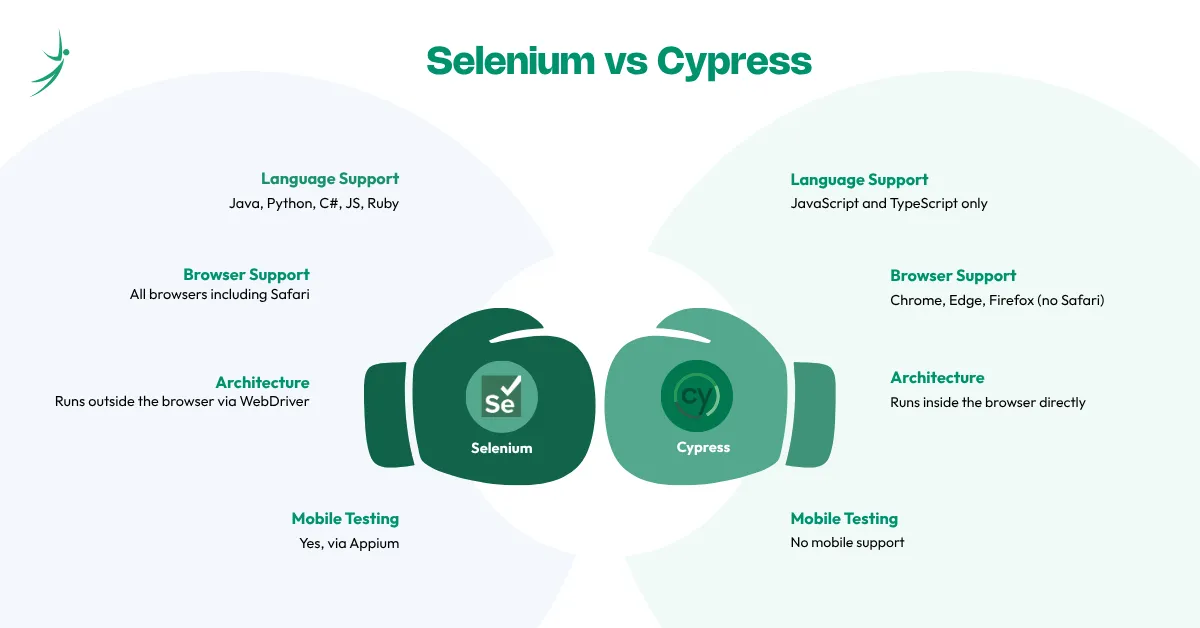
Both tools are used in production QA environments worldwide. Here is how they compare across every dimension that matters when choosing between them.
| Feature | Selenium | Cypress |
|---|---|---|
| Supported languages | Java, Python, C#, JavaScript, Ruby, Kotlin | JavaScript and TypeScript only |
| Browser support | Chrome, Firefox, Safari, Edge, legacy browsers | Chrome, Edge, Firefox, Electron (no Safari) |
| Architecture | External WebDriver (outside the browser) | In-browser (same JS runtime as the application) |
| Setup complexity | High (WebDriver, drivers, test framework, reporting) | Low (single npm install) |
| Learning curve | Steeper, especially without prior Java or Python | Gentler for JavaScript developers |
| Test execution speed | Moderate per test | Faster for smaller suites |
| Test flakiness | More prone without careful wait management | Less prone with automatic built-in waits |
| Debugging experience | Manual (add screenshots and logs yourself) | Built-in time-travel debugging with screenshots |
| Parallel testing | Selenium Grid (free, self-managed) | Cypress Cloud (paid service) |
| Mobile testing | Yes, with Appium | No native support |
| Multi-tab support | Full support | Limited, workarounds required |
| Cross-origin testing | Full support | Limited by same-origin policy |
| CI/CD integration | Jenkins, GitHub Actions, all major pipelines | GitHub Actions, Jenkins, all major pipelines |
| Community and ecosystem | Very large, 20+ years of resources | Fast-growing, strong JavaScript community |
| Licensing | Free and open source | Free core, Cypress Cloud is a paid tier |
| Best suited for | Enterprise, cross-browser, multi-language teams | Modern web apps, JavaScript-first teams |
Speed and Test Stability: Which Tool is Actually Faster?
Speed in test automation has two dimensions: how fast individual tests run and how stable those tests are across different builds and environments.
- Individual test execution speed: Cypress runs individual tests faster than Selenium because commands execute directly inside the browser without a WebDriver round trip. For a suite of 100 tests on a modern JavaScript web application, Cypress will typically finish faster.
- At scale: Selenium Grid closes the speed gap by running tests in parallel across multiple machines and browsers. For enterprise suites with 500 or more test cases, a well-configured Selenium Grid can match or exceed Cypress's throughput.
- Test stability: This is where the difference is most significant in practice. Cypress includes automatic waiting built into every command. When Cypress tells the browser to click a button, it automatically waits for the button to exist, be visible, and be interactable before executing the click. Selenium requires the tester to add explicit wait conditions manually. Teams that skip or misuse Selenium waits spend significant time chasing flaky tests that fail intermittently because the script moved faster than the browser.
For Nepal QA freshers building their first automation framework, Cypress's automatic waits mean fewer debugging sessions spent on timing issues and more time spent on writing meaningful tests.
Setup and Learning Curve: Getting from Zero to First Test
The time it takes to go from nothing to a working automated test is one of the most practical differences between the two tools.
Setting up a Selenium project from scratch:
- Install Java (or Python or C#) and configure your development environment
- Set up a build tool (Maven for Java, pip for Python)
- Add Selenium WebDriver as a dependency
- Download the correct browser driver version for your browser (ChromeDriver, GeckoDriver)
- Choose and configure a test framework (TestNG or JUnit for Java, pytest for Python)
- Add a reporting library (Extent Reports or Allure)
- Set up an IDE and project structure
A Nepal QA fresher with basic programming knowledge can expect this setup to take 2 to 4 hours for a complete working project, not counting time spent debugging version compatibility issues between Selenium, the browser, and the browser driver.
Setting up a Cypress project from scratch:
- Install Node.js
- Run npm install cypress
- Run npx cypress open
That is it. Your first test file is generated automatically. A fresher can go from zero to writing their first real test in under 30 minutes.
For career context, understanding what does a QA engineer do in a real Agile sprint makes it clear why setup time matters: QA engineers need to deliver value quickly within sprint timelines, not spend days configuring a framework before writing a single test.
Selenium vs Cypress in CI/CD Pipelines
Both tools integrate with CI/CD pipelines, and both are widely used in continuous testing environments. The implementation details differ.
Selenium in CI/CD:
Selenium integrates with Jenkins, GitHub Actions, GitLab CI, CircleCI, and every other major pipeline tool. Running Selenium headlessly in a pipeline requires configuring a headless browser mode (Chrome headless, Firefox headless) and making sure the correct driver version is available in the pipeline environment. Selenium Grid handles parallelisation across multiple pipeline workers.
Most larger Nepal outsourcing companies running Jenkins-based pipelines use Selenium because the Java or Python skill set of their existing developers matches Selenium's language requirements.
Cypress in CI/CD:
Cypress runs headlessly out of the box with a single command (cypress run). GitHub Actions integration is straightforward with well-documented YAML configurations. According to JetBrains' 2025 Developer Ecosystem Report, GitHub Actions has reached 62% adoption for personal projects and 41% in organisational settings. Frameworks with native GitHub Actions support reduce pipeline setup time significantly.
Cypress Cloud adds parallelisation, run history, and flakiness detection across CI runs, but requires a paid subscription for teams beyond the free tier limits.
For understanding how both tools fit into the broader types of software testing that QA engineers run across a product lifecycle, regression and smoke testing are the primary use cases where both Selenium and Cypress deliver the most value inside a CI/CD pipeline.
Which Should a Nepal QA Fresher Learn First?
This is the question every Nepal QA fresher is actually here to answer. Here is a clear, market-specific recommendation.
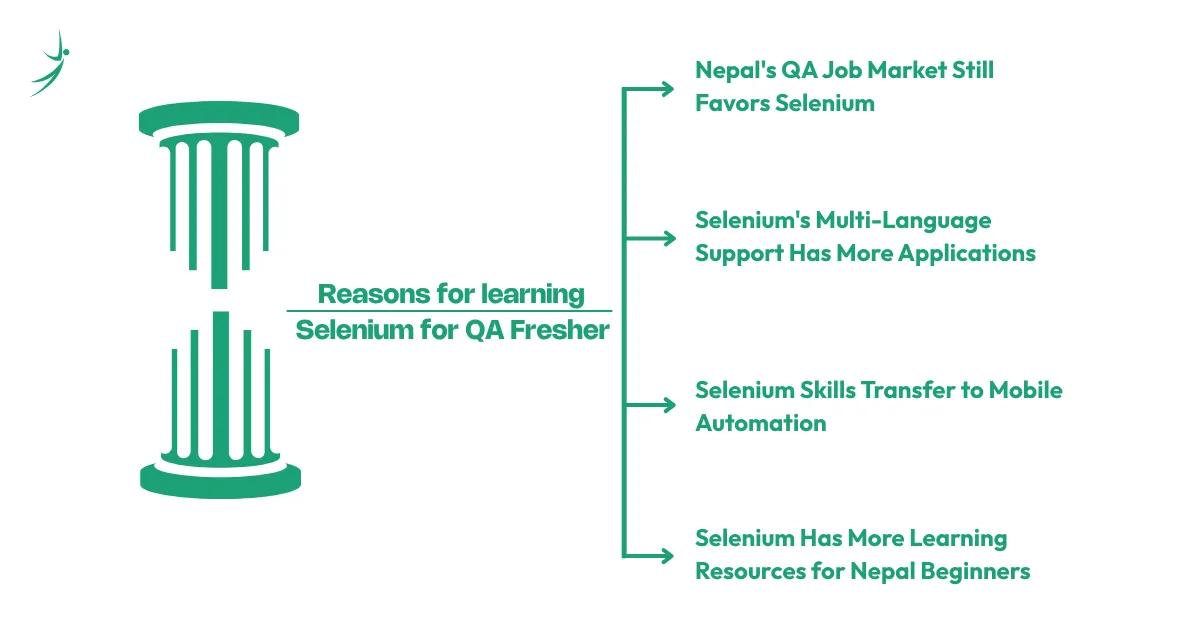
Learn Selenium first.
Here is the reasoning, specific to Nepal's QA job market in 2026:
Reason 1: Nepal's QA Job Market Still Favors Selenium
A LinkedIn Nepal search in June 2026 shows "Selenium" appearing in the large majority of automation QA job listings. Most mid-to-large Nepal IT companies, particularly outsourcing firms that build for international clients, run Java or Python-based Selenium frameworks. Companies like Leapfrog Technology, Cotiviti, and Fusemachines use Java-based enterprise automation stacks where Selenium is the standard tool.
Reason 2: Selenium's Multi-Language Support Has More Applications
Nepal's IT companies use a wide mix of languages. Java is common in enterprise outsourcing. Python appears in data engineering and ML-adjacent projects. C# shows up in .NET-based client work. Selenium works across all of them. Cypress locks you into JavaScript and TypeScript, which limits where you can apply your skills.
Reason 3: Selenium Skills Transfer to Mobile Automation
Nepal's fintech apps like eSewa and Khalti run on Android. Appium, the standard mobile automation framework, uses the same WebDriver architecture as Selenium. A QA engineer who knows Selenium can transfer those skills to Appium with significantly less ramp-up time than starting from scratch. Cypress has no equivalent path to mobile testing.
Reason 4: Selenium Has More Learning Resources for Nepal Beginners
Twenty years of Selenium means an enormous library of tutorials, Stack Overflow answers, YouTube courses, and documentation in multiple languages. When you get stuck at 11pm before a sprint, Selenium's community coverage means you will find an answer faster than you will for Cypress edge cases.
When Cypress Makes More Sense
Learn Cypress first if:
- You already know JavaScript well and your team works with React, Vue, or Next.js frontends
- You are joining a startup or product company that runs a modern JavaScript-first stack
- You want the fastest path to writing your first automated test and developer experience matters more than cross-browser coverage right now
The Career-Optimal Sequence for Nepal
The path that most Nepal QA engineers follow to maximise both speed of employability and long-term earning potential:
- Months 1 to 4: Manual testing fundamentals, JIRA, test case writing (reference: manual vs automation testing guide)
- Months 4 to 8: Selenium with Java or Python, Page Object Model framework, TestNG integration
- Months 8 to 12: Add Postman for API testing, integrate Selenium with GitHub Actions
- Months 12 to 18: Learn Cypress for JavaScript projects, explore Playwright as a third option
The full skill-by-skill breakdown with target roles at each stage is in the QA career roadmap in Nepal guide.
Salary Impact: Selenium vs Cypress in Nepal's QA Market
Both Selenium and Cypress skills push QA engineers into the automation tier of Nepal's salary range, which is 40 to 60% higher than manual-only roles. The tools themselves do not produce dramatically different salaries. What matters is whether you have automation skills at all.
| Role | Monthly Salary (NPR) |
|---|---|
| Manual QA Tester (0 to 1 year) | NPR 25,000 to 50,000 |
| Automation QA Engineer with Selenium (1 to 3 years) | NPR 70,000 to 120,000 |
| Automation QA Engineer with Cypress (1 to 3 years) | NPR 65,000 to 110,000 |
| Senior Automation Engineer (3 to 5 years, either tool) | NPR 120,000 to 200,000+ |
Sources: Glassdoor Nepal, June 2026 | KumariJob Nepal, January 2026 | NecJobs Nepal, April 2026
Selenium-skilled engineers have a slight advantage in Nepal's current market because of higher demand in enterprise outsourcing. Cypress engineers earn comparable salaries at companies with modern JavaScript stacks. The QA salary in Nepal 2026 guide covers the full salary picture by experience level and specialization.
Selenium vs Cypress vs Playwright: What About the Third Option?
Any 2026 comparison of Selenium and Cypress is incomplete without mentioning Playwright. Playwright is a newer automation framework built by Microsoft that combines the in-browser execution model of Cypress with the multi-language support of Selenium.
According to TestDino's 2025 State of Testing Report, Playwright has reached a 45.1% adoption rate among QA professionals while Selenium's adoption rate has declined to 22.1%. Cypress sits between them as the developer-friendly middle ground for JavaScript teams.
| Selenium | Cypress | Playwright | |
|---|---|---|---|
| Supported languages | Java, Python, C#, JS, Ruby | JavaScript, TypeScript | JavaScript, TypeScript, Python, Java, C# |
| Browser support | All browsers including legacy | Chrome, Edge, Firefox | Chrome, Edge, Firefox, Safari, WebKit |
| Architecture | External WebDriver | In-browser JS runtime | Browser DevTools Protocol |
| Mobile testing | Yes via Appium | No | Partial (experimental) |
| Best for | Enterprise, multi-language teams | Modern JS web apps | New projects, full cross-browser coverage |
| Nepal market demand (2026) | High | Growing | Emerging |
For Nepal QA freshers: Playwright is worth learning after Selenium. It gives you Safari support that Cypress lacks, multi-language flexibility, and a modern architecture that is rapidly becoming the default for new automation projects internationally. The top QA tools 2026 guide covers Playwright alongside every other major QA tool in Nepal's market.
Which Companies in Nepal Use Selenium vs Cypress?
Understanding which tool your target employers actually use is the most practical input for this decision.
Companies primarily using Selenium in Nepal:
- Software outsourcing firms with Java or Python stacks: Leapfrog Technology, Cotiviti, Fusemachines
- Enterprise and fintech companies that test across multiple browsers: F1Soft, eSewa
- Companies building for international enterprise clients where cross-browser coverage is a contractual requirement
Companies more likely to use Cypress:
- Product startups and SaaS companies with modern React or Vue frontends
- Smaller development teams where the same JavaScript developers write both application and test code
- Companies using GitHub-based workflows where Cypress's GitHub Actions integration is a natural fit
What Nepal's QA job listings actually show?
LinkedIn Nepal and Merojob both show Selenium in the majority of automation QA listings. Cypress appears more frequently in frontend developer listings than in dedicated QA engineer roles. This confirms the recommendation: Selenium opens more doors for QA-specific roles in Nepal's current market.
For a broader picture of what Nepal's QA job market looks like right now, including which companies hire, what they pay, and which skills are growing, the scope of QA in Nepal guide covers the full market landscape.
Conclusion
Selenium and Cypress both solve the same problem. They automate web browser interactions so QA engineers can run hundreds of test cases in minutes instead of days. The difference is in how they do it, which languages they support, which browsers they cover, and which companies in Nepal's IT market currently use them.
For most Nepal QA freshers in 2026: start with Selenium. It opens more doors, works across more languages, transfers to mobile testing via Appium, and appears in more job listings at the companies most likely to hire you early in your career. Add Cypress when your project calls for it, and keep Playwright on your radar as the tool most likely to define the next five years of automation testing.
The Quality Assurance course at Skill Shikshya covers both Selenium and automation fundamentals with hands-on projects, JIRA integration, and placement support for Nepal's IT market.
Frequently Asked Questions
What is the main difference between Selenium and Cypress?
Which is faster, Selenium or Cypress?
Should I learn Selenium or Cypress first in Nepal?
Can Cypress replace Selenium in 2026?
Does Cypress support all browsers?
Which automation tool do Nepal IT companies use more?
What is the salary for a Selenium automation engineer in Nepal?
About Author:

Mrs. Sumana Ghimire is a Quality Assurance Engineer and Mentor at WLIT with a strong expertise in automation engineering. She is passionate about the journey of continuous discovery, viewing every technical challenge as a new adventure and an opportunity to expand her horizons through meaningful interactions.
With a deep technical toolkit that includes Selenium, Java, Cypress, Playwright, and JMeter, Mrs. Ghimire specializes in building robust automation frameworks that ensure software excellence. She enjoys mentoring aspiring engineers to navigate the complexities of modern testing tools, helping them develop a proactive mindset for learning and exploring in the ever-evolving world of QA.