Quality Assurance Roadmap 2026: From Beginner to Pro QA Engineer Guide
I've watched the software testing field explode over the past few years, and companies across the globe are desperately seeking skilled quality assurance professionals. If you've been wondering how to break into this rewarding career or advance from where you are, I'm going to walk you through the complete quality assurance roadmap that has helped thousands succeed, including myself and my mentees.
Whether you're exploring your first quality assurance internship in Nepal, searching for quality assurance remote jobs, or asking "quality assurance, what is it?" I've got answers. I'll take you through the journey from absolute beginner to professional QA engineer, covering essential skills, tools, career pathways, and incredible opportunities waiting in 2026.
What Is Quality Assurance and Why Should You Care?
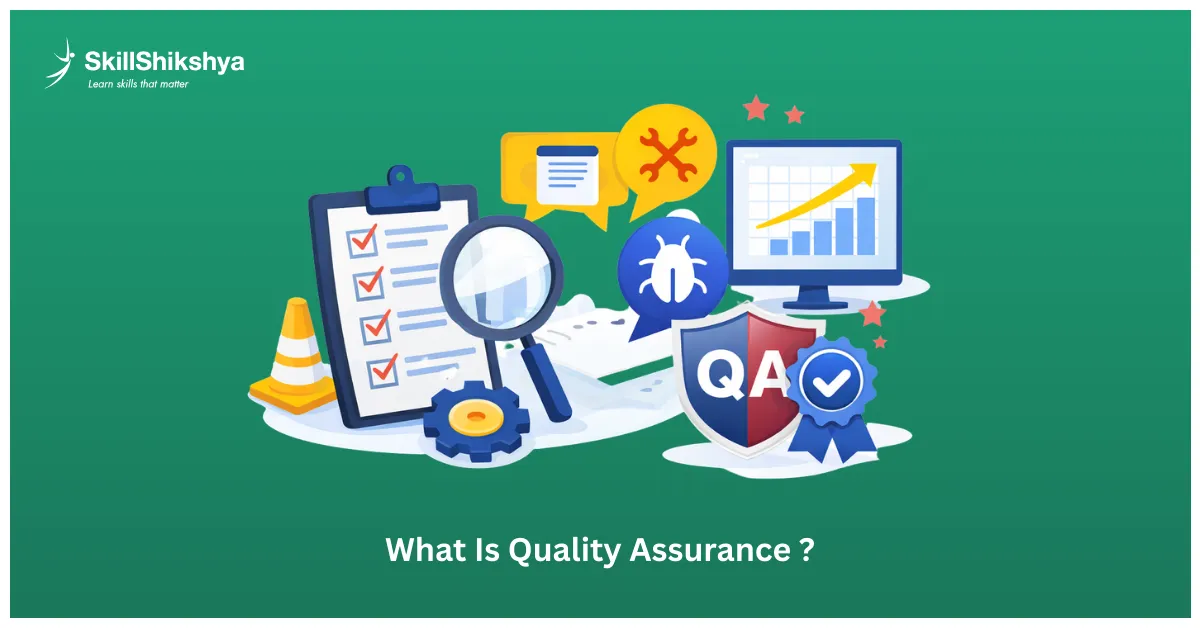
Let me break down what quality assurance really means. It's the systematic process of ensuring software products meet defined standards before reaching end users. The difference between QA and quality control: quality control inspects products after production, while quality assurance designs better processes to prevent defects in the first place.
I've seen how poor software quality impacts businesses. Research shows software bugs cost the U.S. economy approximately $59.5 billion annually. I've witnessed single critical defects damage customer trust, trigger expensive emergency fixes, and derail entire product launches.
Companies investing in robust QA practices consistently see:
- Higher customer retention (users stick with reliable products)
- Reduced costs (finding bugs early prevents expensive production fixes)
- Competitive advantage (consistent quality builds market reputation)
In modern teams, QA fits into Agile and DevOps workflows where testing happens continuously. I work alongside developers from day one, participating in planning, design reviews, and daily standups. This shift-left approach catches issues earlier when they're cheaper and easier to fix.
In 2026, quality assurance isn't just finding bugs—it's enabling teams to ship faster with confidence. I use automation, AI-powered tools, and smart testing strategies to keep pace with rapid release cycles while maintaining high-quality standards.
The Complete Quality Assurance Roadmap for 2026
I'm breaking down this quality assurance roadmap into manageable stages. Each phase builds on previous skills, creating a solid foundation for long-term career growth.
Stage 1 - Foundation Skills (Months 1-3)
When I started my QA journey, I focused first three months on understanding software testing fundamentals. You don't need coding experience to start—just curiosity and attention to detail. For students exploring technology career options after completing SEE, QA is an excellent entry point that doesn't require prior programming knowledge.
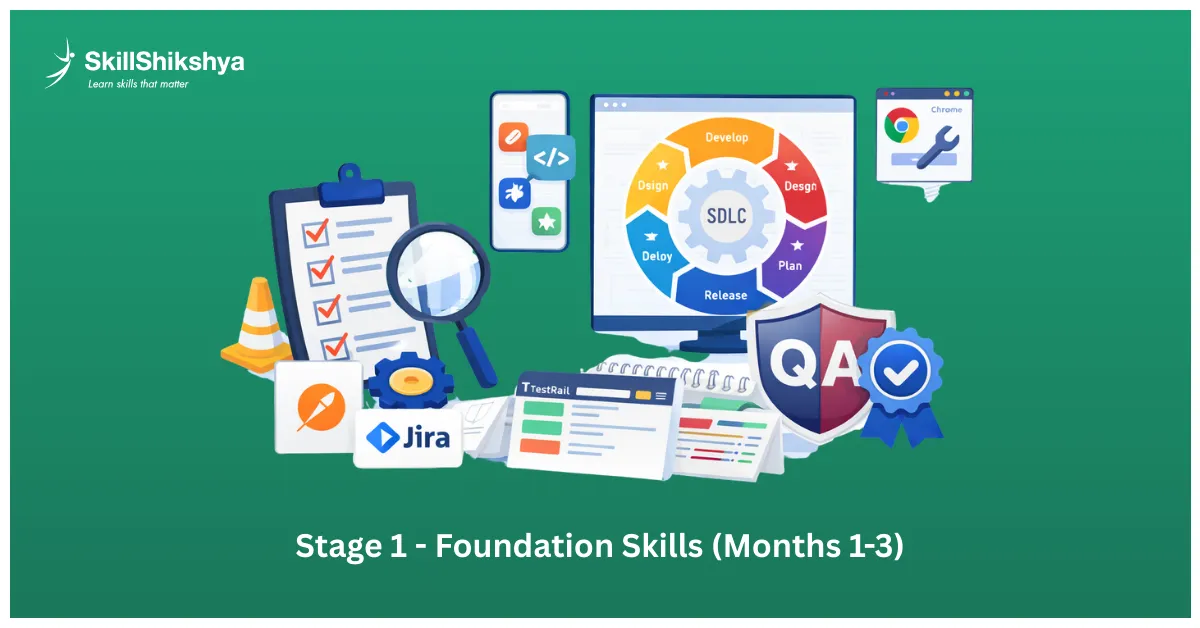
I began learning the Software Development Life Cycle (SDLC). This framework showed me how software moves from initial concept through design, development, testing, and deployment. Understanding SDLC helped me see where testing fits and why it matters.
Next, I mastered manual testing basics:
- How to write clear, detailed test cases covering different scenarios
- Executing tests systematically and documenting results
- Identifying, reproducing, and reporting bugs effectively
- Differentiating between functional, regression, smoke, and exploratory testing
I realized bug reporting is an art form. My good bug reports include steps to reproduce, expected vs actual behavior, screenshots/videos, and environment details. I use tools like Jira daily for tracking defects and collaborating with development teams.
I practiced with real websites and applications—exploratory testing on e-commerce sites, mobile apps, web platforms. I asked: What happens with invalid data? What breaks when using the back button? Can I access features I shouldn't?
Essential tools I started using:
- Jira: Industry-standard tool for bug tracking and project management
- Postman: API testing tool for understanding application communication
- Chrome DevTools: Built-in browser tools for inspecting web elements
- TestRail or Google Sheets:Organizing test cases and results
Stage 2 - Technical Skills Development (Months 4-6)
After grasping testing fundamentals, I added technical skills that set me apart from other testers.
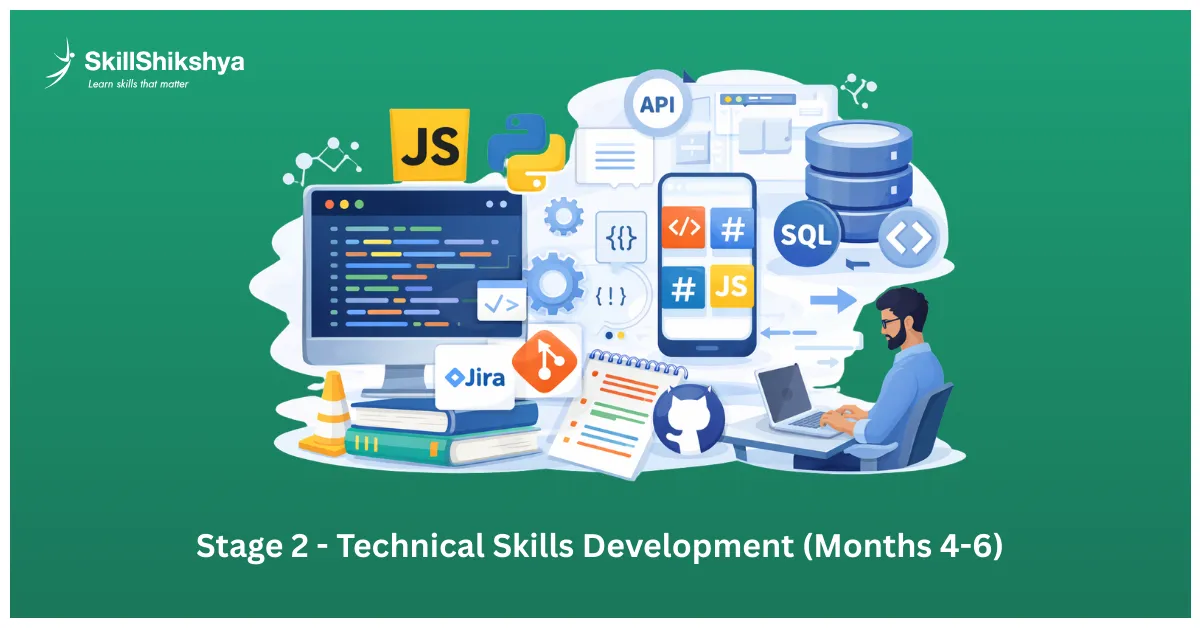
Programming knowledge isn't optional anymore. I started with JavaScript (though Python is equally good)—both are beginner-friendly and widely used in QA automation. If you're deciding between Python, JavaScript, or Java for your first programming language, I'd recommend starting with Python or JavaScript, as they open doors to both development and testing careers.
Programming lets me:
- Read and review developer implementations
- Write basic automation scripts
- Debug test failures more effectively
- Communicate better with engineering teams
Programming concepts I learned:
- Variables, data types, and operators
- Control structures (if/else, loops)
- Functions and error handling
- Working with arrays and objects
- Asynchronous programming basics
I made sure to understand web technologies at functional level—how HTML structures pages, CSS styles them, JavaScript makes them interactive. I studied frontend (what users see) vs backend (server-side logic) and how they communicate through APIs.
Database fundamentals matter because most applications store data. My basic SQL knowledge lets me:
- Verify data accuracy after tests
- Set up test data for specific scenarios
- Troubleshoot data-related issues
- Perform backend validation
Version control with Git and GitHub became essential. Every QA professional needs to:
- Clone repositories
- Create branches for test code
- Commit changes with meaningful messages
- Create pull requests and review code
- Resolve basic merge conflicts
GitHub's official learning resources provides excellent guides for beginners learning version control.
This technical foundation prepared me for automation, where real career growth happened.
Stage 3 - Automation Testing Mastery (Months 7-12)
Automation testing became my ticket to higher salaries and more responsibilities. Companies pay premium rates for QA engineers who can build reliable test automation frameworks.
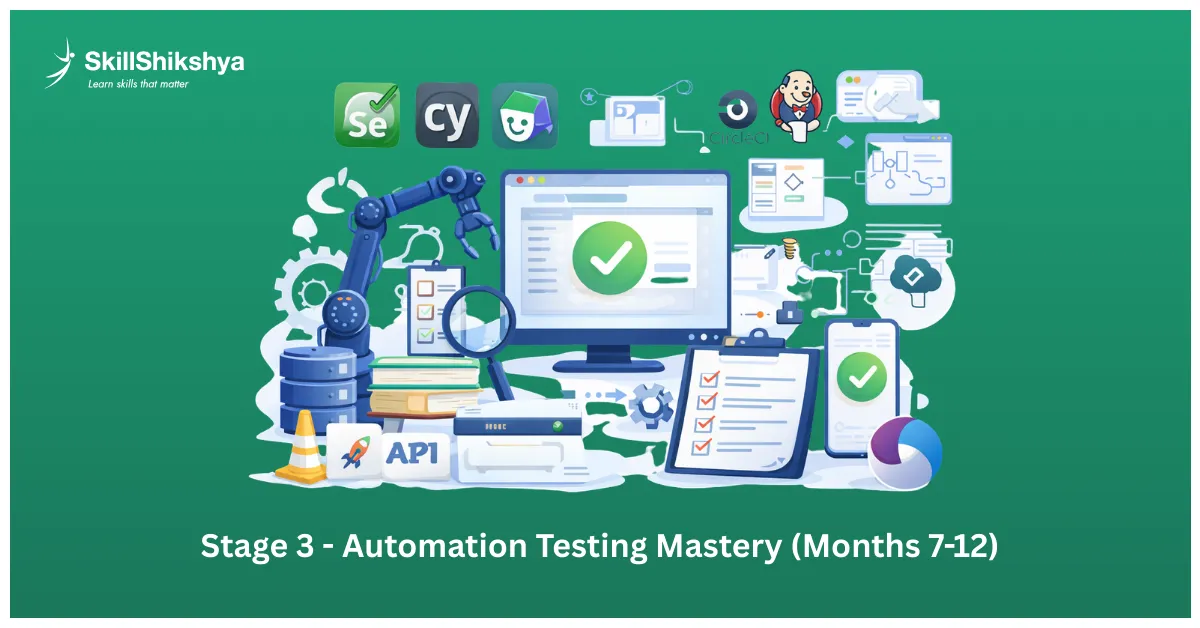
I started with one framework and learned it thoroughly. Popular choices I've worked with:
- Selenium WebDriver: Classic open-source solution supporting multiple programming languages and browsers. Largest community made it easier to find solutions when stuck.
- Cypress: Developer-friendly JavaScript framework with real-time browser execution and excellent debugging. Tests run fast, and visual interface shows exactly what's happening at each step.
- Playwright: Unified automation for Chromium, Firefox, and WebKit. Handles auto-waits intelligently and works across multiple programming languages. Many teams are moving to Playwright for reliability and speed.
I learned the Page Object Model (POM) pattern early. This design pattern separates page-specific code from test logic, making tests easier to maintain when UI changes. Instead of duplicating login code across 50 tests, I write it once in a page object and reuse everywhere.
API testing automation is equally important. I use tools like Axios, REST Assured, or Postman's collection runner to verify backend functionality without UI complexities. API tests run faster, catch more bugs, and work great in CI/CD pipelines.
I didn't skip mobile testing. Frameworks like Appium extended my web automation skills to iOS and Android apps. Understanding mobile-specific challenges (screen sizes, touch gestures, network conditions) made me more valuable.
CI/CD integration brought everything together. My automated tests now run automatically when developers commit code. I've learned to configure pipelines in GitHub Actions, Jenkins, CircleCI, and Azure DevOps.
My goal isn't just writing tests it's building systems that give teams fast, reliable feedback about code quality.
Stage 4 - Advanced QA Engineering (12+ Months)
Once I mastered automation, specialized skills opened new career paths.
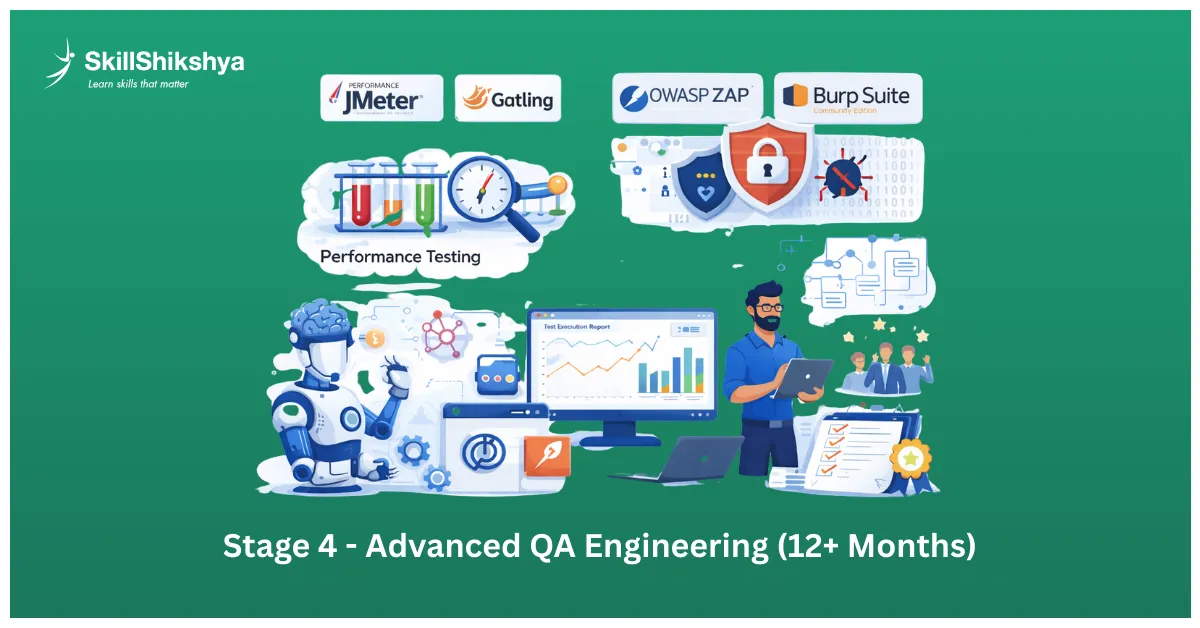
Performance testing ensures applications handle expected load. I simulate hundreds or thousands of concurrent users to identify bottlenecks. I use JMeter, Gatling, and LoadRunner to:
- Create realistic load scenarios
- Measure response times under stress
- Identify memory leaks and resource constraints
- Optimize application performance
Security testing became crucial to protect against vulnerabilities. Even basic knowledge of common security issues (SQL injection, cross-site scripting, authentication flaws) made me invaluable. I use tools like OWASP ZAP and Burp Suite for automated security scans. For those interested in diving deeper into this specialization, check out our comprehensive guide on security fundamentals and ethical hacking which covers security concepts that complement QA security testing skills. For those interested in diving deeper into this specialization, check out our comprehensive cybersecurity career path which covers security fundamentals that complement QA security testing skills.
AI and machine learning in testing represent the future. In 2026, 78% of enterprises use AI-driven tools for software testing. I've used AI to:
- Auto-generate test cases from requirements
- Identify high-risk areas needing more testing
- Self-healing tests that adapt to UI changes
- Predict where bugs are likely to occur
Test architecture and strategy shifted my focus from execution to planning. I now design testing approaches for entire products, choose the right tools, and define what "quality" means for different stakeholders.
Leadership and mentorship skills became crucial as I advanced. As senior QA engineer, I guide junior members, make technical decisions, and influence product quality across organizations. I present testing strategies to executives, negotiate resource allocation, and champion quality throughout the company.
Essential Quality Assurance Skills for 2026
Beyond technical abilities, these skills separate successful QA engineers from the rest.
These align closely with the job-ready competencies that Nepali students need to develop for the competitive tech market:
- Analytical thinking: Breaking down complex systems into testable components and finding patterns in bug reports.
- Communication: Explaining technical issues to non-technical stakeholders, writing clear bug reports, giving effective feedback.
- Attention to detail: Noticing subtle inconsistencies others miss while maintaining focus during repetitive tasks.
- Adaptability: Learning new tools quickly, adjusting to changing requirements, thriving in fast-paced environments.
- Problem-solving: Debugging flaky tests, finding root causes of failures, suggesting solutions rather than just reporting problems.
- Empathy: Understanding user needs, seeing products from customer perspective, advocating for quality improvements.
Industry certifications I've pursued:
- ISTQB Foundation Level (entry point)
- ISTQB Advanced Level (automation, test management)
- Certified Selenium Professional
- Certified Agile Tester
- AWS Certified Developer(for cloud testing)
Learning resources I use:
- Test Automation University (free courses)
- Udemy and Coursera (structured learning paths)
- YouTube channels focused on QA
- GitHub repositories with practice automation projects
- QA communities on Reddit, Discord, and LinkedIn
Quality Assurance Tools Every Engineer Should Master
The quality assurance software I know directly impacts my employability. Essential tools in 2026:
Test Automation Tools
- Selenium WebDriver: Industry standard for browser automation. I've used it with Java, Python, JavaScript, C#, and Ruby. Large community means abundant learning resources and third-party libraries. Official Selenium documentation provides comprehensive guides.
- Cypress: Revolutionized JavaScript testing with developer-friendly approach. Tests run inside browser, providing real-time reload and superior debugging. Trade-off is limited cross-browser support compared to Selenium.
- Playwright: Microsoft's answer to modern testing needs. Handles multiple browsers, mobile viewports, and network conditions elegantly. Auto-waiting feature eliminates most flaky test issues.
- Katalon Studio: Offers codeless automation for teams wanting quick results without deep programming knowledge. Combines API, web, and mobile testing in one platform.
- TestMu AI: New generation of AI-native testing platforms. Features like KaneAI create intelligent tests, while HyperExecute provides ultra-fast parallel execution.
Test Management Tools
- Jira: Dominates daily work in bug tracking and project management. I create issues, manage workflows, and generate reports constantly.
- TestRail: Specialty for test case management with elegant interfaces for planning, executing, and tracking test runs.
- Zephyr: Integrates directly with Jira, popular for teams already using Atlassian products.
- Azure DevOps: End-to-end DevOps capabilities including test planning, execution tracking, and CI/CD integration.
Performance Testing Tools
- JMeter: Open-source standard for load testing. I simulate various load patterns and provide detailed performance reports.
- LoadRunner: Enterprise-scale performance testing with sophisticated analysis capabilities.
- Gatling: Code-based test scenarios (Scala) generating beautiful performance reports I share with stakeholders.
API Testing Tools
- Postman: Makes API testing accessible with intuitive interface. I use collections, environments, and Newman (CLI runner) for complex testing workflows.
- REST Assured: Java's power for API testing with fluent syntax and excellent integration with test frameworks.
- SoapUI: Handles both REST and SOAP APIs with advanced features for data-driven testing.
CI/CD Integration Tools
- Jenkins: Most widely deployed CI/CD platform. Understanding Jenkins pipelines is essential for automation work.
- GitHub Actions: Integrates seamlessly with GitHub repositories, perfect for modern development workflows.
- CircleCI: Fast, reliable CI/CD with excellent Docker support and parallelization features.
Quality Assurance Internship Opportunities in Nepal
I've watched Nepal's IT sector boom over the years, creating numerous opportunities for aspiring QA professionals. Demand for quality assurance interns has grown significantly as companies like Skill Shikshya, Vrit Technologies, Braindigit, CloudFactory, and SoftNEP expand operations.
A quality assurance internship in Nepal typically lasts 3-6 months and focuses on practical skills development. You'll work on real projects, learn industry-standard tools, and gain insights into professional software development.
Required skills for QA internships:
- Basic understanding of software testing principles
- Familiarity with bug tracking tools (I recommend Jira)
- Strong attention to detail and communication skills
- Bachelor's degree in Computer Science, IT, or related field (often preferred but not mandatory)
- Enthusiasm for learning and problem-solving
What interns experience:
First weeks involve orientation and training on company processes. You'll shadow experienced QA engineers, learning how we approach testing, report bugs, and collaborate with developers.
As you progress, you'll receive ownership of smaller testing tasks executing test cases, verifying bug fixes, participating in regression testing. Gradually, you'll contribute to test case design, exploratory testing sessions, and automation efforts.
Many internships include formal training programs covering manual testing, automation basics, Agile methodologies, and specific tools used by the organization. I always assign mentors who provide regular feedback and guidance.
How to apply for QA internships in Nepal:
I recommend platforms like Kumari Job, InternSathi, InterNepal, and company career pages listing verified openings. Submit updated resumes highlighting relevant coursework, personal projects, or any testing practice.
Personal projects make applications stand out. Document exploratory testing you performed on public websites, automation scripts you wrote while learning, or contributions to open-source testing projects.
Turning internship into full-time job:
Companies prefer hiring people they've already trained. To maximize chances:
- Show initiative by learning beyond assigned tasks
- Communicate proactively about progress and blockers
- Build relationships across teams, not just QA
- Demonstrate growth by taking on increasing responsibilities
- Express interest in full-time positions before internship ends
Skill Shikshya and other training institutes in Kathmandu offer QA courses connecting students with internship opportunities. These 2.5-month programs teach fundamentals and help with job placement. However, be mindful of what to look for when selecting the right tech training program to avoid wasting time and money. However, be mindful of common mistakes students make when choosing IT training programs in Nepal.
Quality Assurance Remote Jobs: Your Path to Global Opportunities
I've embraced the shift to remote work, creating unprecedented opportunities for QA professionals. I work with companies worldwide as remote quality assurance engineer, earning competitive salaries without geographic restrictions.
Why remote QA jobs boom in 2026:
Software companies realized QA work translates perfectly to remote environments. Testing doesn't require physical presence, and modern collaboration tools make distributed teams effective. This opened global talent pools, allowing companies to hire best candidates regardless of location.
For QA engineers in Nepal and other developing markets, remote jobs offer:
- Higher salaries (often in USD or EUR)
- Exposure to international projects and teams
- Flexible work schedules
- Elimination of commute time
- Access to cutting-edge technologies and practices
Students interested in building freelance income streams while completing their studies will find that QA skills through freelance testing projects can generate revenue while developing professional expertise.
Students interested in exploring online earning opportunities while studying will find that building QA skills through freelance testing projects can generate income while developing professional expertise.
Top platforms I use for finding remote QA positions:
- Wellfound (formerly AngelList Talent): Specializes in startup jobs with strong remote opportunities. I filter by "Remote" and "Quality Assurance" to see hundreds of openings.
- FlexJobs: Curates legitimate remote positions, screening out scams and low-quality listings. Subscription costs worth the time saved.
- Remotive: Focuses exclusively on remote jobs across all categories. I check their QA section regularly for opportunities from entry-level to senior positions.
- Indeed and Glassdoor: Valuable for remote searches. I use filters carefully and research companies thoroughly before applying.
- LinkedIn: Works well for direct outreach. I follow companies, engage with content, and apply when roles match skills.
Skills needed for remote QA roles:
Beyond standard QA competencies, I've developed:
- Strong written communication (most interaction happens via text)
- Self-discipline and time management
- Comfort with async collaboration tools (Slack, Zoom, Miro)
- Ability to work independently without constant supervision
- Proactive communication about progress and blockers
Average salaries for remote QA engineers:
Entry-level remote QA positions typically offer $30,000-$50,000 annually. I earn in mid-level automation engineer range of $60,000-$90,000, while senior colleagues command $90,000-$130,000 or more.
Geographic arbitrage benefits QA professionals in countries with lower costs of living. A $60,000 remote salary provides comfortable living while being competitive for employers.
Tips for landing first remote QA job:
I built strong online presence. Created LinkedIn profile showcasing skills, projects, and certifications. Share testing insights, write technical posts, and record video tutorials demonstrating knowledge.
I contributed to open-source projects. Many projects welcome testing contributions. Submit bug reports, write test cases, and add automation coverage. This proves abilities while building public portfolio.
I created portfolio website displaying work including:
- Automation frameworks I've built
- Test case samples (with sensitive data removed)
- Bug reports showing analytical process
- Certifications and continuous learning efforts
I tailor applications to each position. Generic resumes get ignored. Highlight experiences and skills directly relevant to specific role. Show you've researched the company and understand their needs.
QA Career Pathways: From Junior to Leadership
I've navigated the quality assurance field and can show clear progression from entry-level to executive roles.

Entry-Level Positions
- QA Intern: Entry point into professional testing. Focus on learning tools, processes, and building foundational skills.
- Junior QA Engineer: Execute test cases, report bugs, contribute to testing efforts under supervision. Typical salary: $25,000-$40,000.
- Manual QA Tester: Specialize in exploratory testing, usability validation, detailed test case creation without automation responsibilities.
Mid-Level Positions
- QA Engineer: Own testing for features or modules. Design test strategies, mentor junior members, contribute to process improvements. Salary: $50,000-$75,000.
- Automation QA Engineer: Build and maintain test automation frameworks. Write complex automation scripts and integrate tests into CI/CD pipelines. Salary: $60,000-$90,000.
- SDET (Software Development Engineer in Test): Hybrid role combining development and testing skills. Build testing infrastructure, create tools, write production-quality test code. Salary: $70,000-$110,000.
Senior-Level Positions
- Senior QA Engineer: Lead major testing initiatives, make architectural decisions, set quality standards. Mentor teams and influence product direction. Salary: $90,000-$130,000.
- QA Lead: Manage QA teams, coordinate testing across projects, ensure testing processes align with business goals. Salary: $100,000-$140,000.
- Test Architect: Design testing strategies for entire organizations. Choose tools, define frameworks, establish quality engineering practices. Salary: $120,000-$160,000.
- QA Manager/Director: Oversee all quality engineering functions. Manage budgets, hire talent, report quality metrics to executives. Salary: $130,000-$200,000+.
My career advancement depended on continuous learning, taking initiative, and demonstrating impact. Fastest-growing QA careers combine technical excellence with business acumen and communication skills.
If you're exploring other tech career paths alongside QA, consider these complementary specializations:
- User experience design and interface prototyping - Great for QA professionals interested in understanding user behavior
- Product marketing and customer acquisition strategies - Useful for understanding market fit and growth tactics
- Technical SEO and website optimization - Complements web application testing knowledge
- Business intelligence and predictive analytics-Perfect for QA engineers interested in test metrics and data-driven decisions
If you're exploring other tech career paths alongside QA, consider these complementary roadmaps:
- UI/UX design career trajectory - Great for QA professionals interested in user experience
- Digital marketing specialization - Useful for understanding product-market fit and user acquisition
- SEO career development - Complements web testing knowledge
- Data analytics and AI pathway- Perfect for QA engineers interested in test data analysis
Why Our QA Training at Skill Shikshya
I'm involved with Skill Shikshya's Quality Assurance training program, designed specifically to address gaps in other QA courses across Nepal.
What makes our program different:
- Real-World Focus: Learn Selenium, Cypress, API testing tools, and CI/CD integration through actual project work—not just theory. We use real applications for practice testing.
- Comprehensive Curriculum: Manual testing fundamentals, test automation frameworks, bug tracking with Jira, API testing, performance testing basics, and portfolio building. Everything employers want.
- Industry Mentors: Instructors are working QA professionals from leading tech companies in Kathmandu. Real industry experience, current best practices, and hiring insights.
- Automation-First Approach: While covering manual testing essentials, heavy emphasis on automation because that's where salaries and opportunities are. You'll build multiple automation projects.
- Portfolio Development: We guide you through creating 3-5 strong portfolio pieces demonstrating skills to potential employers. Major focus—not an afterthought.
- Job Placement Support: Direct connections to hiring companies in Kathmandu's tech ecosystem. We've placed dozens of students in QA roles at F1Soft, Leapfrog, and other top firms.
- Practical Timeline: 2.5-3 months of intensive training, meeting 2 hours daily. We compress 12+ months of scattered self-learning into focused, mentor-guided experience with clear milestones.
- Affordable Investment: NPR 30,000 for complete program. Compare that to months of paid trial-and-error or expensive bootcamps costing 3-4 times more.
- Hands-On Lab Environment: Access to testing lab with configured environments, multiple browsers, mobile devices, and test applications. Practice in realistic scenarios.
You'll finish with job-ready automation skills, strong portfolio, ISTQB preparation, and confidence to ace QA interviews. That's our commitment to every student.
Visit our course page at Skill Shikshya or call us at 9868730959 for enrollment details and upcoming batch schedules.
Current Challenges in Quality Assurance and How to Overcome Them
I face several persistent challenges in QA work in 2026:
- Managing complex testing environments: Modern applications involve microservices, cloud infrastructure, and multiple integration points. Solution: I use containerization (Docker) for consistent environments and invest in service virtualization tools.
- Keeping up with rapid release cycles: Teams ship code multiple times daily, compressing testing windows. Solution: I shift testing left by involving QA early in planning. Automate repetitive tests and focus manual efforts on high-risk areas.
- Balancing automation with manual testing: Over-automation wastes resources on low-value tests while under-automation creates bottlenecks. Solution: I apply risk-based testing approaches. Automate stable, frequently-executed tests while using manual testing for exploratory work and new features.
- Handling flaky tests: Unreliable tests that pass sometimes and fail randomly erode trust in automation. Solution: I implement explicit waits, use stable selectors, isolate tests from external dependencies, and fix flaky tests immediately.
- Ensuring test coverage across platforms: Applications run on various browsers, devices, and operating systems. Solution: I use cloud testing platforms (BrowserStack, Sauce Labs) for cross-browser coverage and prioritize testing on platforms users actually use.
Real-World Success Stories: From Beginner to Professional QA Engineer
Rajesh's Journey: Career Switcher to Automation Engineer
I mentored Rajesh, who worked in construction management for five years before deciding to transition into tech at age 29. With no programming background, he enrolled in a QA training program in Kathmandu covering manual and automation testing.
After three months intensive study and practice, Rajesh secured a quality assurance internship at a fintech startup. He spent six months learning Selenium, contributing to automation frameworks, and proving his ability to learn quickly.
His first full-time role as QA Engineer paid NPR 60,000 monthly—modest but a start. Rajesh continued learning outside work hours, earning ISTQB certification and mastering Cypress. Within 18 months, he landed a remote position with a European company earning $65,000 annually.
Key takeaway: It's never too late to switch careers. Consistent learning, building projects, and demonstrating results matter more than degrees or prior experience.
Sujata's Path: Intern to Senior QA Lead
I worked with Sujata, who joined Leapfrog Technology as quality assurance intern during final year of computer engineering studies. She excelled at test case design and showed initiative by proposing automation for repetitive tests.
After internship, Leapfrog hired Sujata as Junior QA Engineer. She focused on building automation expertise, eventually becoming go-to person for complex automation challenges. Her leadership during major product migration earned promotion to QA Lead within four years.
Today, Sujata manages a team of eight QA engineers, defines testing strategies for new products, and mentors interns just starting careers. Her journey shows value of excelling in current role and taking on increasing responsibilities.
Future Trends in Quality Assurance for 2026 and Beyond
I've observed the quality assurance field evolving rapidly. These trends shape my career and will shape yours:
- AI-powered test generation and maintenance: I use tools with large language models that automatically create test cases from requirements and update them when applications change. This shifts QA focus from test maintenance to test strategy.
- Shift-left testing becoming standard: QA participation in discovery and planning phases is now expected, not exceptional. Teams that embed quality thinking from day one ship faster with fewer issues. Martin Fowler's blog on continuous testing provides excellent frameworks for this approach.
- Observability and quality intelligence: Rather than just testing, I monitor production systems, analyze user behavior, and use data to identify quality risks proactively.
- Contract testing for microservices: As applications split into dozens of services, I use contract testing to verify service integrations work without requiring full end-to-end tests.
- No-code/low-code automation platforms: Tools enabling non-programmers to build automation, reducing barriers to entry while letting me focus on complex scenarios.
- Quality as shared responsibility: "Throw it over the wall to QA" mentality is dying. Developers write tests, product managers define acceptance criteria, and I coach teams on testing practices.
- Rise of QA in discovery phase: Forward-thinking teams involve me when exploring new features. I bring unique perspectives on feasibility, testability, and potential risks before development begins.
How to Choose the Right QA Career Path for You
Not all QA roles are created equal. Finding the right specialization depends on your interests and strengths:
- Manual testing vs automation: If you enjoy analytical thinking, exploratory investigation, and don't want to code extensively, manual testing roles exist and pay well. However, automation skills open more opportunities and higher salaries. Many successful QA professionals started with manual testing and gradually added automation.
- Specialized QA roles: Performance testing suits those interested in scalability and infrastructure. Security testing attracts people passionate about protecting users. Mobile testing appeals to those who love working with latest devices and technologies.
- Industry considerations: FinTech QA involves understanding compliance and financial regulations. Healthcare QA requires knowledge of HIPAA and medical systems. E-commerce QA focuses on user experience and payment processing. Choose industries aligning with your interests.
- Geographic considerations and remote opportunities: If you value working from home or traveling while working, prioritize remote positions. If you prefer office interaction and local networking, focus on companies in your area. This choice significantly impacts lifestyle and career development.
Measuring Success: KPIs and Metrics for QA Engineers
I track these metrics to gauge my impact and career progress:
- Test coverage metrics: Measure what percentage of code has automated tests. Verify critical user journeys are covered. Coverage alone doesn't guarantee quality, but gaps indicate risk.
- Defect detection rate: Track how many bugs I find before production versus after release. High pre-production detection shows effective testing.
- Test automation ROI: Calculate time saved by automation versus time invested in building and maintaining it. Positive ROI justifies automation investments.
- Release quality indicators: Monitor production bugs, customer complaints, and emergency fixes that trend downward as QA practices improve.
- Career progression metrics: Track skills acquired, certifications earned, increased responsibilities, salary growth, and impact on product quality demonstrating personal development.
I've built metrics-driven practice by collecting data consistently, analyzing trends, and using insights to improve processes continuously.
Conclusion and Your Next Steps
I've laid out this quality assurance roadmap to provide complete blueprint for building successful QA career. Whether starting from zero or looking to advance, the path is clear: build foundational knowledge, develop technical skills, master automation, and specialize based on interests.
The opportunities are real. Quality assurance internships in Nepal provide entry points for local professionals. Quality assurance remote jobs offer global reach from anywhere. The quality assurance software tools you learn today determine your career trajectory tomorrow.
Here's what I recommend:
- This week: Choose one free resource (Test Automation University, YouTube tutorials, or practice websites) and start learning
- This month: Complete small automation project and publish it on GitHub
- This quarter: Apply for your first quality assurance internship or entry-level position
- This year: Earn your first QA certification and build portfolio showcasing skills
Remember that every expert QA engineer started as beginner. What separates successful professionals is consistency, curiosity, and commitment to continuous improvement. The quality assurance roadmap I've shared has helped thousands launch rewarding careers now it's your turn.
Start today. Your future in quality assurance awaits.
Frequently Asked Questions
How long does it take to become a QA engineer?
Do I need a computer science degree for QA?
What's the average salary for QA engineers?
Is QA a good career choice in 2026?
Can I transition to QA from a non-technical background?
About Author: