Manual Testing vs Automation Testing: Which Should You Learn First?
You have decided to get into QA. You open LinkedIn, search "QA jobs Nepal," and scroll through 60 job listings. Some ask for Selenium. Some ask for manual test cases. Some ask for Postman. Some ask for all three. You close the tab more confused than when you opened it.
This is the exact moment most QA beginners get stuck. Not because QA is difficult, but because nobody tells them which door to walk through first. Manual testing or automation testing? Which one gets you hired faster? Which one pays more? Which one actually makes sense to learn when you are just starting out?
Before picking a path, it also helps to understand what a full QA career actually looks like. The QA career guide breaks down the roles, skills, and steps to land your first job in Nepal. Now let us get into what each testing approach actually involves.
What is Manual Testing?
Manual testing is exactly what it sounds like. A human tester executes test cases by hand, interacting with the application the same way a real user would. No scripts run in the background. No tools do the clicking. The tester opens the application, follows a set of defined test steps, checks whether the output matches what the requirements say it should be, and logs anything that does not.
What Manual Testers Actually Do Day to Day
- A manual QA tester's day inside a Kathmandu IT company typically looks like this:
- Read the sprint's user stories to understand what features the developers are building
- Write test cases covering happy paths, edge cases, and negative scenarios
- Execute those test cases once the build lands in the test environment
- File bug reports in JIRA with steps to reproduce, expected result, actual result, and a screenshot
- Retest bugs after a developer marks them fixed
- Run exploratory testing on new features without a script, looking for issues formal test cases would miss
That last point matters more than most beginners expect. Exploratory testing is one of the most valuable things a skilled manual tester does, and it is something no automation script can replicate.
When Manual Testing is the Right Call
Manual testing works best in these situations:
- Exploratory testing: You are testing a new feature for the first time and there are no scripts yet. You need a human eye to discover how the system actually behaves.
- Usability testing: Human judgment decides whether an interface feels intuitive or just technically functions.
- User acceptance testing (UAT): Business stakeholders or real users validate the product against their expectations. This is always a manual process.
- Ad hoc testing: A developer asks "can you just try this quickly?" That is manual by nature.
- One-time tests: Tests you will never run again are not worth automating.
What is Automation Testing?
Automation testing uses code-based scripts to execute test cases automatically, without a person running each step. The script interacts with the application, clicks buttons, enters data, submits forms, and checks whether the result matches the expected output. When a check fails, the script flags it and moves on to the next test.
What Automation Engineers Actually Do Day to Day
An automation QA engineer's daily work looks like this:
- Write and maintain test scripts in frameworks like Selenium, Cypress, or Playwright
- Build the automation framework itself, including how test cases are organized, how data is managed, and how results are reported
- Integrate the test suite into the CI/CD pipeline so tests run automatically on every code push
- Investigate test failures to determine whether it is a real bug or a broken script
- Update scripts whenever the application UI changes
Automation engineering also requires programming knowledge. You need to write actual code, understand how to locate elements on a web page, handle dynamic content, and build frameworks that other people on your team can maintain. If you want to know more on test scripts frameworks, this selenium and cypress comparison give detail insights on both frameworks.
When Automation Testing is the Right Call
Automation pays off in these specific scenarios:
- Regression testing: The same tests run after every single code change. Doing that manually at any real volume is not sustainable.
- Smoke testing: Quick build validation on every new deployment saves hours every sprint.
- Performance and load testing: You cannot simulate thousands of concurrent users manually.
- API testing: Validating dozens of endpoints in minutes instead of hours.
- Data-driven testing: Running the same test with hundreds of different input combinations.
- Any test that runs frequently: If it runs more than three or four times, automate it.
Not sure which type of testing your QA training should cover? This guide on types of software testing covers both, so you do not have to choose before you start. Here is the full breakdown of how they differ.
Manual Testing vs Automation Testing: The Direct Comparison
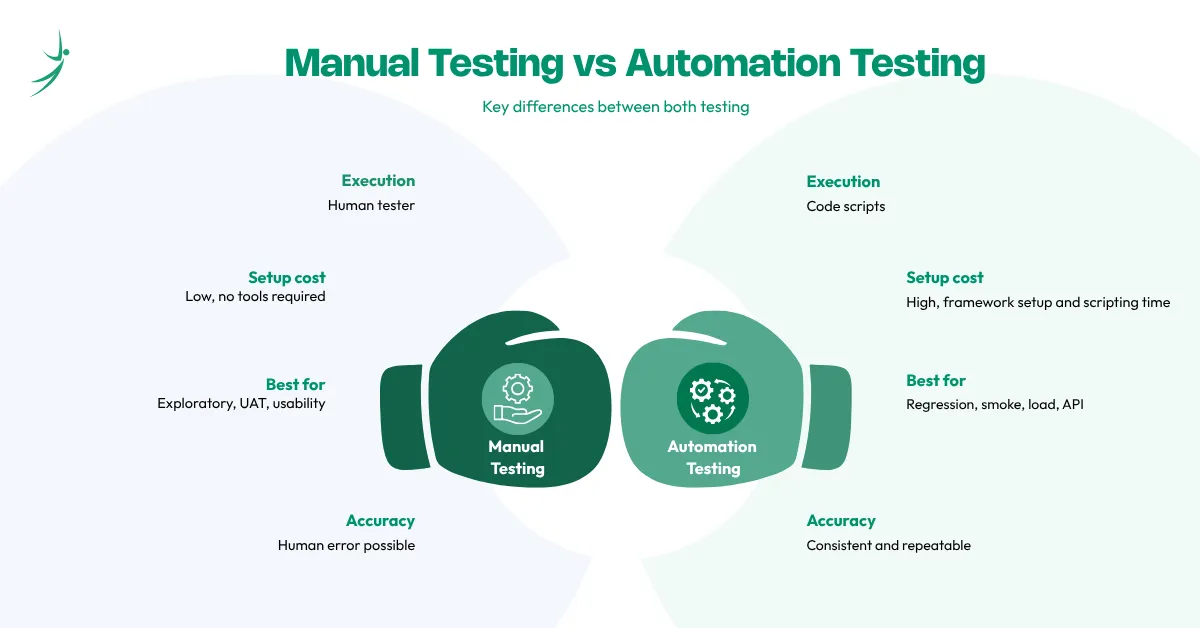
Both approaches have their strengths, and the right one depends on what you are testing and when. Here is a side-by-side breakdown to make the difference clear.
| Manual Testing | Automation Testing | |
|---|---|---|
| Execution | Human tester | Code scripts |
| Speed | Slower | Much faster at scale |
| Setup cost | Low, no tools required | High, framework setup and scripting time |
| Long-term cost | Grows with test volume | Decreases per test over time |
| Best for | Exploratory, UAT, usability | Regression, smoke, load, API |
| Accuracy | Human error possible | Consistent and repeatable |
| Skills required | Testing fundamentals, JIRA | Programming plus testing knowledge |
| Feedback speed | Hours to days | Minutes |
| Maintenance | Low | High, scripts break when UI changes |
| Flexibility | High | Low, rigid scripts |
Neither approach beats the other across every dimension. Manual testing wins where human judgment matters. Automation wins where speed, volume, and repetition matter. The best QA engineers know how to use both.
Pros and Cons of Manual Testing
Pros:
- No programming knowledge needed to start
- Catches problems that scripts miss: visual quirks, confusing flows, edge cases nobody anticipated
- Flexible: you can adapt on the fly when the application changes
- Essential for usability, exploratory, and UAT work that requires real human judgment
- Productive within a few months of structured training
Cons:
- Does not scale. Running 500 regression test cases manually before every release is not realistic
- Cannot keep pace with CI/CD pipelines where developers push code multiple times a day
- Prone to human error on long, repetitive test runs
- More testers needed as test volume grows, which increases cost
Pros and Cons of Automation Testing
Pros:
- Runs hundreds of tests in minutes rather than days
- Consistent and repeatable with no human error on the same checks
- Integrates directly into CI/CD pipelines for instant feedback on every code push
- Scales without adding headcount
Cons:
- Requires programming skills to write and maintain scripts
- High upfront investment in framework design and build
- Scripts break when the UI changes: a button that shifts position or gets a new HTML ID can fail dozens of tests at once
- Cannot replace human judgment for exploratory testing, usability, or UAT
Which Should You Learn First? Here is the Straight Answer
Start with manual testing. Add automation after 6 to 12 months.
Most beginners expect a more complicated answer. The reasoning is straightforward:
Reason 1: Automation without manual fundamentals produces bad automation
If you do not understand what to test and why, you will automate the wrong things. You will write scripts for happy paths and miss the edge cases that actually matter. Every strong automation engineer started with a solid foundation in manual testing. The script is just a faster way to run a test you already understand. If you do not understand the test, the script is useless.
Reason 2: Manual testing gets you employed faster in Nepal
Most fresher QA listings in Nepal ask for:
- Manual testing fundamentals
- JIRA and TestRail
- Test case writing
- Basic SQL
- Understanding of the SDLC
You can build those skills and get your first QA job within 3 to 4 months of focused training. Automation takes longer to learn and employers expect real project experience before trusting you with a framework.
Reason 3: Manual skills never become obsolete
Even senior automation engineers run exploratory tests and UAT manually. Manual testing skills compound with everything else you learn and stay relevant at every career stage.
The Recommended Learning Path for Nepal
| Timeframe | What to Learn | Target Role |
|---|---|---|
| Months 1 to 4 | Manual testing fundamentals, JIRA, TestRail, test case writing, bug reporting, Agile basics, SQL basics | Junior Manual QA Tester |
| Months 4 to 8 | Selenium with Java or Python, API testing with Postman | QA Engineer |
| Months 8 to 12 | Automation framework (POM), GitHub, CI/CD with GitHub Actions | Mid-level QA Engineer |
| Year 2 onwards | JMeter for performance, Cypress or Playwright, test strategy design | Senior QA / Automation Engineer |
For the full step-by-step plan, the QA career roadmap guide maps out exactly what to learn at each stage and which jobs to target along the way.
Manual Testing Tools vs Automation Testing Tools
Manual testing tools:
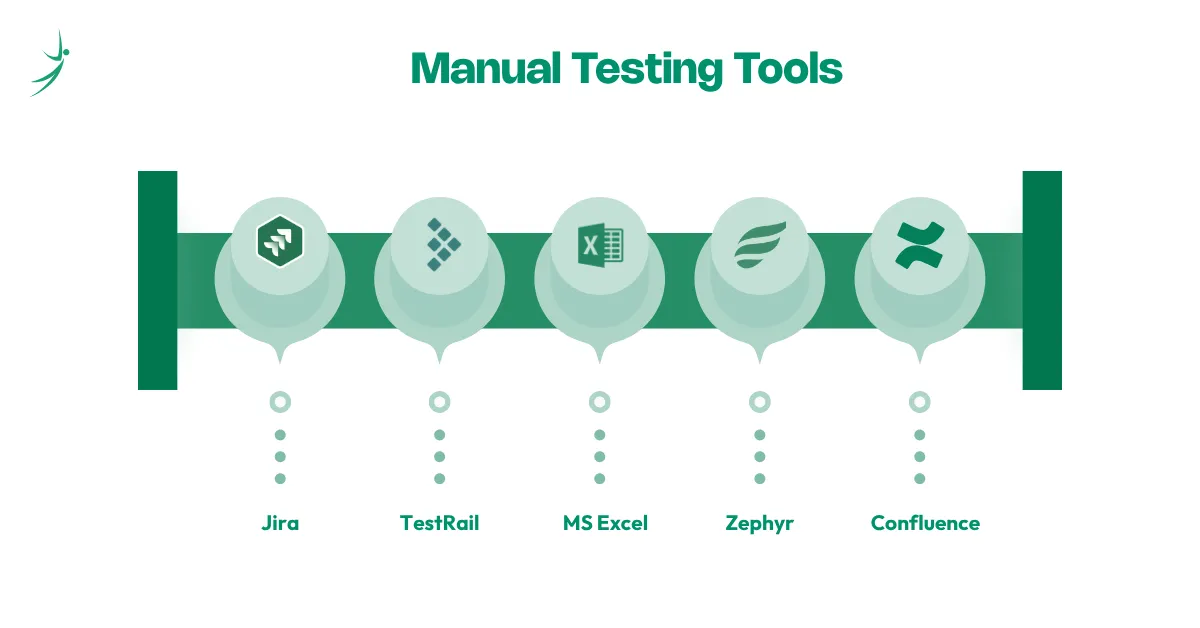
| Tool | What It Does |
|---|---|
| JIRA | Bug tracking and test case management |
| TestRail | Structured test case organization and reporting |
| Excel or Google Sheets | Basic test case documentation for smaller teams |
| Zephyr | Test cycle management as a JIRA plugin |
| Confluence | Test documentation and sprint reporting |
Automation testing tools:
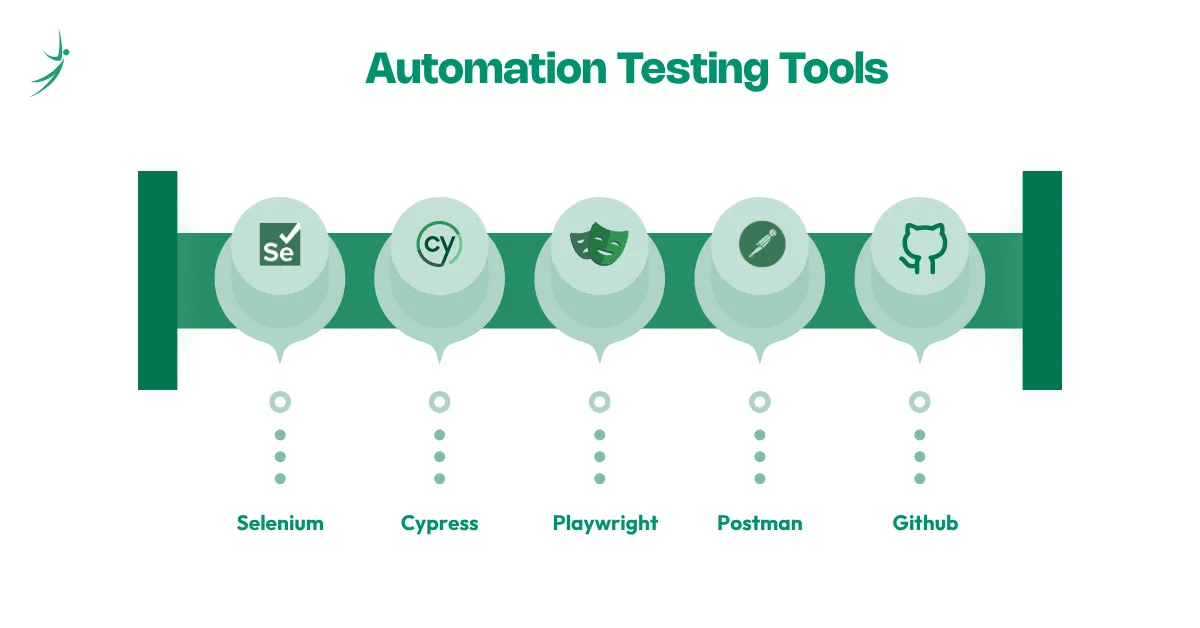
| Tool | Best For |
|---|---|
| Selenium | Web automation, most widely used in Nepal |
| Cypress | Modern JavaScript-based web app automation |
| Playwright | Cross-browser automation with stronger multi-tab support |
| Postman and Newman | API testing and CI/CD-integrated API automation |
| Apache JMeter | Load and performance testing |
| Appium | Mobile app automation on Android and iOS |
| GitHub Actions or Jenkins | CI/CD pipeline integration |
Salary Comparison: Manual Testing vs Automation Testing in Nepal
| Role | Experience | Monthly Salary (NPR) |
|---|---|---|
| Manual QA Tester | 0 to 1 year (Fresher) | NPR 25,000 to 50,000 |
| Manual QA Tester | 1 to 3 years (Mid-level) | NPR 50,000 to 80,000 |
| Automation QA Engineer | 1 to 3 years | NPR 70,000 to 120,000 |
| Senior Automation Engineer | 3 to 5 years | NPR 120,000 to 200,000+ |
| QA Lead or Manager | 5+ years | NPR 150,000 to 300,000+ |
Sources: KumariJobs, NecJobs, Glassdoor Nepal, PayScale Nepal (June 2026)
Key things to know about these numbers:
- Automation engineers earn 40 to 60% more than manual testers at the same experience level
- That salary gap is real, but you cannot become an automation engineer without first mastering manual testing
- Remote automation QA roles for international clients pay $20 to $40 per hour
- Manual testers working at Nepal's fintech and outsourcing companies earn toward the higher end of the manual range
If you want to know more on the salaries of QA Tester, this guide give you a detail breakdown of QA salary in Nepal.
Is Manual Testing Dead in 2026?
This question comes up constantly. The fear behind it is understandable, but the answer is no.
What is declining:
- Purely repetitive manual regression where a tester executes the same 300 test cases by hand every sprint
- Manual testing with no automation awareness and no exploratory testing skill
- Companies are automating that repetitive work, and they should
What is growing:
- Manual testers who bring what scripts cannot: human judgment
- Exploratory testing to catch unexpected behavior
- Usability evaluation to check whether the product actually feels right to a real user
- UAT facilitation and risk-based test planning
- Context-aware bug reporting that tells a developer not just what broke but why it matters
The World Quality Report 2025 found that 43% of organizations are still in the experimental phase with AI in QA, and 89% are only piloting or deploying Gen AI workflows. Full automation at enterprise scale is further away than the headlines suggest. Skilled manual testers who understand automation and can work in both modes are exactly what Nepal's IT companies hire for right now.
The Hybrid Approach: What Nepal's Best QA Engineers Actually Do
The debate between manual and automation is a false choice. The most effective QA engineers in Kathmandu's IT companies do not pick one or the other. They run both and know exactly when to use each.
Here is how a typical Agile sprint actually flows:
- Sprint planning: QA reviews user stories and raises clarifying questions on edge cases
- New feature lands: QA runs manual exploratory testing first because there are no scripts yet
- Feature passes manual testing: QA writes automation scripts for scenarios that need to repeat every sprint
- Scripts go into the regression suite: The CI/CD pipeline runs them automatically on every build from that point forward
The practical split that experienced Nepal QA engineers follow:
- 30% manual: New feature testing, exploratory work, UAT
- 70% automated: Regression, smoke, API, and performance tests that run without human involvement
That ratio shifts as the product matures and the automation suite grows. Early-stage products are more manual-heavy. Mature products with stable UIs tip further toward automation.
What Nepal's QA Job Market Actually Wants in 2026
The scope of QA is increasing with each passing month. LinkedIn Nepal listed over 66 active QA job openings as of June 2026. Here is what those listings ask for at each level:
Fresher level:
- Manual testing fundamentals
- JIRA and basic test case writing
- Understanding of the SDLC
- Basic SQL knowledge
- Most do not expect automation at this level
Mid-level:
- Selenium or Cypress
- Postman for API testing
- Agile sprint experience
- At least one project with an automation framework
Senior level:
- CI/CD integration experience
- Test strategy ownership
- Performance testing with JMeter or k6
- Ability to mentor junior testers
Companies actively hiring QA engineers in Nepal:
- Fintech: F1Soft, eSewa, Khalti
- Software outsourcing: Vrit Technologies, Leapfrog Technology, Cotiviti, Fusemachines
- Startups: Companies across Baneshwor, Pulchowk, and Tinkune
Job portals to watch:
- Merojob
- Jobaxle
- LinkedIn Nepal
- KumariJobs
Conclusion
Manual testing and automation testing are not competitors. They are two parts of the same discipline, and every serious QA engineer eventually needs both.
If you are starting out, start with manual. Learn how software breaks, how to write a test case that actually catches something, how to file a bug report that developers take seriously, and how to work inside an Agile sprint. Get your first QA job on those skills. Then add automation on top of that foundation and watch your earning potential shift significantly.
Nepal's QA market is active and growing. The companies hiring right now want people who understand quality from the ground up, not just people who can run scripts.
If you want to build those skills with real projects, industry tools, and mentors who work in Nepal's IT companies, explore Skill Shikshya's Quality Assurance course. The course covers manual testing fundamentals, Selenium, Postman, JIRA, and live project work so you graduate with a portfolio that Nepal's top companies actually look for.
Frequently Asked Questions
What is the main difference between manual and automation testing?
Which is better, manual testing or automation testing?
Should a fresher in Nepal learn manual testing or automation testing first?
What tools do manual testers use in Nepal?
What is the salary difference between manual and automation testers in Nepal?
Can I switch from manual testing to automation testing?
Is manual testing a good career in Nepal in 2026?
About Author:

Meet Ms. Rashmi Singh, Business Data Analytics with AI mentor at SkillShikshya. She guides learners through practical analytics, AI-powered business techniques, and hands-on data interpretation to turn insights into smarter business decisions.