How to Get Started in QA: Beginner's Guide | Skill Shikshya
career-guides •9 Jun 2026•14 min Read
Quality Assurance is one of Nepal's most accessible and fastest-growing tech careers. Whether you are a fresh graduate weighing your options, a career switcher hunting for your first tech role, or someone who keeps asking "what is quality assurance and is it actually right for me?" you are in the right place. This guide covers everything: what QA means in practice, why companies across Nepal and globally cannot ship software without it, what skills you need to build, what the career path looks like at every stage, and how to land your first QA job locally or remotely. If you are ready to get started right away, take a look at our Quality Assurance course in Nepal.
No CS degree required. No prior tech experience required. Just a clear roadmap and the willingness to follow it.
What Is Quality Assurance?
QA is the process of making sure software works correctly before it reaches real users. But it is more than just finding bugs.
Here is what QA actually covers:
- Prevention over detection: QA engineers build the processes and systems that catch bugs early, before they become expensive production failures
- Not the same as Quality Control: QC inspects a finished product and flags what is wrong. QA builds better processes upstream so fewer things go wrong in the first place. One reacts, the other prevents.
- Part of the SDLC: QA sits inside the Software Development Life Cycle, the structured process every software team follows from idea to working product. To understand exactly where QA fits, read this breakdown of SDLC vs STLC.
- A business necessity: Software bugs cost the U.S. economy an estimated $59.5 billion every year. Every undetected bug is a potential customer lost, a reputation damaged, or a costly rollback. That is why companies keep hiring QA engineers even when other tech roles face slowdowns.
What Does a QA Engineer Actually Do?
A QA engineer is not sitting in a dark room clicking buttons hoping something breaks. The role is collaborative, technical, and sits right in the middle of the product team.
A typical day includes:
- Joining the morning stand-up to discuss what is in progress, what is blocked, and what is ready to test
- Reviewing acceptance criteria so you understand what the software is supposed to do before you check whether it does
- Writing test cases: structured documents that describe exactly what to test, what inputs to use, and what the expected output should be
- Running tests, logging bugs when something does not behave as expected, and retesting fixes
- Exploratory testing, where you go off-script looking for things scripted tests might miss
- API testing to check whether backend services behave correctly
- Bug tracking, making sure every defect is documented clearly enough for a developer to reproduce and fix
QA engineers work in two main modes:
- Manual Testing: Writing test plans, running functional tests, doing regression testing after code changes, and exploratory testing. This is where almost every QA engineer starts.
- Automation Testing: Writing code (usually in Python, Java, or JavaScript) to run tests automatically. Instead of clicking through a login flow by hand every time a developer makes a change, an automation script does it in seconds. This is the track that commands higher salaries and opens the door to senior roles.
One thing that surprises most newcomers: QA engineers spend a lot of time talking. To developers, product managers, and business stakeholders. You are not rubber-stamping code at the end of the pipeline. You are in the middle of it, raising the hard questions about edge cases nobody else thought to ask.
For a full picture of the role at every level, this guide to what a QA engineer does day to day goes much deeper. And if testing types are still fuzzy, this guide to the types of software testing covers all of them.
Why QA Matters in 2026
Software is more complex than ever, and the pressure to ship fast is only growing. Here is why QA is at the center of that:
- Teams ship updates weekly, sometimes daily, which means more releases and more chances for things to break
- Applications run on mobile, desktop, and browser simultaneously, each with different behaviors to test
- Features increasingly use AI models that behave unpredictably at edge cases
- Users have less patience for bugs than ever, and competitors are one tap away
- Fixing a bug in production costs six times more than catching it during development. The earlier QA gets involved, the cheaper problems become
In modern Agile and DevOps teams, QA no longer waits at the end of the line. The "shift-left" approach means QA engineers join at the planning and design stage, reviewing requirements before a single line of code is written.
In Nepal specifically:
- Kathmandu's IT industry is growing fast, with local product companies, outsourcing firms, and startups all expanding
- International clients increasingly require documented QA processes as a baseline condition
- QA jobs in Nepal are growing across both local employment and remote freelance roles
- Automation QA skills open the door to international-level salaries from Nepal
Where Do You Begin? A 5-Step Starting Point
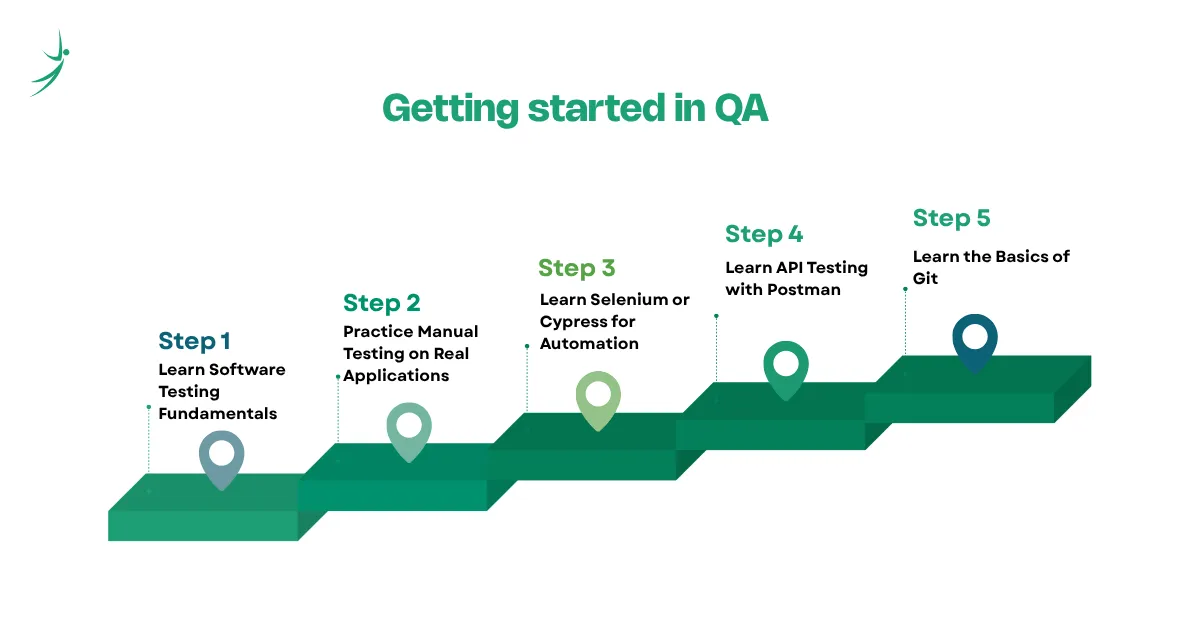
You do not need a computer science degree to start in QA. Structured learning, hands-on practice, and one recognized certification can get you job-ready in three to six months.
Step 1: Learn Software Testing Fundamentals
Before touching any tool, understand the concepts:
- The Software Development Life Cycle and where testing fits inside it
- Core test types: functional, regression, smoke, sanity, and user acceptance testing (UAT)
- What a test case looks like and what a test plan covers
- The bug lifecycle from the moment you log a defect to when a developer marks it resolved
The ISTQB Foundation Level syllabus is free to download and covers all of this. Read it even if you do not plan to sit the exam immediately.
Step 2: Practice Manual Testing on Real Applications
- Pick any live web application (an e-commerce site, a news platform, a free SaaS product) and write test cases for it
- Cover the happy path first, then go looking for edge cases and error states
- Use Jira's free tier to log bugs with clear, reproducible reports: steps to reproduce, expected result, actual result, environment
- Do this with ten bugs and you will understand bug reporting better than most entry-level applicants
This is the step that gives you something concrete to talk about in interviews.
Step 3: Learn Selenium or Cypress for Automation
Once comfortable with manual testing, automation is the move that most directly translates into higher pay:
- Selenium: Industry standard for over a decade, works with Java and Python, widest job market in Nepal and globally
- Cypress: JavaScript-based, faster to set up, popular at product companies and startups
Pick one based on your programming comfort. No background? Start with Cypress. Know some Python? Go with Selenium. This comparison of Selenium vs Cypress breaks it down clearly.
Goal: automate one real test flow end to end (a login, a form submission, a checkout) before moving on.
Step 4: Learn API Testing with Postman
Most modern applications run on APIs that communicate in the background to fetch data and process transactions. Testing those APIs is a core skill employers look for:
- Send GET and POST requests and validate responses
- Write test assertions inside Postman
- Run collections of API tests automatically
This practical guide to API testing with Postman takes you from zero to your first automated API test suite.
Step 5: Learn the Basics of Git
- Clone a repository, create a branch, commit changes, and raise a pull request
- Automation scripts live in the same codebase as the rest of the product, so Git is not optional
- QA engineers who understand Git work far more naturally with development teams
QA Career Path: From Junior Tester to QA Lead
QA is not a dead-end entry role that goes nowhere. It has a clear and well-mapped progression, and the engineers who follow it consistently reach senior positions with strong market demand.
Here is how the career ladder looks in practice:
| Stage | Title | What You Focus On | Typical Timeline |
|---|---|---|---|
| Entry | Junior QA / QA Trainee | Manual testing, writing test cases, logging bugs | 0–1 years |
| Mid | QA Engineer | Automation frameworks, API testing, CI/CD integration | 1–3 years |
| Senior | Senior QA Engineer | Test architecture, mentoring, automation strategy | 3–5 years |
| Lead | QA Lead / Test Manager | Team ownership, sprint planning, stakeholder reporting | 5+ years |
| Specialist | SDET / Automation Architect | Advanced automation, DevOps pipeline integration, tooling | 4+ years |
The highest-leverage career move in QA is the manual-to-automation upgrade. Most QA engineers start in manual testing roles. After six to twelve months of building solid fundamentals (writing good test cases, understanding the application deeply, developing an eye for edge cases), they start learning automation on the side. The engineers who make that transition consistently see their salary jump, their job options widen, and their career trajectory shift from linear to exponential.
If you want a month-by-month breakdown of exactly what to learn and when, the QA career roadmap for Nepal lays out the full learning path from zero to job-ready.
QA Salary in Nepal (and Globally) in 2026
Salary matters when you are making a career decision, and in Nepal the numbers are increasingly strong. For QA engineers who add automation skills and work with international clients remotely, earnings reach a different level entirely.
Here is what the market looks like in 2026:
| Experience Level | Nepal (NPR/month) | India (INR/year) | USA (USD/year) |
|---|---|---|---|
| Entry-Level (0–1 years) | NPR 30,000 – 60,000 | ₹4 – 7 LPA | $65,000 – $85,000 |
| Mid-Level (2–4 years) | NPR 60,000 – 1,20,000 | ₹8 – 14 LPA | $90,000 – $120,000 |
| Senior-Level (5+ years) | NPR 1,20,000 – 2,50,000+ | ₹16 – 25 LPA | $130,000 – $160,000+ |
Sources: Glassdoor Nepal (June 2026), Kumari Job Nepal salary data, industry benchmarks.
The most important number in that table is not the starting salary. It is the gap between mid-level manual QA and mid-level automation QA. Automation engineers in Nepal working on remote contracts for international clients routinely earn two to three times the local market rate for the equivalent experience level. The skill investment pays back fast.
For a detailed breakdown of salary by company type, role specialization, and how remote contracts compare to local employment, this guide to QA salaries in Nepal covers everything.
Top QA Tools Every Beginner Needs to Know
You do not need to learn every tool before applying for jobs. But knowing the landscape helps you make smarter decisions about what to prioritize.
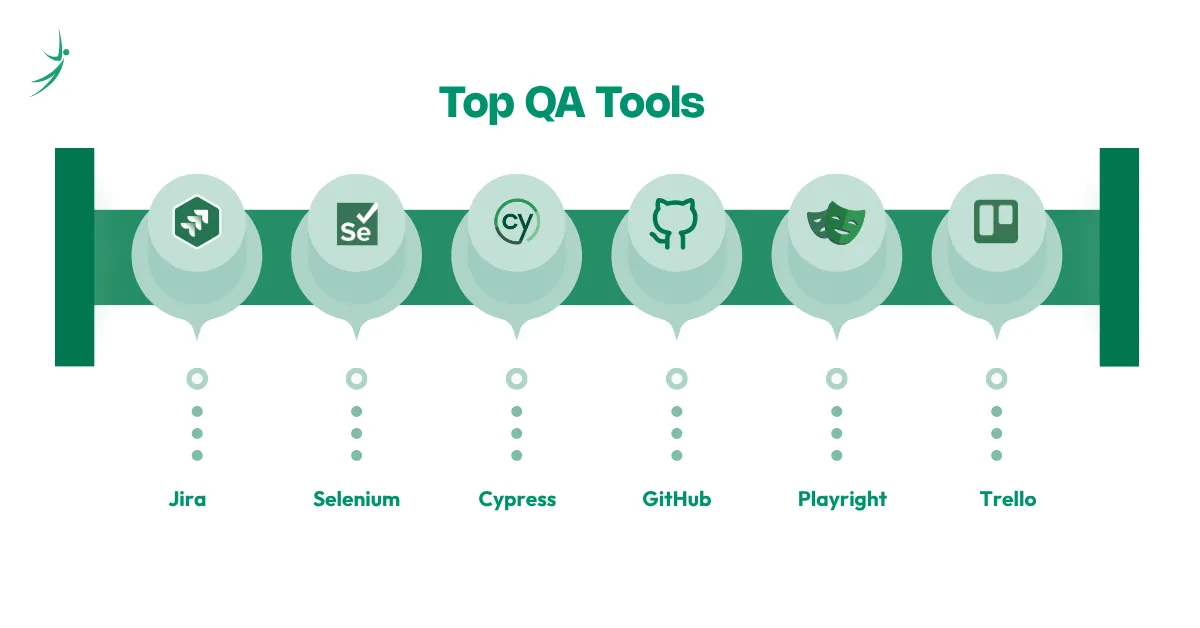
Here is how the QA toolset breaks down by category:
| Category | Tools to Know |
|---|---|
| Test Management | Jira, TestRail, Zephyr |
| Bug Tracking | Jira, Linear, Trello |
| Automation (Web) | Selenium, Cypress, Playwright |
| API Testing | Postman, REST-assured |
| Performance Testing | JMeter, k6 |
| CI/CD Integration | Jenkins, GitHub Actions |
| Version Control | Git, GitHub |
For beginners, the priority order is: Jira first (for test case and bug management), then Postman (for API testing), then Selenium or Cypress (for automation). Everything else in the list builds on top of those three. Learn them well, build real projects with them, and you will be more prepared for interviews than candidates who have a surface-level familiarity with everything.
This guide to QA tools in 2026 covers each category in more detail, including which tools are most commonly required in Nepal's job market specifically.
Certifications Worth Getting in 2026
Certifications signal to employers that your skills have been tested by someone other than yourself. At entry level with no professional QA history, that signal matters.
- ISTQB Foundation Level (CTFL): The global industry standard. Recognized in Nepal and internationally. Start here. The syllabus itself is a rigorous self-study guide even before you sit the exam.
- Selenium WebDriver (structured course): Not a formal board exam, but completing a recognized program and building an automation portfolio project carries real weight. Employers look at the GitHub repository you built alongside it.
- Cypress certification (Cypress.io): Newer but increasingly relevant at product companies and startups in Kathmandu.
- ISTQB Advanced Level (Test Analyst or Test Automation Engineer): The right next step after two or more years of experience. This is the credential that moves you into senior and lead conversations.
One honest note: certifications accelerate your job search and strengthen salary negotiations. Stack them with real portfolio projects and you are hard to ignore.
Start Your QA Career with Skill Shikshya
QA is one of the most practical entry points into a tech career in Nepal, and the demand for skilled engineers is only growing. Reading about it is the first step. Building real skills is what gets you hired.
At Skill Shikshya, our Quality Assurance training programme takes you from complete beginner to job-ready QA engineer through hands-on, project-based learning built around what Nepal's hiring market actually asks for.
- Project-based from day one: You write real test cases, build automation scripts, and test live APIs. Every module ends with something you can show an employer.
- Taught by working QA professionals: Engineers with active industry experience who know what hiring managers in Kathmandu and abroad look for.
- Career support built in: ISTQB certification guidance, portfolio review, and interview preparation. Students leave with a plan, not just a certificate.
- Flexible enough to fit your life: Works for students, working professionals, and career switchers equally.
Frequently Asked Questions
What is quality assurance in simple terms?
Quality assurance is the process of making sure software works correctly before it reaches users. QA engineers build testing processes, write test cases, find bugs, and verify fixes so the product that ships is reliable and meets the standard it was built to.
How do I start learning QA as a complete beginner?
Start with the fundamentals: the SDLC, basic test types, and how to write a test case. Then practice manual testing on any live application. After that, pick up Postman for API testing and one automation tool, either Selenium or Cypress. Three to six months of consistent learning and practice is enough to be interview-ready.
Is QA a good career in Nepal?
Yes, and it is getting better. Local IT companies, outsourcing firms, and product startups in Kathmandu are all hiring QA engineers. Remote opportunities with international clients are growing. QA engineers with automation skills consistently earn above the local IT average, and the demand for the role is not shrinking.
Do I need coding knowledge to become a QA engineer?
Not at the start. Manual testing roles do not require programming. You will need basic scripting skills once you move into automation, but that is something you build over time, not something you need before you begin.
What is the difference between manual and automation testing?
Manual testing means a human tester runs test cases by hand: clicking through the application, entering data, and checking results. Automation testing means writing code that does that same work automatically, which is faster for repetitive tests and regression cycles. Most QA engineers start with manual testing and move into automation as they grow.
How long does it take to become a QA engineer?
With focused, structured learning, three to six months is a realistic timeline to become job-ready for a junior QA role. Moving into mid-level automation work typically takes another six to twelve months of hands-on experience on top of that.
How much does a QA engineer earn in Nepal?
Entry-level QA engineers in Nepal earn between NPR 30,000 and NPR 60,000 per month. Mid-level engineers earn NPR 60,000 to NPR 1,20,000. Senior engineers and those working remotely for international clients earn NPR 1,20,000 to NPR 2,50,000 or more. Automation skills push you toward the upper end of those ranges at every level.
Which QA certification should I get first?
ISTQB Foundation Level (CTFL) is the right first certification for almost everyone. It is globally recognized, structured, and the syllabus itself teaches you QA fundamentals properly even before you sit the exam.
What tools do QA engineers use every day?
The core stack for most QA engineers includes Jira (for test management and bug tracking), Postman (for API testing), Selenium or Cypress (for test automation), and Git (for version control). Most teams also use some form of CI/CD tooling like GitHub Actions or Jenkins to run automated tests on every code change.
What is the full form of QA?
QA stands for Quality Assurance.