Scope of QA in Nepal 2026: Jobs, Salaries & Career Guide
The global software industry is growing faster than most people realize, and right at the center of that growth sits Quality Assurance. If you are a student deciding which IT career to pursue, a developer thinking about a career pivot, or a professional looking for a path into the tech industry without starting a full engineering degree, understanding the scope of QA in Nepal in 2026 gives you a concrete answer to a very practical question: is this field worth my time and money?
In 2026, building software is no longer just about writing code. It is about shipping that code with zero defects, meeting strict quality standards, and protecting users from failures that cost companies their reputation and their users. Before exploring the current scope of QA, it helps to understand what is quality assurance and why software companies across Nepal are prioritising QA engineers over almost any other hire.
If you want to understand exactly what the career path looks like from fresher to senior engineer, the complete QA career guide at Skill Shikshya walks through roles, skills, tools, and the step-by-step path into Nepal's QA job market. This article breaks down the full scope of QA in Nepal: career opportunities, job market size, local and global salaries, which industries are hiring, which specialisations pay most, and how you can get started through a practical QA course at Skill Shikshya designed to build job-ready manual testing, automation, and API testing skills.
How Big is the QA Industry in 2026?
Before understanding the scope of QA in Nepal, it helps to see the size of the global industry we are talking about.
- The Software Testing and QA Services market is valued at $50.67 billion in 2026 and is projected to reach $107.25 billion by 2033, growing at a compound annual rate of 11.5%
- 51% of QA practitioners saw higher-quality software after adopting automation, with 49% able to test more frequently and thoroughly (Katalon State of Software Quality Report 2025)
- 74.6% of QA teams now use two or more automation frameworks simultaneously as products grow in complexity (ThinkSys 2026)
- The manual testing segment is projected to hold a 62.5% share of the market in 2026, due to its precision in uncovering complex user interface issues, usability flaws, and exploratory scenarios that automated tools miss
- The scope of QA in Nepal is growing rapidly, with increasing demand for skilled testers in software, IT, and digital services. Companies are hiring for roles ranging from manual testing to automation, performance, and security testing
This is one of the most stable and consistently growing fields in IT, and Nepal's QA job market is growing alongside the global trend.
What is QA? And Why Are Nepal's Companies Prioritising It?
At its core, QA is the set of structured activities that ensure software meets defined quality standards before it reaches real users. It is not just testing at the end of a development cycle. It runs through every phase from requirements to production, with QA engineers involved from Sprint Day 1. To understand the full day-to-day picture of the role, the what does a QA engineer do guide breaks down every responsibility from test planning to release sign-off.
Key Benefits of QA for Organisations in Nepal
Why are Nepal's software companies, fintech firms, and outsourcing organisations building dedicated QA teams? The business case is clear:
- Faster Releases with Fewer Defects: Shift-left testing and automated regression suites allow development teams to ship faster without sacrificing quality. Teams that incorporate API testing and CI/CD automation report 40% faster release cycles (SmartBear 2025).
- Massive Cost Savings: Defects found in requirements cost almost nothing to fix. The same defects found in production cost 30 times more to resolve (IBM Systems Sciences Institute, 2024). Every QA engineer who catches a bug before release saves the company hours of emergency rework.
- User Trust and Retention: Applications that crash, freeze, or lose user data lose users permanently. In Nepal's competitive fintech market, a single production failure during Dashain can cause thousands of users to switch platforms instantly.
- Regulatory Compliance: Nepal's banking and fintech sector operates under Nepal Rastra Bank (NRB) digital banking guidelines. International outsourcing companies work under ISO standards, GDPR, and strict client SLAs. QA engineers ensure products meet these requirements consistently across every release.
- Competitive Advantage: Companies with strong QA practices ship more reliable products, win more outsourcing contracts, and retain international clients longer than competitors who treat testing as optional.
Types of QA: Where the Scope Branches
QA is not a single activity. It branches into seven major specialisations, each with its own tools, career path, and salary ceiling. Understanding the types of QA helps you choose the right entry point for your skills and goals.
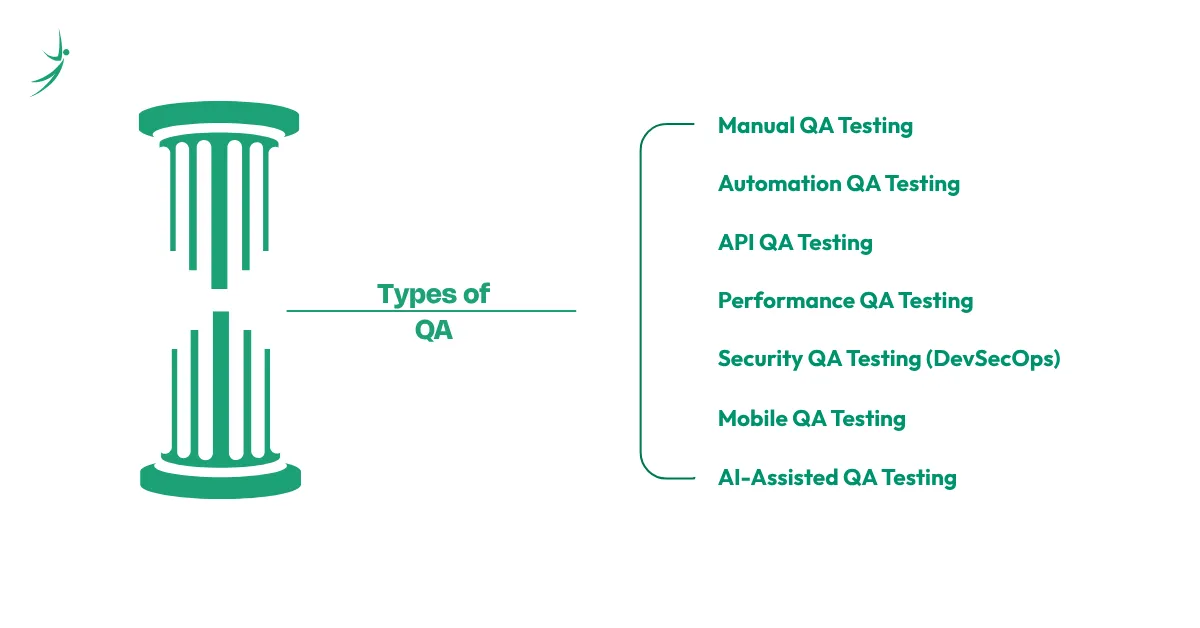
1. Manual QA Testing
- Core Focus: Human-executed testing of software features against defined requirements
- Key Practices: Test case writing, bug reporting in JIRA, exploratory testing, regression execution, UAT facilitation
- Essential Tools: JIRA, TestRail, Excel, Chrome DevTools
- Why It Matters in Nepal: Manual testing is the entry point for most QA careers in Nepal. It requires no programming knowledge, produces immediate value for development teams from day one, and catches the nuanced, judgment-based issues that automation scripts miss. Every QA career in Nepal starts here. Understanding all the types of software testing a manual tester covers gives freshers the full picture of what the role actually involves.
2. Automation QA Testing
- Core Focus: Code-based scripts that execute test cases automatically at speed and scale, replacing repetitive manual execution
- Key Practices: Page Object Model framework design, CI/CD regression pipeline integration, test data management, flaky test analysis
- Popular Tools: Selenium, Cypress, Playwright, Appium, Newman
- Why It Matters in Nepal: Automation is where Nepal's QA salary ceiling opens up. Engineers with Selenium and Postman skills earn 40 to 60% more than manual-only testers. Every Nepal IT company that ships software continuously needs an automation suite to keep their regression coverage running without manual effort every sprint. The debate most freshers face first is covered in the manual vs automation testing guide.
3. API QA Testing
- Core Focus: Validating backend application logic directly through API endpoints, bypassing the user interface entirely
- Key Practices: REST API validation, authentication testing (Bearer token, OAuth 2.0), response body assertion, response time thresholds
- Popular Tools: Postman, Newman, SoapUI, REST Assured
- Why It Matters in Nepal: By 2026, 85% of enterprise software interactions happen via APIs (SmartBear 2025). Nepal's fintech companies run their entire transaction logic through APIs. QA engineers who test APIs directly find bugs faster, earlier, and cheaper than UI-only testers. The API testing with Postman guide covers everything from your first GET request to Newman CI/CD integration for freshers starting from zero.
4. Performance QA Testing
- Core Focus: Measuring how software behaves under load, stress, spike, and endurance conditions at scale
- Key Practices: Load testing, stress testing, spike testing, endurance testing, capacity planning before high-traffic events
- Popular Tools: Apache JMeter, k6, Gatling
- Why It Matters in Nepal: Nepal's fintech platforms like eSewa, Khalti, and F1Soft see massive traffic spikes during Dashain and Tihar. A payment app that works fine for 1,000 users can catastrophically fail when 50,000 hit it simultaneously during a festival. Performance QA engineers prevent those failures. This specialisation commands salaries from NPR 100,000 to NPR 180,000 per month for engineers with production load testing experience.
5. Security QA Testing (DevSecOps)
- Core Focus: Identifying vulnerabilities, authentication flaws, and data exposure risks in software before attackers find them
- Key Practices: SAST, DAST, penetration testing, OWASP Top 10 validation, security regression testing
- Popular Tools: OWASP ZAP, Burp Suite, SonarQube, Checkmarx
- Why It Matters in Nepal: Nepal's outsourcing companies build products for international clients who mandate security testing in their contracts. NRB regulations require security compliance for fintech applications. Security QA is a growing specialisation with premium salary potential and increasing demand from both local and international clients.
6. Mobile QA Testing
- Core Focus: Testing application functionality, compatibility, usability, and performance across Android and iOS devices and screen sizes
- Key Practices: Functional testing, compatibility testing across device models, performance testing on 4G and 3G networks
- Popular Tools: Appium, XCUITest, Espresso, BrowserStack
- Why It Matters in Nepal: Nepal is an Android-dominant market. eSewa, Khalti, and Hamro Patro all run mobile-first products used by millions of Nepali users. QA engineers who can test across Nepal's diverse Android device landscape are directly valuable to the country's most prominent tech brands.
7. AI-Assisted QA Testing
- Core Focus: Using machine learning tools to auto-generate test cases, detect flaky tests, and maintain self-healing automation scripts
- Key Practices: AI-powered visual regression testing, self-healing test scripts, predictive defect detection, prompt-based test generation
- Popular Tools: Testim, Mabl, Applitools, Katalon AI
- Why It Matters in Nepal: AI does not replace QA engineers. It removes the repetitive parts of the job and lets engineers focus on strategy, exploration, and judgment-based testing that machines cannot replicate. The World Quality Report 2025 found that 89% of enterprises are now piloting or deploying AI workflows in their QA process. Nepal's outsourcing companies building for international clients are already adopting these tools, and QA engineers who learn them earn premium salaries.
The Real Scope of QA in Nepal: What It Actually Covers
Scope Across Industries
Nepal's IT industry is increasingly recognising the importance of QA engineering. Traditionally, software development practices in the region were focused primarily on coding and development, often at the expense of rigorous testing. However, as the industry matures, there is a growing emphasis on integrating QA practices into the development lifecycle.
Here is where that demand is concentrated:
- Fintech and Banking: eSewa, Khalti, F1Soft, NIC Asia, and Nabil Bank all run transaction-heavy digital platforms requiring rigorous QA. NRB compliance demands consistent security and functional testing across every release. QA engineers in fintech test payment APIs, mobile wallet transactions, and authentication flows that process millions of real rupees every day. This is the highest-paying domestic sector for QA engineers in Nepal.
- Software Outsourcing: Leapfrog Technology, Cotiviti, Fusemachines, and CloudFactory build software for international clients in the US, UK, and Australia. These clients mandate QA deliverables as part of their contracts, and quality failures directly affect contract renewal. QA engineers at outsourcing firms earn toward the top of Nepal's salary bands because their work has direct business consequences for the company's international reputation.
- SaaS and Product Startups: A growing cluster of Kathmandu-based product companies across Baneshwor, Pulchowk, and Tinkune are building SaaS tools for international markets. These companies need QA engineers who understand automated testing, CI/CD integration, and API testing from the earliest sprints. Understanding how SDLC and STLC work in parallel inside Agile sprints is the foundational knowledge these companies test in interviews.
- EdTech and E-commerce: Platforms like Daraz, Hamro Bazar, and Nepal's growing online education providers need QA engineers to validate user flows, test payment integrations, and ensure compatibility across Nepal's diverse device landscape.
- Healthcare and Government Digital Services: Nepal's expanding digital health platforms and government e-service portals require QA engineers who understand data validation, accessibility testing, and compliance requirements under Nepal's digital governance frameworks.
Scope Across QA Roles and Business Functions
Inside Nepal's IT organizations, QA has moved from an end-of-pipeline gatekeeper to an embedded quality partner across every team:
- Developers at Nepal's IT companies now work alongside QA engineers in every sprint. QA reviews requirements, catches edge cases before developers write a line of code, and provides immediate feedback through automated CI/CD test runs.
- Product Managers at Nepal's product startups rely on QA engineers to validate that features match acceptance criteria before release, reducing the cycle of post-release hotfixes that delay the next sprint.
- DevOps Engineers at outsourcing companies like Leapfrog integrate QA test suites into CI/CD pipelines, making automated test execution a required gate in every deployment workflow.
- Business Analysts work with QA teams to translate business requirements into testable acceptance criteria, connecting stakeholder expectations to engineering delivery in a measurable way.
- Security Teams at Nepal's fintech companies increasingly collaborate with QA engineers on DevSecOps pipelines where security testing runs automatically alongside every code push.
Scope for Freelancers and Remote QA Workers
One of the most significant career advantages of QA in 2026 is the geographical independence the field now offers. Because testing happens in the cloud and across remote development environments, Nepal's QA engineers work for international clients from Kathmandu without relocating:
- Remote API Testing Contracts: International SaaS companies regularly hire remote QA engineers to audit their API test coverage, write Postman collections, and integrate Newman into their CI/CD pipeline. These contracts typically pay $25 to $45 per hour.
- Automation Framework Audits: Companies with slow or flaky automation test suites hire freelance QA engineers to redesign their Selenium or Cypress framework using Page Object Model patterns. Experienced Nepal automation engineers compete directly for these contracts on Upwork and Toptal.
- Performance Testing Engagements: Startups hire freelance JMeter or k6 engineers before major product launches or traffic events to run load tests and provide capacity recommendations. Short engagements at $30 to $50 per hour are common.
- ISTQB-Certified QA Consulting: Nepal's outsourcing companies and international clients increasingly hire certified QA consultants to define test plans, entry and exit criteria, and quality KPIs for long-term projects.
- Mobile Testing Contracts: International app developers hire Nepali QA engineers to run Appium-based compatibility tests across Android device variants for Asian and South Asian markets where device fragmentation is high.
Remote QA roles for Nepali engineers currently pay $20 to $40 per hour on average, with senior automation and performance specialists reaching $40 to $60 per hour for international clients.
Scope Based on Your Strengths
The scope of QA in Nepal is genuinely wide, and the right entry point depends on what you are naturally good at:
- If You Are Detail-Oriented and Analytical: Manual QA testing suits you. Writing precise test cases, spotting edge cases in requirements, and producing clear bug reports that developers act on are your core value. No programming needed to start. Nepal's IT companies hire manual QA freshers every month.
- If You Enjoy Writing Code: Automation QA engineering is your path. Build Selenium frameworks, write Cypress scripts, and integrate test suites into CI/CD pipelines. The salary ceiling for automation engineers is 40 to 60% higher than for manual-only testers at the same experience level.
- If You Think About Systems at Scale: Performance QA engineering lets you simulate real-world traffic loads, find system breaking points, and work directly with infrastructure teams on capacity planning for Nepal's busiest digital platforms.
- If Security Interests You: DevSecOps and security QA is an emerging specialization in Nepal, driven by NRB regulations and international client compliance requirements. Engineers with OWASP ZAP and DevSecOps skills command premium salaries and face limited competition.
- If You Want the Fastest Entry into IT Without Coding: Manual QA testing is the clearest non-coding entry point into Nepal's IT industry. A structured 3-month program builds the skills to qualify for junior roles at software companies, fintech startups, and outsourcing firms.
Global Scope of QA: Salaries Worldwide
Because QA engineers bridge the gap between software development and real user experience, they command strong compensation across every major tech market globally.
| Experience Level | Typical Experience | Average Annual Salary (USD) | Average Hourly Rate (USD) |
|---|---|---|---|
| Intern | 0 years, student or fresher | $45,000 to $65,000 | $22 to $31/hr |
| Entry-Level / Junior | 0 to 2 years | $65,000 to $90,000 | $31 to $43/hr |
| Mid-Level | 2 to 5 years | $90,000 to $130,000 | $43 to $63/hr |
| Senior | 5+ years | $130,000 to $180,000 | $63 to $87/hr |
Sources: Glassdoor Global QA Engineer Salary, June 2026 | PayScale QA Engineer, 2026 | LinkedIn Salary Insights 2026
Scope of QA in Nepal (2026): Jobs and Salaries
QA jobs in Nepal are growing as the tech and software industry expands. Companies now focus on delivering high-quality software, websites, and digital products, which has increased the demand for QA professionals. LinkedIn Nepal listed over 66 active QA job openings as of June 2026, and the volume of listings grows month on month as Nepal's IT sector matures.
The talent gap is real. Nepal produces more software developers than QA engineers each year, which means trained QA professionals enter a market where demand consistently outpaces supply. Ready to step into that gap? The QA training course at Skill Shikshya covers manual testing, Selenium, Postman, JMeter, and JIRA with guaranteed job or internship placement on completion.
Career Scope: Jobs and Salaries in Nepal (2026)
| Experience Level | Average Monthly Salary (NPR) | Essential Skill Expectations |
|---|---|---|
| Intern / Trainee | NPR 10,000 to NPR 25,000 | Test case execution, bug reporting, JIRA basics |
| Entry-Level (0 to 2 years) | NPR 25,000 to NPR 75,417 | Manual testing, JIRA, TestRail, SDLC/STLC, Agile workflows |
| Mid-Level (2 to 5 years) | NPR 75,000 to NPR 180,000 | Selenium, Postman, Newman, GitHub Actions, CI/CD integration |
| Senior-Level (5+ years) | NPR 150,000 to NPR 300,000+ | Automation framework design, JMeter, test strategy, team leadership |
Sources: Glassdoor Nepal, June 2026 | KumariJob Nepal, January 2026 | NecJobs Nepal, April 2026
Salaries increase significantly when you demonstrate hands-on experience with automation tools, API testing, and CI/CD pipeline integration. The QA salary in Nepal 2026 guide covers the full salary picture by role, experience level, specialisation, and remote versus local work, with verified data from Glassdoor Nepal, PayScale, and NecJobs.
Follow the complete QA career roadmap for Nepal to understand which job roles to target, which tools to learn at each stage, which certifications add the most salary value, and how long each stage of the path realistically takes.
Future Trends in QA: What Is Coming in 2026 and Beyond
To fully understand the future scope of QA in Nepal, look at where the global industry is heading and how those trends are arriving in Nepal's IT market:
- AI-Driven QA (AIOps for Testing): Machine learning tools like Testim and Mabl are now embedded into QA workflows at scale. They auto-generate test cases from user behavior patterns, detect flaky tests automatically, and heal broken automation scripts when UI changes break element locators. The World Quality Report 2025 found 89% of enterprises piloting AI workflows in QA. Nepal's outsourcing companies building for international clients are already adopting these platforms. QA engineers who understand AI-assisted testing tools enter a growing premium market.
- Shift-Left Becomes the Standard: Emerging technologies like AI-driven testing and automation frameworks are expanding the scope of QA roles. Professionals who keep learning and adapting will always stay relevant in this dynamic field. QA involvement from Sprint Day 1, test cases written from requirements, and API tests running on every code push are rapidly becoming the baseline expectation at Nepal's IT companies.
- Performance and Observability Convergence: k6 and Grafana are increasingly used together for continuous performance monitoring rather than one-time load tests before releases. QA engineers who understand observability tools work at the intersection of QA and DevOps, one of the fastest-growing and highest-paying specialisations in Nepal's current market. Refer to top QA tools 2026 for a full breakdown of tools by career stage and salary impact.
- Security QA Becomes Mandatory: International outsourcing clients are adding security testing requirements into their contracts. NRB digital banking guidelines are tightening. Security QA engineers with OWASP ZAP and DevSecOps pipeline skills will find growing demand at both Nepal's fintech companies and outsourcing firms over the next two years. The Selenium vs Cypress 2026 guide is a useful context for understanding how automation tool choice affects which company types and international clients you qualify for.
- Remote QA Becomes the Norm: As Nepal's QA engineers build ISTQB credentials, automation portfolios on GitHub, and documented project experience for verifiable client work, the barrier to remote international work keeps dropping. Remote QA is already a reality for mid and senior-level Nepali engineers. The future of QA jobs in Nepal is strong as more companies build software and digital products. As systems become more complex, the need for testing and quality assurance will continue to grow. Professionals who learn automation and improve their technical skills will have better opportunities.
Conclusion
The scope of QA in Nepal in 2026 is larger, better-paying, and more technically interesting than most people outside the field realize. It covers seven distinct specialisations from manual testing to AI-assisted quality engineering. It spans fintech, outsourcing, SaaS, e-commerce, and government digital services. It opens remote opportunities at $20 to $60 per hour for international clients. And it starts with an entry point that requires no prior IT background or programming knowledge.
Nepal's QA job market is growing faster than the supply of trained professionals can fill it. That gap is the opportunity.
If you want to step into it with real skills and guaranteed placement support, the Quality Assurance course at Skill Shikshya covers manual testing fundamentals, Selenium automation, API testing with Postman, performance testing with JMeter, and ISTQB Foundation Level preparation in one 3-month program built specifically for Nepal's IT job market. Compare it against every other institute in the best QA course in Nepal guide before you decide.
Frequently Asked Questions
What is the scope of QA in Nepal in 2026?
Is QA a good career in Nepal?
Which companies hire QA engineers in Nepal?
What is the QA salary in Nepal for freshers?
Will AI replace QA engineers in Nepal?
What is the future of software testing in Nepal?
Can I do QA without a coding background?
How do I start a QA career in Nepal?
About Author:

Meet Mr. Biru Maka Shrestha, QA mentor at Skill Shikshya. He guides learners through real-world testing scenarios, teaching practical quality assurance skills to ensure software reliability and excellence.