What Does a QA Engineer Do? Roles, Skills & Salary in Nepal
Most people in a software company know what a developer does. They write code. They know what a designer does. They make things look good. But ask someone what a QA engineer does, and the answer is usually something vague like "they test stuff."
That answer misses almost everything.
A QA engineer does not just click through an application and look for broken buttons. They review requirements before a single line of code gets written. They write test plans, design test cases, run manual and automated tests, file detailed bug reports, retest fixes, and sign off on whether a build is actually ready to ship. In most companies, nothing goes to production without a QA engineer's approval.
If you are exploring a career in software quality, this QA career guide walks you through the full path from beginner to employed in Nepal's IT market.
Who is a QA Engineer?
A QA engineer, short for Quality Assurance Engineer, is the person responsible for making sure software meets defined quality standards before it reaches real users. If you are new to the field and want to understand the full meaning of quality assurance before diving into the role itself, the what is quality assurance guide covers the foundational concepts clearly. QA engineers work across the entire software development lifecycle (SDLC), from the moment requirements are written to the day a feature ships to production.
QA engineers use a mix of manual testing, automation testing, and process review to catch defects early and prevent them from ever reaching users. They are not just testers at the end of a development cycle. They are quality partners embedded in the development team, involved in every sprint from planning to release.
The term QA engineer sometimes gets used loosely to mean several different roles. Here is how the most common ones actually differ:
| Role | Primary Focus | Coding Required |
|---|---|---|
| Manual QA Tester | Execute test cases by hand | No |
| QA Analyst | Analyze requirements, write test plans | No |
| QA Engineer | Full QA lifecycle, manual and some automation | Sometimes |
| Automation Engineer | Build and maintain automation frameworks | Yes |
| SDET | Write production-level code for test infrastructure | Yes, heavily |
Understanding these distinctions matters because they affect the skills you need to build, the tools you learn, and the salary you can expect at each stage. If you want to build all of these skills in one structured program, the Quality Assurance course at Skill Shikshya takes you from manual testing fundamentals through to Selenium, Postman, and live project work.
What Does a QA Engineer Do? Core Responsibilities
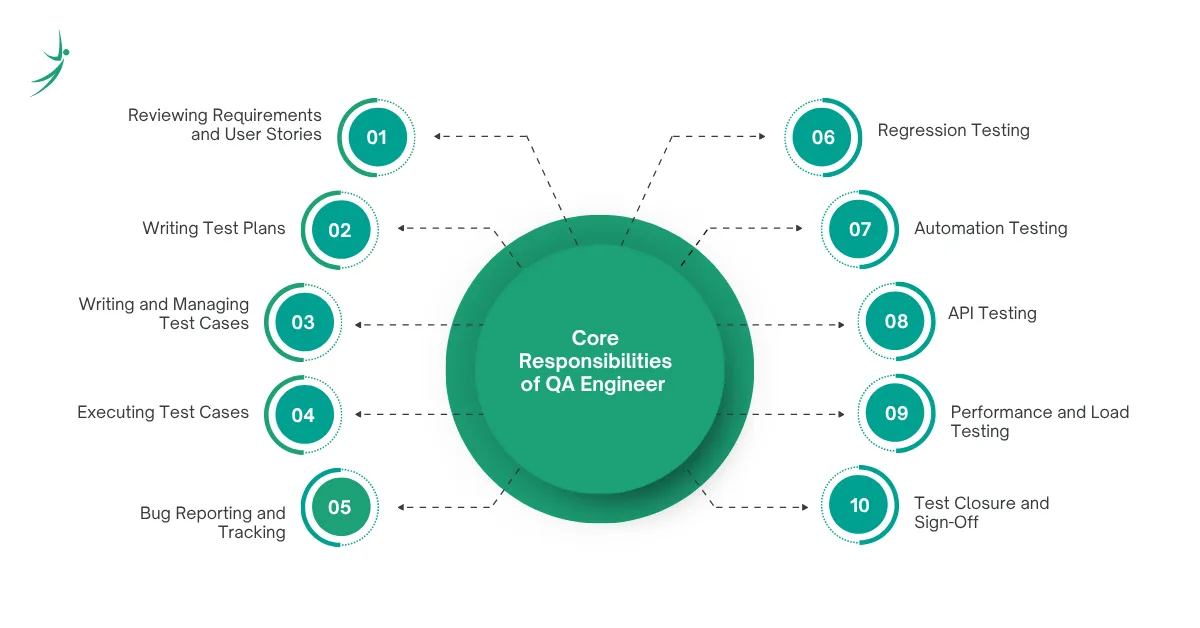
This is the question most people are actually asking. Here is a breakdown of every major responsibility a QA engineer carries, with what each one looks like in practice inside a real Kathmandu IT company.
1. Reviewing Requirements and User Stories
Before a developer writes a single line of code, QA engineers read through the requirements and user stories for the sprint. They look for ambiguity, gaps, and missing edge cases that could turn into bugs later.
They ask questions like:
- What happens if a user leaves this field empty?
- What is the maximum character limit on this input?
- What should the system do if the API times out?
- How does this feature behave on a slow 3G connection?
Catching these gaps before development starts costs almost nothing to fix. The same gap discovered in production can take days of emergency work to resolve. This early involvement is what people mean when they say "shift-left testing," and it is one of the most valuable things a QA engineer does for the team.
2. Writing Test Plans
A test plan is the quality roadmap for a feature or release. QA engineers write test plans that define:
- What will be tested and what is explicitly out of scope
- Which types of testing apply (functional, regression, performance, API)
- Which tools will be used
- Who is responsible for which test areas
- What the entry and exit criteria are for testing to begin and end
Tools used: JIRA, TestRail, Confluence
3. Writing and Managing Test Cases
Test cases are step-by-step instructions for testing a specific feature. Each test case covers:
- Preconditions: what needs to be true before the test runs
- Test steps: the exact actions to take
- Expected result: what the application should do
- Actual result: what it actually did
- Pass or fail status
A well-written test case for a login form does not just check "can a user log in with valid credentials." It also covers wrong password, empty username, SQL injection in the email field, account lockout after five failed attempts, login with special characters in the password, and session behavior after a password reset.
Tools used: TestRail, JIRA Zephyr, Excel, Google Sheets
4. Executing Test Cases
QA engineers run the test cases against each new build and record results. Manual execution means working through each step by hand. Automated execution means running scripts that do the same thing at speed. In most companies, both happen: automation covers the regression suite, and manual testing covers new features.
QA engineers track which tests passed, which failed, and which were blocked by environment issues that prevented the test from running at all.
5. Bug Reporting and Tracking
When a test fails, QA engineers log a bug report. A good bug report is not just "login is broken." It includes:
- A clear, specific title
- Steps to reproduce the issue exactly
- Expected result vs actual result
- Severity level (how serious is this?)
- Priority level (how urgently does it need fixing?)
- Environment details: browser, OS, device, build version
- Screenshot or screen recording
Bug severity levels QA engineers work with:
| Severity | Meaning | Example |
|---|---|---|
| Critical | Blocks all testing or causes data loss | App crashes on login |
| Major | Core feature broken, no workaround | Payment fails for all users |
| Minor | Feature affected but workaround exists | Date picker shows wrong month |
| Trivial | Cosmetic or UI issue | Button slightly misaligned |
QA engineers also track the bug lifecycle: Open, In Progress, Fixed, Retest, Closed, or Rejected. When a developer marks a bug as fixed, QA retests it. This back-and-forth between QA and development is a normal part of every sprint.
Tools used: JIRA, Bugzilla
6. Regression Testing
Every code change carries the risk of breaking something that already worked. Regression testing re-runs a set of existing tests after any code change to confirm nothing broke. A developer fixing a bug in the payment module might unknowingly break the order confirmation email. Regression testing catches that before users do. Regression is just one of the many types of software testing that QA engineers run across a product's lifecycle.
In modern Agile teams, regression testing runs automatically in the CI/CD pipeline. The test suite triggers every time a developer pushes code, and results appear in minutes. This is one of the biggest reasons automation matters: running 300 regression tests manually before every release is not realistic at sprint pace.
7. Automation Testing
QA engineers write and maintain automated test scripts that run test cases without human involvement. They:
- Write scripts in Selenium, Cypress, or Playwright that simulate user actions
- Build the automation framework structure (Page Object Model is the standard approach)
- Integrate the test suite into the CI/CD pipeline
- Review test run results and fix scripts that break when the UI changes
- Expand coverage by adding new scripts when manual tests become repetitive
Automation testing requires programming knowledge. You need to write actual code, locate elements on a web page, handle dynamic content, and build frameworks other team members can use and update.
Tools used: Selenium, Cypress, Playwright, Appium (mobile), Newman (API automation)
8. API Testing
QA engineers test backend APIs directly using Postman or SoapUI, without going through the user interface. They check:
- Correct HTTP response codes (200 OK, 404 Not Found, 401 Unauthorized)
- Correct data returned in the response body
- Proper error handling for invalid inputs
- Authentication and authorization behavior
- Response time within acceptable limits
API testing sits between manual and automation work. Most QA engineers write Postman collections manually first, then automate them with Newman for CI/CD integration. According to KumariJob's QA jobs report for Nepal, API testing with Postman is one of the most frequently requested skills in mid-level QA job listings in Nepal as of 2026.
9. Performance and Load Testing
QA engineers simulate high traffic conditions to check how the application behaves under load. They run:
- Load tests: normal expected traffic, confirming the system handles the volume it was designed for
- Stress tests: traffic well beyond normal levels, finding the breaking point
- Spike tests: sudden sharp bursts of traffic, checking how the system recovers
- Endurance tests: sustained normal traffic over hours or days, catching memory leaks
Nepal's fintech companies run performance tests regularly before major festivals and sale events. A payment app that works fine with 1,000 users can completely break when 50,000 users hit it simultaneously during Dashain. Performance testing is what prevents those incidents.
Tools used: Apache JMeter, k6
10. Participating in Agile Ceremonies
QA engineers are full members of Agile/Scrum teams. Their sprint involvement looks like this:
- Sprint planning: QA reviews user stories, raises edge case questions, and estimates testing effort
- Daily standup: QA reports what was tested yesterday, what is being tested today, and any blockers
- Sprint review: QA demonstrates tested features alongside the development team
- Sprint retrospective: QA contributes to process improvements for the next sprint
This is one of the key differences between QA in modern Agile teams versus older waterfall models. QA is not a final checkpoint. They are embedded partners throughout the sprint.
11. Test Closure and Sign-Off
At the end of each sprint or release cycle, QA engineers produce a test summary report covering:
- Total test cases: how many ran, how many passed, how many failed
- Defect summary: how many bugs were found, how many are resolved, how many remain open
- Known issues: outstanding defects that the team is aware of going into release
- Release recommendation: is this build ready to ship, or does it need more work?
Nothing goes to production without QA sign-off. This is the final gate between the development environment and real users.
A Day in the Life of a QA Engineer in Vrit Technologies
Here is what a typical sprint day looks like for a QA engineer working at a software company(Vrit Technologies) in Kathmandu.
Morning (9:00 to 11:00)
- Open JIRA and check newly assigned bugs and overnight CI/CD test run results
- Attend the daily standup (15 minutes): report what was tested yesterday, what is planned today, any blockers
- Review the developer's latest code merge and identify which features need retesting
Mid-morning (11:00 to 13:00)
- Execute manual test cases on the new payment feature that landed in the test environment overnight
- Find a bug: the form does not handle Nepali Unicode characters in the address field correctly
- Log a detailed bug report in JIRA with steps, screenshots, and severity level
Afternoon (14:00 to 17:00)
- Write Selenium scripts for the user registration flow that passed manual testing last sprint and now belongs in the regression suite
- Review a pull request and flag a missing input validation scenario the developer did not account for
- Update the test plan in Confluence for next sprint's features after reading the new user stories
End of day
- Verify that the regression suite passed on the latest build in the CI/CD pipeline
- Update test case statuses in TestRail
- File the daily test progress note in the sprint board
QA Engineer Responsibilities by Career Level
A QA engineer's role changes significantly as they gain experience. Here is what each level actually involves in Nepal's IT companies.
Junior QA Engineer (0 to 2 years)
What they do:
- Execute manual test cases written by senior team members
- Log detailed bug reports in JIRA
- Retest bugs after developer fixes
- Learn the team's tools and QA processes
- Assist with writing simple test cases under mentorship
Tools: JIRA, TestRail, Excel, browser developer tools
Mid-Level QA Engineer (2 to 4 years)
What they do:
- Own test case design for assigned features independently
- Write and maintain basic Selenium automation scripts
- Perform API testing with Postman and integrate with Newman for CI/CD
- Contribute to test planning and sprint estimation
- Mentor junior testers
Tools: Selenium, Postman, JIRA, TestRail, GitHub, Jenkins basics
Senior QA Engineer (4+ years)
What they do:
- Design and own the full automation framework for the product
- Define test strategy and quality standards for the team
- Integrate test suites into CI/CD pipelines with Jenkins or GitHub Actions
- Lead performance and security testing initiatives
- Review requirements at the architecture level
- Mentor mid and junior QA engineers
- Sign off on major releases
Tools: Cypress, Playwright, JMeter, k6, Jenkins, GitHub Actions, Docker basics
QA Lead or Manager (5+ years)
What they do:
- Own quality strategy for the entire product or engineering team
- Hire, manage, and grow the QA team
- Define and track quality KPIs: defect density, test coverage, escape rate
- Report quality metrics to engineering leadership and stakeholders
- Drive shift-left testing and continuous testing adoption across the team
Skills Every QA Engineer Needs in 2026
Technical Skills
- Test case design: boundary value analysis, equivalence partitioning, decision table testing
- Manual testing fundamentals: SDLC, STLC, test plan writing, bug lifecycle management
- Automation testing: Selenium with Java or Python, Cypress, Playwright
- API testing: Postman, REST API basics, HTTP status codes, JSON response validation
- Performance testing: JMeter, k6
- Version control: Git and GitHub
- CI/CD basics: Jenkins or GitHub Actions for automated test triggers
- SQL basics: querying test databases to verify data integrity behind the UI
Soft Skills
- Attention to detail: catching issues others walk past
- Analytical thinking: breaking a feature into every possible testable scenario
- Written communication: filing bug reports that developers act on quickly
- Curiosity: asking "what happens if..." before the user gets the chance to find out
- Collaboration: working directly with developers, product managers, designers, and business stakeholders throughout the sprint
Does QA Require Coding?
This is one of the most-searched questions among beginners in Nepal. The honest answer depends on which QA role you are going into.
Manual QA testing does not require coding. You need sharp analytical skills, solid documentation habits, and familiarity with JIRA and TestRail. Many successful QA professionals in Nepal work entirely in manual testing for years before adding any automation knowledge.
Automation QA engineering does require coding. You write scripts in Java, Python, or JavaScript. You build frameworks. You work with version control and CI/CD tools. The coding is different from application development, but it is real programming.
If you are starting out, you do not need to decide right now. Start with manual testing. Add coding skills when you are ready to move into automation. The manual vs automation testing guide breaks down exactly when and how to make that transition.
QA Engineer Tools Used in Nepal's IT Companies
| Category | Tools |
|---|---|
| Bug tracking | JIRA, Bugzilla |
| Test management | TestRail, Zephyr (JIRA plugin) |
| Web automation | Selenium, Cypress, Playwright |
| Mobile automation | Appium |
| API testing | Postman, SoapUI, Newman |
| Performance testing | Apache JMeter, k6 |
| CI/CD integration | Jenkins, GitHub Actions |
| Version control | Git, GitHub |
| Documentation | Confluence, Notion |
QA Engineer vs Software Developer: How They Work Together
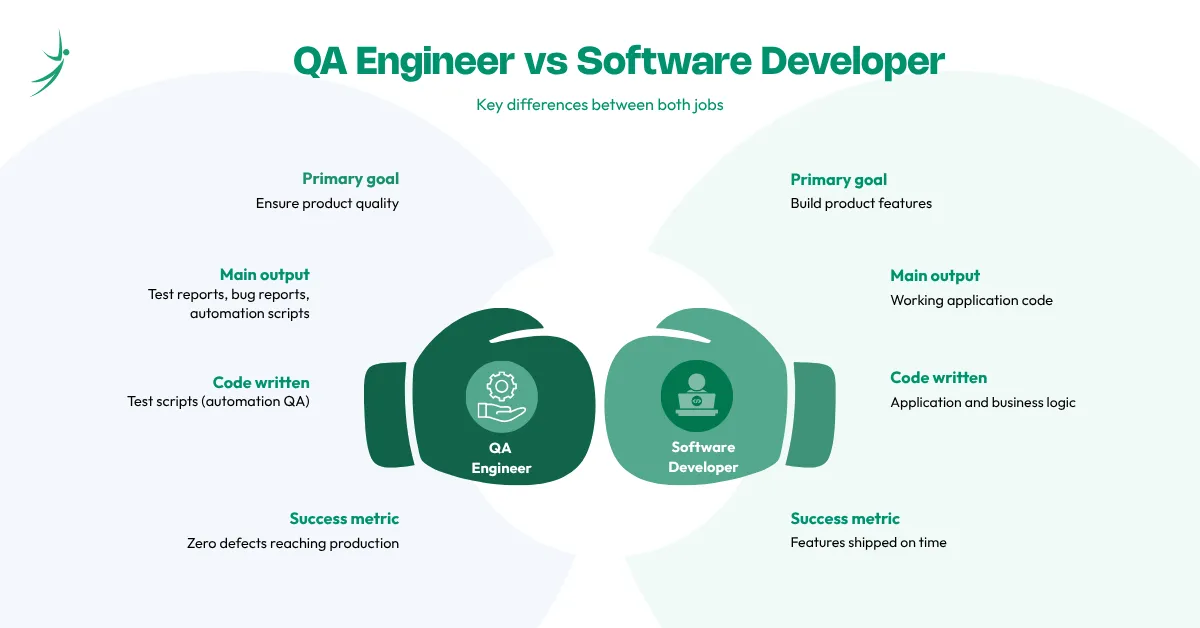
A common misconception is that QA engineers and developers are in opposition. Developers build things; QA breaks them. In reality, the best software teams treat QA as a partner to development, not a checkpoint at the end of it.
| QA Engineer | Software Developer | |
|---|---|---|
| Primary goal | Ensure product quality | Build product features |
| Main output | Test reports, bug reports, automation scripts | Working application code |
| Mindset | Find what breaks before users do | Build what works |
| Code written | Test scripts (automation QA) | Application and business logic |
| Success metric | Zero defects reaching production | Features shipped on time |
| Works with | Developers, PM, business stakeholders | QA, PM, designers |
The relationship works best when QA is involved from the start of a sprint rather than waiting until development is complete. When QA engineers review requirements alongside developers, both teams catch problems earlier, fix them faster, and ship software that actually works.
QA Engineer Salary in Nepal [2026]
Here is the verified salary data from multiple Nepal-specific sources as of mid-2026.
| Role | Experience | Monthly Salary (NPR) |
|---|---|---|
| Associate / Junior QA Engineer | 0 to 1 year | NPR 25,000 to 50,000 |
| QA Engineer | 1 to 3 years | NPR 55,583 to 102,083 |
| Senior Software QA Engineer | 4 to 6 years | NPR 120,069 to 221,683 |
| QA Lead or Manager | 5+ years | NPR 150,000 to 300,000+ |
Sources: Glassdoor Nepal, June 2026 | KumariJob Nepal, January 2026 | NecJobs Nepal, April 2026
Key things to know:
- Automation engineers consistently earn 40 to 60% more than manual testers at the same experience level
- Nepal's fintech companies (eSewa, Khalti, F1Soft) pay toward the upper end of each salary range
- QA engineers with Selenium, Postman, and CI/CD experience get faster promotion cycles
- Remote automation QA roles for international clients pay $20 to $40 per hour through platforms like Upwork and Toptal
How to Become a QA Engineer in Nepal in 2026
Here is the practical path most Nepal QA engineers follow:
- Step 1: Learn manual testing fundamentals Start with test case writing, bug reporting, JIRA, TestRail, SDLC basics, and Agile workflows. These skills alone qualify you for entry-level QA jobs.
- Step 2: Practice on demo applications SauceDemo, OrangeHRM, and DemoQA are open-source applications built specifically for QA practice. Build a test case portfolio using these.
- Step 3: Add API testing with Postman Learn REST API basics, write and run Postman collections, and understand HTTP response codes. API testing unlocks mid-level roles faster than almost any other skill.
- Step 4: Learn Selenium or Cypress for automation Pick one and build your first automation framework for a demo application. Push it to GitHub. This is what hiring managers check.
- Step 5: Prepare for ISTQB Foundation Level certification The ISTQB Foundation Level is globally recognized and respected by Nepal's IT companies. Preparation takes 4 to 6 weeks of focused study. Registration costs approximately $150 to $200 USD.
- Step 6: Apply through Nepal's QA job portals Merojob, Jobaxle, LinkedIn Nepal, and KumariJob all list active QA openings regularly. LinkedIn Nepal had 66+ active QA listings as of June 2026.
For the full step-by-step career plan with tool priorities at each stage, the QA career roadmap in Nepal guide maps everything out clearly.
Conclusion
A QA engineer does far more than test software. They review requirements before development starts, write test plans, design and execute test cases, log detailed bug reports, run regression suites, test APIs and performance, build automation frameworks, and sign off on every release. They sit inside the development team and contribute to every single sprint.
It is one of the clearest entry points into Nepal's IT industry, with defined skill levels, a predictable learning path, and strong salary growth from junior manual tester to senior automation engineer. If you want to apply for a QA role in any level, this guide helps you prepare for any type of interview to get started.
If you are ready to start building those skills with real tools, live projects, and mentors who work in Nepal's IT companies, the Quality Assurance course at Skill Shikshya gives you everything you need to get hired.
Frequently Asked Questions
What does a QA engineer do exactly?
What is the difference between a QA engineer and a software tester?
Does a QA engineer need to know coding?
What tools does a QA engineer use?
What is the salary of a QA engineer in Nepal in 2026?
What is the full form of QA?
Is QA engineering a good career in Nepal in 2026?
About Author:

Meet Mr. Biru Maka Shrestha, QA mentor at Skill Shikshya. He guides learners through real-world testing scenarios, teaching practical quality assurance skills to ensure software reliability and excellence.