What is Quality Assurance? A Complete Guide for Beginners | Skill Shikshya
Picture this: you open your eSewa app on the day of a Dashain transfer. You enter the amount, hit send, and the app crashes. No confirmation. No money moved. Just a frozen screen.
Who should have stopped that from happening? A QA engineer.
Quality Assurance sits between your development team and your users. It is the discipline that makes sure software works the way it is supposed to, before real people depend on it. If you have spent any time exploring IT careers in Nepal, you have almost certainly come across the term QA. But what is quality assurance exactly? Is it just testing? Is it a job role? A methodology?
This guide answers all of that. You will learn what QA means, how it differs from quality control and testing, the types of QA that exist, how the QA process works inside a real software team, and what a QA career looks like in Nepal in 2026. If you want to get started in this field, this guide covers everything on how to get into Quality Assurance.
If you want to get into this field with hands-on training, Skill Shikshya's QA course in Nepal covers everything from manual testing to Selenium, Postman, and JIRA with real projects.
What is Quality Assurance? Definition and Core Meaning
Quality Assurance, or QA, is the set of planned activities that ensure a software product meets defined quality standards throughout the development process. The International Software Testing Qualifications Board (ISTQB) defines quality assurance as "activities focused on providing confidence that quality requirements will be fulfilled."
In plain terms: QA is about getting the process right so the product comes out right. It is proactive, not reactive. QA teams do not wait for the software to break and then fix it. They put systems, standards, and checkpoints in place so breakage is less likely to happen in the first place.
What Does QA Do on a Practical Level?
At its core, QA is a quality management practice that runs through the entire software development lifecycle (SDLC). From the moment a business requirement lands on paper to the day a feature ships to users, QA is asking: are we building this correctly, and are we building the correct thing?
Think of QA as the safety inspector on a construction project. They do not lay bricks. They review the blueprint before construction starts, check that materials meet standards during the build, and sign off before the structure opens to the public.
In software, that looks like: reviewing requirements before developers write a single line of code, defining test standards during development, and validating features before they go live.
What is the Difference Between QA, QC and Testing?
This is the question that trips up almost every fresher. QA, quality control (QC), and testing are related, but they are not the same thing.
Quality Assurance (QA)
QA is process-oriented and proactive. The goal is to prevent defects by making sure the processes used to build software are sound and consistently followed. QA involves the entire team, not just testers. It covers things like defining coding standards, creating test plans, reviewing requirements for ambiguity, and conducting process audits.
Quality Control (QC)
QC is product-oriented and reactive. The goal is to detect defects in the product itself, after it has been built or partially built. A QC team inspects the output against a set of predefined requirements. Technical reviews, code inspections, and software testing all fall under QC.
Testing
Testing is a subset of QC. It is the act of executing the software, either manually or through automated scripts, to find bugs. Testing tells you whether the software runs as expected under specific conditions.
The simplest way to think about it: QA improves the factory. QC inspects the product coming off the line. Testing runs the product and checks what breaks.
| QA | QC | Testing | |
|---|---|---|---|
| Focus | Process | Product | Execution |
| Approach | Proactive | Reactive | Reactive |
| Goal | Prevent defects | Detect defects | Find bugs |
| Stage | Throughout SDLC | End of development | Any stage |
| Owned by | Entire team | QC team | QA/QC engineers |
Types of Quality Assurance
QA is not a single activity. It branches into several specialized practices based on what part of the software you are checking and how you are checking it.
1. Process-Based QA
Process-based QA focuses on improving internal workflows, coding standards, and documentation practices. It asks: are teams following the right processes? Activities include Agile retrospectives, ISO compliance audits, and standard operating procedure reviews. When a development team adopts peer code reviews before merging, that is process-based QA in action.
2. Functional QA (Manual Testing)
Functional QA verifies that every feature of the software works exactly as the requirements specify. Manual testers execute test cases by hand, clicking through the application the way a real user would. This is the entry point for most QA freshers in Nepal. It requires sharp attention to detail, strong documentation habits, and a good understanding of user behavior.
3. Automation QA
Automation QA uses code-based scripts to run test cases automatically. Instead of a human manually clicking through a login form a hundred times, a script does it in seconds. Tools like Selenium, Cypress, and Playwright power automation testing. Automation QA requires programming knowledge, which is why automation engineers command significantly higher salaries than manual testers.
4. Performance QA
Performance QA checks how the system behaves under load. It tests response times, throughput, and stability when thousands of users hit the application simultaneously. Tools like Apache JMeter and k6 handle this type of testing. In Nepal's fintech industry, performance QA is critical because platforms like eSewa and Khalti see massive traffic spikes during festivals and sale events.
5. Security QA (DevSecOps)
Security QA identifies vulnerabilities, authentication flaws, and data leakage risks in the application. Tools like OWASP ZAP and Burp Suite help QA engineers run security scans as part of the testing pipeline. With Nepal's outsourcing sector growing fast, security QA is one of the most in-demand specializations in Kathmandu right now.
6. API QA
API QA tests the backend of an application directly, without going through the user interface. It checks that APIs return the correct responses, handle errors properly, and perform within acceptable limits. Postman is the standard starting tool for API testing. Most software companies in Nepal's tech corridor use REST APIs extensively, which makes API QA skills extremely hireable.
7. Mobile QA
Mobile QA covers testing on Android and iOS devices. It checks functionality, usability, performance, and compatibility across different screen sizes and OS versions. Appium is the most widely used mobile testing framework. Given that Nepal is a heavily Android-first market, mobile QA engineers who understand device fragmentation testing are in strong demand.
The QA Process: How It Works Inside a Real Softwar
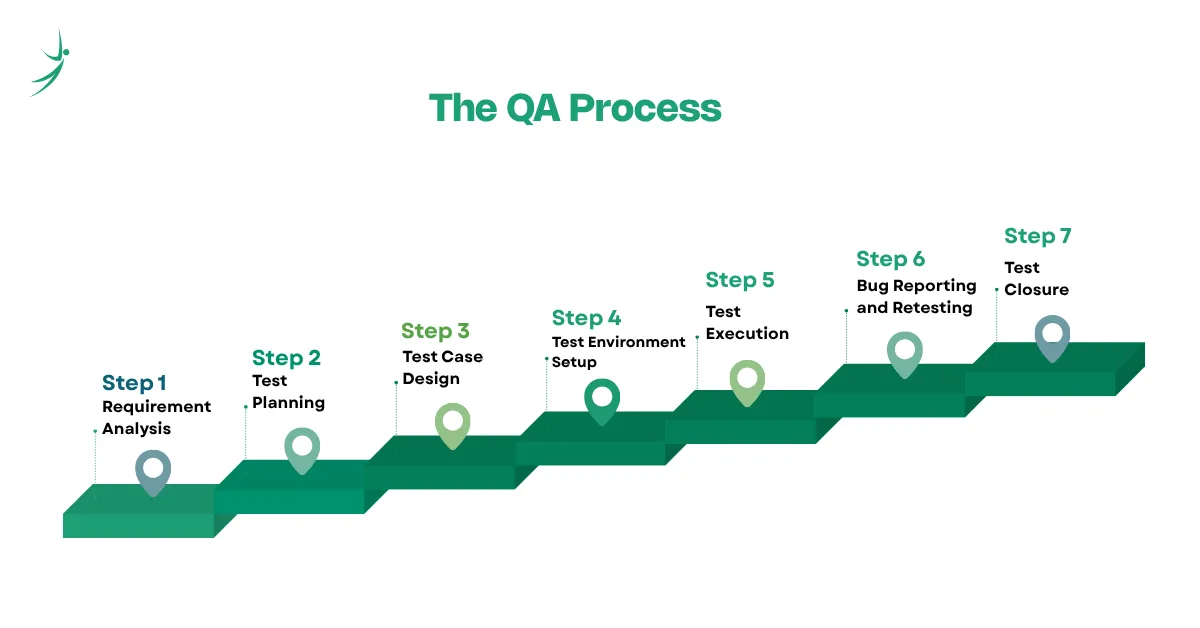
Most Nepal IT companies run on Agile and Scrum. Here is what a QA engineer's workflow actually looks like inside a sprint.
Step 1: Requirement Analysis
Before developers write a single line of code, QA reads through the user stories and business requirements. The goal is to spot ambiguity early. If a requirement says "users should log in quickly," QA asks: what does quickly mean? Two seconds? Five? Catching these gaps before development starts saves hours of rework later. This early involvement is what people mean when they say "shift-left testing."
Step 2: Test Planning
QA creates a test plan that defines what will be tested, which testing types apply, what tools will be used, who is responsible, and what the entry and exit criteria are. A test plan is the quality roadmap for the entire sprint.
Step 3: Test Case Design
QA writes detailed test cases that cover happy paths, edge cases, and negative scenarios. A test case for a login module, for example, would include: valid credentials, invalid password, empty fields, SQL injection attempt, and maximum character input. Tools like TestRail and JIRA handle test case management.
Step 4: Test Environment Setup
QA prepares the staging environment where tests will run. This includes the test server, database, browsers, and any mock services that simulate third-party integrations.
Step 5: Test Execution
QA runs the test cases, either manually or through automation scripts, and logs every result. Bugs get reported in JIRA with severity level, steps to reproduce, screenshots, and expected versus actual behavior.
Step 6: Bug Reporting and Retesting
The bug lifecycle moves from Open to In Progress to Fixed to Retest to Closed. Once a developer marks a bug as fixed, QA retests it. Regression testing runs alongside this to confirm that the fix did not break anything else.
Step 7: Test Closure
At the end of the sprint or release cycle, QA produces a sign-off report: how many test cases ran, how many passed, how many failed, what known issues remain, and whether the build is ready to ship.
QA in 2026: Will AI Replace QA Engineers?
With AI tools generating code and running scripts at speed, the question comes up constantly: will AI replace QA engineers?
The short answer is no. The longer answer is more useful.
How AI is Changing QA
AI tools have started doing tasks that used to take QA engineers hours. Platforms like Testim and Mabl use machine learning to auto-generate test cases from user behavior data. AI-powered visual testing tools like Applitools catch pixel-level UI regressions automatically. Self-healing test scripts update themselves when the UI changes, eliminating hours of maintenance work.
A 2025 Reuters Technology report found that 78% of enterprises now use AI-driven tools for software testing, with 62% reporting measurable improvements in test coverage and defect identification.
Why QA Engineers Are More Valuable, Not Less
AI runs scripts well. It cannot define a test strategy for a business it does not understand. It cannot spot a UX problem that will frustrate real Nepali users but technically passes a functional check. It cannot make judgment calls about whether a known bug is a release blocker or an acceptable risk.
What the 2026 market actually rewards is QA engineers who know how to work alongside AI tools: engineers who can design frameworks that AI-generated tests slot into, who understand what the scripts are actually checking, and who catch what the automation misses.
The World Quality Report for 2025 showed that 58% of enterprises are already upskilling their QA teams in AI tools, cloud testing, and security. Demand for skilled QA engineers is rising, not falling.
QA Tools Every Beginner Should Know
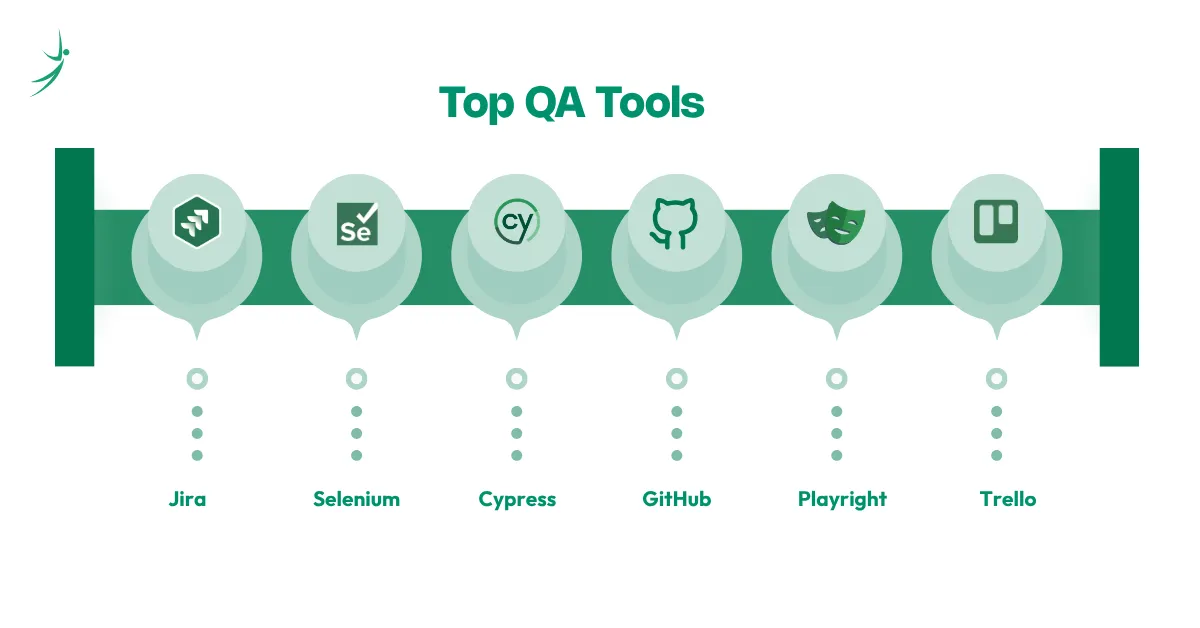
You do not need to master all of these on day one. But knowing the landscape helps you understand what each stage of QA work involves. Below mentioned are the top QA tools that are used by every QA Engineers:
| Category | Tools |
|---|---|
| Test Management | JIRA, TestRail |
| Manual Testing | JIRA, Excel test cases, TestRail |
| Automation | Selenium, Cypress, Playwright |
| API Testing | Postman, SoapUI |
| Performance Testing | Apache JMeter, k6 |
| Bug Tracking | JIRA, Bugzilla |
| CI/CD Integration | Jenkins, GitHub Actions |
| Mobile Testing | Appium |
QA Career Path and Jobs in Nepal [2026]
Nepal's IT sector is growing fast. Software outsourcing firms, fintech companies, and SaaS startups across Kathmandu are all hiring QA engineers. The scope of QA is getting better and better each passing year. As of June 2026, LinkedIn Nepal lists over 66 active QA job openings, and platforms like Merojob and Jobaxle show consistent demand for both manual and automation testers.
Who is Hiring QA Engineers in Nepal?
- Fintech leaders: F1Soft, eSewa, and Khalti run transaction-heavy platforms that require rigorous QA to stay stable during peak periods. F1Soft alone listed multiple QA openings at associate and mid-level as of June 2026.
- Software outsourcing firms: Companies like Vrit Technologies, Leapfrog Technology, Cotiviti, and Fusemachines build products for international clients and maintain high testing standards to meet global delivery expectations.
- Startups and SaaS companies: Kathmandu's tech corridor around Baneshwor, Pulchowk, and Tinkune has a growing cluster of product companies that hire QA engineers as early team members.
Common QA Roles in Nepal
- Manual QA Tester: The most common entry-level role. Freshers write and execute test cases by hand, log bugs, and document results. No programming background required to start.
- QA Analyst: A step up from manual testing. QA analysts own test planning, coordinate with developers, and track quality metrics across a sprint.
- QA Engineer: Builds automation frameworks, integrates tests into CI/CD pipelines, and handles API and performance testing alongside functional work.
- Performance QA Engineer: Specializes in JMeter or k6 load testing. Typically earns more than a general QA engineer because the skill set is narrower and more technical.
- QA Manager / Lead: Owns the quality strategy for an entire product or team. Responsible for hiring, mentoring junior testers, and reporting quality metrics to leadership.
See the full step-by-step plan in our QA career roadmap for Nepal 2026.
How to Start Your QA Journey in Nepal
The Self-Study Route
If you are disciplined and self-directed, you can build QA fundamentals for free. Start with the ISTQB Foundation Level syllabus, which is available as a free PDF. Pair it with YouTube channels like Software Testing Mentor and Automation Step by Step. Practice on open-source demo applications like SauceDemo and OrangeHRM to build a hands-on portfolio.
The challenge with self-study is structure. QA covers a wide range of tools and concepts, and it is easy to learn things in the wrong order or skip the practical work that employers actually care about.
Structured Training (The Faster Path)
A QA course gives you a sequenced learning path, live project work, mentor feedback, and a network of alumni already working in Nepal's IT companies. When evaluating a course, look for: real JIRA and Selenium lab work, ISTQB preparation, API testing with Postman, and placement support with direct company connections.
Certifications Worth Pursuing
- ISTQB Foundation Level: The globally recognized baseline certification. Nepal's IT companies recognize it, and international clients expect it. Registration costs roughly $150 to $200 USD, and preparation takes four to six weeks of focused study.
- Postman API Fundamentals: Free certification from Postman's learning center. Takes a few days to complete and is worth listing on your CV.
Benefits of Quality Assurance
Catches Problems Before Users Do
QA finds bugs during development, when fixing them costs a developer a few hours. Bugs that reach production cost companies days of emergency fixes, user complaints, and sometimes real financial damage. A 2024 IBM Systems Sciences Institute study found that fixing a bug in production costs six times more than fixing it during testing.
Reduces Rework
When developers write code against clear, QA-reviewed requirements, they build the right thing the first time. Ambiguous requirements lead to misaligned features that get rebuilt from scratch. QA review of requirements upstream eliminates much of that waste.
Builds Trust With Users
Applications that crash, freeze, or lose data lose users fast. In Nepal's fintech space, a single high-profile failure during a peak period can take months to recover from in terms of user trust. Consistent QA keeps the product stable and keeps users coming back.
Supports Faster Releases
Counterintuitively, teams that invest in QA ship faster, not slower. Automated regression suites let developers merge new code confidently because they know the existing functionality still works. Manual QA without automation is a bottleneck. A properly built QA pipeline removes the bottleneck.
Challenges in Quality Assurance
Building Automation Takes Time Upfront
Writing and maintaining an automation framework requires significant investment before it pays off. Freshers often underestimate the setup time. A well-built Selenium suite takes weeks to build for a medium-sized application.
Requirements Change Constantly
In Agile teams, requirements shift sprint to sprint. QA engineers need to update test cases continuously, which adds workload. Good documentation habits and modular test design reduce this burden.
Test Coverage Is Never Perfect
It is not possible to test every combination of inputs, environments, and user behaviors. QA engineers make risk-based decisions about what to test thoroughly and what to cover lightly. This judgment comes with experience.
Keeping Automation Stable
Automation scripts break when the UI changes. A button that shifts position or changes its ID will cause dozens of tests to fail. Self-healing automation tools help, but someone still needs to manage the framework.
Conclusion
Quality Assurance has moved from a back-end phase in the software process to a core discipline that runs through every stage of development. In Nepal's growing IT sector, where fintech platforms, outsourcing firms, and SaaS startups all need reliable software, the demand for skilled QA engineers keeps rising.
Whether you are a student who just finished +2, a BCA graduate looking for a clear entry into IT, or a professional considering a career switch, QA offers a structured, well-paying career path with room to grow into automation, performance, security, and leadership roles.
Ready to start? Explore Skill Shikshya's Quality Assurance training course and build real skills in manual testing, Selenium, Postman, JIRA, and live project work with mentors who work in Nepal's IT industry.
Frequently Asked Questions
What is the primary goal of Quality Assurance?
What is the difference between QA and QC?
Is QA the same as software testing?
What does a QA engineer do day to day?
What is the QA salary in Nepal in 2026?
Can I learn QA without a coding background?
Is QA a good career in Nepal in 2026?
About Author:

Ms. Ankita Gupta is an Associate Lead in SDET at UBA Solutions Pvt. Ltd. and an experienced QA Mentor. She is passionate about ensuring software excellence through a rigorous and strategic approach to testing, specializing in the intersection of development and quality engineering.
With a leadership role at UBA Solutions, Ms. Gupta brings a wealth of practical knowledge in building robust testing frameworks and maintaining high-quality standards in fast-paced environments. She enjoys mentoring aspiring QA professionals to develop a strong technical foundation, helping them master the skills needed to bridge the gap between software development and quality assurance.