Scope of Data Science and Machine Learning in 2026: Career Opportunities, Salary & Future Growth
As we navigate through 2026, data has cemented its position as the ultimate catalyst for enterprise innovation and automation. Organizations across the globe are no longer just collecting information; they are actively re-architecting their entire operational setups around specialized intelligence systems. If you want to capitalize on this massive technological wave, enrolling in a best Data Science and Machine Learning Course in Nepal provides a robust, real-world launchpad for your professional path. By acquiring these advanced analytical capabilities, you position yourself at the very forefront of a booming global job market where the overall scope of data science continues to break new boundaries.
How Big Is the Data Science and Machine Learning Industry in 2026?
Global AI and Data Science market growth
The global machine learning market size has crossed approximately 126.91 billion USD in 2026, showing an extraordinary compound annual growth rate that puts it on track to reach 1.71 trillion USD by 2035. Concurrently, global spending on artificial intelligence infrastructure and software has hit 301 billion USD this year, proving that businesses are heavily investing in algorithmic systems to stay competitive.
Rising demand across industries
Traditional sectors like agriculture, logistics, and healthcare are rapidly converging with automated technologies. Meanwhile, banking, corporate retail, and entertainment platforms depend entirely on live data analysis to survive. In 2026, data infrastructure is no longer an optional project; it is a core business necessity.
Why Data Science and Machine Learning remain among the fastest-growing careers
Organizations are facing immense pressure to move their algorithmic experiments out of sandboxes and into live production environments. This operational shift requires specialized individuals who understand how to maintain stable data pipelines and clean architectures, keeping a modern data science career highly relevant and extremely resilient against automated displacement.
Key hiring statistics and future outlook
Hiring trends reveal a persistent talent shortage across the technological sector. The U.S. Bureau of Labor Statistics projects employment for specialized data scientists to grow by 34% over the next decade, which is significantly faster than the average for traditional occupations. With hundreds of thousands of new roles created over the past year, the ratio of open positions to qualified candidates remains heavily skewed in favor of skilled job seekers.
What Is Data Science and Machine Learning? Why Is It One of the Most In-Demand Career Fields?
What Is Data Science?
Data science is an interdisciplinary field that utilizes mathematical principles, statistical algorithms, advanced programming, and domain expertise to extract actionable insights from unstructured data. To explore this core concept further, you can read our comprehensive breakdown on data science to understand how companies convert raw inputs into strategic decisions.
What Is Machine Learning?
Machine learning is a specialized subset of artificial intelligence focused entirely on building systems that learn and improve from experience without following hard-coded rules. If you want to grasp the algorithmic mechanics behind these systems, check out our guide about machine learning to explore how models autonomously discover patterns.
How Data Science and Machine Learning Work Together
Data science manages the complete data lifecycle, including data cleaning, ingestion, and strategic interpretation. Machine learning acts as the computational engine inside that lifecycle, driving automation and deep predictive tracking. They exist in a highly complementary relationship, and analyzing the division between them is vital, as outlined in our study on machine learning vs data science.
Key Benefits of Learning Data Science and Machine Learning
- High Career Demand: Data science and machine learning professionals are sought after across industries such as healthcare, finance, e-commerce, cybersecurity, and technology, creating excellent career opportunities.
- Strong Earning Potential: These are among the highest-paying technology careers, with competitive salaries and rapid growth opportunities for skilled professionals.
- Problem-Solving Skills: Learn to analyze complex datasets, uncover patterns, and build intelligent solutions that help organizations make better, data-driven decisions.
- Versatile Career Opportunities: The skills you gain are transferable across multiple roles, including Data Scientist, Machine Learning Engineer, Data Analyst, AI Engineer, and Business Intelligence Analyst.
- Future-Proof Career: As artificial intelligence and automation continue to transform industries, expertise in data science and machine learning remains highly relevant and positions you for long-term career success.
Career Opportunities
Entering this technical ecosystem opens up a massive global network of well-paying professional pathways, allowing you to choose between structural data engineering, applied algorithmic modeling, or corporate decision consultation.
Types of Data Science and Machine Learning Career Paths
Types of Data Science Career Paths
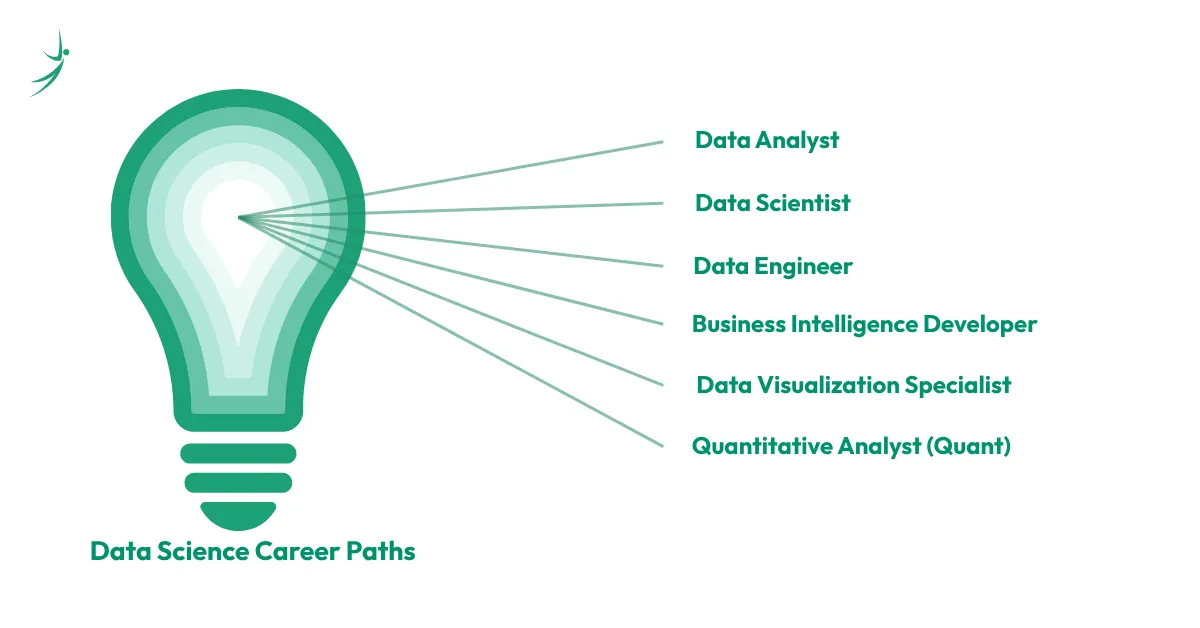
- Data Analyst: Data analysts focus heavily on data collection and cleaning, structural business reporting, interactive dashboard development, and KPI tracking. Evaluating the overall scope of data analytics in future reveals that analysts are quickly evolving into strategic decision partners who help teams interpret real-time corporate metrics.
- Data Scientist: Data scientists design predictive analytics systems, manage statistical modeling workflows, conduct rigorous feature engineering, and direct data-driven decision making. Succeeding in this role requires a robust collection of analytical capabilities, which you can read about in our analysis of crucial data scientist skills.
- Data Engineer: Data engineers build the robust computational architecture that holds everything together. They focus on building scalable data pipelines, managing ETL processes, maintaining enterprise data warehousing, and executing database optimization. Understanding this role is essential, which we highlight in our comparison of data engineer vs data scientist.
- Business Intelligence (BI) Developer: BI developers synthesize massive database tables into intuitive corporate metrics. They build Power BI dashboards, coordinate Tableau reporting systems, run custom SQL queries, and implement decision support systems to maximize business performance.
- Data Visualization Specialist: These creative specialists convert abstract data points into clear visual stories. They build interactive dashboards, master the art of storytelling with data, handle corporate reporting automation, and deliver polished visual analytics for executive reporting.
- Quantitative Analyst (Quant): Quants operate at the high-stakes intersection of mathematical finance and statistical programming. They design algorithmic financial modeling, run institutional risk analysis, execute time-series forecasting, and direct statistical research for investment analytics.
- Freelance Data Science Consultant:Independent consultants take charge of discrete business intelligence projects, provide independent data analytics consulting, build custom dashboard architectures, and manage remote freelance opportunities. The global market for flexible, contract-based data science jobs continues to grow rapidly for freelance professionals.
Types of Machine Learning Career Paths
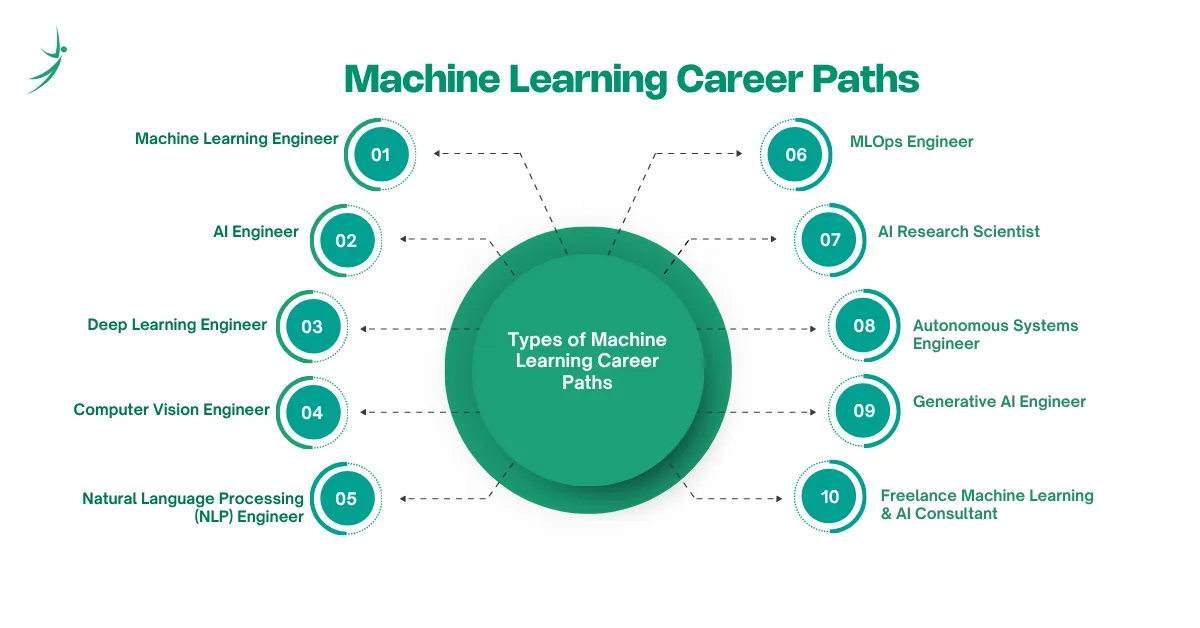
- Machine Learning Engineer: An ML engineer focuses on machine learning model development, structural model optimization, production model deployment, and scaling automated systems. Commencing a professional machine learning career requires mastering these deployment frameworks, bridging the gap between statistical theory and solid software engineering.
- AI Engineer: AI engineers build cutting-edge generative AI applications, orchestrate Large Language Models (LLMs), develop intelligent automation layers, and guide full-scale AI product development to solve modern corporate challenges.
- Deep Learning Engineer: Deep learning engineers design advanced artificial neural networks, train complex computer vision systems, construct speech recognition tools, and manage high-performance GPU-based model training. To explore these intricate networks, look into our detailed article on what is deep learning.
- Computer Vision Engineer: These engineers teach computers to comprehend visual data, specializing in real-world image recognition, object detection, facial recognition algorithms, automated OCR applications, and live video analytics.
- Natural Language Processing (NLP) Engineer: NLP specialists focus on text and speech comprehension. They build context-aware conversational chatbots, develop advanced language models, run large-scale text analytics, and optimize automated machine translation systems.
- MLOps Engineer: MLOps engineers ensure production systems stay reliable by managing automated model deployment, setting up CI/CD pipelines for machine learning, tracking model drift, and handling distributed ML infrastructure.
- AI Research Scientist: Research scientists push the scientific boundaries of automation. They engage in foundational machine learning research, develop new optimization algorithms, publish academic papers, and construct experimental AI models.
- Robotics & Autonomous Systems Engineer: These specialized engineers design intelligent control systems for autonomous vehicles, industrial robotics, edge AI hardware, and complex reinforcement learning simulations.
- Generative AI Engineer: Generative AI specialists create custom GPT-based applications, deploy autonomous AI agents, optimize prompt engineering parameters, and build multimodal AI copilots to enhance corporate workflows.
- Freelance Machine Learning & AI Consultant: Independent AI professionals offer custom model implementation, build standalone AI solutions, and manage remote AI projects across global freelancing platforms. The rising volume of remote machine learning jobs allows expert programmers to serve international clients easily, demonstrating the vast global scope of machine learning.
The Real Scope of Data Science and Machine Learning – What It Actually Covers
Scope Across Industries
- Healthcare: Powering automated diagnostic tools, medical imaging classification, and personalized genomic therapeutics.
- Banking & Finance: Implementing real-time fraud detection, automated credit scoring, and algorithmic trading models.
- E-commerce: Driving hyper-personalized consumer recommendation engines, dynamic pricing, and inventory forecasting.
- Education: Personalizing learning platforms through adaptive curricula and predictive student analytics.
- Manufacturing: Reducing operational friction and downtime via predictive maintenance infrastructure.
- Agriculture: Leveraging computer vision for crop health monitoring and automated yield forecasting.
- Government: Automating public service distribution, reducing welfare fraud, and tracking digitization metrics.
- Telecommunications: Optimizing network traffic routing and predicting customer churn.
- Logistics: Improving supply chain tracking and fleet route optimization using deep learning systems.
- Cybersecurity: Detecting malicious network behavior and coordinating automated threat intelligence.
- Media & Entertainment: Personalizing digital content recommendation feeds and automating subtitle generation.
To explore how these use cases map out across modern corporate sectors, take a look at our complete analysis of the scope of data science.
Scope Across Technical Roles & Business Functions
- Analytics: Uncovering historical trends to set current operational baselines.
- Product Development: Infusing smart algorithmic layers into consumer applications.
- Marketing: Segmenting target audience profiles and maximizing digital ad spend.
- Finance: Managing corporate financial risk and generating automated asset forecasts.
- HR Analytics: Identifying employee turnover patterns and optimizing recruitment pipelines.
- Operations: Mapping production bottlenecks to automate industrial workflows.
- Risk Management: Evaluating strategic downside scenarios using statistical methods.
- Customer Experience: Implementing intelligent support systems to lower resolution times.
- Business Strategy: Directing corporate expansion goals based on verified statistical inference.
Scope for Freelancers and Remote Professionals
The modern technical landscape has completely detached career growth from physical locations. Highly qualified specialists can secure competitive remote AI jobs, manage independent freelance data science projects, join global consulting tournaments, and work with international clients right from their local workspace.
Scope Based on Your Interests and Strengths
- Mathematics & Statistics: Ideal for individuals who love proving theorems and optimizing complex loss functions.
- Programming: Perfect for developers focused on writing clean code and scaling data infrastructure.
- Business Analytics: Suited for strategic thinkers who translate statistical metrics into commercial value.
- Research: Tailored for pioneers who want to invent next-generation neural architectures.
- Artificial Intelligence: Designed for engineers building cognitive, autonomous software agents.
- Automation: Built for systems architects removing manual friction from industrial pipelines.
- Visualization: Tailored for communicative professionals who craft intuitive data stories.
- Domain Expertise: Perfect for specialists applying statistical inference to niche areas like economics or biology.
Global Scope of Data Science and Machine Learning
Data Science and Machine Learning Salaries Around the World
| Country or Region | Estimated Salary Range | Compensation Interval |
|---|---|---|
| USA | 112,000 USD to 170,000 USD (Senior: 200,000+ USD) | Annual Base Pay |
| Canada | 90,000 CAD to 120,000 CAD | Annual Base Pay |
| United Kingdom | 50,000 GBP to 75,000 GBP (London pays higher premium) | Annual Base Pay |
| Germany | 45,000 EUR to 85,000 EUR | Annual Base Pay |
| Australia | 100,000 AUD to 140,000 AUD | Annual Base Pay |
| UAE | 180,000 AED to 300,000 AED (Tax-free hubs) | Annual Base Pay |
| Singapore | 80,000 SGD to 150,000 SGD | Annual Base Pay |
| Remote Opportunities | Contract rates matching standard foreign currency levels | Project or Hourly |
The above data is taken form the official site of the glassdoor.
Scope of Data Science and Machine Learning in Nepal (2026)
The ongoing corporate digitization wave across domestic commercial banks, fintech corporations, healthcare platforms, and outsourced international IT agencies has significantly expanded the domestic technological ecosystem. This transition translates to high-paying local career tracks for trained technical experts.
Domestic Compensation Benchmarks in Nepal
| Career Experience Level | Monthly Salary Range (NPR) | Experience (Years) |
|---|---|---|
| Entry-Level Analyst | NPR 35,000 – NPR 65,000 | 0 – 2 years |
| Mid-Level Professional | NPR 60,000 – NPR 100,000 | 2 – 5 years |
| Senior Specialist | NPR 100,000 – NPR 150,000+ | 5+ years |
The above data is taken form the official site of Kumarijob.
Data Science and Machine Learning vs Other Technology Careers
Data Science vs Software Development
Software development focuses on writing clean code to build functional application user interfaces and maintain web infrastructure. Data science focuses on running statistical experiments, exploring hidden data dependencies, and constructing predictive systems to drive strategy.
Data Science vs Cybersecurity
Cybersecurity centers on hardening network perimeters, managing encryption, and preventing security breaches. Data science uses historical data and algorithmic patterns to predict business trends and automate analytical systems.
Data Science vs Business Analytics
Business analytics typically uses historical records and standard spreadsheet tools to generate retrospective charts. Data science delves much deeper into advanced programming, utilizing Python, big data frameworks, and complex machine learning to build live automated solutions.
Data Science vs Data Engineering
Data engineering focuses exclusively on building clean data collection architecture, scaling databases, and maintaining reliable ingestion pipelines. Data science takes that structured infrastructure to run statistical experiments.
Machine Learning vs Artificial Intelligence
Artificial intelligence represents the overarching domain of creating software capable of simulating intelligent behavior. Machine learning is the practical, data-driven core within AI where algorithms learn from training sets independently. To understand this structure deeply, look into our article on what is machine learning.
Machine Learning vs Deep Learning
Machine learning contains an array of linear, logistical, and decision-tree algorithms. Deep learning is a specialized sub-domain within machine learning that utilizes multi-layered artificial neural networks to process complex unstructured inputs like live video, speech, and audio files.
Future Trends in Data Science and Machine Learning
- Generative AI: Moving past basic chat platforms to full corporate system integrations that autonomously build enterprise assets.
- Large Language Models (LLMs): Fine-tuning compact, open source foundation models to handle proprietary corporate knowledge bases securely.
- AI Agents: Developing autonomous software agents that execute multi-step business workflows without constant human prompting.
- Explainable AI (XAI): Building transparent model architectures so that compliance teams can easily audit algorithmic decisions.
- Edge AI: Running optimized models directly on localized hardware devices to eliminate cloud network latency.
- Responsible AI: Establishing strict corporate data governance frameworks to prevent algorithmic bias and protect consumer data privacy.
- AI Automation: Leveraging language models to write boilerplate code, augmenting human engineers rather than replacing them.
- Multimodal AI: Implementing single model architectures that process text, audio, images, and tables simultaneously.
- Synthetic Data: Creating secure, artificially generated datasets to train models where real-world data is highly restricted.
- MLOps Adoption: Standardizing automated deployment pipelines to manage model updates and monitor operational drift smoothly.
- AutoML: Democratizing basic model training so that data professionals can focus heavily on high-level strategy and architectural translation.
- AI-assisted Analytics: Blending natural language interfaces into visualization dashboards to make data exploration instantaneous.
Skills Required to Build a Successful Career in Data Science and Machine Learning in 2026
- Mathematics & Statistics Fundamentals: Before importing libraries, you must master linear algebra matrices, vector calculus, probability distributions, hypothesis testing, and inferential statistics.
- Python Programming Skills: Python remains the absolute language standard for statistical computing. To build your scripting capabilities efficiently, read our guide on python for data science to learn how to manipulate data frames cleanly.
- SQL & Database Management: You must know how to handle complex relational databases, optimize execution queries, and structure clean joins across massive data warehouses.
- Data Cleaning and Preprocessing: The ability to handle structural outliers, map missing values, and normalize raw inputs is a critical skill for everyday engineering.
- Exploratory Data Analysis (EDA): Using statistical summaries and structural graphs to detect underlying patterns and dependencies before modeling begins.
- Data Visualization: Data visualization helps transform complex data into clear and actionable insights. Power BI is used to build interactive dashboards and reports, Tableau creates engaging visual stories for business analysis, Matplotlib generates customizable charts for data exploration, and Seaborn produces attractive statistical visualizations that make patterns and trends easier to understand. To master these tools, review our expert resource list outlining essential data science tools.
- Machine Learning Algorithms: Understanding how linear regression, decision trees, support vector machines, random forests, and gradient boosting models behave.
- Deep Learning Fundamentals: Grasping backpropagation mechanics, neural activation functions, and convolutional network architectures.
- Feature Engineering: Creating lag features for time-series, encoding categorical variables, and normalizing data attributes to maximize model precision.
- Big Data Basics: Big data technologies enable organizations to process and analyze massive datasets efficiently. Apache Spark is used for fast, distributed data processing, while Hadoop provides reliable distributed storage and large-scale data management.
- Cloud & Deployment Basics: Cloud platforms simplify the deployment and scaling of machine learning solutions. AWS supports model development and deployment with services like Amazon SageMaker, Microsoft Azure offers enterprise-grade analytics and AI tools, and Google Cloud provides scalable machine learning workflows through Vertex AI.
- Git & Version Control: Managing codebase histories, coordinating branches, and collaborating smoothly with software engineering teams.
- MLOps Fundamentals: Tracking model experiments, managing model registries, and setting up automated monitoring systems.
- AI Tools for Data Scientists: Leveraging modern code intelligence setups like ChatGPT, GitHub Copilot, Claude, Gemini, Cursor, and NotebookLM to maximize your development speed.
How to Enter This Field: Data Science and Machine Learning Course in Nepal
- What Beginners Should Learn First: Beginners should focus heavily on programming logic, statistical intuition, and basic SQL query syntax before jumping into complex deep learning setups.
- Recommended Learning Roadmap: A structured approach is vital to avoid getting overwhelmed by the volume of frameworks. To guide your studies systematically, follow our step by step data science roadmap to build your capabilities logically.
- Build Real-World Projects: Theoretical knowledge will not get you hired. You must apply your capabilities by working on practical data science projects that solve actual business challenges.
- Create an AI & Data Science Portfolio: Host your clean code repositories on GitHub and publish detailed project case studies on personal blogs to catch the eye of recruiters.
- Earn Industry Certifications: Secure globally recognized technical credentials to validate your specialized capabilities and stand out in the job market.
- Prepare for Data Science Interviews: Once your portfolio is ready, practice solving algorithmic problems and review our list of data science interview questions to handle corporate technical rounds with absolute confidence. You can also explore our student placement success stories to see how past candidates successfully transitioned into top-tier tech roles.
Conclusion
The scope of this unified technology field is expanding exponentially as we move forward through 2026. Transitioning into this domain requires dedication, but the financial and professional rewards are unparalleled. By choosing a structured training route, mastering core statistical principles, and building an excellent project portfolio, you can easily secure elite technical positions globally or locally. Explore the best data science course in Nepal today to select the ideal training framework and launch your technical journey with confidence.
Frequently Asked Questions
Is Data Science a good career in 2026?
Is Data Science still in demand?
What is the job role of a Data Scientist?
Are Data Science jobs declining?
How many months does it take to learn Data Science?
Which companies hire Data Science professionals?
How do I start a career in Data Science?
Is Machine Learning Engineer a good career?
About Author:

Dhiraj Bashyal is a Machine Learning Engineer at Vrit Technologies, with 3 years of hands-on experience in applied AI and machine learning. He brings that industry experience directly into the classroom, teaching Data Science and Machine Learning at Skill Shikshya, where he helps learners build a practical, project-ready foundation in Python, ML workflows, and real-world data problem-solving.