Data Science & Machine Learning Course in Nepal
Build a future-ready career in artificial intelligence and predictive analytics with Skill Shikshya's best data science and machine learning course Course In Nepal. Learn how leading tech companies, fintech platforms, and AI startups extract actionable business insights and deploy intelligent models using modern data science tools. This practical program covers Python, Pandas, SQL, Scikit-learn, TensorFlow, and MLOps workflows used by production AI teams worldwide. Whether you are a beginner looking for a structured data science course,or an ambitious professional stepping into machine learning in ai, this hands-on training provides the exact roadmap needed to become a confident developer. You will understand the true data science and machine learning by building production-ready predictive systems from the ground up.
Course Key Highlights

Hybrid Classes
Attend class physically or online from anywhere and learn practical, real-world skills with guidance from industry professionals.

Industry Practices
Learn essential strategies used by agencies, brands, and global marketing teams.

Flexible Schedule
Morning and evening batches designed for students and working professionals.

Beginner Friendly
No prior experience required to start learning and building your skills.
Learn Data Science & Machine Learning with Skill Shikshya
Skill Shikshya's data science training in Nepal is an intensive, project-driven training experience based in Kathmandu and accessible live online across Nepal. Moving far beyond theoretical definitions, our curriculum focuses heavily on exploratory data analysis, statistical decision-making, model optimization, and production deployment.
As businesses across Nepal and international remote markets transition toward automated analytics, the demand for skilled data practitioners has grown rapidly. Tech companies are actively recruiting talent for lucrative data science jobs in Nepal and remote data science jobs globally. An entry-level data science salary in Nepal ranges from NPR 50,000 to 80,000 per month, with senior roles commanding significantly higher compensation. Similarly, a machine learning engineer salary reflects the high value placed on AI implementation skills.
To help you master this domain, our program provides a clear data science roadmap and machine learning roadmap:
- Foundational Python and Data Wrangling: Master data science with python by writing clean, efficient scripts to extract, clean, and manipulate complex data tables.
- Statistical Foundations and EDA: Apply descriptive and inferential statistics to extract actionable business metrics from raw, unstructured data.
- Supervised and Unsupervised Learning: Master core machine learning types, including regression, classification, clustering, and dimensionality reduction.
- Algorithm Implementation: Implement standard machine learning algorithms such as Linear Regression, Decision Trees, Random Forests, XGBoost, and Neural Networks.
- Deep Learning and AI Architectures: Transition from standard machine learning to deep neural networks, computer vision, and natural language processing.
- Production Deployment and MLOps: Wrap your functional models inside Docker containers and deploy them as live APIs using FastAPI frameworks.
What You Will Achieve
- Build Production-Grade ML Pipelines: Graduate with a public portfolio featuring machine learning projects and Kaggle challenges that prove your capabilities to hiring managers.
- Master Machine Learning from Scratch: Gain deep practical competence in machine learning from scratch and machine learning in python, understanding how algorithms function before utilizing production libraries like Scikit-learn and TensorFlow.
- Launch a Career as a Data Scientist or Machine Learning Engineer: Apply confidently for data science vacancies and machine learning jobs in Nepal, or jumpstart your career as a data science intern or machine learning intern.
- Ace Technical Data Science & AI Interviews: Prepare thoroughly with mock technical interviews, portfolio reviews, live coding sessions, and whiteboarding evaluations.
- Guaranteed Placement and Internship Pathways: Benefit from Skill Shikshya's 91% placement rate and access to our growing network of 80+ active corporate hiring partners across Nepal.
Why Skill Shikshya's Data Science and Machine Learning Course?
When evaluating options for a machine learning course in Nepal or a data science course in Nepal, here is what sets an industry-grade program apart from generic tutorial videos:
- 3.5 Months of Structured Depth: We deliver 180+ hours of structured learning covering Python, statistics, machine learning, deep learning, NLP, and model deployment.
- AI Coding & Analytics Tools Integrated in Class: Learn how modern data scientists work. Cursor, GitHub Copilot, ChatGPT Code Interpreter, Julius AI, Hugging Face, and LangChain are integrated directly into modules.
- Real-World Portfolio & Hands-On Focus: Gain extensive machine learning hands on experience by constructing 4 to 6 real-world projects and two complete capstone deployments.
- Career Support Included: Portfolio reviews, CV optimization, LinkedIn positioning, mock technical interviews, and internship placement assistance are fully integrated into the program.
- Hybrid Campus & Online Access: Participate in person at our modern Baneshwor campus in Kathmandu or join interactive live online sessions from anywhere across Nepal.
Data Science & AI Stacks Comparison
If you are comparing career paths before enrolling in a machine learning course, here is how data science in Nepal compares to related technology disciplines:
| Discipline / Role | Core Focus | Primary Tools & Frameworks | Primary Strengths | Ideal For |
|---|---|---|---|---|
| Data Science & Machine Learning | Predictive modeling, AI automation, statistical analysis | Python, Pandas, Scikit-learn, TensorFlow, SQL, FastAPI | End-to-end model creation, high corporate demand, strong salary growth | Analytical minds seeking to build intelligent systems and predictive software |
| Data Analytics | Historical business reporting, trend visualization | Power BI, Tableau, SQL, Excel, Basic Python | Rapid learning curve, immediate business utility | Beginners focused on business intelligence and visual reporting |
| Data Engineering | Data pipelines, ETL architecture, database systems | SQL, Apache Spark, Hadoop, Airflow, Cloud Warehouses | High scalabilty, robust backend infrastructure | Engineers interested in backend data management and warehousing |
| Software Engineering | User interfaces, web backend logic, application APIs | React, Node.js, Python Django, Flutter, REST APIs | Massive global software ecosystem, rapid feature production | Developers focused on web, mobile, or enterprise application products |
Who Is This Course For
Students and Graduates
Start your career with practical training and build job-ready, indusrty-relevant skills.
Entrepreneurs and Business Owners
Apply modern strategies to grow your business and reach more customers.
Aspiring Professionals
Build a strong foundation and transition into a professional career path.

Freelancers and Side Hustlers
Work independently, offer services globally, and build income-generating skills.
Skills You Will Learn
Data Science Fundamentals
Understand the data science lifecycle, how companies use data to make decisions, and where machine learning fits in modern AI strategy.
Python for Data Science
Learn Python from scratch alongside NumPy and Pandas, the core programming skills that every data science role requires.
Data Analysis & Statistics
Apply statistics, probability, and hypothesis testing to analyse real-world datasets and draw defensible conclusions.
Data Visualization & Insights
Create clear, persuasive visualisations using Matplotlib, Seaborn, and Plotly, and learn how to tell stories with data that non-technical stakeholders actually understand.
Machine Learning Algorithms
Build and evaluate models using regression, classification, clustering, and ensemble techniques including XGBoost, Random Forest, and LightGBM.
Deep Learning & Neural Networks
Develop CNNs, RNNs, and transformer architectures using TensorFlow and Keras for image, sequence, and language tasks.
Natural Language Processing (NLP)
Process text data using NLP techniques; sentiment analysis, named entity recognition, and Retrieval-Augmented Generation (RAG) pipelines, the core technology behind most AI products in 2026.
Data Engineering & Big Data Basics
Understand ETL pipelines, data warehousing fundamentals, and how data flows from raw collection through to a trained model.
ML Model Deployment & MLOps
Deploy machine learning models using APIs, Docker, and cloud platforms (AWS SageMaker, GCP Vertex AI). Learn model monitoring, drift detection, and LLMOps basics.
LLM Applications & Agentic AI
Build applications on top of large language models using LangChain and LangGraph, the skill that sets 2026 data scientists apart from 2023 graduates.
Real-World Projects & Portfolio
Graduate with a portfolio of end-to-end data science and ML projects that demonstrate your ability to solve genuine business problems not toy exercises.
Platforms & Tools You'll Master
You will learn industry-standard tools used by agencies and companies.
 Python


AI-INTEGRATED COURSE: WHAT YOU DO AT EVERY STAGE
A data scientist in 2025 spent a significant portion of every week writing boilerplate code, debugging pandas errors, and manually hunting through documentation. In 2026, those tasks are handled differently: AI coding assistants generate the scaffolding, explain the error, and suggest the fix, while the data scientist focuses on what AI cannot do: deciding which question to ask, judging whether the model's output makes business sense, and interpreting results for stakeholders who will act on them. This course teaches both: the technical foundation and the professional judgment to work effectively alongside AI tools.
AI Tools Table
| Task in the Data Science Workflow | AI Tool Used | What You Used to Do | What You Do Now (2026) |
|---|---|---|---|
| Writing Python code & debugging | Cursor / GitHub Copilot | Write boilerplate code manually, Google error messages, spend 30–60 min debugging a single pandas or NumPy error | Describe what you need in plain English; Copilot generates the code. Cursor's multi-file Agent mode refactors entire notebooks in one operation. You review, validate, and move on. |
| Exploratory Data Analysis (EDA) | Julius AI / ChatGPT Code Interpreter | Upload CSV, manually write 20–30 lines of exploratory code, guess which distributions and correlations are worth visualising | Upload your dataset and ask "What patterns should I look at?" Julius and Code Interpreter generate charts, summarise distributions, and flag anomalies in minutes — you decide what matters. |
| Understanding ML algorithms & theory | ChatGPT / Claude | Search through textbooks and Stack Overflow pages; sometimes still unsure why a concept works | Ask "Explain gradient boosting like I'm building my first XGBoost model for a loan default prediction problem in Nepal." Get a targeted, example-driven explanation immediately. |
| Building baseline ML models | H2O.ai AutoML / SageMaker Autopilot | Manually try 6–8 algorithms, tune hyperparameters one at a time, wait hours between experiments | Run AutoML: it tests XGBoost, Random Forest, LightGBM, and neural networks simultaneously, tunes hyperparameters, and returns a leaderboard. You pick the winner and optimise from a strong starting point. |
| Natural Language Processing & RAG pipelines | Hugging Face + LangChain | Fine-tune models from scratch (weeks of work requiring GPU access and significant ML expertise) | Load a pre-trained model from Hugging Face's 1M+ model library. Build a RAG pipeline with LangChain that retrieves relevant context before generating answers. What once took a senior ML engineer weeks now takes a trained data scientist days. |
| Finding and using pre-trained models | Hugging Face Hub | Train models from scratch on small datasets, inferior results, weeks of compute time | Browse 1M+ community models. Fine-tune a domain-specific model on your data in hours. Apply transfer learning to tasks your dataset alone could never solve. |
| Writing documentation & EDA reports | NotebookLM / ChatGPT | Write narrative summaries of findings manually after the analysis was done, the part most data scientists skipped | Paste your findings and ask for a structured insight report. You edit and validate; AI drafts the skeleton so you spend time on accuracy, not formatting. |
| Learning prompts for this course: | All tools above | — | "Generate a Python function to detect outliers in [column] using IQR, then explain what each line does." "Turn this EDA summary into a business insight paragraph for a non-technical client." You'll practise prompts like these at every module. |
DATA SCIENCE & MACHINE LEARNING COURSE CURRICULUM
SkillShikshya's Data Science & Machine Learning Course in Nepal is structured to take you from zero data knowledge to a confident, job-ready data scientist and machine learning engineer. Every module includes practical coding exercises, real-world ML projects, and portfolio-building case studies, so you graduate with both technical skills and proven project experience.
The curriculum covers the complete data science workflow: Python programming, data analysis with Pandas, statistical modeling, supervised and unsupervised machine learning, deep learning, NLP, computer vision, model deployment, and portfolio development, everything required to succeed as a data scientist in Nepal's growing tech industry and the global AI market.
Accordian Title

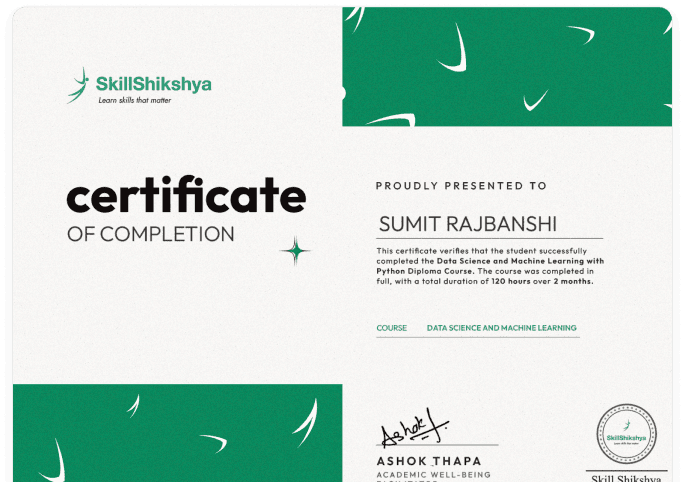
Earn a Certification & Advance Your Career
After completing the program, you will receive a certification from At Skill shikshya, the best online learning institute in Nepal. This certification helps demonstrate your professional skills when applying for jobs or freelance opportunities.
How We Make Learning Different
Thinking of enrolling? Here's what makes our courses different.

Beginner Friendly
Start from the basics and gradually progress to advanced concepts.

Expert Led Training
Learn from professionals with real-world industry experience.

Hands-On Projects
Work on practical projects and build a strong, portfolio-ready skillset.

Lifetime Learning Resources
Access learning materials, updates, and resources even after completing the program.

Career Support
Get guidance for job applications, internships, and career growth opportunities.

Industry Certification
Earn a recognized certification that validates your skills and knowledge.

Batch Repeating Options
Repeat sessions if needed to strengthen your understanding.

Free Workshops
Access additional workshops covering tools, trends, and evolving practices.
HR & CV Sessions
Resume building, interview preparation, and career counseling support.
Learn From Industry Experts

Sailesh Adhikari
Data Science & Machine Learning Mentor

Dhiraj Bashyal
Data Science & Machine Learning Mentor
Career Support
Our structured system helps you go from learning to applying it in real-world scenarios with confidence and direction.
Build real experience, present your skills professionally, and confidently step into jobs, internships, or freelance opportunities.
Join the Data Science & Machine Learning (AI Integrated) Course Today
Learn Python, data analysis, machine learning, and AI to build real-world projects and become job-ready.
Enroll Now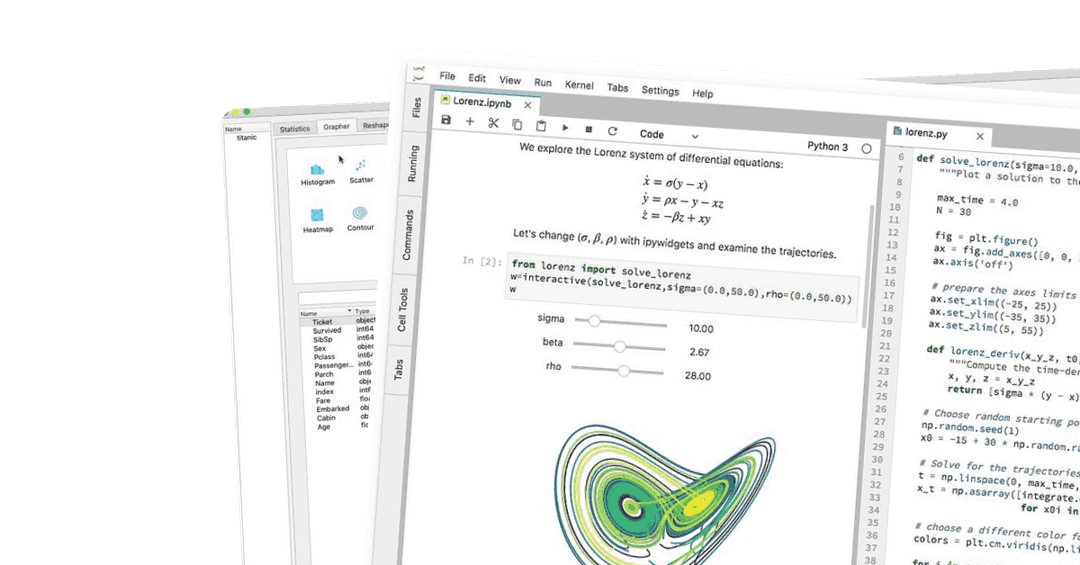
Real words from real learners
What Our Students Say
Hear what our
students have to say

SkillShikshya’s syllabus and pricing felt very reasonable, and the two-hour interactive classes with supportive mentors made learning data analysis much more effective.
Suraj Shrestha
Data Science & Machine Learning Student
Frequently Asked Questions
Everything you need to know about our Professional Courses in Nepal
What is data science?
What does a data scientist do?
Does machine learning involve coding?
What AI tools will I use in this course, and are they free?
How is machine learning different from artificial intelligence?
What jobs can I apply for after completing this course?
Is this course available online or only in Kathmandu?
Will I get help finding a job after the course?
Why is data science important?
What is machine learning?