What is Machine Learning? A Complete Beginner's Guide (2026) | Skill Shikshya
In the rapidly evolving technological landscape of 2026, artificial intelligence has completely transformed how corporate systems process information. Organizations no longer rely on manual automation to handle vast flows of operational records. Instead, smart architectures adapt and grow smarter independently. If you want to position yourself at the cutting edge of this revolution, enrolling in a professional machine learning course in Nepal provides the ultimate structured training path to break into this multi-industry engineering domain. Choosing a best machine learning course will equip you with the practical methodologies required to build, optimize, and deploy predictive systems from scratch.
What is Machine Learning?
Machine learning has transitioned from a niche academic discipline into the core infrastructure of modern software engineering. It powers everything from the personalized feeds on your social media accounts to the highly secure fraud prevention networks deployed by international financial institutions.
What Does Machine Learning Actually Mean?
- A Branch of AI: It is a specialized subfield of Artificial Intelligence that focuses on creating systems capable of learning from data.
- Contrast with Traditional Programming: In traditional programming, developers must write rigid, explicit rules to turn an input into an output, which breaks if conditions change. Machine learning eliminates this limitation.
- Autonomous Rule Creation: Computational systems analyze raw datasets to discover complex mathematical patterns and establish their own logical rules without being explicitly programmed for every scenario.
- Dynamic Parameter Refinement: By consuming vast amounts of historical data, the software continuously refines its internal mathematical parameters over time.
- The Learning Analogy: It works like a human learning a musical instrument—not by just reading a rulebook, but through continuous feedback loops of practice, identifying mistakes, adjusting inputs, and optimizing performance over time.
What Does a Machine Learning Engineer Do?
- Data Automation: Focuses on turning raw operational data into actionable, automated business solutions.
- Bridging Technical Disciplines: Acts as a vital bridge connecting scientific theory and research with practical software engineering.
- Core Engineering Tasks: Building robust predictive models, Training complex artificial neural systems, Optimizing mathematical formulas to handle extreme data workloads
- Cross-Functional Collaboration: Partners with Data Scientists to understand deep statistical data patterns, Partners with Software Engineers to smoothly integrate intelligent algorithmic code into consumer-facing applications.
- Production & MLOps: Takes charge of deploying trained systems into secure live production environments, ensuring that running algorithms operate at high speeds, remain stable, and seamlessly handle real-time user requests.
Core Components of Machine Learning (The 7 Pillars)
Building an enterprise-ready intelligent application requires a deep understanding of multiple technical domains. A comprehensive machine learning tutorial always breaks the discipline down into seven foundational pillars.
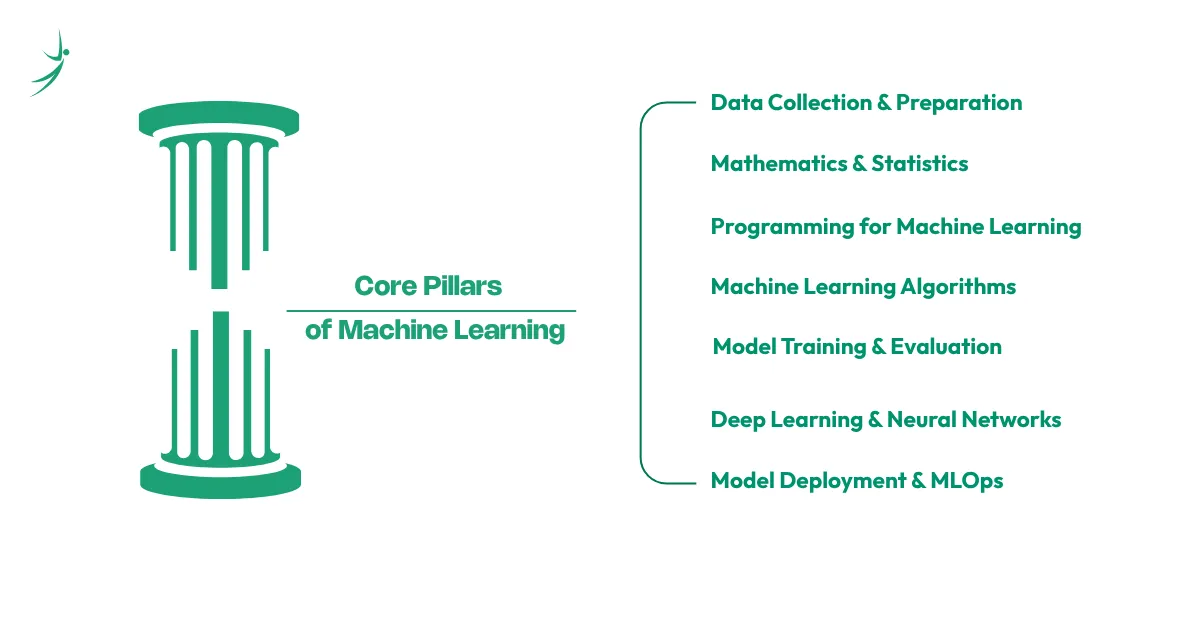
1. Data Collection & Preparation
An algorithm is only as good as the information it consumes. This pillar emphasizes the rigorous gathering of high-quality raw data. Engineers spend a massive portion of their time performing data cleaning, filtering structural anomalies, preprocessing text or images, and conducting feature engineering to turn chaotic information into clean matrices.
2. Mathematics & Statistics
You cannot master this domain without facing the underlying machine learning math. Models do not think like humans; they calculate geometric distances and optimize statistical curves. The core mathematical framework relies on:
- Probability: To calculate uncertainties and evaluate prediction risks.
- Linear Algebra: To represent massive datasets as multi-dimensional matrices and vectors.
- Calculus: Using derivatives and partial differentials to minimize model error rates.
- Statistics: Applying hypothesis testing and distribution analysis to validate performance.
3. Programming for Machine Learning
Writing production-grade code requires fluent software engineering skills. Python remains the undisputed programming language for this field due to its clean syntax and massive ecosystem. Engineers use SQL extensively to extract records from relational databases and master essential machine learning libraries in python such as NumPy for matrix computations and Pandas for structured data manipulation.
4. Machine Learning Algorithms
Algorithms are the engine blocks of AI systems. Depending on the corporate objective, engineers select specific algorithmic frameworks to handle regression tasks, binary classification problems, multi-class sorting, clustering, and advanced real-time recommendation systems.
5. Model Training & Evaluation
Once an algorithm is chosen, it must be trained using specialized machine learning datasets. The data is split systematically into training datasets to teach the model, validation datasets to fine-tune internal parameters, and testing datasets to judge final performance. Engineers track accuracy metrics like precision, recall, and mean squared error to verify reliability.
6. Deep Learning & Neural Networks
Deep learning represents an advanced subset of machine learning that utilizes multi-layered artificial neural networks to process unstructured data. This pillar explores the inner workings of Convolutional Neural Networks (CNNs) for computer vision, Recurrent Neural Networks (RNNs) for time-series data, and Transformers for natural language translation.
7. Model Deployment & MLOps
A model sitting on a local computer provides no value to a company. MLOps (Machine Learning Operations) focuses on deploying trained weights into live cloud environments, monitoring architectural performance, tracking data drift, and automatically updating systems to keep predictions accurate over time.
How Machine Learning Works
Understanding how a machine learning model works requires looking at it as an iterative engineering lifecycle rather than a single coding event. The entire process follows a strict, interconnected workflow.
The Complete Machine Learning Workflow
- Define the Problem: Clearly establish what corporate metric you want to automate or predict.
- Collect Data: Gather diverse historical information relevant to the target goal.
- Prepare the Data: Clean out corrupted files, normalize numeric scales, and handle missing attributes.
- Select Features: Isolate the most impactful variables that contribute directly to the prediction.
- Choose an Algorithm: Pick the mathematical model best suited for the unique data structure.
- Train the Model: Feed the training data into the algorithm so it learns the underlying patterns.
- Evaluate Performance: Test the trained system against unseen data to check for errors.
- Improve the Model: Fine-tune settings and apply optimization techniques to boost accuracy.
- Deploy into Production: Package the system inside web services or containers for public access.
- Monitor & Retrain: Track how the live system handles real-world requests and retrain it regularly.
Popular Machine Learning Algorithms
To build functional applications, you must master the core machine learning algorithms that form the toolkit of modern engineers.
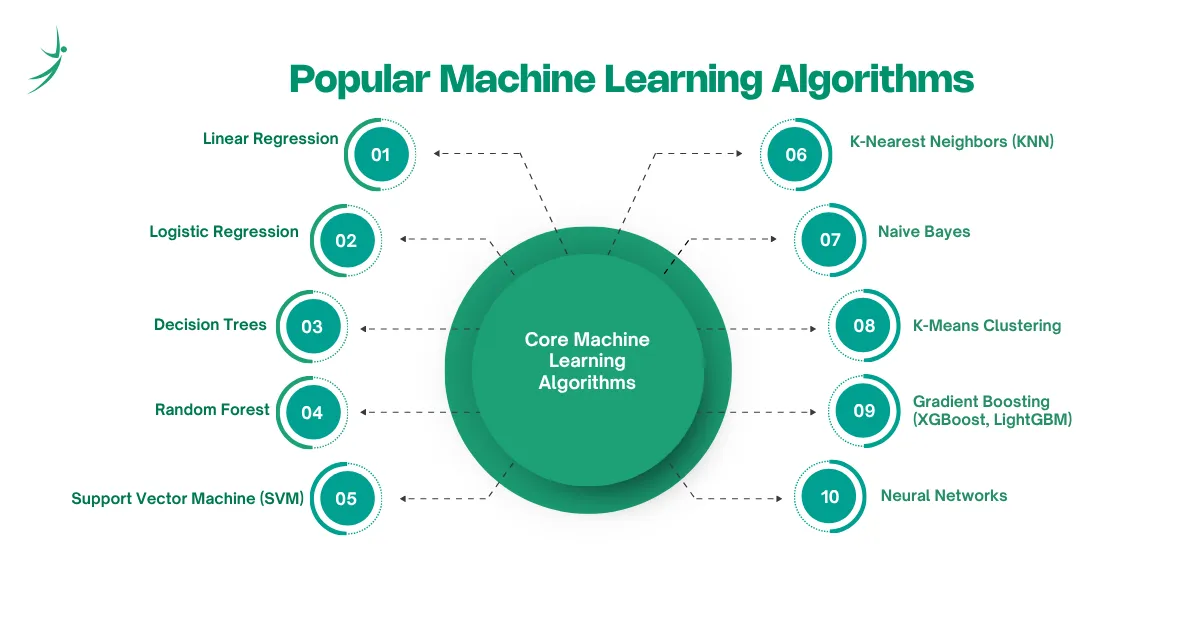
- Linear Regression: This foundational statistical approach maps a straight linear relationship between independent variables and a continuous numeric target. It is extensively taught in entry-level studies as machine learning linear regression to predict metrics like corporate revenue growth or real estate valuation.
- Logistic Regression: Despite its name, this algorithm is used for classification rather than regression. It applies a sigmoidal mathematical function to calculate the probability that a specific input belongs to a particular binary class, such as determining if a bank transaction is fraudulent or legitimate.
- Decision Trees: A machine learning decision tree splits data repeatedly into branches based on specific attribute criteria. It mimics human flowchart logic, making it exceptionally easy to interpret, read, and explain to non-technical business managers.
- Random Forest: An ensemble method that builds an entire network of independent decision trees during training. By combining the individual outputs of multiple trees, it reduces the risk of overfitting and delivers highly stable predictions on complex datasets.
- Support Vector Machine (SVM): SVM projects data points into a high-dimensional geometric space and calculates an optimal dividing line or hyperplane. This boundary maximizes the distance between different data classes, ensuring clean separation.
- K-Nearest Neighbors (KNN): A simple, intuitive distance-based algorithm. It classifies a new data point by looking at the characteristics of its closest neighboring data points within the multi-dimensional geometric matrix.
- Naive Bayes: Based on Bayes Theorem of conditional probability, this algorithm operates under the assumption that all input features are entirely independent of one another. It is exceptionally fast and highly effective for text classification tasks like sentiment analysis.
- K-Means Clustering: The most popular unsupervised algorithm. It partitions a chaotic dataset into K distinct, non-overlapping clusters by iteratively calculating geometric centroids and assigning data points to their nearest center.
- Gradient Boosting (XGBoost, LightGBM): An advanced ensemble strategy that trains decision trees sequentially. Each new tree focuses specifically on correcting the mathematical prediction errors made by the previous trees, yielding state-of-the-art accuracy on tabular records.
- Neural Networks: Computational frameworks inspired by the biological architecture of the human brain. They feature layers of interconnected nodes that pass information forward, compute errors, and adjust weights via backpropagation to handle highly complex patterns.
Types of Machine Learning
The computational strategies utilized to train automated models are categorized into four distinct machine learning types.
- Supervised Learning: Supervised learning happens when an algorithm trains on fully labeled datasets. This means every single training input comes paired with its correct, predefined output answer. Real-world examples include email spam filters and credit score classification systems. Common machine learning models used here include linear networks and support vector architectures.
- Unsupervised Learning: When dealing with unlabeled data, engineers utilize machine learning unsupervised learning strategies. Here, the system receives inputs without any matching output labels. The algorithm must explore the dataset completely independently to uncover hidden clusters, natural groupings, and structural anomalies. A prime example is automated customer segmentation for targeted marketing campaigns.
- Semi-Supervised Learning: This approach serves as a strategic middle ground. It is deployed when labeling data is too expensive or time-consuming. The system trains on a very small set of labeled data combined with a massive volume of unlabeled information, drastically reducing preparation costs while maintaining strong accuracy.
- Reinforcement Learning: Reinforcement learning operates on a system of interactive rewards and penalties. An autonomous software agent interacts directly with a dynamic environment, executing trials, tracking negative or positive feedback, and optimizing its behavioral policy to achieve maximum cumulative rewards. It forms the foundational technology behind modern robotics, autonomous self-driving cars, and complex gaming systems.
Machine Learning Tools & Technologies Ecosystem
Modern engineering requires navigating an expansive toolkit of specialized programming languages, database architectures, and cloud execution environments.
| Category | Primary Technologies & Systems |
| Programming Languages | Python, R, Julia |
| Libraries & Frameworks | NumPy, Pandas, Scikit-learn, TensorFlow, PyTorch, Keras, XGBoost |
| Data Visualization | Matplotlib, Seaborn, Plotly |
| Data Storage Systems | SQL, PostgreSQL, MongoDB |
| Cloud AI Platforms | AWS SageMaker, Google Vertex AI, Microsoft Azure ML |
| Deployment & MLOps | Docker, Kubernetes, MLflow, FastAPI |
Real-World Applications of Machine Learning
The systemic adoption of algorithmic automation has created massive scope of machine learning and engineering solutions across all commercial sectors. The diverse array of modern machine learning applications spans multiple global industries.
- Healthcare: Hospitals deploy algorithms to scale automated medical imaging diagnostics, analyze genetic sequencing records for personalized cancer treatments, and build predictive monitoring systems that alert doctors before a patient experiences critical organ failure.
- Finance: Algorithmic trading platforms process market data feeds at microsecond speeds to execute high-frequency trades. Quantitative systems leverage predictive models to forecast stock market trends and optimize asset portfolios for institutional wealth management.
- Banking: Traditional banks use intelligent classification pipelines to execute real-time credit scoring for loan applicants, monitor transactional logs to stop credit card fraud instantly, and manage automated risk evaluation compliance structures.
- E-commerce: Digital retail giants leverage deep recommendation systems to personalize consumer homepages. Predictive regression infrastructure scans historical data to automate supply chain inventory tracking and dynamically adjust product prices based on real-time market demand.
- Cybersecurity: Security infrastructure uses algorithmic anomaly detection to identify malicious user behavior profiles, track data exfiltration attempts, and execute automated threat hunting to isolate zero-day vulnerabilities within corporate cloud systems.
- Marketing: Corporate marketing departments use clustering algorithms to automate customer segmentation, build natural language models to monitor brand sentiment on public forums, and deploy predictive tools to optimize digital advertisement targeting.
- Manufacturing: Smart factories utilize sensory data streaming from assembly line machinery to run predictive maintenance protocols. This helps identify mechanical wear and tear early, preventing catastrophic factory shutdowns and minimizing operational downtime.
- Agriculture: Drones equipped with computer vision systems scan agricultural fields to detect crop diseases early, automate soil moisture tracking, and deploy machine learning pipelines to optimize harvesting schedules and maximize crop yields.
- Transportation: Logistics companies use deep routing algorithms to calculate the most fuel-efficient delivery paths. Ride-sharing applications apply predictive systems to calculate dynamic surge pricing and optimize driver distribution based on local passenger demand.
- Education: Modern learning platforms use adaptive learning models to analyze student performance metrics in real time, customize educational curriculum paths to match individual learning speeds, and automate grading pipelines for structural assessments.
Machine Learning vs Artificial Intelligence vs Deep Learning
Navigating the technical landscape requires a clear understanding of where these terms sit conceptually. Reviewing the core architectural differences between machine learning vs data science and artificial intelligence helps clarify the professional landscape.
- Artificial Intelligence (AI): The overarching corporate vision of building smart, autonomous computing systems capable of mimicking human cognitive functions like reasoning, learning, and problem-solving.
- Machine Learning (ML): A specific operational subset of AI focused entirely on training algorithms to learn rules and detect statistical regularities from historical data instead of relying on rigid, manual programming.
- Deep Learning (DL): A hyper-specialized technical subset of ML that utilizes deep neural networks with many hidden layers to autonomously parse unstructured data types like video, speech, and raw documents. For a deeper breakdown of this specialized neural architecture, you can read our complete guide on what is deep learning.
Machine Learning in the Age of Generative AI
The global emergence of modern foundation models has changed how engineering teams construct technical software.
How Generative AI Uses Machine Learning
Generative AI does not replace traditional foundations; it is completely powered by them. Large Language Models (LLMs) and modern image generators are massive transformers trained on global internet data using advanced machine learning architectures. They apply foundational algorithms at an unprecedented scale to predict the next logical token or generate realistic pixel arrays.
Will Generative AI Replace Machine Learning Engineers?
Absolutely not. While automated tools excel at writing basic boilerplate scripts, they lack the capacity to architect complex system pipelines, understand unique corporate business logics, handle severe data security constraints, or optimize models for low-latency production environments. Generative AI simply serves as a powerful productivity booster, freeing engineers to focus on high-level architecture and complex algorithmic optimizations.
Future of Machine Learning in 2026 and Beyond
Moving forward into 2026 and beyond, the industry is transitioning rapidly toward edge computing, where compact models run directly on localized mobile devices and IoT hardware. Furthermore, the market demand for robust MLOps engineering, automated continuous integration, and ethical, interpretable AI frameworks is scaling at an exponential rate.
What is a Machine Learning Project?
A machine learning project is a structured data engineering endeavor designed to solve a tangible problem by building a verifiable predictive system. To validate your skills, you must move away from reading tutorials and focus heavily on building practical machine learning projects.
Beginner Portfolio Projects
- House Price Prediction: A regression project utilizing structural real estate data to predict market valuations based on parameters like location, size, and proximity to transit.
- Spam Detection: A text classification system applying natural language processing to filter malicious emails from legitimate communications.
- Movie Recommendation System: Utilizing collaborative filtering algorithms to suggest personalized digital content to users based on historical rating matrices.
- Stock Price Prediction: Implementing time-series forecasting models to predict market asset variations using historical trading logs.
- Customer Churn Prediction: A binary classification pipeline designed to identify which enterprise clients are most likely to cancel their subscriptions.
- Image Classification: Deploying convolutional neural networks to accurately sort image arrays into distinct categorical labels.
- Sentiment Analysis: Building text processing pipelines to automatically classify social media commentary as positive, neutral, or negative.
- Loan Approval Prediction: A high-security classification tool used to evaluate applicant risk and automate institutional loan authorization.
Machine Learning Career Opportunities
The worldwide boom in automated intelligence has created an unprecedented shortage of technical experts. If you understand how to get into machine learning, you can successfully pivot into a variety of highly lucrative specialized roles.
- Machine Learning Engineer: Focuses squarely on the software engineering side of AI. They take analytical models developed in research labs and scale them into production-ready web APIs capable of serving millions of active users.
- AI Engineer: Specializes in integrating pre-trained foundation models, building intelligent API pipelines, orchestrating vector databases, and managing semi-autonomous generative workflows inside existing corporate applications.
- Data Scientist: Acts as a strategic data investigator. They focus heavily on exploratory analysis, corporate statistical modeling, and discovering hidden commercial trends. To understand how their core responsibilities differ from pipeline architecture, read our breakdown on data engineer vs data scientist.
- NLP Engineer: A hyper-specialized professional focused entirely on language computing. They build transcription systems, automated translation tools, semantic search engines, and advanced text summary architectures.
- Computer Vision Engineer: Specializes in teaching machines how to process and interpret visual data. They write algorithms for facial recognition infrastructure, medical imaging diagnostics, and real-time object detection for autonomous robotics.
- MLOps Engineer: The system administrators of the AI world. They manage continuous integration pipelines, configure Docker containers, manage cloud orchestration via Kubernetes, and monitor live systems for operational failures.
- Research Scientist: Operates at the bleeding edge of innovation. They work in corporate research labs or academic institutions, designing completely new mathematical algorithms and advancing the baseline limits of computing science.
Skills Required to Learn Machine Learning
Breaking into this highly competitive engineering domain requires a deliberate blend of deep technical capabilities and robust professional soft skills.
- Technical Core: Fluent Python programming, solid SQL query extraction, advanced statistics, multi-dimensional matrix mathematics, data visualization expertise, Git version control, and cloud computing infrastructure.
- Professional Soft Skills: Analytical problem-solving, critical thinking to debug complex architectural failures, business understanding to connect algorithms to corporate revenue, and clear communication skills to explain complex statistical outputs to non-technical corporate executives. For a closer look at the key competencies needed, explore our guide on essential machine learning engineer skills.
Follow a Structured Machine Learning Roadmap
To maximize your efficiency, you must follow a modern, best machine learning roadmap. Your progression should transition systematically through the following engineering phases:
- Phase 1: Math Foundations
- Phase 2: Python & SQL Core
- Phase 3: Data Analysis & Visualization
- Phase 4: Classical ML Algorithms
- Phase 5: Deep Learning
- Phase 6: MLOps Cloud Deployment
Free vs Paid Machine Learning Courses
While self-guided individuals can easily access scattered introductory videos online, relying completely on unguided learning often leads to severe conceptual gaps, a lack of production-grade portfolio projects, and no direct pathway to professional employment.
In contrast, choosing an industry-vetted, paid program or bootcamp provides a structured curriculum, daily hands-on coding practice, real-world corporate project development, direct mentorship from active tech leaders, and comprehensive job placement assistance to smoothly transition you into the corporate tech workforce.
Industry-Recognized Machine Learning Certifications
To make your professional portfolio stand out immediately to global corporate recruiters, it is highly strategic to earn globally recognized certifications:
- Google Professional Machine Learning Engineer: Validates your capacity to design, build, and scale live enterprise AI solutions using cloud architectures.
- Microsoft Azure AI Engineer Associate: Proves your absolute proficiency in deploying cognitive services, NLP infrastructure, and computer vision systems.
- AWS Certified Machine Learning Specialty: Demonstrates your expertise in constructing, training, and deploying models inside the Amazon Web Services cloud ecosystem.
- IBM Machine Learning Professional Certificate: A comprehensive, multi-course certification verifying practical engineering mastery of classical algorithms and deep architectures.
- Databricks Certified Machine Learning Associate: Confirms your technical capability to execute scale-up data preparation and model tracking using advanced data platform tools.
Why Machine Learning is One of the Most In-Demand Skills
The rapid, cross-industry adoption of intelligent computing has made this expertise exceptionally valuable. A quick review of the global technology sector highlights why these skills command such massive premium leverage:
- Unmatched Earnings: Due to severe talent scarcity, companies offer exceptionally high compensation packages to qualified professionals.
- Global Remote Leverage: The entire infrastructure of algorithmic development is entirely remote-compatible, allowing engineers based in local environments to work for international tech firms.
- Future-Proof Security: As legacy manual software development tracks face automation, professionals who design the automation systems enjoy long-term career growth.
- Enterprise Adoption: From agile tech startups to massive corporate enterprises, utilizing intelligent forecasting models has become standard practice to survive market competition.
Common Challenges in Machine Learning (and How to Overcome Them)
Developing intelligent software is fraught with complex technical hurdles. Navigating these roadblocks requires continuous vigilance and robust debugging methodologies:
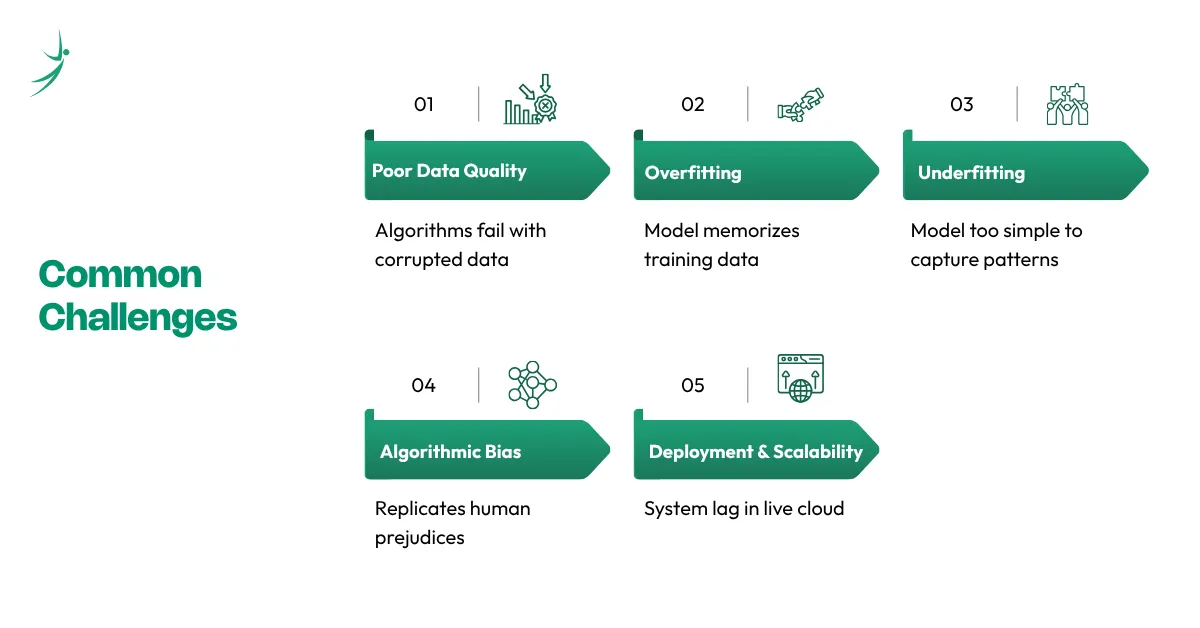
- Poor Data Quality: Algorithms fail when fed corrupted data. Resolve this by enforcing strict, automated data cleaning and preprocessing pipelines.
- Overfitting: Happens when a model memorizes training datasets perfectly but fails to generalize to unseen data. Overcome this by implementing cross-validation and regularizing parameters.
- Underfitting: Occurs when a model is too simple to capture the underlying patterns. Fix this by selecting more robust algorithms or engineered features.
- Algorithmic Bias: Systems can accidentally replicate human prejudices present in historical records. Mitigate this by sourcing highly diverse datasets and running strict ethical fairness audits.
- Deployment & Scalability: Transitioning from an experimental laptop script to a live cloud database often causes system lag. Overcome this by packaging code inside Docker containers and practicing proper MLOps methodologies from day one.
Conclusion
Machine learning has fundamentally reshaped the boundaries of human technological capability. From predictive banking grids to automated healthcare diagnostics, the demand for professionals who can manipulate data and construct intelligent systems is expanding exponentially. If you are determined to stop wandering through fragmented internet tutorials and want to launch a resilient career, taking a professional best data science course in Nepal provides the mentorship, code structure, and portfolio development required to thrive in the modern tech economy. Take the definitive first step: explore a verified machine learning roadmap, start writing clean Python scripts daily, build real-world portfolio projects, and position yourself at the center of global innovation today!
Frequently Asked Questions
What is machine learning in simple words?
Does Machine Learning Require a GPU?
Does Machine Learning Have a Future?
What Does a Machine Learning Engineer Do?
How Is Machine Learning Related to AI?
How Does a Machine Learning Model Work?
How Much Does a Machine Learning Engineer Earn?
Are Machine Learning and AI the Same?
AI or Machine Learning: Which Is Better?
About Author:

Dhiraj Bashyal is a Machine Learning Engineer at Vrit Technologies, with 3 years of hands-on experience in applied AI and machine learning. He brings that industry experience directly into the classroom, teaching Data Science and Machine Learning at Skill Shikshya, where he helps learners build a practical, project-ready foundation in Python, ML workflows, and real-world data problem-solving.