What is Deep Learning? A Complete Beginner's Guide (2026) | Skill Shikshya
In the rapidly evolving technological landscape of 2026, artificial intelligence has completely transformed how global and local industries operate. Organizations no longer rely on rigid software applications; instead, they deploy advanced systems capable of automated reasoning, predictive analysis, and contextual understanding. If you are determined to break into this high-impact field and master these systems from scratch, enrolling in a premier data science and machine learning course in Nepal is the most definitive step you can take to build production-ready expertise. At the absolute core of this modern technological revolution lies deep learning, an advanced methodology that serves as the primary engine powering the world's most sophisticated computational breakthroughs.
What is Deep Learning?
The concept of deep learning represents a specialized methodology designed to mimic the intellectual and analytical functions of the human brain. While early computing frameworks required explicit step-by-step instructions to perform a single task, this advanced subset of artificial intelligence allows algorithms to interact directly with raw information, discovering underlying structures and patterns completely on their own. Today, it has become the undeniable driving force behind modern AI systems such as ChatGPT, Gemini, autonomous self-driving vehicles, advanced robotics, and real time computer vision systems that can identify complex objects in a fraction of a second.
What Does Deep Learning Actually Mean?
To understand deep learning as a beginner, it helps to look at how the word "deep" applies to computation. In traditional software engineering, data passes through a single layer of logic. In contrast, this technology utilizes artificial neural networks containing tens, hundreds, or even thousands of processing layers stacked on top of one another.
The term "deep" refers specifically to these multiple hidden layers nested between the initial input layer and the final output layer. As raw data passes through these sequential stages, each layer extracts increasingly abstract and complex features.
For a simple real world analogy, imagine teaching a computer to recognize a handwritten picture of a cat. A traditional algorithm would require human experts to manually program specific rules about the shapes of ears, whiskers, and tails. A deep neural network operates differently:
- The first layer analyzes individual pixels and raw light values.
- The second layer combines those pixels to detect simple edges and lines.
- The third layer recognizes shapes, curves, and corners.
- The deeper hidden layers assemble these shapes into complex facial structures like eyes and noses.
- The final output layer accurately concludes whether the image represents a cat, doing so without any human engineer ever defining what a whisker looks like.
What Does a Deep Learning Engineer Do?
A deep learning engineer is a specialized professional who builds, trains, optimizes, and deploys these complex multi layered neural network models. Their roles and responsibilities move far beyond writing basic application logic. They spend their days managing large scale computing infrastructure, designing advanced network architectures, and handling massive data pipelines.
Industries actively hiring deep learning engineers span nearly every major commercial sector, including healthcare for automated disease diagnosis, financial institutions for algorithmic high frequency trading, retail platforms for predictive user personalization, and tech agencies building generative AI models.
The daily workflow of an engineer typically involves:
- Sourcing and preprocessing terabytes of unstructured data.
- Selecting and configuring specialized neural architectures like Transformers or Convolutional Networks.
- Running rigorous training pipelines across clusters of specialized computer chips.
- Tuning hyperparameters to minimize model error and maximize generalization.
- Collaborating with software infrastructure teams to package models inside isolated containers and serve them via high speed programming interfaces.
How Deep Learning Fits into Artificial Intelligence
To build a sustainable technical career, professionals must understand the clear structural hierarchy that governs this computational field. These terms are often used interchangeably in casual tech conversations, but they possess distinct technical boundaries.
Artificial Intelligence vs Machine Learning vs Deep Learning
The easiest way to visualize this ecosystem is through three concentric circles, where each domain forms the foundational framework for the next:
- Artificial Intelligence (AI): This is the broadest outer domain, encompassing any computational system, algorithm, or machine that demonstrates human-like intelligence, logic, problem solving, or decision making capabilities.
- Machine Learning (ML): This represents the active inner circle of AI. It focuses exclusively on systems that learn, adapt, and refine their own parameters based on historical data inputs, rather than following static, pre-written rules. If you are exploring this field, understanding about machine learning provides the necessary context for model training.
- Deep Learning (DL): This is the hyper specialized core located at the center of machine learning. It relies entirely on multi-layered artificial neural networks to process massive volumes of unstructured data automatically, removing the need for manual feature selection.
Why Deep Learning Became So Popular
While the mathematical concepts behind neural networks have existed for decades, deep learning in ai experienced an unprecedented explosion in popularity over recent years. This sudden ascent was driven by three intersecting technical catalysts:
- The Data Explosion: Traditional algorithms plateau in accuracy once they hit a certain threshold of data. Deep neural networks, however, exhibit a continuous upward performance curve, performing better as they consume more training information.
- The GPU Revolution: Training deep architectures requires billions of simultaneous mathematical matrix multiplications. The transition from standard computer processors to highly parallel graphics processing units turned weeks of computation into hours.
- Algorithmic Breakthroughs: Innovations in optimization functions, regularizations, and architectural frameworks like Transformers fundamentally solved legacy training limitations, allowing networks to grow deeper and more stable than ever before.
Core Components of Deep Learning (The 8 Pillars)
Building a comprehensive understanding of deep learning theory requires mastering eight essential operational pillars. Each pillar represents a critical stage in the structural lifecycle of an intelligent system.
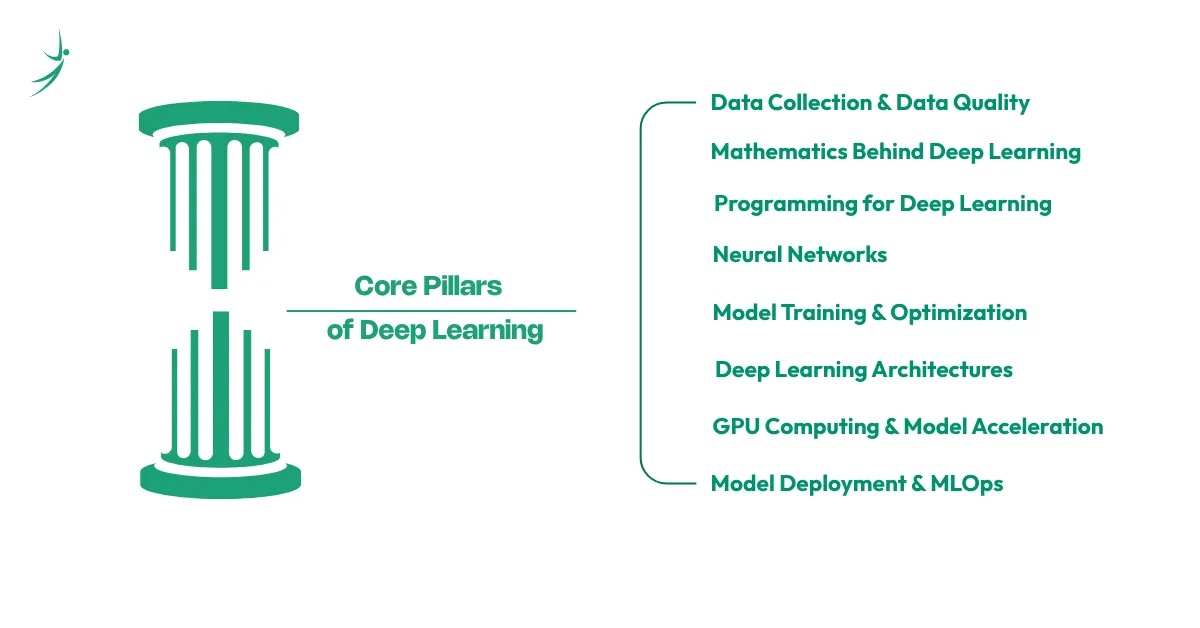
1. Data Collection & Data Quality
Data is the fundamental fuel of any neural network. Unlike traditional analytical pipelines that operate on highly organized, structured databases, deep neural networks excel at extracting meaning from massive, unstructured datasets such as raw text corpora, millions of images, high resolution audio tracks, and continuous video streams. Achieving exceptional model accuracy requires rigorous data labeling processes, where human specialists or automated systems tag raw inputs to give the network an explicit ground truth to learn from.
2. Mathematics Behind Deep Learning
An engineer cannot build stable systems without mastering the underlying mathematical foundations. Linear algebra forms the vocabulary of the field, as data inputs are stored and manipulated as multi dimensional matrices and vectors. Calculus, particularly partial derivatives, powers the mechanism that allows networks to learn from their mistakes. Probability and statistics ensure models can quantify uncertainty and make accurate predictions, while mathematical optimization techniques continuously adjust internal parameters to minimize errors.
3. Programming for Deep Learning
To translate mathematical formulas into functional applications, engineers rely heavily on deep learning with python as their default development environment. Python provides a clean syntax and integrates seamlessly with foundational computational libraries such as NumPy for high performance matrix calculations and Pandas for structural data manipulation and preprocessing before information enters a neural layer.
4. Neural Networks
The architecture of a model is built out of interconnected structural units called deep learning neurons, which act as the fundamental processing elements mimicking biological pathways. These computational nodes are organized into sequential collections known as layers: an input layer, multiple hidden processing layers, and an output layer. Every neuron utilizes a specialized activation function, such as ReLU or Sigmoid, to introduce non linearity into the system, allowing the model to learn highly complex, non linear relationships during the forward propagation stage.
5. Model Training & Optimization
Model training is a continuous error correction loop. During this phase, a specialized loss function calculates the exact mathematical discrepancy between the model's prediction and the actual ground truth. Optimization algorithms, such as gradient descent, then compute the directional adjustment needed for millions of internal weights. This error signal is propagated backward through the entire architecture using backpropagation, repeating across thousands of operational iterations defined by explicit batch sizes and training epochs.
6. Deep Learning Architectures
Engineers do not utilize a single uniform network for every task; instead, they choose specialized structural designs tailored to specific data types. Convolutional Neural Networks (CNNs) are engineered for spatial image analysis, Recurrent Neural Networks (RNNs) and Long Short-Term Memory (LSTM) blocks manage sequential time series data, and modern Transformers handle complex natural language tasks. Autoencoders focus on data compression, while Generative Adversarial Networks (GANs) utilize competing network structures to generate completely new synthetic data.
7. GPU Computing & Model Acceleration
Because training deep architectures requires trillions of mathematical operations, standard central processing units (CPUs) are highly inefficient. Engineers utilize advanced graphics processing units (GPUs) and specialized parallel processing architectures like NVIDIA's CUDA platform. This hardware acceleration allows models to perform thousands of matrix calculations simultaneously, turning complex training processes that would take months on a standard processor into highly manageable cloud based computing workflows.
8. Model Deployment & MLOps
A model is only valuable when it transitions out of a research notebook and enters a live corporate production environment. This final pillar involves serving trained models through secure, scalable application programming interfaces (APIs). Engineers leverage MLOps frameworks, utilizing Docker containers to isolate software dependencies and Kubernetes platforms to orchestrate, monitor, and version models continuously as real world data evolves over time.
How Deep Learning Works
To understand the continuous lifecycle of an intelligent application, one must follow the complete end to end development workflow that guides deep learning projects from inception to production.
The Complete Deep Learning Workflow
- Problem Definition: Establish clear, quantifiable objectives, determining exactly what the system needs to predict, classify, or generate to solve a specific business problem.
- Data Collection: Gather vast amounts of raw data from database repositories, web scraping engines, corporate logs, or third party text and image providers.
- Data Cleaning: Inspect the gathered data to strip out corrupt entries, handle missing attributes, eliminate duplicate values, and format information into uniform formats.
- Feature Engineering: While deep networks minimize the need for manual feature selection, initial formatting, normalization, and scaling remain critical to ensure stable gradient calculations.\
- Neural Network Design: Architect the network by selecting appropriate layers, defining neuron counts, choosing non linear activation functions, and setting up initial loss frameworks.
- Model Training: Feed the preprocessed data through the designed network, allowing the optimization algorithms to adjust internal weights over multiple iterative cycles.
- Validation: Pass a separate, unseen validation dataset through the model to check how well the neural patterns generalize to new information outside the training set.
- Hyperparameter Tuning: Systematically adjust external configuration settings, such as learning rates, optimizer types, layer depths, and dropout values, to maximize model efficiency.
- Testing: Run a final, independent evaluation using a dedicated testing dataset to verify absolute performance metrics like precision, recall, and overall accuracy.
- Deployment: Wrap the optimized neural network inside a scalable container, deploying it to cloud infrastructure to process real time user requests via secure API endpoints.
- Continuous Monitoring: Track production performance continuously to catch systematic model drift, monitor computing hardware utilization, and trigger automated retraining pipelines when accuracy drops.
Types of Deep Learning Models
Selecting the appropriate algorithmic architecture is a critical step for an engineer. Different network structures are optimized for distinct data shapes, dimensions, and operational tasks.
- Feedforward Neural Networks (FNN): This is the foundational archetype of all neural structures, where information moves strictly in a single, linear direction, flowing forward from the input nodes, through the hidden layers, directly to the final output layer. There are no internal loops, cycles, or backward connections within the network graph, making FNNs ideal for straightforward tabular classification and regression tasks.
- Convolutional Neural Networks (CNN): CNNs are the undisputed industry standard for any task involving spatial data matrices, such as image recognition, video processing, and medical scan analysis. They utilize specialized mathematical filters that slide across an image, automatically extracting invariant spatial features like edges, textures, boundaries, and complex object parts regardless of where they appear in the visual frame.
- Recurrent Neural Networks (RNN): Unlike traditional linear structures, RNNs possess internal memory loops that allow information to persist across operational steps. This makes them highly effective for processing sequential data streams where the context of a previous input directly influences the meaning of the next, such as analyzing continuous audio waves or tracking daily financial market changes.
- Long Short-Term Memory (LSTM): Traditional recurrent structures suffer from a severe mathematical limitation known as the vanishing gradient problem, which prevents them from retaining context over long sequences. LSTMs solve this by introducing specialized internal gating mechanisms that regulate the flow of information, allowing the model to remember critical pieces of data across thousands of sequential steps.
- Transformers: Transformers represent the state of the art architecture powering modern natural language processing and generative AI systems. They completely eliminate recurrent loops, relying instead on a mechanism called self attention. This allows the model to analyze an entire document simultaneously, mapping the complex contextual relationships between all words regardless of their distance from one another.
- Generative Adversarial Networks (GANs): GANs leverage a highly creative architectural framework consisting of two separate neural networks competing against each other in a continuous game. The Generator network attempts to create highly realistic synthetic data, such as artificial human faces, while the Discriminator network attempts to determine if the sample is real or fake, resulting in highly realistic data generation over time.
- Autoencoders: This specialized unsupervised architecture is designed to learn efficient, compressed representations of input datasets. The network forces data through a narrow central bottleneck layer, stripping out noise and redundant attributes. This makes autoencoders exceptionally powerful for dimensional reduction, data denoising, and automated anomaly detection inside complex computer systems.
Popular Deep Learning Frameworks & Tools
Building advanced deep networks from scratch using raw code would take months of redundant labor. Modern developers rely on a highly sophisticated ecosystem of open source software and specialized deep learning tools to streamline development:
- Python: The undisputed foundation language that unites the entire global AI development community.
- TensorFlow: A comprehensive, enterprise grade open source platform created by Google, optimized for large scale deployment and industrial production.
- PyTorch: Developed by Meta's AI Research lab, this framework has become the favorite platform for researchers and developers worldwide due to its dynamic computational graph. Mastering deep learning with pytorch is essential for building highly adaptive models.
- Keras: A high level, human centric abstraction API designed to run on top of TensorFlow, allowing developers to prototype deep neural networks in just a few lines of clean code.
- Hugging Face Transformers: An indispensable repository that provides instant access to thousands of state of the art, pre trained foundation models for text, vision, and audio tasks.
- Jupyter Notebook: An interactive web based computing environment that allows engineers to mix live code execution, data visualizations, and descriptive markdown text.
- CUDA: A specialized parallel computing platform designed by NVIDIA that allows developers to harness the immense mathematical processing power of modern graphics chips.
- OpenCV: A powerful, highly optimized open source computer vision library used to handle complex, real time image and video preprocessing pipelines.
- ONNX (Open Neural Network Exchange): An open ecosystem that allows developers to convert models between different frameworks, ensuring cross platform compatibility.
- MLflow: A comprehensive platform built to manage the entire machine learning lifecycle, tracking computational experiments, packaging code, and managing model registries.
- Weights & Biases: A highly visual developer tool used to track hyperparameter tuning experiments, log performance metrics, and visualize neural training histories in real time.
- Google Colab: A cloud based coding environment that provides free access to powerful GPU hardware, allowing beginners to run intense training scripts directly inside a browser.
Real-World Applications of Deep Learning
This advanced computational framework has transitioned completely out of academic research laboratories and into everyday commercial operations, transforming how global business sectors handle complex challenges.
- Healthcare: Deep neural networks analyze thousands of medical imaging files, such as X-rays, MRIs, and CT scans, detecting cancerous anomalies and structural diseases with accuracy rates that match or exceed human radiologists.
- Finance: Financial institutions deploy complex architectures to analyze millions of continuous transaction records, executing real time fraud detection models to secure digital banking ecosystems.
- Retail: E-commerce giants leverage deep recommendation systems to analyze past user browsing histories, predicting shopping desires and displaying hyper personalized product feeds.
- Manufacturing: Industrial facilities install high speed camera systems linked to convolutional neural models along automated assembly lines, executing continuous quality inspections to catch minute product defects.
- Education: Smart learning platforms utilize adaptive neural networks to analyze individual student performance, automatically customizing the difficulty and style of curriculum delivery.
- Agriculture: Autonomous drones equipped with computer vision models fly over massive agricultural fields, automatically identifying crop diseases, assessing soil hydration, and mapping yield expectations.
- Cybersecurity: Advanced threat detection engines analyze continuous network traffic packets, using deep anomaly detection models to identify zero day exploits and malicious system intrusions before data breaches occur.
- Marketing: Generative platforms analyze consumer sentiment data across digital channels, automatically crafting optimized marketing copy, visual advertisements, and target audience segments.
- Autonomous Vehicles: Self driving cars process continuous, real time multi sensor data feeds, utilizing deep path planning models to navigate complex urban streets safely.
- Robotics: Industrial robotic arms leverage reinforcement deep learning models to master complex physical tasks, such as sorting irregular items or executing precision mechanical assemblies.
- Smart Assistants: Conversational voice systems utilize deep speech processing and language models to understand spoken user intent and respond with natural human phrasing.
Deep Learning vs Machine Learning vs Artificial Intelligence
To help clarify your professional trajectory, the following comprehensive comparison table outlines the exact technological boundaries that separate these core computational domains:
| Comparison Attribute | Artificial Intelligence (AI) | Machine Learning (ML) | Deep Learning (DL) |
| Technical Definition | Broad systems mimicking human cognitive functions. | Algorithms learning from historical data patterns. | Multi-layered neural networks processing raw data. |
| Learning Method | Rules, logic, or explicit mathematical structures. | Statistical optimization from structured data. | Autonomous feature extraction through deep layers. |
| Data Requirement | Operates effectively on minimal data inputs. | Requires thousands of clean, structured records. | Demands millions of diverse, unstructured data points. |
| Human Intervention | Highly dependent on initial human programming. | Requires manual feature engineering and curation. | Minimizes human intervention via automated learning. |
| Performance Level | High for deterministic, logic-bound problems. | Plateaus once data limits are reached. | Scales continuously as training data volumes expand. |
| Architectural Complexity | Ranges from basic linear logic to nested rules. | Moderate mathematical and statistical structures. | Highly complex networks with millions of parameters. |
| Training Time Required | Almost instant execution for standard logic. | Minutes to hours depending on algorithm choice. | Days to weeks demanding high-performance hardware. |
| Hardware Dependencies | Runs smoothly on basic, standard CPU chips. | Executes efficiently on standard desktop computers. | Demands specialized parallel processing GPU clusters. |
| Common Algorithms | Expert systems, search graphs, decision trees. | Linear regression, Random Forests, XGBoost, SVM. | CNNs, RNNs, LSTMs, Transformers, GANs, Autoencoders. |
| Real-World Use Cases | Chess playing engines, basic automation scripts. | Credit scoring models, basic customer churn forecasts. | ChatGPT, autonomous vehicles, facial recognition. |
Deep Learning in the Age of Generative AI
The global technological landscape is experiencing an unprecedented revolution driven by Generative AI. Every major system captivating the world, from text models to image generators, is powered by advanced neural network structures.
How Generative AI Uses Deep Learning
Generative AI is not a separate technology; it is a direct product of advanced research. Large Language Models (LLMs) rely on massive Transformer architectures that analyze billions of text parameters to generate coherent, contextual human responses. Diffusion models leverage deep neural networks to systematically reverse noise patterns, generating high resolution imagery from raw text prompts. Multimodal AI frameworks stack vision and text networks together, allowing a single unified system to see, hear, read, and write simultaneously.
Can Generative AI Replace Deep Learning Engineers?
A common question among tech students is whether automated generation tools will eliminate engineering roles. The definitive answer is no. While generative systems can write basic code snippets, they cannot design custom neural architectures, manage enterprise MLOps infrastructure, optimize hardware compute pipelines, or solve complex mathematical errors.
Generative tools act as powerful co-pilots, accelerating the daily workflow of human engineers, which allows them to focus on high level system design, custom model tuning, and architectural innovation.
Future of Deep Learning in 2026 and Beyond
As we navigate through 2026, the trajectory of this field is moving toward highly sophisticated operational frontiers:
- Agentic AI: Autonomous software systems that do not just answer questions, but actively plan actions, execute complex tasks, and use external software tools independently.
- Advanced AI Reasoning: Networks moving beyond basic pattern matching to execute multi step logical deductions, verification loops, and analytical problem solving.
- Edge AI & Specialized Chips: Optimizing massive neural models to run locally on low power mobile devices, smart appliances, and specialized, energy efficient AI microchips.
- Small Language Models (SLMs): Developing compact, hyper efficient neural models that achieve enterprise grade accuracy on specific tasks while consuming a fraction of the computational power.
- Green AI & Federated Learning: Designing sustainable training frameworks that optimize energy consumption, alongside decentralized learning methods that train models across private devices without compromising user data privacy.
What is a Deep Learning Project?
For anyone looking to break into the tech industry, building a hands-on portfolio is essential. A project involves taking a raw dataset, defining a clear objective, designing a custom neural network, and training the system to solve a real world problem.
Beginner Portfolio Projects
To demonstrate your alignment with an industry standard roadmap, you should focus on building and deploying these practical, end to end portfolio projects:
- Image Classification: Build a convolutional network that classifies pictures into distinct categories, such as identifying different types of vehicles or sorting retail inventory items automatically.
- Face Mask Detection: Create a real time computer vision application that processes video frames to detect whether individuals are wearing safety masks correctly in industrial zones.
- Handwritten Digit Recognition: Construct a foundational neural network using the classic MNIST dataset to accurately identify handwritten numbers, mastering the basics of forward and backward propagation.
- Intelligent Chatbot: Design a custom conversational assistant by fine tuning an open source language model, connecting it to a private vector database to answer specialized user queries.
- Sentiment Analysis: Develop a natural language processing model that analyzes text reviews across social channels, automatically classifying customer sentiment as positive, negative, or neutral.
- Object Detection Pipeline: Utilize advanced frameworks like YOLO to build a real time video processing system that identifies and tracks multiple moving objects simultaneously.
- Image Caption Generator: Combine a convolutional vision network with a recurrent language architecture to build a system that analyzes an input image and generates a descriptive text caption automatically.
- AI Resume Screener: Create a text processing application that parses unstructured documents, automatically ranking applicant resumes based on skill context and role requirements.
- Medical Image Classification: Develop a high precision neural network that analyzes historical skin lesion images to identify potential health risks, practicing rigorous model evaluation metrics.
Deep Learning Career Opportunities
The demand for specialized technical talent has reached an all time high, creating premium professional pathways for qualified individuals globally and locally.
As local financial institutions, telecommunications providers, logistics operations, and digital agencies scale up their automated operations, the technical scope within the local market has become incredibly vibrant. For professionals wanting to understand how these positions compare to broader analytical tracks, exploring the differences between a data engineer vs data scientist clarifies where neural engineering fits.
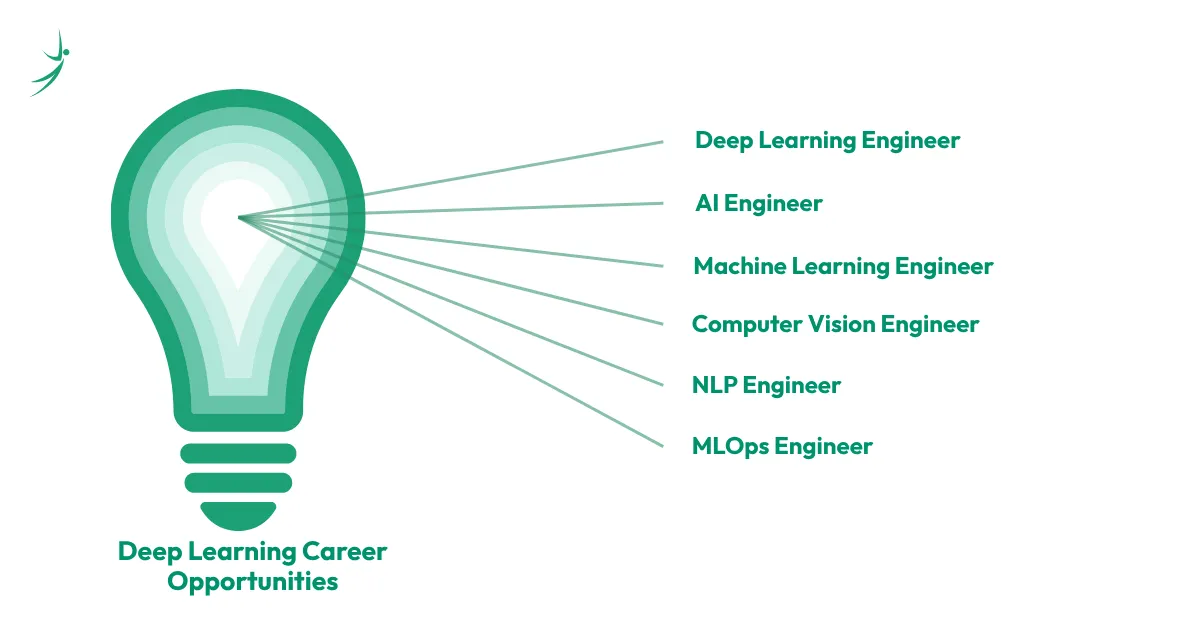
The primary career roles available in today's tech ecosystem include:
- Deep Learning Engineer: Specializes in designing, training, and optimizing custom multi layered neural network architectures for complex data tasks.
- AI Engineer: Focuses heavily on integrating pre trained foundation models, building intelligent API pipelines, orchestrating vector databases, and managing generative workflows inside corporate applications.
- Machine Learning Engineer: Bridges the gap between data science theory and software engineering, building and deploying robust predictive systems into live production environments. If you are preparing for entry evaluations, mastering classic machine learning interview questions is highly recommended.
- Computer Vision Engineer: Specializes in vision processing tasks, building systems for facial recognition, video surveillance, industrial inspection, and automated spatial tracking.
- NLP Engineer: Focuses on computational linguistics, building systems for automated translation, semantic document search, conversational voice assistants, and text generation.
- MLOps Engineer: Manages the operational infrastructure of AI, handling continuous model deployment, containerized orchestration, automated testing, and performance tracking.
Salary Overview & Market Trends
Investing in a high quality technical education yields exceptional long term financial returns. In the current local tech ecosystem, compensation trends reflect the immense demand for specialized talent:
- Entry Level (0 to 2 years): Ranges from NPR 35,000 to NPR 65,000 per month for freshly certified individuals or interns who possess strong personal project portfolios.
- Mid Level (2 to 5 years): Ranges from NPR 70,000 to NPR 150,000 per month as engineers take ownership of custom model training and deployment pipelines.
- Senior Level (5+ years) & Tech Leads: Ranges from NPR 160,000 to over NPR 300,000 per month for professionals who architect enterprise wide AI strategies and direct technical engineering teams.
Furthermore, because deep neural engineering skills are universally uniform across the globe, local professionals enjoy immense access to international remote internships and full time remote engineering roles. These opportunities allow local talent to collaborate with global tech teams, bringing international currency compensation straight to their local environment while elevating their global professional portfolio.
Skills Required to Learn Deep Learning
Transitioning into a professional engineering role demands a balanced blend of rigorous technical competencies and polished soft skills.
Technical Skills
- Advanced Python Programming: Mastery of object oriented python, virtual environments, and data packaging.
- Mathematical Proficiency: Deep understanding of linear matrix algebra, calculus derivatives, and statistical optimization.
- Core Machine Learning: Solid grounding in supervised and unsupervised theories before jumping into neural networks. Reviewing a detailed data science and machine learning roadmap keeps this foundational learning organized.
- Data Processing: Ability to clean and transform messy, unstructured text and image data streams.
- Cloud Computing & Git: Proficiency with distributed version control and cloud training environments like AWS or Google Vertex AI.
Soft Skills
- Structured Problem Solving: The ability to break down vague, complex business challenges into clear computational tasks.
- Research Mindset: A continuous desire to read academic research papers and experiment with brand new algorithmic methodologies.
- Clear Communication: The ability to translate dense, highly technical model metrics into clear, actionable insights for corporate stakeholders.
Follow a Structured Deep Learning Roadmap
Attempting to learn this field by jumping randomly between scattered tutorials often leads to frustration. To build production ready expertise, you must follow a structured, linear learning pathway:
Python & Math Foundations -> Machine Learning Basics-> Neural Network Core->Advanced Architectures->MLOps & Cloud Portfolio->Live Job Applications
Free vs Paid Deep Learning Courses
When launching your learning journey, you will encounter multiple educational formats:
- Self Learning (Free Videos & Blogs): Excellent for initial exposure and high level concept overviews, but often lacks structured progression, expert feedback, and production code evaluations.
- University Courses: Provide deep theoretical mathematics, but frequently suffer from outdated curriculum and rarely cover modern deployment tools like Docker, Hugging Face, or live MLOps pipelines.
- Instructor Led Bootcamps & Specialized Training: Represent the most efficient path to career transition. They combine an industry aligned curriculum, direct daily mentorship from active professionals, and hands-on portfolio development with real world datasets.
Industry-Recognized Deep Learning Certifications
Earning an industry recognized certification serves as a powerful validation of your technical expertise, helping your professional profile stand out to international corporate recruiters. Some of the most valuable certifications in today's market include:
- DeepLearning.AI Deep Learning Specialization: Taught by industry pioneer Andrew Ng, this course provides exceptional coverage of foundational neural mechanics, structuring machine learning projects, and advanced network architectures.
- NVIDIA Certified Associate: Highly valuable for demonstrating practical competence in GPU computing, parallel processing acceleration, and deploying vision or language models at scale.
- Google Cloud Professional Machine Learning Engineer: Focuses heavily on architectural design, data pipeline management, and scaling models inside enterprise cloud environments using modern MLOps tools.
- AWS Certified Machine Learning: Validates an engineer's ability to design, implement, and deploy custom neural networks across complex cloud infrastructures.
Why Deep Learning is One of the Most In-Demand Skills
We are living in an era where specialized automated intelligence is being integrated into every software stack. Organizations across the globe are moving away from legacy analytics and moving aggressively toward predictive, generative architectures. This massive paradigm shift has created an unprecedented global talent shortage, resulting in exceptional long term career stability and highly competitive salaries for those who master the field.
By building a deep understanding of neural networks, you position yourself at the very front of the next wave of computing, ensuring your skills remain completely future proof as AI continues to redefine human industry.
Common Challenges in Deep Learning (and How to Overcome Them)
Working with deep networks introduces unique operational obstacles. Succeeding as an engineer requires knowing how to troubleshoot these system limitations:
- Large Data Requirements: Deep networks demand massive amounts of training data to prevent errors. Solution: Leverage transfer learning, using pre-trained foundation models from repositories like Hugging Face and fine tuning them on your specific, smaller dataset.
- Expensive Hardware Costs: Training models from scratch demands high end GPU systems. Solution: Utilize free cloud development platforms like Google Colab or set up scalable, on demand cloud instances that you only pay for while your training script runs.
- Overfitting: When a model memorizes the training data perfectly but fails to predict accurately on new data. Solution: Implement robust regularization techniques such as dropout layers, weight decay, early stopping, and active data augmentation.
- Model Explainability (The Black Box Challenge): Deep networks make accurate decisions, but explaining exactly why a specific neuron fired is incredibly difficult. Solution: Integrate specialized interpretability tools like SHAP or LIME to map feature importance and explain model choices to corporate stakeholders.
- Model Drift: When a deployed model's real world accuracy decays over time because live user data changes. Solution: Establish automated MLOps tracking pipelines that continuously monitor incoming data distributions and trigger automated retraining loops when variance drops below a set threshold.
Deep Learning Learning Roadmap (2026)
If your objective is to navigate this field efficiently, follow this step by step roadmap designed to take you from absolute beginner to production ready engineer:
- Master Python Programming: Focus heavily on object oriented programming, data structures, and virtual environments.
- Study Foundational Mathematics: Build a clear comfort level with linear matrix manipulations, partial calculus derivatives, and basic probability.
- Learn Core Machine Learning: Master classic algorithms like linear regressions and decision trees. Exploring a detailed guide on how to get into data science and machine learning clarifies this transition phase.
- Master Data Analysis Tools: Learn to manipulate messy data packages using foundational tools like NumPy and Pandas, and explore the fundamentals of data science workflows.
- Understand Neural Network Foundations: Build a simple feedforward network from scratch, mastering activation functions, loss calculations, and backpropagation loops.
- Study Deep Learning Frameworks: Transition your workflow to industry standard core data science tools by mastering frameworks like PyTorch and TensorFlow.
- Build Specialized Vision Projects: Construct Convolutional Neural Networks (CNNs) to handle custom image classification and real world object tracking tasks.
- Master Natural Language Processing: Study sequential models, moving quickly into modern self attention Transformer architectures and Large Language Models.
- Explore Generative AI Architectures: Experiment with fine tuning foundation models, orchestrating vector databases, and constructing autonomous AI agents.
- Master MLOps Infrastructure: Learn to package your trained models inside isolated Docker containers and deploy them securely to cloud environments.
- Assemble a Public AI Portfolio: Publish your hands on analytics projects directly to GitHub, writing detailed technical documentation for each system.
- Apply for Engineering Roles: Start targeting local internships and international remote roles, leveraging specialized essential deep learning skills to clear technical interviews.
Why Learn Deep Learning at Skill Shikshya?
Navigating this complex mathematical and computational ecosystem requires more than watching pre recorded videos; it requires a structured, expert led environment. Skill Shikshya offers an intensive, industry aligned curriculum specifically engineered to transform beginners into job ready technical professionals.
When you choose to study at Skill Shikshya, your educational experience includes:
- Direct Professional Mentorship: Learn directly from active data scientists and AI engineers who bring real world corporate insights into the classroom.
- Hands On Production Projects: Move beyond theoretical lectures by building, optimizing, and deploying real world neural networks using massive, unstructured datasets.
- Comprehensive Tool Ecosystem: Gain deep practical familiarity with the entire modern software stack, writing production code with Python, TensorFlow, PyTorch, Hugging Face, and cloud MLOps platforms.
- Dedicated Career Guidance: Receive intensive support designed to accelerate your career transition, including resume building sessions, portfolio formatting, and real world interview preparation.
- Placement & Internship Opportunities: Leverage Skill Shikshya's robust corporate network to access exclusive internships and entry level engineering placements across the growing local tech market.
Conclusion
The domain of deep learning has firmly established itself as the defining technological frontier of our era. From powering massive generative AI models to enabling autonomous vehicles to safely navigate real world streets, this advanced subset of artificial intelligence is fundamentally rewriting how human industry operates. For aspiring technical professionals, mastering neural networks represents the single most valuable, future proof skill set you can acquire in today's market.
The path to becoming an expert requires dedication, starting with strong programming foundations and progressively moving into complex model architectures and cloud deployments. If you are ready to stop being a passive consumer of technology and start building the future of artificial intelligence yourself, take the first definitive step by exploring the best data science and machine learning course in Nepal at Skill Shikshya today.
Frequently Asked Questions
What is deep learning in simple words?
What is the difference between AI, machine learning, and deep learning?
What is the relationship between machine learning and deep learning?
What is the difference between deep learning and machine learning?
What is deep learning related to?
What is deep learning with an example?
How does deep learning work?
Why is deep learning so popular?
Why is deep learning used?
Where is deep learning used?
About Author:

Dhiraj Bashyal is a Machine Learning Engineer at Vrit Technologies, with 3 years of hands-on experience in applied AI and machine learning. He brings that industry experience directly into the classroom, teaching Data Science and Machine Learning at Skill Shikshya, where he helps learners build a practical, project-ready foundation in Python, ML workflows, and real-world data problem-solving.