What is Data Science? A Complete Beginner's Guide (2026) | Skill Shikshya
Welcome to the digital era where data functions as the primary driver of technological change across the globe. Whether you are looking to pivot your career or launch a fresh technical journey, enrolling in a best data science course in Nepal provides you with the hands-on training required to succeed. If you want to transform raw information into powerful corporate strategies, selecting an authorized data scientist course in Nepal will guide you from a complete beginner to an industry-ready professional. Let's explore everything you need to know about this revolutionary field.
What is Data Science?
What Does Data Science Actually Mean?
- Simple definition: At its core, data science is an interdisciplinary field that uses scientific methods, processes, algorithms, and systems to extract actionable insights and knowledge from structured and unstructured data. By combining statistics, computer science, and domain expertise, it allows professionals to uncover hidden patterns within vast datasets.
- Data science vs raw data: Raw data is chaotic, unorganized, and meaningless on its own. Think of it as unrefined oil. Data science acts as the refinery, cleaning up the mess and converting it into highly structured information that businesses can act upon. If you are trying to grasp the differences between various data fields, reading about data science vs data analytics vs data analysis can help clarify how these practices process information differently.
- Why organizations use data science: In 2026, companies no longer make decisions based on gut feelings. Organizations leverage data science to optimize operational efficiency, predict market trends, automate repetitive systems, and enhance customer satisfaction. Without data science, modern businesses operate completely in the dark.
What Does a Data Scientist Do?
- Solving business problems with data: A data scientist acts as a strategic problem solver. They listen to the challenges a company faces, formulate data driven hypotheses, and figure out how historical patterns can resolve current operational bottlenecks.
- Collecting, analyzing, and interpreting data: The day to day work involves gathering massive amounts of records from multiple sources. They filter through the noise, analyze corporate metrics, and interpret the numbers to give leadership clear direction.
- Building predictive models: Instead of looking backward, data scientists design mathematical models to forecast future events. To fully understand what goes into this process, you should learn more about essential data scientist skills required to handle complex algorithms efficiently.
- Supporting business decision-making: Ultimately, a data scientist converts technical findings into easy-to-digest summaries. They act as the bridge between raw code and executive boardrooms, ensuring every engineering effort aligns perfectly with revenue targets.
Core Components of Data Science (The 7 Pillars)
The seven pillars of data science are:
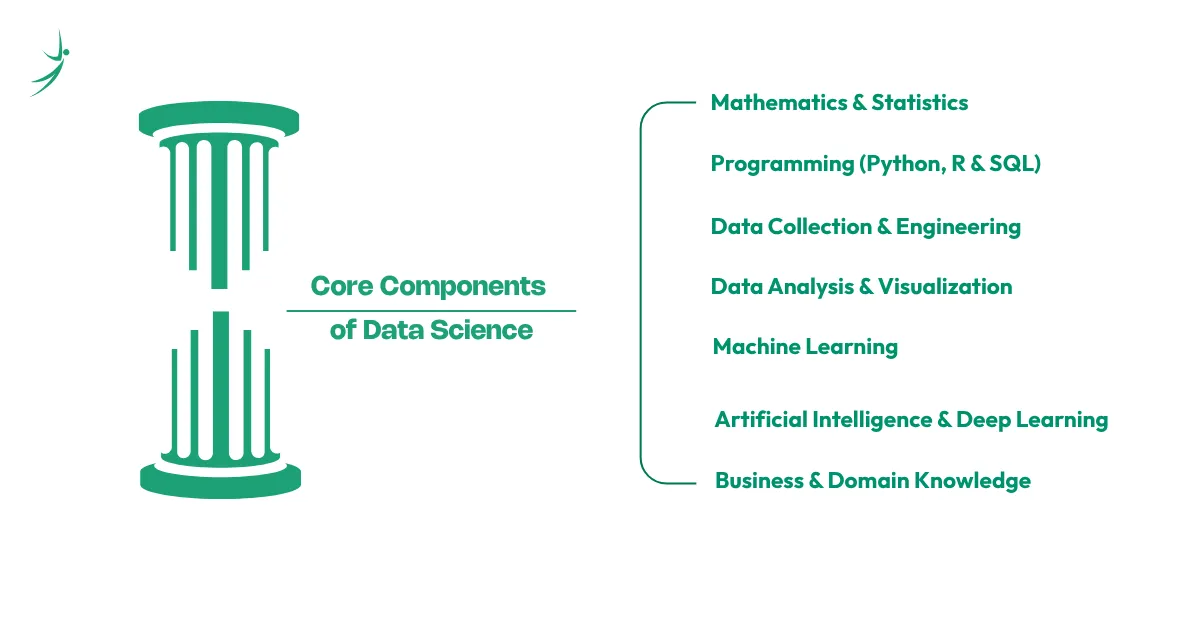
1. Mathematics & Statistics (The Foundation)
Every predictive model sits on top of fundamental math concepts:
- Probability: Essential for calculating risks and identifying the likelihood of future market shifts.
- Linear algebra: The primary driver behind multidimensional datasets and complex algorithmic engines.
- Statistical analysis: Allows professionals to validate hypotheses and differentiate actual trends from simple random noise.
2. Programming (Python, R & SQL)
Why programming matters: Code is the medium through which we instruct computers to clean, transform, and analyze datasets containing billions of rows.
- Python ecosystem: Python has become the undisputed king of data science due to its clean syntax and readability. If you want to dive deeper into this language, check out how using Python for data science forms the bedrock of modern corporate analytics.
- SQL for data querying: Relational databases store the world's commercial records. Structured Query Language (SQL) is the tool used to fetch, filter, and extract that data safely.
3. Data Collection & Engineering
Structured vs unstructured data: Data scientists work with clean tables (structured) as well as messy audio recordings, emails, and social media feeds (unstructured).
- Databases: Storing information securely requires deep knowledge of both SQL databases and NoSQL architectures. To understand who builds these large scale storage environments, look into the data engineer vs data scientist roles comparison to see how engineers lay the groundwork for scientists.
- ETL pipelines: Extract, Transform, and Load (ETL) is the standard method for taking data from various raw points, cleaning it up, and storing it in centralized warehouses.
4. Data Analysis & Visualization
- Exploratory Data Analysis (EDA): This is the initial investigation phase where scientists use graphs and summary statistics to understand the general characteristics of a new dataset.
- Dashboards: Transforming numbers into interactive visual applications like Tableau or PowerBI makes insights accessible to non-technical managers.
- Business insights: The ultimate goal of visualization is to highlight anomalies and growth opportunities that would otherwise remain buried in massive spreadsheets.
5. Machine Learning
This pillar enables software to learn without explicit programming rules:
- Supervised learning: Training algorithms using labeled data, like predicting house prices based on historical sales.
- Unsupervised learning: Grouping unlabeled data into clusters, which is highly useful for automated customer segmentation.
- Model building: Developing clean, reusable code structures to deploy automated decision engines. If you are looking to specialize in this wing, following a comprehensive machine learning complete roadmap ensures you do not miss vital steps. Furthermore, understanding the distinct boundaries of machine learning vs data science differences will keep your learning highly structured as you follow a specialized machine learning roadmap.
6. Artificial Intelligence & Deep Learning
- Neural networks: Simulating human brain structures to identify highly complex, non linear relationships within big data.
- Generative AI: Building models capable of producing original text, code, or images based on simple text prompts.
- Computer vision: Teaching machines to process, analyze, and understand digital images or live video feeds.
- NLP: Natural Language Processing allows systems to read and comprehend human languages effortlessly.
If your goal is to master these bleeding-edge subfields, building a dedicated ai ml roadmap or a general ai roadmap will give you an exact blueprint. Many developers rely on popular community frameworks, such as a customized deep learning roadmap sh style blueprint, to guide their progress. Aspiring AI builders should also map out a clear roadmap of machine learning engineer paths to transition smoothly into production environments. When building advanced vision systems, mastering deep learning path planning becomes incredibly vital for robotics and navigation applications.
7. Business & Domain Knowledge
- Turning insights into decisions: A technically flawless model is useless if it does not solve a real corporate problem.
- Understanding industry problems: True data experts must understand their specific sector, whether it is finance, healthcare, or retail, to ask the right questions and deliver actual financial value.
The Data Science Workflow: Lifecycle
To successfully complete any enterprise project, professionals navigate a highly structured process.
As shown in the diagram above, this workflow is a continuous loop where each phase informs the next. Let's break down the seven core stages of this lifecycle.
The Seven Stages of the Data Science Lifecycle
- Business Understanding: Defining the core problem, project scope, and success criteria before touching any code.
- Data Collection: Sourcing relevant information from APIs, web scraping, internal databases, or third party repositories.
- Data Cleaning: Fixing missing values, removing duplicate records, and correcting formatting errors. This phase takes up roughly 70% of a data scientist's time.
- Exploratory Data Analysis: Visualizing data distributions and discovering correlations between different variables.
- Feature Engineering: Selecting, transforming, and combining raw variables to create more informative inputs for mathematical models.
- Model Building & Evaluation: Training machine learning algorithms and testing their real world accuracy using historical validation sets.
- Deployment & Monitoring: Launching the finalized model into a production environment and constantly monitoring its performance to prevent degradation over time.
The Data Science Tools & Technologies Ecosystem
To carry out the stages mentioned above, professionals rely on an expansive toolkit. Reading about popular data science tools provides a great deep dive into how these platforms operate together.
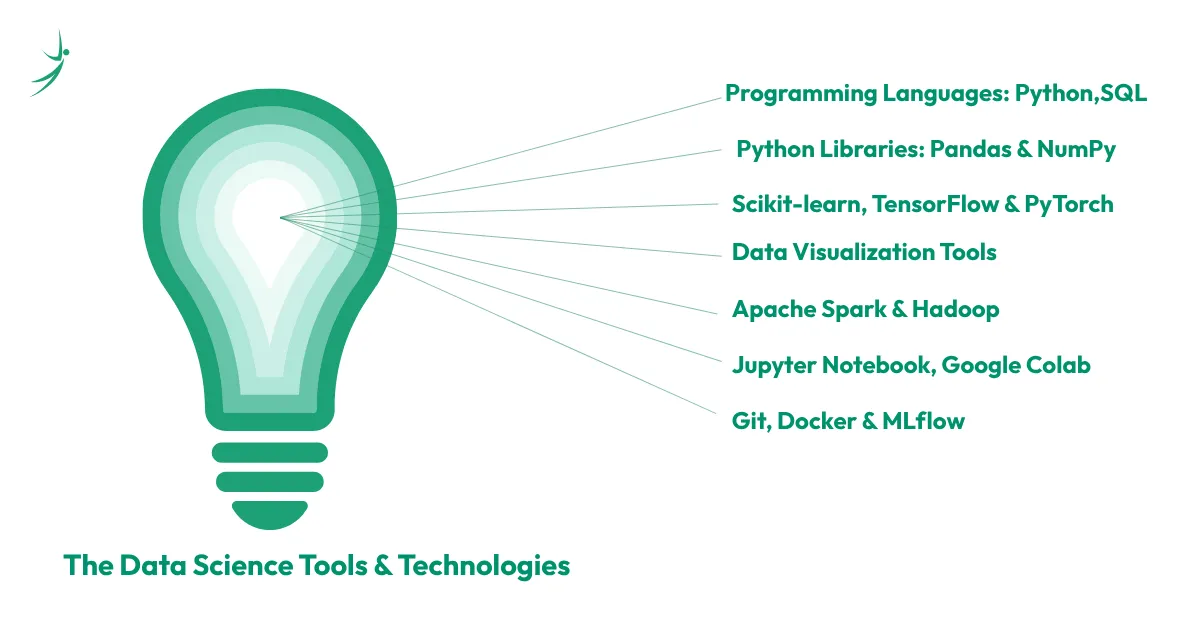
- Programming Languages: Python, R & SQL: Python dominates industry development, R remains a favorite for pure statistical research, and SQL is absolutely mandatory for managing core databases.
- Data Analysis Libraries: Pandas & NumPy: Pandas offers high performance data structures like DataFrames, while NumPy provides lightning fast mathematical operations for multi dimensional arrays.
- Machine Learning Frameworks: Scikit-learn, TensorFlow & PyTorch: Scikit-learn handles classic machine learning algorithms beautifully. For deeper neural networks and complex AI structures, TensorFlow and PyTorch are the gold standards globally.
- Data Visualization Tools: Matplotlib, Seaborn & Plotly: Matplotlib handles basic plotting, Seaborn turns raw data into beautiful statistical aesthetics, and Plotly enables highly interactive, web ready charts.
- Big Data Technologies: Apache Spark & Hadoop: When datasets grow too large for a single computer's memory, distributed systems like Apache Spark and Hadoop step in to split the computing load across large clusters.
- Development Environments: Jupyter Notebook, Google Colab & VS Code: Jupyter and Google Colab allow scientists to mix live code, equations, and visual charts in single interactive files. VS Code remains the ultimate environment for writing production grade software.
- Version Control & Deployment: Git, Docker & MLflow: Git tracks code changes across engineering teams. Docker packages applications into isolated containers to prevent deployment bugs, and MLflow tracks machine learning model experiments.
What is a Data Science Project?
A data science project is a practical application where you take a messy dataset, apply the entire data science lifecycle, and build a working solution to a problem. Building these is the primary way to prove your technical capabilities to recruiters.
Top Portfolio Project Ideas for Data Science Beginners
If you want to build a standout resume, working on data science projects for beginners is the best way to gain real confidence. Here are excellent examples to try:
- House Price Prediction: A classic regression project using parameters like square footage and location to estimate property values.
- Customer Churn Prediction: Classifying which subscription users are likely to cancel their service based on usage behavior.
- Movie Recommendation System: Building collaborative filtering systems similar to Netflix to suggest content to users.
- Fake News Detection: Applying Natural Language Processing to scan news headlines and flag misinformation.
- Credit Card Fraud Detection: Analyzing transaction histories to catch anomalous, unauthorized banking activities in real time.
- Sales Forecasting: Using time series analysis to help retail brands predict upcoming inventory demands.
- Sentiment Analysis: Scanning social media feeds to evaluate public opinions about specific product launches.
- Stock Price Prediction: Developing deep sequential models to map financial market fluctuations.
- Resume Screening AI: Automating the recruitment process by scanning CVs for specific corporate keywords.
- Image Classification: Building deep learning models to identify objects or medical anomalies within digital photographs.
What is a Data Scientist? Roles and Responsibilities
A data scientist is part analyst, part programmer, and part business advisor. Their responsibilities shift dynamically depending on corporate demands, but core tasks include:
- Data collection: Designing secure methods to aggregate records from distributed operational systems.
- Cleaning data: Filtering out corrupted entries, handling missing parameters, and ensuring high input quality.
- Model development: Creating, training, and fine tuning algorithms to maximize predictive accuracy.
- Business reporting: Converting complex algorithmic outputs into clean summaries that senior executives can understand.
- Dashboard creation: Building self service operational monitoring tools for non technical product managers.
- AI implementation: Setting up automated systems to handle repetitive human decisions.
- Collaboration with stakeholders: Partnering closely with engineering, marketing, and finance teams to solve high impact enterprise problems.
Data Science in the Age of Generative AI: Will It Be Replaced?
How AI Makes Data Scientists More Productive
Generative AI tools do not replace data scientists; they amplify them. Modern systems handle tedious tasks like boilerplate coding, debugging, and initial data cleaning. This shift frees up human experts to focus on complex architecture design, deep business context, and critical model evaluation.
Why Human Data Scientists Remain Essential
AI lacks intuition, domain understanding, and true critical thinking. An AI engine can generate a beautiful chart, but it cannot tell you why an unexpected drop in consumer metrics matters to your specific brand strategy. Furthermore, designing an enterprise ai integration roadmap requires human leadership to navigate ethical boundaries, privacy laws, and model biases.
The Future of Data Science and AI
The role is transforming from pure code writing to strategic system orchestration. Data scientists who know how to manage automated tools are experiencing unprecedented demand. To stay ahead of the curve, following an updated ai engineer roadmap 2025 blueprint will ensure you transition smoothly into these hybrid roles.
How to Start Your Data Science Journey
Starting out can feel overwhelming, but breaking down your educational journey into distinct, manageable steps changes everything.
Ready to stop planning and start building? Here is how to map your approach.
Following the Ultimate Data Science Roadmap
To avoid overwhelming yourself, take this structured data science roadmap phase by phase:
- The Foundations: Master statistical analysis, probability distributions, linear algebra basics, and foundational mathematical concepts.
- Core Programming: Deep dive into modern Python fundamentals, advanced data structures, and relational SQL data querying models.
- Data Engineering & Analysis: Learn exploratory data analysis, Pandas manipulation, data cleaning methodologies, and visualization libraries like Seaborn.
- Machine Learning: Study predictive model building, supervised and unsupervised learning algorithms, and structural evaluation metrics.
- Advanced AI & Deployment: Learn deep learning neural networks, generative AI concepts, and production model deployment pipelines.
Navigating a clear structured data science roadmap keeps you fully focused on skills that companies are actively hiring for right now.
Choosing the Best Data Science Course: Free vs Paid Learning
Free tutorials are excellent for getting your feet wet, but they often lack deep mentorship, updated production workflows, and job placement assistance. If you want to fast track your education, enrolling in a premier data science course in Kathmandu bridges the gap between basic theory and professional corporate standards. Choosing a targeted ai course or exploring the options for the best data science course in Nepal will give you access to live instructors, real world group projects, and structured portfolio reviews that self study simply cannot match.
Industry-Recognized Data Science Certifications
Earning external validation boosts your credibility significantly when entering the competitive job market. Excellent global and local options include:
- IBM Data Science Professional Certificate: A phenomenal entry level program covering fundamental Python tools and basic methodologies.
- Microsoft Certified - Azure Data Scientist Associate: Perfect for professionals wanting to validate their cloud based machine learning skills.
- Google Data Analytics Professional Certificate: Focused deeply on the foundational core of data analysis, SQL, and business metrics.
- AWS Certified Machine Learning: Best for validating advanced deployment capabilities within Amazon's cloud ecosystem.
- Databricks Certified Data Scientist: Highly respected for enterprise level big data processing capabilities.
- Skill Shikshya Certification: A localized, industry aligned certification highly recognized by top employers looking for skilled data professionals across the region.
Why Data Science is One of the Most In-Demand Careers
Choosing to build a professional data science career path or a specialized machine learning career path offers unmatched professional security. Let's look at why this field remains so incredibly attractive:
- High salaries: Because these skills directly impact profitability, corporations offer competitive compensation packages. Reading about the data scientist salary in Nepal highlights how lucrative this path is compared to standard IT roles.
- AI revolution: As automation sweeps through the corporate ecosystem, organizations require internal talent to design and control these systems.
- Remote jobs: Data science is inherently digital, allowing skilled individuals to work for international clients right from their living rooms.
- Cross-industry demand: From tracking disease spreads in healthcare to managing algorithmic trading in banking, every single vertical needs data experts.
- Career growth: The path from junior analyst to Chief Data Officer provides long term professional advancement.
- Future-proof skills: Technology will evolve, but the human capability to extract meaning from large sets of records will remain indispensable for decades.
Exploring the future scope of data science reveals just how deeply integrated this discipline has become across industries.
The Primary Challenges of Data Science (and How to Overcome Them)
- Poor-quality data: Real world data is messy, incomplete, and full of errors. Solution: Master advanced data cleaning techniques and build rigorous validation steps into your ETL pipelines.
- Data privacy: Stricter international regulations require safe handling of consumer metrics. Solution: Learn data anonymization practices and stay updated on local compliance policies.
- Model bias: Algorithms can unintentionally learn human prejudices hidden within historical data records. Solution: Always run thorough fairness audits and utilize balanced datasets during your training phases.
- Large datasets: Processing massive tables can slow down systems and inflate infrastructure costs. Solution: Learn to use distributed computing tools like Apache Spark to spread workloads efficiently.
- Keeping skills updated: The tech stack evolves rapidly, which can lead to early burnout. Solution: Focus heavily on mastering core foundations like statistics and basic programming, then learn specific software libraries only as needed.
- Business communication: Explaining complex mathematical equations to corporate stakeholders can create misunderstandings. Solution: Practice data storytelling, avoid using confusing jargon, and focus entirely on how your model helps the company grow.
- Model deployment: Many accurate models get stuck in notebooks and never reach production. Solution: Learn MLOps frameworks to bridge the gap between initial experimentation and live production engineering.
Conclusion
Data science has completely transitioned from an elite tech luxury into a core requirement for modern business survival. Understanding the baseline mechanics of this field is the first major step toward building a resilient, future proof career.
Whether your long term vision involves following a specialized machine learning nepal track, studying global systems, or reviewing how to get into data science strategies, the opportunities ahead are massive. Reviewing real student placement success stories proves that dedication combined with structured mentorship turns complete novices into highly competitive industry leaders. Take the leap, select a structured learning path, and start exploring the fascinating world of data today.
Frequently Asked Questions
What is data science ?
What does a data scientist do?
Is Python necessary for data science?
What is the difference between data science and machine learning?
About Author:

Dhiraj Bashyal is a Machine Learning Engineer at Vrit Technologies, with 3 years of hands-on experience in applied AI and machine learning. He brings that industry experience directly into the classroom, teaching Data Science and Machine Learning at Skill Shikshya, where he helps learners build a practical, project-ready foundation in Python, ML workflows, and real-world data problem-solving.