Data Science and Machine Learning Skills: Complete Guide for Beginners (2026) | Skill Shikshya
The digital landscape is changing rapidly, and data has become the ultimate driver of strategic innovation. If you are looking to build a futureproof career, acquiring a robust combination of data science skills and machine learning capabilities is your most certain pathway. At Skill Shikshya, we design our best Data Science and Machine Learning Course in Nepal to equip you with real world expertise, taking you from foundational concepts to building advanced generative AI architectures. Navigating this vast domain requires a clear understanding of what data science is and how these analytical capabilities translate into high paying tech opportunities.
Before exploring the essential skills, learn what Data Science and Machine Learning are and how they power modern AI-driven applications.
Why Data Science and Machine Learning Skills Matters
The major reasons are:
- Exploding Global Demand: The massive explosion of corporate data has created an unprecedented global demand for qualified data professionals. Every modern organization relies heavily on algorithmic intelligence to optimize operations, enhance customer retention, and automate workflows.
- Industry Transformation via AI: Artificial Intelligence is actively transforming every industry, from healthcare diagnostic tools to real-time financial fraud detection systems.
- Emphasis on Practical Expertise: In this highly technical environment, employers now place a far greater emphasis on practical skills and portfolio evidence than on traditional academic degrees. If you can clean a complex dataset, deploy an optimized model, and extract actionable business insights, you are highly employable.
- Lucrative Opportunities in Nepal and Globally: This shifting paradigm provides incredible career opportunities in Nepal and globally. Organizations across Kathmandu and international remote platforms are searching for individuals who possess a comprehensive technical capabilities matrix.
- Accessible to Diverse Backgrounds: This path is ideal for computer science graduates, software developers looking to transition into AI, business analysts wanting to upgrade their analytical power, or even ambitious beginners with strong logical capabilities.
To begin exploring this vast career field, read through our detailed guide on how to break into the data science industry industry to map out your long term career trajectory.
Core Technical Skills Every Data Scientist and Machine Learning Engineer Needs
Build job ready skills for data science and machine learning.
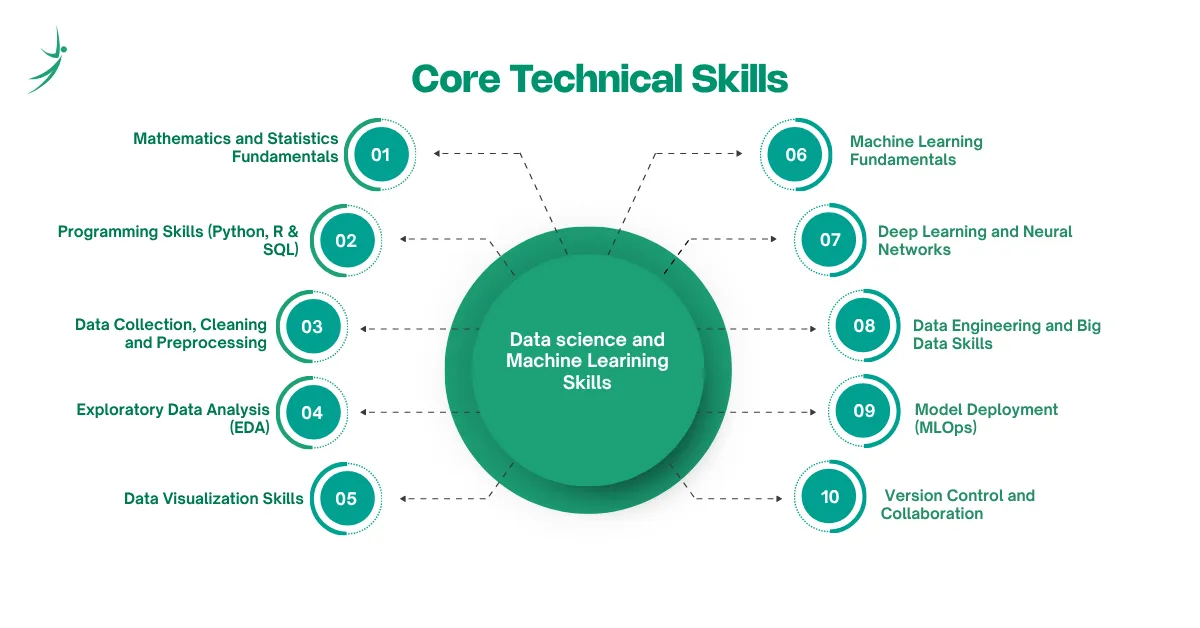
1. Mathematics and Statistics Fundamentals
You cannot build reliable corporate solutions without mastering underlying quantitative concepts. Acquiring specific data science math skills ensures you can evaluate model metrics accurately and avoid algorithmic bias.
- Probability: Crucial for understanding stochastic processes, Bayesian models, and prediction confidence intervals.
- Descriptive Statistics: Mastering measures of central tendency, variance, data distribution, and standard deviation.
- Inferential Statistics: Conducting hypothesis testing, calculating p values, and understanding A/B testing frameworks.
- Linear Algebra: The mathematical bedrock of advanced operations, focusing on vectors, matrices, matrix multiplication, and eigenvalues.
- Calculus (basics): Understanding partial derivatives and gradients to grasp how optimization systems operate.
- Optimization: Learning gradient descent techniques to minimize error rates in complex predictive systems.
Developing a foundational grasp of machine learning math allows professionals to understand exactly what happens underneath the hood of automated software libraries.
2. Programming Skills (Python, R & SQL)
Code is the primary mechanism used to translate mathematical concepts into functional applications. If you review any comprehensive data analytics skills list, proficiency in database management and core programming is mandatory.
- Python fundamentals: The absolute standard language for modern data tasks due to its vast ecosystem. For a closer look, explore our guide on mastering Python programming for data analysis.
- Object-oriented programming: Writing clean, modular, reusable code for scalable software deployment.
- R programming (optional): Highly effective for heavy statistical research and legacy data analysis architectures.
- SQL queries: Mastering relational databases, joins, subqueries, indexing, and advanced aggregation techniques.
- Data manipulation: Slicing, indexing, filtering, and structuring complex unorganized data tables.
3. Data Collection, Cleaning and Preprocessing
Raw enterprise data is rarely clean. It is often filled with missing values, formatting anomalies, and duplicate records.
- Data gathering: Fetching information via web scraping APIs, database connections, and unstructured text files.
- Missing values: Deciding whether to drop rows or impute values using statistical means, medians, or algorithmic predictions.
- Outlier detection: Identifying anomalous records using Z scores or Interquartile Range methods.
- Feature engineering: Creating new informative variables out of existing data to boost predictive accuracy.
- Data transformation: Normalizing, scaling, and encoding categorical text attributes into format friendly numerical matrix inputs.
- Machine learning pipeline: Building structured automation layers that systematically run data through validation, cleaning, and transformation processes without human intervention.
4. Exploratory Data Analysis (EDA)
EDA allows you to interrogate your data before building complex models. This phase relies heavily on exploring diverse machine learning datasets to detect hidden anomalies.
- Understanding datasets: Examining shape, data types, and primary structural aspects of information files.
- Statistical summaries: Analyzing percentile spreads, standard deviations, and value distributions.
- Correlation analysis: Utilizing heatmaps to identify strong linear or non-linear relationships among variables.
- Pattern discovery: Uncovering seasonal variations, cyclical trends, or clusters within the dataset.
- Data storytelling: Translating technical data observations into strategic insights for business decision makers.
5. Data Visualization Skills
Representing structural data visually is the easiest way to align your technical findings with executive corporate objectives.
- Matplotlib: The foundational 2D plotting library for Python visualizations.
- Seaborn: Built on top of Matplotlib, providing beautiful statistical graphics out of the box.
- Plotly: Creating interactive, web ready dashboards and dynamic user charts.
- Tableau: Drag and drop business intelligence tool used to build enterprise grade analytical dashboards.
- Power BI: Microsoft business analytics service offering robust cloud data connection capabilities.
6. Machine Learning Fundamentals
Developing strong machine learning skills means understanding when to apply specific types of algorithmic logic to solve specific business problems.
- Supervised Learning: Teaching models using labeled training data. This includes mastering standard machine learning algorithms like machine learning linear regression for continuous value prediction and machine learning decision tree architectures for robust categorical classification tasks.
- Unsupervised Learning: Grouping unlabeled structural records based on intrinsic similarities using machine learning unsupervised learning methods such as K-Means clustering.
- Reinforcement Learning: Training autonomous systems using systems of behavioral rewards and penalties.
- Model Selection: Comparing multiple statistical approaches to find the most accurate algorithmic fit for a specific challenge.
- Training vs Testing: Splitting historical data cleanly to train your systems while holding back unseen data for unbiased performance validation.
- Evaluation Metrics: Grading your machine learning models using structural indicators like Precision, Recall, F1 Score, ROC AUC, and Mean Squared Error.
7. Deep Learning and Neural Networks
Deep learning powers modern breakthroughs in image generation, natural language understanding, and automated vision systems.
- Artificial Neural Networks: Understanding input layers, hidden structures, weights, biases, and activation functions.
- CNN: Convolutional Neural Networks designed for computer vision and advanced spatial pixel processing.
- RNN: Recurrent Neural Networks used for sequential timeline processing and text analysis.
- Transformers: Modern foundational attention mechanisms that changed natural language modeling.
- LLM Fundamentals: Learning the structural building blocks of modern Large Language Models.
- Generative AI: Designing deep learning engines capable of generating novel synthetic images, text, or functional code blocks.
To properly understand how these complex architectures build upon core analytics, read our detailed introduction to deep learning architectures.
8. Data Engineering and Big Data Skills
When datasets grow into terabytes and petabytes, standard computer hardware fails, necessitating cloud systems and distributed frameworks.
- ETL: Extracting, Transforming, and Loading corporate data assets across diverse organizational databases.
- Apache Spark: Utilizing distributed memory clusters to process heavy computations at lightning speeds.
- Hadoop: MapReduce frameworks designed for distributed storage and heavy data processing.
- Data Warehousing: Managing cloud repositories like Snowflake or Amazon Redshift.
- Cloud Storage: Storing unorganized data safely within scalable systems like AWS S3 or Google Cloud Storage buckets.
Understanding the direct connection between processing big data and model building is vital. Read our comparison on the roles of data engineers versus data scientists to see how these specialized professionals collaborate.
9. Model Deployment (MLOps)
A predictive model provides zero corporate value if it sits isolated on a local Jupyter Notebook.
- Docker: Packaging application code, dependencies, and environment configurations into reliable software containers.
- FastAPI: Building high performance, production ready RESTful backend web APIs to serve predictions.
- Flask: Utilizing lightweight Python web frameworks to deploy microservices.
- Streamlit: Rapidly converting data scripts into functional web based dashboard interfaces for clients.
- MLflow: Managing the lifecycle of machine learning, including experimentation, reproducibility, and deployment tracking.
- CI/CD for ML: Setting up automated continuous integration and delivery pipelines for machine learning code updates.
- Monitoring Models: Tracking post deployment prediction decay, data drift, and performance latency.
10. Version Control and Collaboration
Modern enterprise work requires collaboration within multi disciplinary teams. Developing a complete data science skills set requires solid version control capabilities.
- Git: Locally tracking code updates, managing repository branches, and rolling back errors.
- GitHub: Hosting open source code, managing code pull requests, and conducting team reviews.
- Documentation: Writing detailed readmes, system architecture summaries, and inline code explanations.
- Agile workflow: Participating in sprint planning, using Jira boards, and hitting project milestones.
- Team collaboration: Syncing efficiently with business executives, data engineers, and cloud architecture specialists.
Essential Data Science and Machine Learning Tools
To navigate the industry successfully, you must master the fundamental software ecosystem. You can read a complete breakdown of these core components in our review of must have data science and machine learning software tools.
| Category | Specific Tools to Master |
| Programming Languages | Python, SQL, R |
| Data Analysis Libraries | Pandas, NumPy |
| Machine Learning Libraries | Scikit-learn, TensorFlow, PyTorch, XGBoost |
| Visualization Tools | Tableau, Power BI, Matplotlib, Seaborn |
| Development Environments | Jupyter Notebook, Google Colab, VS Code |
| Cloud Platforms | AWS (Amazon Web Services), Azure, Google Cloud Platform |
Soft Skills Every Data Scientist and ML Engineer Needs
To turn information into business success, professionals must develop foundational non technical capabilities. True mastery requires combining heavy computational skills with specific data science key skills that ensure your findings drive real organizational value.
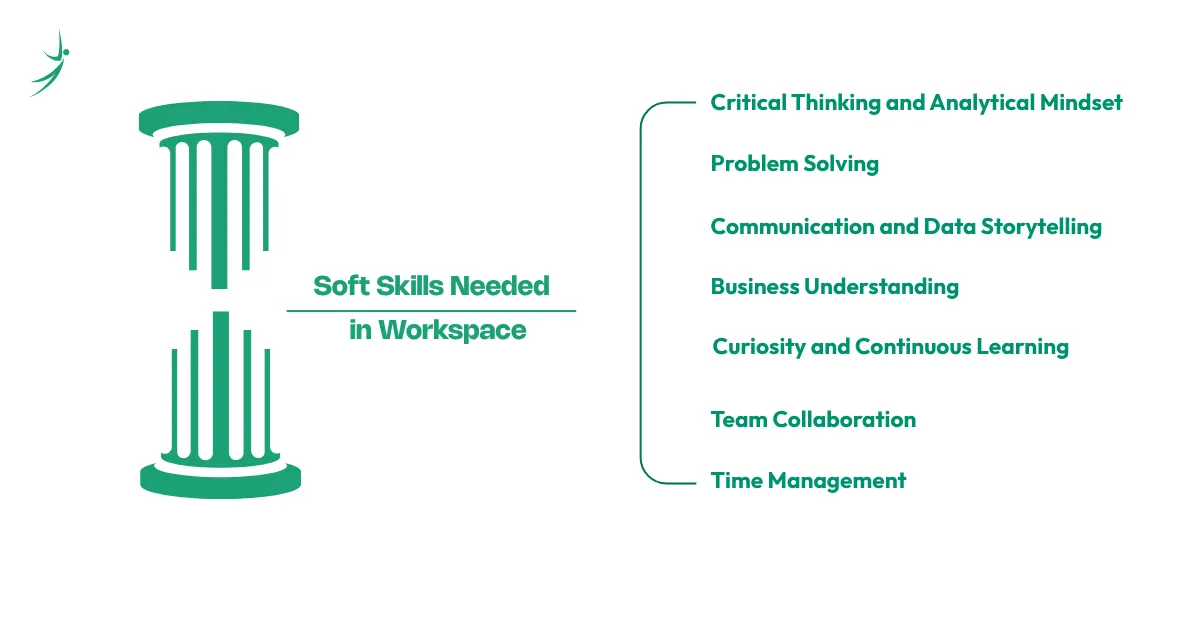
- Critical Thinking and Analytical Mindset: Questioning baseline corporate assumptions and validating data credibility before running models , which allows you to break down large enterprise operational challenges into structured, testable hypotheses.
- Problem Solving: Designing creative data workarounds when dealing with restricted, unstructured, or messy input parameters.
- Communication and Data Storytelling: Explaining complex neural network operations to non technical stakeholders clearly and building compelling narrative journeys out of historical numbers to justify corporate investments.
- Business Understanding: Aligning data collection strategies with organizational revenue goals and performance metrics.
- Curiosity and Continuous Learning: Actively searching out fresh open source tools and novel analytical methodologies while regularly updating your knowledge base as fresh generative AI architectures launch weekly.
- Team Collaboration: Working fluidly with multi functional corporate marketing, engineering, and sales business units.
- Time Management: Balancing multiple parallel exploratory analytics tracks and model optimization schedules.
To understand how these traits define a professional analyst, read our guide on the essential attributes of a professional data scientist.
Most In-Demand Data Science and Machine Learning Skills in Nepal
The employment landscape for technical experts is growing rapidly. Many local startups, fintech banks, logic outsourcing firms, and international telecom agencies are creating dedicated internal intelligence units, driving a major spike in data science jobs in nepal.
Skills Most Requested by Nepalese Employers
Local organizations in Nepal prioritize rapid development cycles and immediate business intelligence support.
- Python: The undisputed language standard required across Nepalese development houses.
- SQL: Essential for querying complex banking, e commerce, and local enterprise transactional databases.
- Power BI: Heavily utilized by executive leadership teams in Nepal for interactive weekly corporate reporting.
- Machine Learning: Building localized recommendation engines, demand forecasting software, and automated credit scoring systems.
- Statistics: Ensuring corporate analytical conclusions stand up to mathematical verification.
- Excel: Used widely for fast financial parsing, quick cross calculations, and initial data reporting.
- AI: Integrating modern pre-trained deep learning APIs into legacy application architectures.
Skills Required for Remote International Jobs
If you intend to work for global corporations from Nepal, you must target advanced architecture domains.
- Cloud Computing: Setting up scalable, enterprise grade data environments inside global cloud frameworks.
- MLOps: Managing complex, automated model deployment pipelines across distributed cloud nodes.
- Deep Learning: Architecting advanced multi layered neural systems for complex computer automation tasks.
- NLP: Building contextual chatbots, parsing translation layers, and conducting automated sentiment analysis.
- Computer Vision: Implementing real time object identification, facial recognition, and image classification systems.
- LLM Applications: Customizing major open source models via advanced fine tuning and Retrieval Augmented Generation (RAG).
- Generative AI: Engineering specialized corporate prompt workflows and synthetic text generation nodes.
To see how mastering these localized and global technical requirements impacts your potential earnings, read our breakdown of the average data scientist salary in Nepal.
How to Build Your Data Science and Machine Learning Skills
Transitioning into this high income field requires following a methodical, disciplined learning strategy. To build a solid foundation, it is vital to review a best data science learning path to track your progressive development phases.
- Learn Programming Fundamentals: Begin by learning Python core syntax. Master data containers, loop logic, custom functions, and object-oriented paradigms. Move directly into using Pandas and NumPy libraries for handling structured analytical data tables.
- Master Statistics: Dedicate structured time to understanding central tendency, variance distributions, probability metrics, and hypothesis testing. This ensures your data conclusions are accurate and structurally sound.
- Practice with Real Datasets: Avoid working solely with perfectly cleaned textbook data tables. Download messy public datasets from open web platforms to practice real world parsing, handling missing entries, and removing outlier anomalies.
- Build Portfolio Projects: Apply your knowledge by building unique analytics engines. Create end-to-end models that address tangible problems. To guide your project work, explore our curated list of hands on data science portfolio projects for inspiration.
- Participate in Kaggle Competitions: Join global online challenges to test your capabilities against international data professionals. Review public Kaggle community code notebooks to learn advanced feature optimization tricks from elite engineers.
- Learn Deployment: Do not stop once your model training finishes. Learn how to wrap your functional code into Docker containers and deploy your work as public web APIs via FastAPI frameworks.
- Contribute to Open Source: Review public GitHub repositories of useful data utilities. Read open code bases, correct documentation bugs, submit pull requests, and learn from global peer reviews.
- Earn Certifications: Validate your practical capabilities by completing a structured data science skills assessment and securing respected professional credentials. Industry recognized certifications demonstrate your technical proficiency to corporate recruiters.
Common Mistakes Beginners Make While Learning Data Science and ML
The most common mistakes begineer data science and machine learning enthusiast made are :
- Learning algorithms before Python: Trying to understand complex random forest mathematics without knowing how to write clean, operational Python code scripts.
- Ignoring statistics: Assuming machine learning software libraries require zero structural math understanding, leading to inaccurate predictions and model bias.
- Memorizing instead of practicing: Watching endless tutorial streams without manually writing, testing, and debugging your own code.
- No portfolio: Completing countless online modules without publishing a personal public GitHub repository to showcase your practical coding abilities.
- Not deploying projects: Building predictive systems that only run locally inside isolated personal Jupyter notebooks without ever exposing them to web APIs.
- Avoiding SQL: Focusing exclusively on deep learning tools while completely ignoring relational databases, which store the vast majority of real world corporate data.
- Skipping EDA: Jumping straight into complex predictive model training phases before checking data quality or identifying structural anomalies.
To avoid these common pitfalls, it helps to understand the core differences between related technical fields. Read our detailed analysis on the difference between data science, analytics, and analysis to clarify your path.
Data Science Skills vs Machine Learning Skills
While these domains share considerable overlap, they focus on different core objectives. To clarify your specialization path, read our comprehensive comparison of machine learning and data science.
| Data Science Focus | Machine Learning Focus |
| Data Analysis: Discovering hidden corporate insights | Model Building: Creating automated predictive applications |
| SQL: Querying large, unstructured relational databases | Algorithms: Optimizing complex operational code models |
| Visualization: Building beautiful dashboard visual tracking | Neural Networks: Designing multi layered deep architectures |
| Statistics: Verifying hypotheses and analytical trends | Feature Engineering: Optimizing data tables for algorithmic inputs |
| Business Insights: Driving corporate decision making | Model Optimization: Reducing execution error rates |
| Dashboarding: Building reporting systems for stakeholders | Deployment: Integrating live models into production code |
Developing a comprehensive understanding of both paths helps define the top skills required for data scientist roles across the modern tech sector.
Career Opportunities After Learning Data Science and Machine Learning Skills
Acquiring these advanced capabilities opens doors to a wide range of highly rewarding, specialized tech roles across the global economy.
- Data Scientist: Extracting deep operational insights, run experimental models, and guide executive corporate strategies.
- Machine Learning Engineer: Scaling, optimizing, and deploying automated predictive software applications into live production environments.
- Data Analyst: Tracking daily corporate metrics, running SQL aggregations, and maintaining business dashboards.
- AI Engineer: Designing, building, and fine tuning advanced artificial intelligence architectures and generative models.
- Business Intelligence Analyst: Transforming large datasets into structured strategic visual reports for corporate leadership teams.
- Data Engineer: Creating the foundational data pipelines, extraction layers, and distributed computing warehouses that power analytical applications.
- Research Scientist: Inventing novel data processing approaches and advanced machine learning algorithms within corporate R&D spaces.
- NLP Engineer: Engineering software applications that interpret, translate, and synthesize human languages.Computer Vision Engineer: Developing visual automated inspection models, facial tracking tools, and real time processing applications.
- MLOps Engineer: Managing infrastructure scaling, container tracking, and continuous integration systems for machine learning deployments.
To see how these advanced technical roles can change your professional trajectory, explore a real world student career placement success story from our graduates.
Elevate Your Data Science and Machine Learning Career with Skill Shikshya
Building a successful career in this highly technical domain requires focused, practical preparation. The top 12 skills data scientists need to succeed in 2026 demand hands on experience with live data assets, automated deployment tools, and real world enterprise business problems.
At Skill Shikshya, we deliver premium tech education designed to turn ambitious learners into field ready professionals. Our industry leading data science training program in Nepal provides a comprehensive learning environment:
- Industry-led Curriculum: Master the exact toolsets requested by modern corporate tech employers.
- AI-integrated Training: Gain hands on experience building and optimizing modern Large Language Models and Generative AI pipelines.
- Real-world Projects: Build a robust professional portfolio by engineering solutions for actual corporate datasets.
- Internship Opportunities: Gain valuable professional experience working on live enterprise production tasks.
- Career Counseling: Map out your specialized career path with guidance from experienced data professionals.
- Placement Assistance: Connect directly with leading tech companies through our structured local and international hiring network.
- Portfolio Development: Create an impressive public GitHub repository that showcases your data engineering capabilities to recruiters.
- Certification: Earn respected professional credentials that validate your skills across the global technology marketplace.
Take the definitive step toward professional success. Secure your place in our next cohort and build the futureproof technical capabilities you need to thrive.
Frequently Asked Questions
What skills are required for data science?
What skills are required for machine learning?
How long is a data science course?
Can machine learning predict the stock market?
Why is machine learning used?
Where is machine learning used?
Which machine learning course is best?
Does machine learning require a GPU?
What does a machine learning engineer do?
How much does a machine learning engineer earn?
About Author:

Dhiraj Bashyal is a Machine Learning Engineer at Vrit Technologies, with 3 years of hands-on experience in applied AI and machine learning. He brings that industry experience directly into the classroom, teaching Data Science and Machine Learning at Skill Shikshya, where he helps learners build a practical, project-ready foundation in Python, ML workflows, and real-world data problem-solving.