Data Science & Machine Learning Roadmap 2026
In the current technological landscape of 2026, data has firmly established itself as the core engine driving global business transformation. Organizations no longer just store information; they actively deploy complex algorithmic models to automate processes, forecast market shifts, and build intelligent applications. If you are determined to break into this high-impact field, enrolling in a best data science and machine learning course in Nepal is the most definitive action you can take to build production-ready expertise. Navigating this vast ecosystem requires a structured approach, and following a verified data science roadmap will keep your learning organized, linear, and highly efficient. Whether your ultimate goal is to find international remote roles or secure top-tier local positions, selecting a well-designed data scientist course in Nepal provides the technical framework, professional mentorship, and portfolio structure required to go from absolute beginner to industry professional.
What Is Data Science?
To understand the fundamentals of what is data science, one must view it as a comprehensive, multidisciplinary field. It extracts hidden patterns and actionable knowledge from vast amounts of both structured and unstructured datasets by combining scientific methodologies, statistical mathematics, and specialized programming systems.
What Is Machine Learning?
When diving into the core definition of what is machine learning, it is a dedicated branch of artificial intelligence that focuses on building systems capable of learning from historical data. Instead of relying on rigid, explicitly written rules, these algorithms identify statistical regularities to improve their accuracy automatically over time.
Why Learn Data Science & Machine Learning in 2026?
The year 2026 marks an era where specialized automated intelligence is integrated into every software stack. Following a modern machine learning roadmap 2026 ensures that you are acquiring skills that are future-proof. Organizations are moving away from legacy analytics and moving aggressively toward predictive architectures, making this specific skill set incredibly valuable.
What Does a Data Scientist Do?
A data scientist acts as a strategic bridge between raw technological infrastructure and corporate execution. When analyzing the operational boundaries of data engineer vs data scientist roles, the data scientist focuses on constructing predictive models, deploying statistical evaluations, and crafting the analytics architecture that directly answers major corporate questions.
What does machine learning engineer do?
A Machine Learning (ML) Engineer is a specialized software engineer who sits at the absolute intersection of data science and traditional software engineering. While a data scientist focuses on exploring data, running statistical experiments, and prototyping models, a Machine Learning Engineer is responsible for taking those prototype models and building the production-ready infrastructure needed to deploy, scale, and maintain them in the real world.
Why Data Science Is One of the Best Career Choices in 2026
Data Science vs Machine Learning vs Artificial Intelligence
Understanding how these domains intersect is crucial for your professional journey. By comparing machine learning vs data science, we can see that while data science covers the entire lifecycle of data management and analysis, machine learning provides the predictive algorithms, and AI serves as the overarching umbrella of automated intelligence.
Industries Hiring Data Scientists
The demand for these skills spans almost every major sector globally:
- Finance & Banking: Driving automated fraud detection systems and algorithmic high-frequency trading.
- E-Commerce: Powering hyper-personalized consumer recommendation engines.
- Healthcare: Scaling automated medical imaging diagnostics and genetic sequencing analytics.
- Logistics & Supply Chain: Optimizing distribution routes and predicting accurate inventory demands.
Why Every Business Needs Data Science
In a highly competitive corporate environment, relying on intuition or guesswork is a recipe for failure. Businesses utilize advanced analytics to minimize operational inefficiencies, identify hidden market opportunities, optimize pricing strategies, and thoroughly understand shifting customer behaviors.
Industries Hiring Machine Learning Engineers
The demand for these specialized engineering skills spans across every major technological sector globally:
- Automotive and Autonomous Systems: Powering self driving vehicles, advanced driver assistance systems, and complex deep learning path planning algorithms to navigate real world terrain safely.
- Cybersecurity and Cloud Infrastructure: Deploying real time algorithmic anomaly detection, automated user behavior profiling, and predictive threat hunting systems to protect sensitive corporate networks.
- Entertainment and Streaming Media: Driving deep semantic content recommendation engines, predictive user engagement analytics, and automated content tagging architectures to personalize user experiences at scale.
- Manufacturing and Robotics: Enabling highly accurate predictive maintenance protocols for factory machinery, autonomous assembly line sorting, and high speed automated quality control visual inspections.
Why Every Business Needs Machine Learning?
In a modern digital economy, reliance on static software rules and manual data analysis is no longer scalable. Committing to a robust corporate machine learning roadmap allows organizations to construct systems that automatically learn, evolve, and adapt from new operational inputs without explicit manual reprogramming. Businesses utilize these predictive technologies to automate repetitive cognitive tasks, scale complex real time decision workflows, drastically minimize operational overhead, and establish a clear ai integration roadmap designed to keep their technical architecture completely future proof.
The Complete Data Science & Machine Learning Roadmap (Step-by-Step)
To navigate this field successfully, you must commit to a structured data science learning path that builds your skills logically from the ground up.
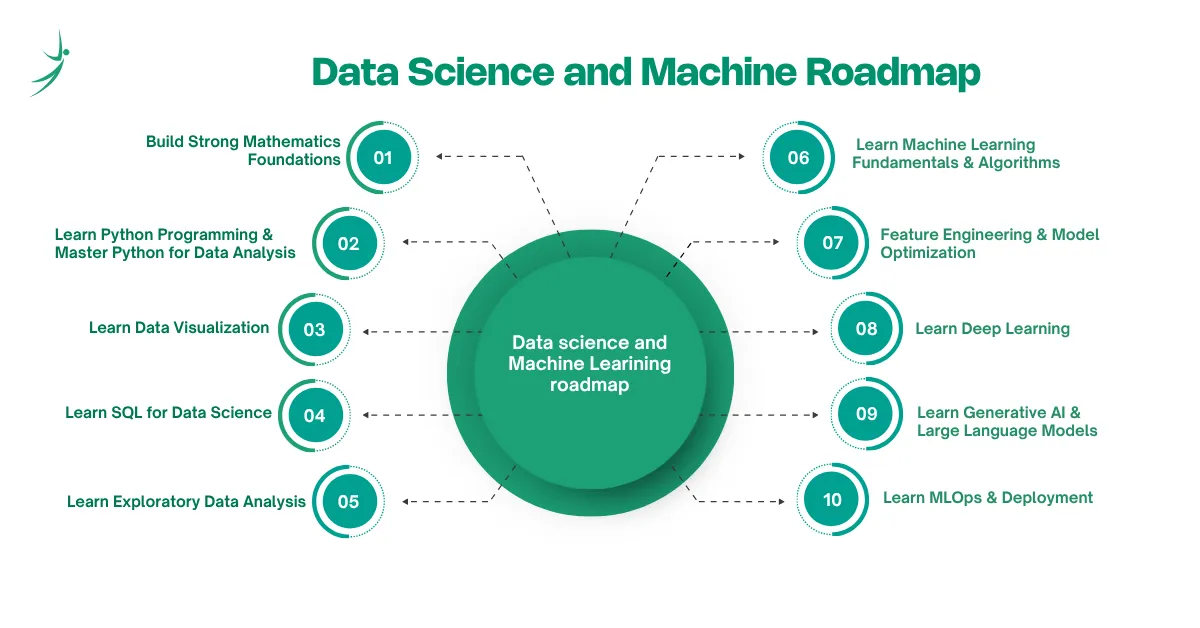
1. Build Strong Mathematics Foundations
Before writing scripts or building models, you must master the fundamental mathematical frameworks that power complex algorithms:
- Linear Algebra: Focus heavily on matrices, vectors, eigenvalues, and eigenvectors, which form the structural basis of data representation.
- Probability: Master conditional probability, Bayes theorem, and random variables to evaluate model uncertainties.
- Statistics: Learn descriptive and inferential statistics, hypothesis testing, p-values, and diverse probability distributions.
- Calculus: Understand differential calculus and partial derivatives to comprehend optimization methods like gradient descent.
2. Learn Python Programming & Master Python for Data Analysis
Python is the undisputed language of the modern data community. When learning Python, your initial focus should center around basic syntax before transitioning directly into data-specific operations. Distinguishing between data science vs data analytics vs data analysis reveals that deep data preparation is where data scientists spend most of their time:
- Variables & Data Types: Understanding strings, lists, dictionaries, tuples, and sets.
- Functions & Control Flow: Writing reusable modules, handling conditional statements, and optimizing loops.
- Object-Oriented Programming (OOP): Implementing classes, inheritance, and encapsulation for scalable code.
- Libraries & Package Managers: Utilizing pip to install and manage external software dependencies.
- Virtual Environments: Isolating development environments using venv or Conda to avoid version conflicts.
- NumPy: Managing high-performance multidimensional arrays and vector operations.
- Pandas: Mastering DataFrames to load, filter, merge, and group real-world datasets.
- Data Cleaning: Identifying structural anomalies, handling missing information, and resolving data inconsistencies.
- Data Manipulation: Transforming structural text strings, altering column types, and parsing complex datetime formats.
3. Learn Data Visualization
Data is only valuable if its insights can be communicated effectively to corporate stakeholders. Use visualization to convert dense numeric matrices into highly scannable narratives:
- Matplotlib: Constructing basic static graphs, histograms, scatter plots, and custom subplots.
- Seaborn: Layering attractive, advanced statistical visualizations over Matplotlib defaults.
- Plotly: Building dynamic, interactive charts that allow users to hover, zoom, and filter data points.
- Dashboard Basics: Combining diverse charts to tell a unified story about business operations.
4. Learn SQL for Data Science
Corporate data rarely lives in clean files. It is secured inside relational database management systems. You must learn SQL to interact with these environments:
- Queries: Using SELECT statements with complex WHERE filters to retrieve targeted records.
- Joins: Combining information from multiple database tables using INNER, LEFT, RIGHT, and FULL joins.
- Aggregations: Summarizing massive transactional logs using GROUP BY, HAVING, and functions like SUM, AVG, and COUNT.
- Window Functions: Running advanced analytical calculations across specific data partitions using ROW_NUMBER, RANK, and LEAD/LAG.
- Database Concepts: Understanding primary keys, foreign keys, indexing, and normalization practices.
5. Learn Exploratory Data Analysis (EDA)
EDA is the critical diagnostic process of analyzing datasets to summarize their main statistical characteristics before formal modeling begins:
- Data Cleaning: Stripping out duplicate values and rectifying systematic input errors.
- Feature Understanding: Inspecting data types, counts, and basic ranges to grasp the structure.
- Correlation Analysis: Utilizing correlation matrices and heatmaps to discover linear dependencies between data points.
- Outlier Detection: Implementing box plots and Z-score calculations to isolate data points that deviate drastically from the norm.
- Missing Values: Deciding whether to drop rows or impute missing data using mean, median, or predictive modeling.
6. Learn Machine Learning Fundamentals & Master Machine Learning Algorithms
With clean data ready, you can now enter a structured machine learning roadmap to understand model architectures. A robust roadmap of machine learning engineer specialties requires deep practical knowledge of both core learning theories and foundational algorithms:
- Supervised Learning: Training algorithms on fully labeled target datasets to map inputs to correct outputs.
- Unsupervised Learning: Finding underlying structures or clusters in data that does not have predefined labels.
- Reinforcement Learning: Training autonomous agents to maximize cumulative rewards through trial and error.
- Model Evaluation: Measuring model health using precision, recall, F1-score, ROC-AUC, and mean squared error (MSE).
- Linear & Logistic Regression: For continuous numeric predictions and binary classification tasks.
- Decision Trees & Random Forests: Utilizing tree-based decision logic and ensemble methods to boost prediction power.
- Support Vector Machines (SVM): Drawing optimal geometric hyperplanes to separate complex data classes.
- KNN & Naive Bayes: Applying distance-based metrics and probabilistic theories for quick classification.
- Gradient Boosting & XGBoost: Leveraging velocity-based error correction models to achieve state-of-the-art accuracy on tabular datasets.
7. Feature Engineering & Model Optimization
Raw features are rarely optimal for machine learning algorithms. Optimization refines your data to maximize model performance:
- Feature Selection: Removing redundant or low-value metrics to simplify models and prevent overfitting.
- Feature Scaling: Using normalization and standardization to bring all numeric inputs into an identical scale.
- Hyperparameter Tuning: Implementing Grid Search and Random Search to discover the absolute best algorithm settings.
- Cross-Validation: Utilizing K-Fold cross-validation to ensure models generalize well to completely unseen data.
8. Learn Deep Learning
For unstructured data like images or raw text, you must dive deeper into what is deep learning. For individuals wanting a hyper-specialized mathematical track, checking out a community-driven deep learning roadmap sh will show you the exact sequence of dense neural operations to study:
- Neural Networks: Designing interconnected layers of artificial neurons that mimic biological pathways.
- TensorFlow & PyTorch: Master these industry-standard frameworks to write, compile, and execute deep models.
- CNNs & RNNs: Deploying Convolutional Neural Networks for computer vision and Recurrent Neural Networks for sequential data.
- Transformers: Mastering attention mechanisms, which form the core engine behind modern language understanding.
9. Learn Generative AI & Large Language Models
The modern AI landscape demands proficiency in advanced foundational systems. Your ai roadmap is incomplete without generative technologies:
- Prompt Engineering: Crafting highly optimal text instructions to extract accurate outputs from pre-trained language models.
- OpenAI APIs & Hugging Face: Integrating commercial language models and open-source model weights into custom software applications.
- LangChain: Building complex application pipelines that link multiple model prompts, memories, and tools together.
- RAG (Retrieval-Augmented Generation): Connecting LLMs to private corporate databases to eliminate model hallucinations.
- AI Agents: Designing semi-autonomous workflows where language models call external APIs to execute real-world tasks.
10. Learn MLOps & Deployment
A model that only runs on your local computer provides zero commercial value. You must transition your work into a unified ai integration roadmap to make systems accessible:
- Flask/FastAPI: Packaging your trained Python model weights inside lightweight web APIs.
- Docker: Packaging application code, libraries, and system configurations inside isolated container systems.
- Git & GitHub: Versioning source code and collaborating with global engineering networks seamlessly.
- CI/CD Pipelines: Automatically testing, building, and deploying updated model code whenever modifications are made.
- Cloud Deployment: Navigating AWS, Google Cloud, or Azure to scale infrastructure to millions of users.
- Model Monitoring: Tracking data drift and performance drops once models are live in production.
Data Science and Machine Learning Timeline
| Phase | Duration | Core Learning Focus | Expected Output |
| Beginner | 0 to 2 Months | Linear Algebra, Basic Statistics, Core Python syntax, and basic SQL queries. | Ability to clean raw tabular datasets and extract structured insights from relational databases. |
| Intermediate | 3 to 6 Months | EDA, Scikit-learn, supervised algorithms, and advanced interactive dashboards. | Building and evaluating predictive models on real-world datasets with clear documentation. |
| Advanced | 6 to 12 Months | Deep learning architectures, NLP, Computer Vision, and foundational LLM integrations. | Creating complex neural applications and working with unstructured text or image data. |
| Professional | 12+ Months | MLOps pipelines, automated CI/CD deployment, cloud scaling, and model monitoring. | Deploying production-ready models to cloud environments that auto-update dynamically. |
Data Science and Machine learning Career Roadmap
Navigating your professional growth requires understanding how technical roles scale in the real world. When outlining a definitive data science career path, your progression should not be viewed as a single straight line but rather as a highly structured tree with branching paths. Depending on whether your strengths lie in business strategy, robust software architecture, or heavy statistical mathematics, your personal machine learning career path will evolve through distinct industry tiers.
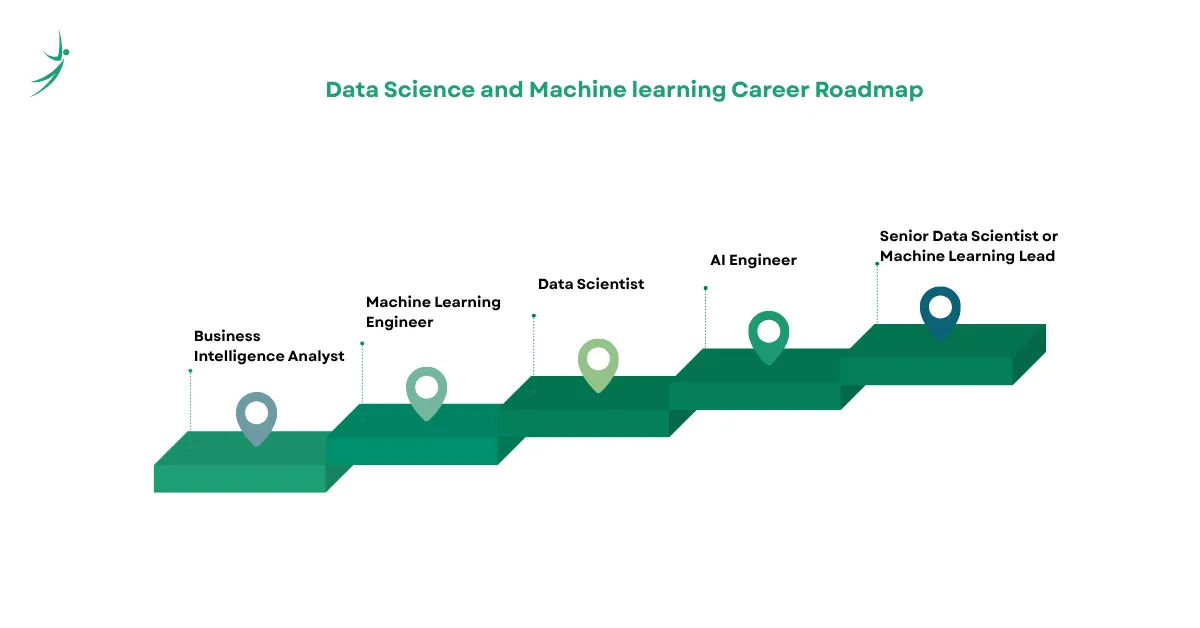
- Business Intelligence Analyst: Operating closer to corporate strategy and management layers, a business intelligence analyst utilizes enterprise analytics software to translate historic data trends into clear financial decisions. They focus on tracking key performance indicators and presenting operational overviews to corporate stakeholders without necessarily writing heavy machine learning code.
- Machine Learning Engineer: Operating at the absolute intersection of data science and advanced software engineering, a professional pursuing a defined roadmap of machine learning engineer specialties focuses purely on scaling, optimizing, and deploying complex algorithmic workflows into live production software environments. When evaluating the operational boundaries of a data engineer vs data scientist or machine learning infrastructure specialist, this role requires deep knowledge of system design, infrastructure scaling, and automated MLOps principles to ensure predictive models can handle massive live user traffic.
- Data Scientist: A versatile and highly strategic role that unifies experimental statistics, predictive modeling, and business logic to solve complex corporate challenges from end to end. The data scientist is responsible for discovering hidden insights within massive data environments, conducting statistical evaluations, and building the initial algorithmic prototypes that power corporate growth.
- AI Engineer: An emerging and highly critical path in modern engineering teams, an AI engineer focuses on implementing generative automation systems, deploying large neural models, fine tuning foundation weights, and building autonomous agentic software pipelines. Following this track ensures you know how to build advanced conversational tools and integrate external API layers into custom product infrastructure.
- Senior Data Scientist or Machine Learning Lead: An executive engineering professional who designs large scale technology strategies, selects cross platform data infrastructure, and leads technical production teams. Reaching this milestone means managing the entire long term scope of data science and automated intelligence operations within an enterprise, making vital architectural decisions that directly impact organizational revenue.
Data Scientist and Machine Learning Engineer Salary in Nepal(2026)
Investing in a high-quality education yield significant long-term financial returns. Referencing a comprehensive breakdown of data science and machine learining salary in Nepal provides a realistic view of current compensation trends:
Data Scientist Salary Structure in Nepal
The following data is taken from the kumari job official site
| Experience Level | Monthly Salary Range (NPR) | Key Operational Focus |
| Entry Level (0 to 2 years) | NPR 35,000 to NPR 65,000 | Structural data cleaning, descriptive reporting, and building interactive visualization dashboards |
| Mid Level (2 to 5 years) | NPR 60,000 to NPR 1,70,000 | Constructing predictive algorithms, model evaluation metrics, and running cross validation pipelines |
| Senior Level (5+ years) | NPR 1,80,000 to NPR 3,50,000+ | Designing enterprise tech strategies, leading analytics teams, and managing big data architectures |
Machine Learning Engineer Salary Structure in Nepal
| Experience Level | Monthly Salary Range (NPR) | Key Operational Focus |
| Entry Level (0 to 2 years) | NPR 35,000 to NPR 65,000 | Algorithmic model training pipelines, fundamental Python scripting, and basic version control |
| Mid Level (3 to 5 years) | NPR 70,000 to NPR 1,60,000 | Model packaging via FastAPI, pipeline optimization, and managing continuous integration workflows |
| Senior Level (6+ years) | NPR 1,60,000 to NPR 3,000,000+ | Distributed database scaling, cloud infrastructure optimization, and end to end MLOps implementation |
Data Science Demand in Nepal
- Companies Hiring Data Scientists: Large corporate entities, growing software agencies, and local digital outsourcing hubs are actively looking for qualified data professionals to build out their internal analytics capabilities.
- Banking & FinTech Opportunities: Commercial banks and digital payment wallets utilize predictive analytics to analyze user credit risk, detect anomalous fraudulent transactions, and build personalized credit systems.
- Healthcare & Telecom Opportunities: Telecommunication giants process billions of connection logs daily, requiring analysts to optimize network performance and reduce user churn, while digital health startups deploy algorithms to optimize resource distribution.
- Freelancing Opportunities: Platforms like Upwork and Toptal are filled with international clients looking for specialized data cleaning, dashboard creation, and predictive model building tasks.
- Remote AI Jobs: The rise of distributed work cultures allows Nepali developers to secure full-time, high-paying engineering positions with companies based in Europe, Australia, or the United Sta
Top Resources to Learn Data Science & Machine Learning
To master these complex modern data science tools, you should utilize a balanced mix of structural training and high-quality educational references:
- Official Documentation: Always read the core documentation for Python, Pandas, Scikit-learn, and PyTorch to learn best practices directly from the creators.
- YouTube Channels: Use video-sharing platforms for quick feature tutorials and conceptual high-level overviews.
- Interactive Learning Platforms: Use environments like LeetCode or HackerRank to hone your advanced SQL querying skills.
- Books: Read foundational texts like "Introduction to Statistical Learning" to build deep algorithmic intuition.
- GitHub Repositories: Explore open-source projects to learn how experienced developers organize and structure production-level code.
- Kaggle Competitions: Join active data science competitions to test your predictive models against a global community of developers.
Common Mistakes While Learning Data Science and Machine Learining
Many students face difficulties early in their comprehensive career guide on how to get into data science because they fall into common learning traps. Reviewing the essential data scientist skills checklist highlights what you should actually focus on:
- Learning Too Many Libraries Too Early: Beginners often try to memorize every tool framework simultaneously, leading to confusion. Focus on mastering core Python and Pandas thoroughly first.
- Ignoring Mathematics: Skipping the underlying statistical math means you will struggle to debug or optimize machine learning models when things go wrong.
- Skipping SQL: Many students focus purely on building machine learning models while completely neglecting SQL, yet extracting data from databases is the first step in any real corporate job.
- Building Projects Without Understanding Concepts: Copying and pasting tutorial code blindly without understanding why specific parameters were selected will leave you unprepared for live technical assessments.
- Not Creating a Portfolio: If your data science code only lives on your local machine, recruiters cannot see it. Always host your clean, documented source files publicly on GitHub.
- Memorizing Algorithms Instead of Solving Problems: Do not try to memorize code blocks line by line. Focus on understanding the core business challenge and figuring out how to map data structures to solve it.
Future of Data Science & Machine Learning After 2026
- Rise of AI Engineers:The engineering market is shifting rapidly. Following a dedicated machine learning career path now naturally leads into the AI Engineering domain, where developers specialize in orchestrating pre-trained foundation models.
- Growth of Generative AI: Generative automation is no longer a luxury. If you look ahead to the structural requirements outlined in an ai engineer roadmap 2025 framework, you will notice that managing complex context lengths, prompt fine-tuning, and embedding models has become standard.
- MLOps Becoming Essential: As more businesses move models out of research sandboxes and into production, the demand for continuous integration, model versioning, and automated infrastructure deployment is growing rapidly.
- Automation Will Increase Demand, Not Replace Data Scientists: Automated tools may write boilerplate code quickly, but they cannot understand unique business challenges, design custom architectures, or ensure data security. Automation simply frees up professionals to focus on high-level strategy.
How to Choose the Best Data Science and Machine Learining Course
If you want to transition from self-guided confusion to professional readiness, enrolling in the best data science course in Nepalis critical. Look for a program that checks the following boxes:
- Curriculum That Covers AI & ML: Ensure the course goes beyond basic Excel sheets and teaches advanced machine learning and generative workflows.
- Real Industry Projects: The training should center around constructing functional end-to-end portfolios rather than just theoretical slide reviews.
- Experienced Mentors: Learning from active industry practitioners ensures you are mastering modern, real-world development workflows.
- Career Support & Placement: Select an academy that actively prepares you for technical interviews, helps build your resume, and connects you with corporate hiring managers.
- Hands-on Learning with Python: The entire program should emphasize writing clean, production-grade Python code daily.
Conclusion
Breaking into this domain requires dedication, structured learning, and consistent coding practice. By committing to a unified ai ml roadmap, you are positioning yourself at the absolute forefront of modern technological innovation.
If you are ready to stop wandering through disjointed internet tutorials and want a structured, mentored environment to accelerate your journey, take action today. Explore our professional data science and machine learning course to see how our graduates transformed their careers, and launch your own journey right now!
Frequently Asked Questions
How long does it take to become a Data Scientist?
Can I learn Data Science without a computer science degree?
Can I learn Data Science after +2?
Do I need mathematics for Data Science?
Should I learn Python or R first?
What projects should I build to become a Data Scientist?
Is Machine Learning difficult for beginners?
What salary can a Data Scientist earn in Nepal?
What is the difference between AI, Machine Learning, and Data Science?
Is SQL necessary for Data Science?
What skills do companies look for in Data Scientists?
About Author:

Dhiraj Bashyal is a Machine Learning Engineer at Vrit Technologies, with 3 years of hands-on experience in applied AI and machine learning. He brings that industry experience directly into the classroom, teaching Data Science and Machine Learning at Skill Shikshya, where he helps learners build a practical, project-ready foundation in Python, ML workflows, and real-world data problem-solving.