MERN Stack Interview Questions (2026): Q&A, Tips & Examples
Preparing for a MERN stack interview can feel overwhelming when you do not know what to expect. This guide brings together the most commonly asked MERN stack interview questions, from JavaScript basics to advanced system design, so you can walk into your interview with confidence. Whether you are a fresher applying for your first role or an experienced developer targeting a senior position, these mern stack developer interview questions that cover every stage of the hiring process. If you feel your fundamentals need work before you start applying, joining a structured MERN stack training in Nepal program can help you build real project experience and close any gaps before your next interview.
How to Prepare for a MERN Stack Interview
Before jumping into the actual interview questions for mern stack developer roles, it helps to understand how recruiters structure their evaluation. Most interviews move through five stages: fundamentals, layer by layer stack knowledge, project discussion, coding rounds, and company specific questions. Preparing for each of these stages separately makes the entire process much less stressful.
- Master JavaScript Fundamentals: Every part of the MERN stack, from React components to Express routes, is built on JavaScript. Interviewers almost always test your grip on closures, promises, the event loop, and ES6 syntax before moving to framework specific questions. If you are still working out the basics of how to enter this field, this guide on how to get into MERN stack development walks through the learning path step by step.
- Understand Every Layer of the MERN Stack: You should be able to explain what happens at each layer of a request, from the browser to the database and back. This means knowing what React is and how it renders the user interface, understanding what Node.js does on the server side, and being clear on the differences between frontend, backend, and full stack roles. Interviewers often ask candidates to trace a single action, like a button click, all the way through the application.
- Build and Showcase MERN Projects: Nothing demonstrates your ability better than a working project you can explain in detail. Make sure you understand the core MERN stack skills employers look for, and be ready to discuss the popular MERN stack frameworks and libraries you used along the way, such as Redux, Tailwind, or Mongoose.
- Practice Coding Problems: Technical rounds often include live coding, whether that is a simple algorithm question, a small API you need to build on the spot, or a bug you must fix in existing code. Regular practice with data structures and small backend exercises keeps your problem solving sharp under pressure.
- Research the Company Before the Interview: Look into the products the company builds, the scale they operate at, and the specific technologies mentioned in the job posting. Understanding the current scope of MERN stack development in the industry, along with reading a solid career guide for MERN stack developers, will help you frame your answers around what the company actually needs.
MERN Stack Interview Questions (Quick Answers)
These are the foundational mern stack interview questions that almost every interview starts with. Get comfortable answering these in under a minute each.
Q1. What is the MERN Stack?
MERN is a JavaScript based technology stack used to build full stack web applications. It stands for MongoDB, Express.js, React, and Node.js, and it allows developers to write both the frontend and backend using a single language. If you want a deeper breakdown, this article on what the MERN stack is covers each component in detail.
Q2. What technologies are included in MERN?
MERN includes MongoDB for the database, Express.js as the backend framework, React for building the user interface, and Node.js as the runtime environment that executes JavaScript on the server. Some teams also compare this setup with Angular based stacks, and understanding the MERN stack vs MEAN stack comparison can help you explain why a company might choose one over the other.
Q3. Why is React used in MERN?
React is used because it allows developers to build reusable UI components and update the interface efficiently using a virtual DOM instead of reloading the entire page. Its component based structure also makes large applications easier to maintain. Many interviewers like to test whether you understand the broader React vs Angular vs Vue comparison, since it shows you know why the team picked React specifically.
Q4. What is Virtual DOM?
The Virtual DOM is a lightweight copy of the real DOM kept in memory by React. When state changes, React compares the new virtual DOM with the previous version, calculates the minimal set of changes, and updates only those parts of the real DOM. This process makes UI updates much faster than manipulating the DOM directly.
Q5. What is JSX?
JSX stands for JavaScript XML. It is a syntax extension that lets developers write HTML like code inside JavaScript files, which React then compiles into standard JavaScript function calls using tools like Babel.
Q6. What are React Components?
Components are independent, reusable pieces of code that return a piece of the user interface. They can be functional or class based, and they accept inputs called props to control what they render.
Q7. What is the State in React?
State is an object that holds data which can change over the lifetime of a component. When state updates, React automatically re-renders the component to reflect the new values on screen.
Q8. What are Props?
Props, short for properties, are read only values passed from a parent component to a child component. They allow data to flow down the component tree and let components stay reusable across different parts of an application.
Q9. What is Express.js?
Express.js is a minimal and flexible Node.js framework used to build APIs and web applications. It simplifies routing, middleware handling, and request processing so developers do not need to write repetitive server logic from scratch.
Q10. What is Node.js?
Node.js is a JavaScript runtime built on Chrome's V8 engine that allows developers to run JavaScript outside the browser, typically on a server. It uses a non blocking, event driven model, which makes it well suited for building fast and scalable network applications. You can read more in this guide covering what Node.js does under the hood.
Q11. What is MongoDB?
MongoDB is a NoSQL, document oriented database that stores data in flexible, JSON-like documents called BSON. Unlike relational databases, it does not require a fixed schema, which makes it a natural fit for applications with rapidly evolving data structures.
Q12. What is Mongoose?
Mongoose is an Object Data Modeling library for MongoDB and Node.js. It provides schema based validation, built in type casting, and query building, making it easier to work with MongoDB in a structured way.
Q13. What is REST API?
A REST API is an interface that follows the principles of Representational State Transfer, using standard HTTP methods such as GET, POST, PUT, and DELETE to allow communication between the client and server. Resources are typically represented as URLs, and responses are usually returned in JSON format.
Q14. What is JWT Authentication?
JWT, or JSON Web Token, is a compact and secure way to transmit information between a client and server as a digitally signed token. After a user logs in, the server issues a JWT that the client stores and sends with future requests to prove their identity without needing to log in again on every call.
Q15. What is CRUD?
CRUD stands for Create, Read, Update, and Delete. These are the four basic operations that almost every application performs on data stored in a database, and they map directly to the POST, GET, PUT, and DELETE HTTP methods in a REST API.
Q16. What are Middleware Functions?
Middleware functions are functions that run between the incoming request and the final route handler in an Express application. They can modify the request or response objects, end the request cycle, or pass control to the next middleware using the next function, and they are commonly used for tasks like authentication, logging, and error handling.
Q17. What is CORS?
CORS, or Cross Origin Resource Sharing, is a browser security feature that restricts web pages from making requests to a domain different from the one that served the page. Backend servers must explicitly allow specific origins using CORS headers if they want to accept requests from a different frontend domain.
Q18. Explain MVC Architecture.
MVC stands for Model, View, and Controller. The Model manages data and business logic, the View handles what the user sees, and the Controller processes user input and coordinates between the Model and View. In a MERN application, MongoDB and Mongoose schemas act as the Model, React handles the View, and Express route handlers often act as the Controller.
Q19. What are Environment Variables?
Environment variables are key value pairs stored outside the codebase that hold configuration details such as database URLs, API keys, and port numbers. Keeping them separate from the code protects sensitive information and allows the same application to run differently across development, testing, and production environments.
Q20. Explain the Request-Response Cycle.
When a user interacts with a React application, a request is sent from the browser to an Express server, often through an API call. The server processes the request, may interact with MongoDB to fetch or update data, and then sends a response back to the client, which React uses to update the interface accordingly.
MERN Stack Internship Interview Questions
Internship interviews focus less on advanced architecture and more on understanding, curiosity, and how well you can talk through your own work.
Basic Concept Questions
Q: Why did you choose MERN Stack Development?
Interviewers want to hear a genuine reason tied to your interests, such as enjoying building complete applications end to end, or liking the idea of using one language across the entire stack. Keep your answer honest and specific rather than generic.
Q: Explain your favorite MERN project.
Pick one project you understand thoroughly and describe the problem it solved, the tech choices you made, and one challenge you overcame. Being able to speak confidently about a single project matters more than listing many shallow ones.
Q: How does React communicate with the backend?
React typically uses the Fetch API or a library like Axios to send HTTP requests to Express routes. The backend processes these requests, often queries MongoDB, and returns data as JSON, which React then uses to update its state and re-render the interface.
Q: What happens when a user submits a login form?
The form data is captured in React state, validated on the client side, and sent to the backend through a POST request. Express receives the request, checks the credentials against the database, and if valid, generates a token that is sent back to the client for future authenticated requests.
Practical & Portfolio Questions
Q: Walk me through one of your MERN projects.
Describe the project from start to finish: the purpose, the main features, the folder structure, and how the frontend and backend communicate. Mention any third party APIs or libraries you integrated.
Q: What challenges did you face while building your project?
Talk about a real obstacle, such as handling asynchronous data fetching, managing complex state, or debugging a tricky API bug, and explain the steps you took to solve it. This shows problem solving skills more than a flawless story would.
Q: How did you deploy your application?
Explain the platforms you used, such as Vercel or Netlify for the frontend and Render or Railway for the backend, along with how you configured environment variables and connected your MongoDB Atlas database in production.
Q: How do you debug a MERN application?
Mention using browser developer tools and React DevTools for the frontend, console logging and debugging tools like the Node inspector for the backend, and checking network requests to isolate whether an issue is happening on the client or server side.
MERN Stack Interview Questions for Freshers
Fresher interviews put heavy weight on fundamentals since you may not have years of production experience to fall back on. Strong preparation here, paired with a structured MERN stack training program, can make you far more competitive for mern stack fresher jobs even without prior work history.
JavaScript Fundamentals
Q: Explain let, const, and var.
var is function scoped and can be redeclared, while let and const are block scoped. const cannot be reassigned after its initial value is set, whereas let allows reassignment, and both let and const are generally preferred over var in modern JavaScript.
Q: What are Closures?
A closure is created when a function retains access to variables from its outer scope even after that outer function has finished executing. Closures are commonly used to create private variables and to build functions that remember state between calls.
Q: Explain Hoisting.
Hoisting is JavaScript's behavior of moving variable and function declarations to the top of their scope before code execution. Function declarations are fully hoisted, while variables declared with var are hoisted but initialized as undefined, and let and const remain in a temporal dead zone until their line of code runs.
Q: What are Promises?
A Promise is an object representing the eventual completion or failure of an asynchronous operation. It has three states: pending, fulfilled, and rejected, and it allows developers to chain operations using then and catch instead of relying on nested callbacks.
Q: What is Async/Await?
Async and await are keywords built on top of Promises that let developers write asynchronous code in a way that looks synchronous. A function marked async always returns a Promise, and await pauses execution inside that function until the Promise resolves.
Q: What is an Event Loop?
The event loop is the mechanism that allows Node.js and browsers to perform non-blocking operations despite JavaScript being single threaded. It continuously checks the call stack and the task queue, pushing queued callbacks onto the stack once it becomes empty.
React Questions
Q: Difference between Functional and Class Components?
Functional components are plain JavaScript functions that return JSX and use hooks for state and lifecycle logic, while class components extend React.Component and use methods like render and lifecycle hooks such as componentDidMount. Functional components with hooks are now the standard approach in most modern React codebases.
Q: Explain React Hooks.
Hooks are functions that let developers use state and other React features inside functional components without writing a class. Common hooks include useState for managing local state, useEffect for side effects, and useContext for accessing shared data across components.
Q: What is useEffect()?
useEffect is a hook that runs side effects after a component renders, such as fetching data, subscribing to events, or manually updating the DOM. It accepts a dependency array that controls when the effect re runs.
Q: What is useState()?
useState is a hook that adds local state to a functional component. It returns an array containing the current state value and a function to update it, and calling that update function triggers a re-render.
Q: What is a React Router?
React Router is a library that enables client side routing in React applications, allowing different components to render based on the URL without triggering a full page reload. It supports nested routes, dynamic parameters, and programmatic navigation.
Backend Questions
Q: Difference between Express and Node.js?
Node.js is the runtime environment that lets JavaScript execute outside the browser, while Express is a framework built on top of Node.js that simplifies building servers and APIs. In short, Node.js provides the engine, and Express provides the structure.
Q: What are RESTful APIs?
RESTful APIs are web services that follow REST principles, using standard HTTP methods and stateless communication to let clients interact with server side resources. Each resource is typically accessed through a unique URL, and responses are commonly formatted as JSON.
Q: Explain Express Middleware.
Middleware in Express refers to functions that execute during the request response cycle, with access to the request, response, and next function. They are used for tasks such as parsing request bodies, logging, authentication checks, and error handling before a request reaches its final route handler.
Q: What is Authentication?
Authentication is the process of verifying a user's identity, typically through credentials such as a username and password, or through tokens like JWT once a user has already logged in once.
Q: Explain Authorization.
Authorization determines what an authenticated user is allowed to do or access within an application. While authentication confirms who a user is, authorization controls their permissions, such as whether they can view, edit, or delete specific data.
Database Questions
Q: SQL vs MongoDB?
SQL databases store data in structured tables with fixed schemas and use SQL for querying, while MongoDB stores data as flexible, JSON-like documents that do not require a predefined schema. SQL databases are often preferred for highly relational data, while MongoDB suits applications with evolving or nested data structures.
Q: What are Collections and Documents?
In MongoDB, a collection is a group of related documents, similar to a table in a relational database, and a document is an individual record stored in BSON format, similar to a row but far more flexible in structure.
Q: Explain Aggregation Pipeline.
The aggregation pipeline is a framework in MongoDB used to process data through a sequence of stages, such as filtering with match, grouping with group, and reshaping documents with project. Each stage transforms the data and passes it to the next, enabling complex data analysis directly within the database.
Q: What are Indexes in MongoDB?
Indexes are special data structures that store a small portion of a collection's data in an order that makes queries significantly faster. Without proper indexes, MongoDB must scan every document in a collection to find matching results, which becomes slow as data grows.
MERN Stack Interview Questions for Experienced Developers
Once you move beyond entry level roles, interviews shift toward mern stack advanced interview questions that test depth of understanding, performance thinking, and system design ability rather than basic syntax.
Advanced React Questions
Q: Explain React Reconciliation.
Reconciliation is the process React uses to compare a new virtual DOM tree with the previous one and determine the minimal number of changes needed to update the real DOM. React uses a diffing algorithm that assumes elements of the same type produce similar trees, which allows it to update the UI efficiently.
Q: What is React Fiber?
React Fiber is the reimplementation of React's core reconciliation algorithm, introduced to allow rendering work to be split into units, paused, and resumed. This enables features like concurrent rendering and gives React more control over prioritizing updates, especially for animations and interactions.
Q: Code Splitting vs Lazy Loading?
Code splitting is the technique of breaking a large JavaScript bundle into smaller chunks so the browser only downloads what is needed. Lazy loading is one way of applying code splitting, where specific components are loaded only when they are actually needed, typically using React's lazy function paired with Suspense.
Q: Performance Optimization in React?
Common strategies include memoizing components and values to avoid unnecessary re-renders, using code splitting to reduce initial bundle size, virtualizing long lists, and avoiding unnecessary state updates that trigger cascading renders across the component tree.
Q: Memoization (React.memo, useMemo, useCallback)?
React.memo prevents a component from re rendering when its props have not changed. useMemo caches the result of an expensive calculation between renders, and useCallback caches a function reference so it does not get recreated on every render, which is particularly useful when passing callbacks to memoized child components.
Advanced Node.js & Express Questions
Q: How does the Node.js Event Loop work?
Node.js uses a single threaded event loop backed by libuv, which handles asynchronous operations like file system access and network calls in the background using a thread pool. The event loop cycles through phases such as timers, pending callbacks, and I/O callbacks, executing queued functions once the call stack is clear.
Q: What is Clustering?
Clustering allows a Node.js application to take advantage of multi-core systems by spawning multiple worker processes that share the same server port. The built in cluster module distributes incoming requests across these workers, improving throughput on machines with multiple CPU cores.
Q: Streams vs Buffers?
A buffer is a fixed chunk of memory used to temporarily hold binary data, while a stream processes data piece by piece as it becomes available, without needing to hold the entire dataset in memory at once. Streams are especially useful for handling large files or continuous data efficiently.
Q: How do you handle file uploads?
File uploads are typically handled using middleware such as Multer, which parses multipart form data and stores files either on disk, in memory, or forwards them directly to cloud storage services like AWS S3 or Cloudinary.
Q: Error Handling Best Practices?
Good practice includes using centralized error handling middleware in Express, wrapping asynchronous route handlers to catch rejected Promises, returning consistent error response formats, and logging errors properly without exposing sensitive details to the client.
Advanced MongoDB Questions
Q: Explain Replication.
Replication in MongoDB involves maintaining multiple copies of data across different servers, known as a replica set. One node acts as the primary that handles writes, while secondary nodes replicate that data, providing redundancy and automatic failover if the primary becomes unavailable.
Q: Explain Sharding.
Sharding is the process of distributing data across multiple servers to handle datasets that are too large or too high in traffic for a single server. Data is partitioned based on a shard key, allowing MongoDB to scale horizontally as data grows.
Q: Transactions in MongoDB.
MongoDB supports multi document ACID transactions, allowing multiple operations across one or more collections to be executed as a single atomic unit. If any operation within the transaction fails, all changes are rolled back, keeping data consistent.
Q: Schema Design Best Practices.
Good schema design in MongoDB depends on how data will be queried rather than strict normalization rules. This often means embedding related data that is read together frequently, referencing data that changes independently or grows unbounded, and designing indexes around your most common query patterns.
System Design & Architecture Questions
Q: How would you design a scalable MERN application?
A scalable design typically separates the frontend and backend into independent services, uses load balancers to distribute traffic across multiple server instances, applies caching for frequently requested data, and uses a properly indexed, sharded database as traffic grows.
Q: How do you improve API performance?
Common approaches include adding pagination to large data responses, using proper database indexing, implementing caching layers such as Redis, compressing responses, and minimizing the number of database calls per request through efficient query design.
Q: How do you secure a MERN application?
Security practices include validating and sanitizing all user input, hashing passwords with a library like bcrypt, using HTTPS, setting secure HTTP headers, implementing rate limiting, and properly configuring CORS and authentication token expiration.
Q: How do you implement caching?
Caching can be implemented at multiple levels, such as browser caching for static assets, server side caching using Redis for frequently accessed database queries, and content delivery networks for serving static files closer to the user.
Q: Explain Microservices vs Monolithic Architecture.
A monolithic architecture bundles the entire application, including the frontend logic, backend logic, and database access, into a single codebase and deployment unit. Microservices architecture breaks the application into smaller, independently deployable services that communicate over the network, offering more flexibility at the cost of added operational complexity.
HR & Behavioral MERN Stack Interview Questions
Q. Tell me about yourself.
Give a short summary of your background, the skills you have developed as a MERN stack developer, and what you are looking for in your next role. Keep it focused on relevant experience rather than a full life history.
Q. Why do you want to become a MERN Developer?
Share a genuine reason connected to your interest in building complete applications, your enjoyment of problem solving, or a specific project that got you hooked on full stack development.
Q. What is your biggest project?
Describe the scope, your specific contributions, the technologies used, and the outcome or impact of the project, whether that was solving a real problem or simply demonstrating a skill you were proud of learning.
Q. Describe a difficult bug you solved.
Walk through the symptoms of the bug, how you narrowed down the cause, the tools you used to debug it, and the fix you implemented. This question tests your problem solving process more than the specific bug itself.
Q. How do you handle deadlines?
Explain your approach to prioritizing tasks, breaking large problems into smaller milestones, and communicating early if a deadline looks at risk, rather than staying silent until the last moment.
Q. Have you worked in a team?
Talk about a specific team project, your role within it, how you communicated with teammates, and how you handled any disagreements or coordination challenges along the way.
Q. What are your strengths and weaknesses?
Choose a real strength relevant to development work, such as attention to detail or strong debugging skills, and a genuine weakness paired with the steps you are actively taking to improve it.
Q. Where do you see yourself in five years?
Share a realistic growth path, such as moving from a developer role into a more senior or specialized position, while showing that you are genuinely interested in growing within the field long term.
Coding Questions Asked in MERN Stack Interviews
Q. Reverse a String
A classic warm up question that tests your understanding of loops, string methods, and sometimes recursion. Interviewers often follow up by asking you to solve it without using built-in reverse methods.
Q. Find Duplicate Elements
You are typically given an array and asked to identify repeated values efficiently, often using a hash map or a Set to track values you have already seen while keeping time complexity low.
Q. Debounce Function
This question tests your understanding of closures and timing functions. You are usually asked to implement a function that delays execution until a certain period has passed since the last time it was invoked, commonly used for search inputs and resize events.
Q. Build a REST API
You may be asked to build a small API on the spot, covering basic routes for creating, reading, updating, and deleting a resource, along with proper status codes and error handling.
Q. Authentication API
This exercise usually involves creating registration and login endpoints, hashing passwords securely, and issuing a token that can be used to protect other routes in the application.
Q. Pagination API
You will typically need to modify an existing endpoint to accept page and limit parameters, then use them to return a specific slice of results along with metadata such as total pages or total records.
Q. Todo CRUD Application
A common practical exercise where you build full create, read, update, and delete functionality for a simple todo list, often touching both the frontend and backend within a limited time frame.
Q. Shopping Cart Functionality
This question tests how you manage more complex state, such as adding and removing items, updating quantities, and calculating totals, either on the frontend using React state or through backend logic tied to a database.
MERN Stack Interview Tips: What Recruiters Look For
- Strong JavaScript Fundamentals: Recruiters consistently look for candidates who can explain core JavaScript concepts clearly, since weak fundamentals tend to show up quickly once questions move beyond basic syntax.
- Clear Understanding of the MERN Architecture: Being able to explain how data flows between MongoDB, Express, React, and Node.js in a real application matters more than memorizing definitions in isolation.
- Real Project Experience: Recruiters pay close attention to candidates who can speak in detail about decisions made in their own projects, rather than reciting generic best practices they have not actually applied.
- Clean Coding Practices: Readable code, sensible naming conventions, and proper file organization signal that a candidate will be easy to work with on a real team codebase.
- Problem-Solving Skills: How you approach an unfamiliar problem, including how you break it down and communicate your thinking, is often weighted more heavily than whether you reach the perfect solution immediately.
- Communication & Teamwork: Since most development work happens in teams, recruiters look for candidates who can explain technical concepts clearly and describe how they have collaborated with others in the past.
MERN Stack Interview Preparation Checklist
Use this checklist in the final week before your interview to make sure nothing important slips through.
- JavaScript Revision: Review closures, promises, async and await, array methods, and the event loop, since these topics form the base for almost every other question you will face.
- React Concepts: Revisit hooks, component lifecycle, state management, and routing, and be ready to explain how and why you used them in your own projects.
- Node.js & Express APIs: Practice building simple routes, middleware, and error handling patterns from memory rather than only reading about them.
- MongoDB Queries: Practice writing basic queries, updates, and aggregation pipelines so you are comfortable working with the database directly rather than only through Mongoose.
- Authentication & Security: Review how JWT based authentication works end to end, along with basic security practices like password hashing and input validation.
- Portfolio Projects: Pick two or three projects you know inside and out and prepare a short, clear summary of each that you can deliver confidently without notes.
- Git & GitHub: Be comfortable explaining your typical Git workflow, including branching, committing, and resolving merge conflicts, since version control questions come up often even in non technical rounds.
- Deployment Experience: Review how you deployed your projects, including hosting platforms, environment variable configuration, and any issues you encountered while moving from development to production.
Common MERN Stack Interview Mistakes to Avoid
- Not Understanding JavaScript Basics: Many candidates jump straight into React and Node.js without solidifying core JavaScript concepts, which becomes obvious the moment questions dig slightly deeper than surface level syntax.
- Memorizing Without Building Projects: Reciting definitions without having applied them in a real project rarely holds up under follow up questions, since interviewers can usually tell when an answer is not backed by hands on experience.
- Ignoring Backend Concepts: Some candidates focus heavily on React and neglect Node.js, Express, and database concepts, which leaves noticeable gaps during full stack interviews.
- Weak Database Knowledge: Being unable to explain schema design, indexing, or basic MongoDB queries is a common weak spot that stands out quickly, even for candidates with strong frontend skills.
- Poor Communication During Technical Interviews: Solving a problem silently without explaining your thought process makes it harder for interviewers to evaluate how you think, even if you eventually reach the correct answer.
- Not Explaining Your Thought Process: Interviewers generally value a clear, structured approach to a problem more than a fast but unexplained answer, so narrating your reasoning as you work is worth practicing ahead of time.
MERN Stack Interview Do's and Don'ts
Beyond technical preparation, how you carry yourself during the interview often decides the outcome. Here is a quick reference of what to do and what to avoid.
Do's
- Research the company's tech stack, products, and any recent updates before your interview.
- Prepare two or three MERN projects you can explain in full detail, including your specific contributions to each.
- Practice explaining your reasoning out loud while solving a problem instead of working through it silently.
- Review your own resume thoroughly so you can speak confidently about anything listed on it.
- Ask thoughtful questions about the team, the codebase, or the company's development process near the end of the interview.
- Test your internet connection, camera, and microphone ahead of time if the interview is conducted remotely.
- Bring specific numbers and outcomes when discussing past projects, such as performance improvements, load times, or user counts.
- Send a short thank you message after the interview to leave a good final impression.
Don'ts
- Do not memorize answers word for word without actually understanding the underlying concept.
- Do not claim expertise in a technology you have only briefly touched, since follow up questions will expose the gap quickly.
- Do not interrupt the interviewer or rush through your answers without pausing to think first.
- Do not speak negatively about a previous employer, team, or project during the conversation.
- Do not skip preparation just because you assume a fresher or internship interview will be easy.
- Do not let your portfolio links, GitHub profile, or resume sit outdated before you start applying.
- Do not guess confidently when you are unsure of an answer; admitting you do not know something and explaining how you would find out is far better than an incorrect guess.
MERN Stack Interview Tips for Nepal's Job Market in 2026
Nepal's IT sector has grown quickly, and the mern stack developer interview questions asked by local companies now sit alongside expectations shaped by international clients, remote teams, and a much more competitive hiring market than a few years ago.
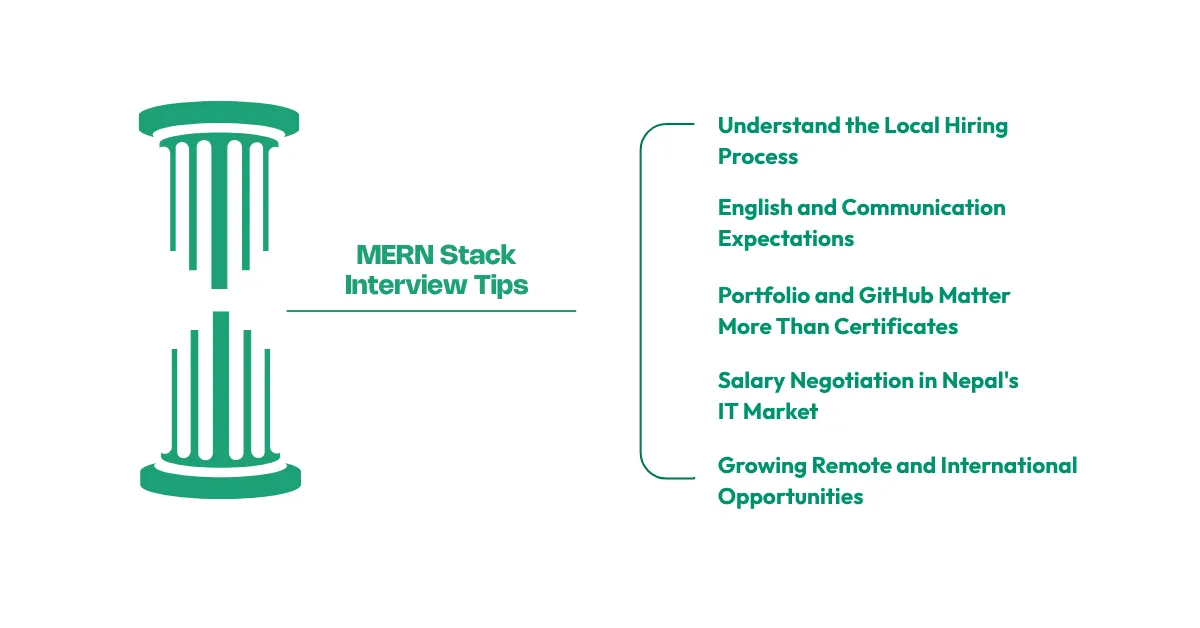
- Understand the Local Hiring Process: Most IT companies in Nepal follow a similar pattern: an initial resume screening, an HR round covering communication and salary expectations, a technical assessment or coding test, a technical interview with senior developers, and a final HR discussion. Knowing this structure ahead of time helps you prepare the right kind of interview questions for mern stack developer roles at each stage rather than treating every round the same way.
- English and Communication Expectations: Many Nepali software companies work directly with clients in the United States, United Kingdom, and Australia, so being able to explain technical concepts clearly in English matters even for junior positions. Practicing how you describe your projects and technical decisions out loud will help far more than only reviewing definitions silently.
- Portfolio and GitHub Matter More Than Certificates: Recruiters in Nepal's growing tech scene increasingly place more weight on an active GitHub profile and live, deployed projects than on certificates alone. Keeping your repositories updated, writing clear documentation, and deploying at least one or two working applications can set you apart from candidates who only list technologies on paper.
- Salary Negotiation in Nepal's IT Market: Understanding a realistic mern stack developer average salary range for your experience level, as shared earlier in this guide, gives you a much stronger position when a recruiter brings up compensation. Freshers are generally better off prioritizing learning environment and mentorship over squeezing out the highest possible starting salary, while mid level and senior developers have more room to negotiate based on demonstrated project impact.
- Growing Remote and International Opportunities: 2026 has brought a noticeable rise in remote and freelance opportunities for Nepali developers working with foreign companies, often paying in US dollars. This trend has widened the pool of mern stack fresher jobs available beyond just local Kathmandu based companies, making it worth applying to remote first teams even early in your career.
Conclusion
Preparing for a MERN stack interview is less about memorizing every possible question and more about genuinely understanding how MongoDB, Express, React, and Node.js work together to build a complete application. Work through the fundamentals first, build real projects you can speak about confidently, and practice explaining your reasoning out loud as you solve problems. If you want a more guided path, exploring the best MERN stack course in Nepal is a good next step, and you can find more detailed guides and tutorials on our blog to keep building your knowledge over time.
Frequently Asked Questions
What questions are asked in a MERN Stack interview?
Is MERN Stack enough to get a job?
What JavaScript topics are most important for MERN interviews?
How do I prepare for a MERN Stack interview?
Are coding questions asked in MERN interviews?
What projects should I build before a MERN interview?
What is the salary of a MERN Stack developer in Nepal?
How long does it take to prepare for a MERN Stack interview?
About Author:

Mr. Asim Chaulagain, Full Stack MERN mentor at SkillShikshya and developer at Vrit Technologies, empowers learners to build real-world web applications. Through hands-on projects, he turns coding skills into practical, career-ready expertise.