React vs Angular vs Vue: 2026 Comparison | Skill Shikshya
The front-end landscape moves exceptionally fast. In 2026, building web applications is no longer just about rendering a user interface; it requires building optimized, edge-ready, scalable, and highly performant digital products. Whether you are an aspiring web developer deciding which ecosystem to anchor your career to, or a CTO mapping out a multi-year enterprise architecture, choosing between React, Angular, and Vue.js is one of your most critical decisions.
While react remains the market dominant giant, angular continues its massive renaissance with zoneless reactivity, and vue js secures its place as the leanest, most developer-friendly progressive ecosystem.
This comprehensive technical guide breaks down their core features, key differences, performance benchmarks, and real-world architectures in 2026.
Before diving into the comparison, aspiring developers looking to specialize in modern frontend development can explore our Frontend React Course to gain practical experience with React, component-based architecture, APIs, state management, and industry-standard development workflows.
Why React, Angular, and Vue Dominate Modern Frontend Development
Modern web users expect page interactions to load instantaneously and update seamlessly across all form factors. Today, more than 60% of professional developers rely on a modern client-side framework to build scalable production apps.
React, Angular, and Vue dominate because they successfully solved the core problems of legacy JavaScript engineering: DOM manipulation bottlenecks, chaotic state tracking, and unmaintainable monolithic scripts. By introducing component-driven architectures, declarative UIs, and robust internal tooling ecosystems, these three technologies have become foundational pillars of the global tech stack.
What is React?
React (often referred to as react js) is an open-source, declarative JavaScript library for building user interfaces, maintained by Meta and a massive global community. Technically speaking, it is a library rather than a react framework, meaning it handles only the view layer of an application, giving developers the absolute freedom to assemble their own tooling, state, and routing ecosystems.
Key Features of React

- Virtual DOM & Fiber Architecture: Instead of altering the browser's heavy DOM directly, React uses an in-memory Virtual DOM abstraction. The React Fiber reconciliation engine schedules and splits rendering work into adaptive chunks, keeping highly complex user interfaces fluid, jank-free, and responsive under heavy data loads.
- Component-Driven Reusability: Application layouts are broken down and encapsulated into independent, self-sustaining functional components. These modules pass data downstream via read-only react props (immutable parameters) and manage internal local state dynamically, making codebases easier to maintain and scale.
- Declarative UI Syntax: React leverages JSX (JavaScript XML), a hybrid syntax that allows developers to write structural HTML elements directly inside JavaScript logic. This design shifts away from imperative DOM selection, letting developers focus on describing what the UI should look like based on the current application state.
- Unidirectional Data Flow: React enforces a strict, predictable one-way data binding architecture. Data flows exclusively from parent components down to child components, which simplifies debugging, prevents cascading side-effects, and makes state changes remarkably easy to track throughout large applications.
- React Server Components (RSC) & Streaming: By 2026, React completely integrates Server Components natively. This allows data-heavy components to execute directly on cloud edges or backend servers, stripping massive library weights and data-fetching dependencies out of the client-side JavaScript bundle to achieve near-instantaneous page delivery.
React Ecosystem and Libraries
Because React is lean by design, its strength lies in its modular, highly competitive ecosystem:
- Routing: Handled standardly by react router dom, enabling dynamic, nested, and client-side page transitions.
- Data Fetching & Server State: React query (TanStack Query) has become the golden standard for caching, syncing, and updating asynchronous backend data.
- UI Components: Ecosystems like react icons, Tailwind CSS, and Shadcn/ui enable lightning-fast interface layout.
- State Management: Redux Toolkit (react redux) remains dominant for heavy corporate logic, while Zustand offers lighter client-side state alternatives.
These technologies collectively form the frontend layer of many modern MERN applications. If you're unfamiliar with the stack, explore our guide about the MERN Stack?
Popular Companies Using React
Meta (Facebook, Instagram), Netflix, Airbnb, Uber, Spotify, and Pinterest.
If you're new to the ecosystem, our detailed guide about react, explains its architecture, benefits, and real-world use cases in greater depth.
What is Angular?
Angular (the modern successor to legacy angular js) is a comprehensive, TypeScript-first web application platform engineered and backed by Google. Unlike React, Angular is a fully integrated, opinionated framework. It enforces a strict architectural blueprint and ships with everything an enterprise engineering team needs out-of-the-box.
Key Features of Angular

- Strict TypeScript Integration: Engineered as a type-safe ecosystem from day one, Angular completely removes JavaScript guesswork. It enforces strict type definitions, interfaces, and object-oriented paradigms across all components, services, and routing layers right from its command-line interface generation tools.
- Bidirectional Data Binding: Synchronizes the underlying data models and the visible HTML layout automatically. Any data changes in the logic layer update the view instantaneously, and any user inputs in the interface mutate the model immediately, making real-time financial dashboards and interactive enterprise systems highly responsive.
- Built-in Dependency Injection (DI): A robust structural design pattern that supplies dependencies to components seamlessly without hardcoding class initializations. This built-in DI system maximizes code efficiency, decoupling, and automated testing compliance across distributed corporate engineering teams.
- Signals & Zoneless Reactivity: By 2026, Angular has shifted standardly toward native Angular Signals. This compile-time, fine-grained reactivity tracking allows the engine to isolate and update only the precise DOM nodes that change, completely removing the heavy overhead of Zone.js tree-scans and drastically reducing initial bundle execution latency.
- Comprehensive Out-of-the-Box Tooling: Unlike libraries that require fragmented third-party setups, Angular ships as a complete software platform. It features an integrated enterprise-grade router, secure HTTP client modules, an automated CLI migration ecosystem, and a standardized form-handling architecture out of the box.
Angular Architecture and Ecosystem
The Angular architecture relies heavily on separate structural layers—Components for layout, HTML templates for semantic markup, and Services for data operations. It does not require external third-party routing or fetching packages because its internal toolkit includes everything:
- Angular Router: Complete enterprise-grade client-side page routing.
- HttpClient Module: Advanced, secure observable-driven network fetching.
- Angular CLI: The industry's most robust command-line scaffolding and migration automation ecosystem.
Popular Companies Using Angular
Google, Microsoft, PayPal, Deutsche Bank, Samsung, and Forbes.
What is Vue.js?
Vue.js (commonly searched as vue or vue js) is an open-source, progressive JavaScript framework created by Evan You and sustained entirely by an independent global community. It is termed "progressive" because it can scale down to act as a simple script tag library inside a legacy application or scale up seamlessly to handle multi-route cloud software.
Key Features of Vue.js
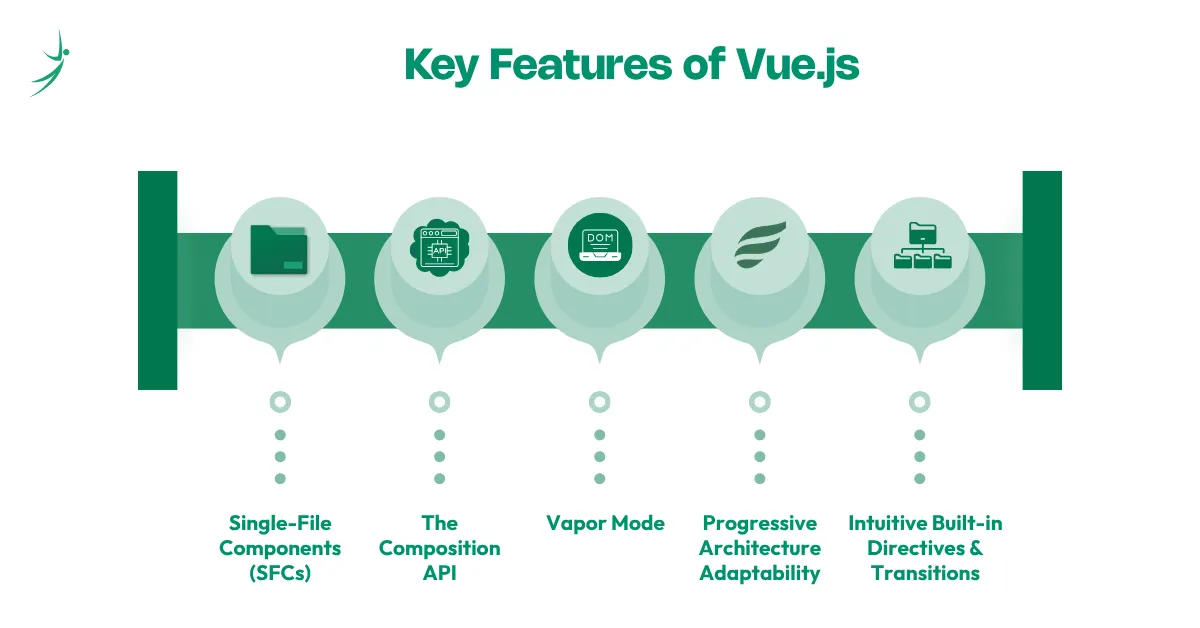
- Single-File Components (SFCs): Vue structures interactive modules cleanly by placing semantic HTML elements (<template>), script logic (<script>), and component-scoped styling rules (<style>) together inside a single unified .vue file. This architecture provides an intuitive, highly readable developer experience.
- The Composition API: Designed to handle highly complex, large-scale application logic, the Composition API provides clean, hook-like code organization. It enables developers to group related logical concerns together and share stateful code smoothly across independent components without sacrificing Vue’s clean readability.
- Vapor Mode: Vue’s modern, cutting-edge rendering strategy compiles components into pure, optimized vanilla JavaScript DOM code. By completely bypassing Virtual DOM tracking layers during compilation, Vapor Mode achieves blazing-fast execution speeds and minimal memory footprint.
- Progressive Architecture Adaptability: Vue is engineered to scale seamlessly with project needs. It can be integrated progressively as a lightweight script tag library inside a legacy application to handle simple widgets, or easily scale up via Nuxt.js to manage massive, multi-route global cloud systems.
- Intuitive Built-in Directives & Transitions: Vue comes pre-packaged with powerful HTML syntax extensions (like v-model for easy input synchronization, v-if for structural evaluation, and v-for for list rendering), alongside a built-in transition system that enables flawless, GPU-accelerated enter/leave UI animations without requiring complex CSS libraries.
Vue Ecosystem and Tooling
The Vue core team explicitly builds and maintains its companion tools, removing the ecosystem confusion often found in React:
- Build System: Vite, originally born in the Vue ecosystem, provides instantaneous Hot Module Replacement (HMR).
- Routing: Handled natively by vue js routing via the official Vue Router package.
- State Management: Pinia (which succeeded Vuex) offers a modular, type-safe, and intuitive data warehouse for large web systems.
- Meta-Framework: Nuxt.js, which enables deep Server-Side Rendering (SSR) and edge deployment.
Popular Companies Using Vue.js
Nintendo, GitLab, Xiaomi, Adobe, Behance, and Upwork.
React vs Angular vs Vue: Quick Comparison Table
The below table shows the quick comparison between react, angular and vue.
| Feature / Metric | React | Angular | Vue.js |
| Type | UI View Library | Full-Scale Framework | Progressive Framework |
| Primary Maintainer | Meta + Community | Google + Community | Evan You + Community |
| Language Base | JavaScript / JSX / TS | Strict TypeScript | HTML / JS / TypeScript |
| Data Binding | Unidirectional (One-way) | Bidirectional (Two-way) | Bidirectional / Reactive |
| Rendering Strategy | Virtual DOM / Server Components | Real DOM (Zoneless Signals) | Virtual DOM / Vapor Mode |
| Routing / Fetching | Needs 3rd Party (react-router) | Built-in out-of-the-box | Official Packages (vue-router) |
| Learning Curve | Moderate | Steep / Hard | Smooth / Gentle |
| Bundle Size | Medium (Ecosystem dependent) | Large (Slimmer with Signals) | Extremely Small & Lean |
React vs Angular vs Vue: Key Differences
Learning Curve
The learning curve varies heavily depending on a developer's foundational JavaScript knowledge.
- React: React sits in the middle; developers must become deeply comfortable with JSX, functional immutable programming paradigms, and the nuances of component rerendering rules.
- Angular: Angular has the steepest learning curve. It forces developers to learn TypeScript, dependency injection patterns, RxJS observable streams, and rigid architectural rules from day one.
- Vue: Vue.js features the smoothest learning curve. Its template design reads natively to anyone familiar with standard HTML and CSS.
Performance and Speed
In 2026, raw runtime performance is extraordinarily optimized across all three options, but their underlying mechanics differ:
- React: React leverages React Server Components (RSC) to render database-heavy code directly on cloud edges, stripping execution payloads out of client browser packages completely.
- Angular: Angular apps used to suffer from bundle bloat, but modern zoneless setups deliver blazing-fast startup times and improved Core Web Vitals (LCP, FID) for massive transactional operations.
- Vue: Vue.js leads initial page-load speeds for small to medium apps due to its lightweight core bundle. With its modern compiler strategy, it updates specific nodes instantly.
Architecture and Flexibility
- React: React provides ultimate architectural flexibility. You choose your own state managers, bundling layers, and testing suites. However, this flexibility can sometimes lead to choice paralysis or fragmented legacy code patterns.
- Angular: Angular relies on a strict, highly opinionated architecture. This means any Angular developer globally can step into an Angular corporate repo and understand its file mapping immediately.
- Vue: Vue.js strikes a flawless balance—offering structured, official architectural layers while remaining highly flexible inside component implementations.
State Management
- React: React separates state into local data (useState) and global providers. Handling asynchronous application states requires powerful external abstraction engines like react query or Redux Toolkit.
- Angular: Angular utilizes reactive Angular Signals for local states, and pairs with RxJS or NgRx platforms for highly complex, multi-layered enterprise state tracking.
- Vue: Vue.js implements native, fine-grained reactivity out of the box. Pinia serves as the elegant, lightweight global store, eliminating the boilerplate writing common in older React setups.
Scalability for Large Applications
- React: React scales phenomenally well, but its long-term corporate health depends heavily on the discipline of the engineering team to enforce clean coding guidelines.
- Angular: Angular is explicitly engineered for massive corporate scalability. Its built-in dependency patterns and strict modular compilation guardrails prevent massive internal teams from stepping on each other's code.
- Vue: Vue.js scales securely into large scopes when backed by a domain-driven feature folder structure and Nuxt-driven deployment pipelines.
Community and Ecosystem
- React: React maintains the largest community and job ecosystem on earth. Its sheer size means almost every UI element or API wrapper has an actively maintained open-source package.
- Angular: Angular possesses a deeply loyal enterprise community backed by predictable release roadmaps and long-term Google support tables.
- Vue: Vue.js has a highly satisfied developer following, backed by stellar centralized vue js documentation that is widely considered the absolute benchmark for instructional clarity.
SEO Capabilities
- React: React leverages Next.js or Remix for elite Server-Side Rendering (SSR).
- Angular: Angular includes its own native Server-Side Rendering (SSR) and pre-rendering systems directly within the core CLI toolkit.
- Vue: Vue utilizes Nuxt.js for optimized hybrid rendering and instant edge generation.
TypeScript Support
- React: React offers native TypeScript parsing, complete auto-completion, and deep compile-time type safety across all components.
- Angular: Angular was engineered from day one around TypeScript patterns, making it the default option for type-safe applications.
- Vue: Vue offers native TypeScript parsing, complete auto-completion, and deep compile-time type safety across all components.
Development Speed
- React: React is slightly slower due to initial architecture configuration requirements, but accelerates rapidly once an internal design system is established.
- Angular: Angular development speeds are slower at the start of a project due to strict configuration setups, but pay massive dividends during long-term maintenance cycles.
- Vue: Vue.js wins in solo-developer and startup environments where speed-to-market is the primary objective. Its low boilerplate and rapid Vite compilation loop facilitate rapid feature deployment.
Testing and Debugging
- React: React relies heavily on Jest and React Testing Library, paired with react developer tools extensions to profile performance and inspect dynamic state hierarchies.
- Angular: Angular ships with a built-in testing harness, moving standardly toward modern, lightning-fast testing engines like Vitest and Playwright.
- Vue: Vue.js leverages its specialized Vue DevTools alongside Vitest to run lightning-quick component evaluations with zero brittle CSS selector dependencies.
React vs Angular vs Vue: Similarities
Despite their fierce ecosystem rivalries, these solutions share key architectural philosophies:
- Component-Driven Ideology: Everything centers around creating modular, encapsulated UI segments that can be reused across multiple pages.
- Reactive UI Flow: Views are direct reflections of data state; when data updates, the user interface refreshes automatically without requiring manual DOM targeting.
- Modern Tooling Support: All three blend smoothly with modern build pipelines, support absolute TypeScript type safety, and can be easily optimized to achieve maximum Core Web Vitals performance.
Which Framework Performs Best in 2026?
Performance is no longer a major bottleneck for any of these ecosystems; instead, it depends on choosing the correct rendering strategy for your specific product type.
- For content-heavy marketing applications, media sites, and large e-commerce platforms, React (Next.js) and Vue (Nuxt) perform best by leveraging hybrid edge-rendering to deliver near-zero hydration costs and perfect SEO.
- For data-dense administrative dashboards, complex SaaS platforms, and enterprise software, Angular performs best, utilizing compile-time signals to maintain 60fps scrolling and instant calculations across thousands of continuous data changes.
React vs Angular vs Vue: Real-World Use Cases
When to Choose React
- You are building a custom product where you need complete control over the architecture, tooling, and third-party packages.
- Your application relies on massive, asynchronous real-time server syncing (leveraging react query).
- Your organization wants access to the largest possible pool of professional frontend engineering talent.
When to Choose Angular
- You are engineering a large-scale enterprise application with distributed, multi-national development teams.
- Your app features highly complex forms, data-dense interfaces, and strict internal security demands.
- You want a unified framework that guarantees seamless long-term maintenance and predictable upgrades without relying on third-party libraries.
When to Choose Vue.js
- You are a startup or a lean product team that needs to build, validate, and ship a gorgeous product to market as fast as humanly possible.
- You want an intuitive tool that allows new developers to onboard and write clean production code with minimal training friction.
- You are incrementally modernizing a legacy multi-page architecture without executing a costly complete code rewrite.
Can React, Angular, and Vue Be Used for Enterprise Applications?
Absolutely. All three power massive global enterprise architectures, but they tackle corporate scale differently.
Angular handles enterprise scale via strict, forced architectural patterns that prevent code fragmentation across distributed teams. React achieves enterprise scale through flexible composition, letting organizations assemble micro-frontend architectures where independent teams deploy isolated code features safely. Vue handles enterprise scope beautifully through clean domain-driven architecture design, modular Pinia storage warehouses, and powerful edge-rendering optimizations via Nuxt.
Conclusion: Making Your Final Choice
The debate between React, Angular, and Vue.js is no longer about finding the absolute "best" tool, it is about finding the right match for your project architecture, team size, and business goals. As we navigate the web landscape, each ecosystem has uniquely optimized its engine to meet different modern engineering challenges:
- Choose React: if you want ultimate architectural freedom, seamless access to the largest global talent pool, and a massive ecosystem of plug-and-play packages like react router dom and react query to power flexible, edge-ready applications.
- Choose Angular: if you are building heavy enterprise systems or large-scale internal dashboards where strict TypeScript enforcement, predictable long-term Google support, and native, compile-time reactivity via Signals are non-negotiable requirements.
- Choose Vue.js: if your priority is speed-to-market, clear developer onboarding through flawless vue js documentation, and unmatched performance via ultra-lean compilation architectures like Vapor Mode.
React continues to dominate modern frontend development and powers thousands of production applications worldwide. If you're looking to build job-ready skills, explore our React Frontend Development Course and learn React, APIs, state management, Git, and deployment through hands-on projects.
Frequently Asked Questions
What is Angular Javascript?
How popular is Angular?
Is Angular harder than React?
Which is better: React or Angular?
Is AngularJS dead?
Is Vue.js frontend or backend?
What is Vue.js?
Is Vue.js a framework?
About Author:

Mr. Asim Chaulagain, Full Stack MERN mentor at SkillShikshya and developer at Vrit Technologies, empowers learners to build real-world web applications. Through hands-on projects, he turns coding skills into practical, career-ready expertise.