Mern Stack Skills - Complete Guide for Beginners | Skill Shikshya
In the rapidly expanding technology ecosystem, full stack web development has become one of the most highly sought after domains. Among the various software development architectures available today, the MERN ecosystem stands out as an exceptionally powerful and cohesive choice. Because it allows software engineers to build complete end to end web architectures entirely using JavaScript, mastering this toolset unlocks immense career potential.
If you want to transition into software engineering, understanding the exact mern stack skills required by the modern tech industry is the first step toward securing employment. To navigate this path effectively, exploring comprehensive career guides can give you the clarity needed to succeed. This ultimate guide breaks down the core technical proficiencies, modern workflows, soft skills, and localized employment trends you need to master to go from an absolute beginner to a job ready full stack engineer.
Want to master these in-demand MERN Stack skills? Join our MERN Stack Development Course and gain hands-on experience by building real-world full-stack applications.
Why MERN Stack Skills Matter
In modern software development, architectural versatility is highly valued. Businesses no longer want to hire isolated frontend and backend developers who operate in separate silos. Instead, they look for developers who can seamlessly span across user interfaces, routing controllers, middleware integrations, and database schemas. This is where having solid, practical mern skills makes an immense competitive difference.
By learning about mern stack, you realize that mastering a single primary language like JavaScript gives you the ability to build, maintain, optimize, and deploy complete systems. This unparalleled efficiency is why startups, enterprises, and offshore development centers alike are aggressively looking to fill mern jobs. Possessing comprehensive mern stack developer skills ensures that you can rapidly build prototypes, optimize database queries, and deliver fluid user experiences, making you an invaluable asset to any engineering squad.
Core Technical Skills Every MERN Stack Developer Needs
To establish yourself as a competent professional, your technical foundation must be robust. Understanding how different mern stack frameworks interact with each other allows you to build highly responsive applications. Below is a comprehensive breakdown of the core technical requirements that constitute full stack mastery.
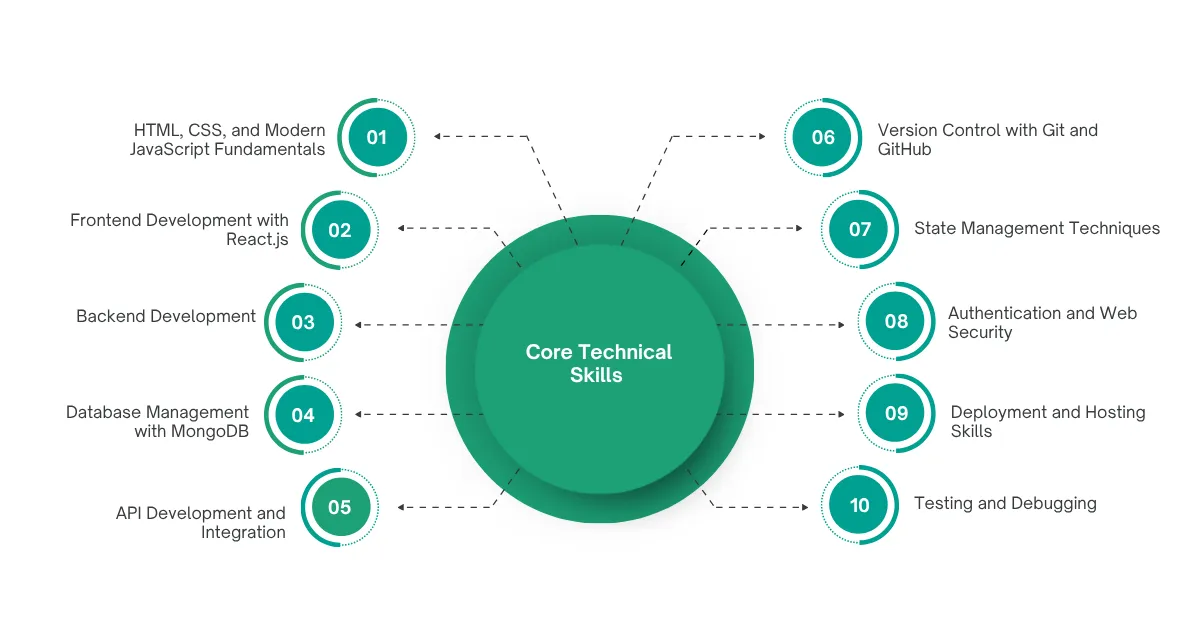
1. HTML, CSS, and Modern JavaScript Fundamentals
Before diving into complex application frameworks, you must master the fundamental languages of the web browser.
- Understanding HTML5 and Semantic Elements: Writing high quality code begins with semantic HTML5. You must look beyond generic division and span wrappers and use structural tags such as header, nav, main, section, article, and footer. Proper semantic elements ensure superior search engine optimization indexing and meet web accessibility standards, allowing screen readers to parse the application safely.
- CSS3, Flexbox, Grid, and Responsive Design: Modern web applications must operate fluidly across mobile phones, tablets, notebooks, and wide screen monitors. You need a deep command of CSS3 layout mechanisms, specifically Flexbox for one dimensional layouts and CSS Grid for two dimensional structures. Mastering media queries and mobile first responsive design paradigms ensures your frontend looks pristine on any hardware.
- Modern JavaScript (ES6+) Features Every Developer Should Know: Since the entire MERN ecosystem is built on JavaScript, your core programming fundamentals must be exceptional. You must be intimately familiar with modern JavaScript syntax and concepts, including arrow functions, block scoped variables, destructuring of arrays and objects, rest and spread operators, template literals, and modular import or export syntax. Asynchronous programming primitives like Promises and async await are vital for handling data operations.
2. Frontend Development with React.js
React.js is the presentation layer of your system. Knowing what is react and how it handles user interfaces is essential for frontend engineering.
- Understanding React Components and JSX: React relies on a component based architecture where the user interface is split into independent, reusable pieces of code. You need to understand how to write clean functional components and how to use JSX to describe what the user interface should look like dynamically.
- State Management with Hooks and Context API: Tracking dynamic application data is crucial. You must master React Hooks, beginning with foundational ones like useState for local component state tracking and useEffect for handling side effects like database application programming interface synchronization. For handling medium scale state without complex prop drilling, you must also be proficient with the React Context API.
- React Router and Component Based Architecture: Single Page Applications do not reload the entire browser when a user navigates pages. You need to use client side routing libraries like react router dom to manage complex multi page routing paths, dynamic parameters, and protected routing systems for secure user portals.
- Best Practices for Building Scalable React Applications: Building production ready software requires strict adherence to clean code rules. This involves maintaining an organized directory tree, splitting complex components into smaller atomic pieces, utilizing custom hooks to isolate business logic from presentation layout, and implementing lazy loading to optimize initial load times. When weighing frontend alternatives, reviewing a detailed react vs angular vs vue analysis helps clarify why React remains dominant.
3. Backend Development with Node.js and Express.js
The backend represents the engine room of your stack, where business rules are validated and databases are accessed. To excel here, you must acquire the essential skills required for backend developer roles.
- Understanding the Node.js Runtime Environment: Node.js is an open source, cross platform JavaScript runtime environment built on the V8 engine. Understanding what is nodejs means learning how its single threaded, event driven, non blocking input output model allows it to manage thousands of concurrent requests smoothly without crashing or consuming excessive server memory.
- Building REST APIs with Express.js: Express.js is the minimalist web application framework designed to sit on top of Node.js. It acts as the backbone layer for processing requests. You need to know how to initialize an Express server, listen to dedicated network ports, parse request payloads, and return standardized JSON responses to incoming clients.
- Middleware, Routing, and Error Handling: Middleware functions are functions that have access to the request object, the response object, and the next middleware function in the application cycle. You must learn how to configure global application middleware, write modular route architectures, and implement centralized error handling middleware blocks to catch server bugs gracefully.
- Best Practices for Writing Secure Backend Code: Securing an application programming interface requires proactive architectural choices. You must configure essential security elements, including Cross Origin Resource Sharing rules, input validations to filter malicious parameters, and environment variable protection files to keep secret database credentials from being leaked to public repositories.
4. Database Management with MongoDB
MongoDB represents the database solution optimized for rapid application iteration, allowing you to store data flexibly.
- Understanding NoSQL Databases: Unlike legacy relational databases that organize data into rigid rows and columns, MongoDB is a document oriented NoSQL database. It saves data payloads in flexible, JSON like document format objects, allowing developers to change database structures instantly as features scale.
- CRUD Operations with MongoDB: You must have an ironclad grasp of fundamental database actions: Create, Read, Update, and Delete. This means knowing how to add raw documents into databases, search data through deep filters, modify records based on specific criteria, and securely wipe outdated data points.
- Data Modeling and Schema Design with Mongoose: To bring structure and programmatic validation rules to MongoDB, developers use Mongoose, which is an Object Data Modeling library. You must master defining strict Mongoose schemas, specifying data types, configuring auto validations, and implementing virtual fields or pre save database middleware hooks.
- Best Practices for Database Performance and Security: As databases scale into millions of items, speed can degrade. You must learn how to add database indexes on frequently searched parameters, prevent slow database loops, utilize efficient projection methods to only request necessary fields, and isolate access permissions using cloud based firewall configurations.
5. API Development and Integration
An application is only as good as the communication paths that stitch its frontend interface and backend server together.
- REST API Principles: You must understand HTTP verbs and resource based path architectures, such as GET for fetching an existing resource, POST for creating a new resource, PUT or PATCH for modifying entries, and DELETE for erasing data points.
- Connecting Frontend and Backend: You need to master connecting your client side React user interface to your backend database endpoints using HTTP fetching clients like Axios or the native browser Fetch API. This includes handling loading behaviors, capturing asynchronous response structures, and managing networking headers safely.
- Authentication and Authorization with JWT: You must understand the distinct operational rules of authentication, which proves who a user is, versus authorization, which verifies what files or features that specific user has permission to view. This communication is securely achieved across decoupled stacks using JSON Web Tokens saved inside secure browser storage handlers.
- API Testing Using Postman: Before deploying frontend views, backend systems must be thoroughly validated. You need to know how to use Postman to construct mock requests, pass customized request headers, evaluate returned status codes, and simulate multi step authentication testing workflows.
6. Version Control with Git and GitHub
No developer works in absolute isolation. Code tracking is the bedrock skill that keeps massive multi engineer platforms from dissolving into chaotic file overwrites.
- Why Version Control Matters: Version control tracks every code modification down to the specific line. If a freshly deployed feature inadvertently breaks a production system, version control allows the development squad to immediately roll back the database and server environments to the last stable state within seconds.
- Essential Git Commands Every MERN Developer Should Know: You must be completely comfortable utilizing the command line interface to fire off essential Git instructions, including initializing repositories, cloning remote codebases, tracking modifications with add and commit commands, and pushing or pulling updates safely.
- Git Branching Strategies: To work on features safely without accidentally breaking the core production branch, you must implement organized branching techniques. This involves creating temporary feature branches off the main codebase, testing modifications locally, and creating Pull Requests for peer validation before merging.
- Best Practices for Git Commits: Commit messages must be clear, concise, and descriptive. Instead of writing simple summaries, follow clear commit guidelines with descriptive summaries that capture the true intent of your structural code modifications.
- Collaborating with GitHub: GitHub is the centralized cloud home for your repositories. You must master working inside GitHub panels, reviewing open pull requests, resolving file structural conflicts, adding descriptive issues, and assigning code review tasks to your technical teammates.
7. State Management Techniques
As your frontend views morph into deep application trees, coordinating shared states across remote layout components requires dedicated strategies.
- Local State vs Global State: Local State is managed directly inside an isolated individual component using hooks like useState. It is ideal for micro interactions, such as toggling a sidebar or tracking form inputs. Global State is read and updated by completely unrelated components scattered across different layers of the view tree. Examples include checking if a user is currently logged in, tracking active item selections in a shopping cart, or applying user wide display themes.
- Context API vs Redux: While the native React Context API is fantastic for light to medium global state workloads, highly intensive tracking architectures benefit from dedicated tools like Redux Toolkit. Redux brings deterministic state changes through a centralized store, explicit actions, and predictable data reducer paths, keeping enterprise grade applications easy to trace.
- Choosing the Right State Management Solution: An experienced developer chooses tools based on optimization, not hype. For minor projects, simple state variables and basic prop passing are sufficient. For generic business profiles, Context API is perfectly optimized. For large dashboards filled with real time asynchronous data modifications, leveraging Redux Toolkit or modern state synchronizers is preferred.
8. Authentication and Web Security
In an era of rampant security breaches, building an application that simply works is no longer acceptable. Full stack development requires deep defensive engineering skills.
- User Authentication Using JWT: When a user logs in, the backend issues an encrypted JSON Web Token signed with a secret server key. The client securely attaches this token to the request headers of every subsequent API call, enabling the backend to verify the user identity without continually querying the core database.
- Password Encryption with bcrypt: Raw user passwords must never touch your database files. You must implement advanced cryptographic algorithms, leveraging libraries like bcrypt, to hash and salt user passwords before storing them in MongoDB. This ensures that even if a database is compromised, the user credentials remain completely unreadable.
- Preventing Common Web Security Vulnerabilities: You must protect your platform against typical system injection threats. This involves sanitizing database inputs to block NoSQL Injection vectors, implementing Cross Site Scripting protections to prevent malicious script injection into browser views, and configuring security headers using modern node packages.
- Role Based Access Control (RBAC): Not all users are created equal. An administrative panel requires strict verification mechanisms. You must write server side authorization checks that parse user profiles and grant or deny access to explicit database routes depending on their structural roles.
9. Deployment and Hosting Skills
A project is not finished until it is deployed live on a public URL for users to access around the world.
- Deploying React Applications: Frontend Single Page Applications consist of static assets. You must know how to generate an optimized build production folder and deploy it to modern content delivery network hosting services like Vercel, Netlify, or GitHub Pages.
- Hosting Node.js Applications: Since Node.js applications require a continuously running server environment to process requests, they cannot be hosted on static platforms. You must learn to host your server runtimes on cloud services like Render, Railway, DigitalOcean, or AWS instances.
- Working with MongoDB Atlas: In professional environments, databases are decoupled from processing servers. You must master setting up production databases on MongoDB Atlas, configuring structural database user access lists, white listing server IP addresses, and embedding connection string variables into production servers securely.
- CI CD Basics for MERN Developers: Continuous Integration and Continuous Deployment pipelines automate testing and deployment workflows. You should understand how to configure basic automation tools like GitHub Actions, which automatically trigger quality tests and push fresh builds to production servers every time changes are merged into the main branch.
10. Testing and Debugging
Writing software inevitably results in bugs. The true caliber of an engineer is defined by how fast they can identify and fix system defects.
- Debugging Frontend and Backend Applications: You must develop an organized methodology for troubleshooting bugs. Instead of relying solely on repetitive print statements, you must read stack traces systematically, analyze backend terminal logs, and inspect HTTP response payloads to identify exactly where a data pipeline is failing.
- Unit and Integration Testing Basics: To ensure your applications remain robust as new features are added, you need to understand the fundamentals of automated testing. This involves learning how to construct unit tests for isolated functions using frameworks like Jest, and writing integration tests to verify that your API routes interact correctly with MongoDB.
- Browser Developer Tools and VS Code Debugger: You must be proficient with the advanced engineering panels built directly into your workstation. This includes navigating the Chrome DevTools network tab to analyze API latency and payload structures, utilizing the React Developer Tools to audit component rendering states, and using the built in VS Code Debugger to step through code execution line by line.
- Writing Maintainable and Bug Free Code: The best way to handle bugs is to prevent them from being written in the first place. This means strictly following clean code practices: using clear variable names, creating functions that do exactly one thing, configuring strict code formatting systems, and utilizing linters to catch syntax mistakes automatically before execution.
Soft Skills Every MERN Stack Developer Needs
While technical excellence gets you past initial coding screenings, soft skills are what keep you employed and accelerate your promotion into engineering leadership positions.
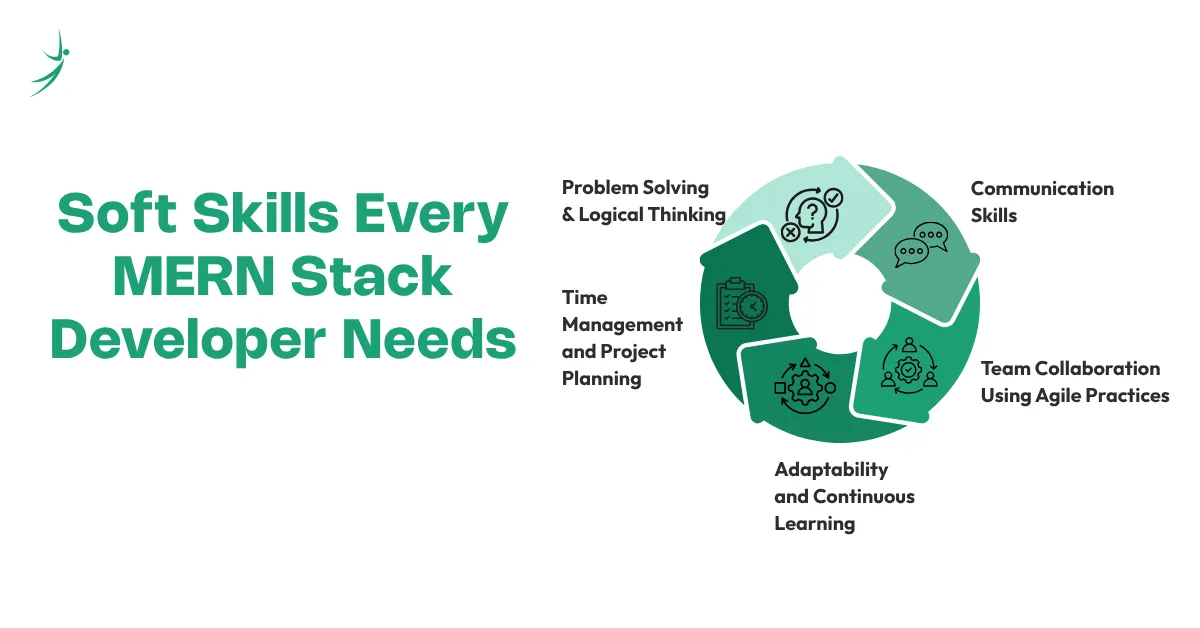
- Problem Solving and Logical Thinking: At its core, programming is not about memorizing syntax rules. It is about decomposing complex, ambiguous business problems into small, logical, executable steps. Cultivating strong analytical frameworks allows you to map data transformations cleanly before writing code.
- Communication Skills: As a full stack developer, you act as the ultimate bridge across teams. You must possess the verbal and written clarity needed to explain intricate backend database architectures to frontend designers, and translate technical limitations into simple business terms for non technical project managers.
- Team Collaboration Using Agile Practices: Modern software applications are built by collaborative teams using Agile development methodologies. You must understand how to operate within standard Agile frameworks: participating in daily stand up syncs, managing your assigned features inside tracking dashboards like Jira or Trello, and contributing to sprint reviews.
- Adaptability and Continuous Learning: The web development ecosystem evolves at a breakneck speed. To maintain a competitive edge, you must remain inherently curious and adaptable, ready to learn new tech variants, update your structural practices, and explore shifts in full stack engineering frameworks without friction.
- Time Management and Project Planning: When you handle both the client side user interface and server side databases, it is easy to get overwhelmed. You must cultivate strong time management habits: estimating feature delivery timelines accurately, prioritizing high value structural dependencies first, and organizing your daily tasks to prevent project bottlenecks.
If you want to strengthen these career-defining abilities, read our complete guide on soft skills for Developers.
Most In-Demand MERN Stack Skills in Nepal
The technology landscape in Nepal is undergoing an unprecedented wave of digital transformation. Local software houses, fintech enterprises, and offshore development centers handling global outsourcing contracts are aggressively hunting for local JavaScript talent. If you want to stand out in the local market, prioritize these core areas:
- Proficiency in JavaScript and ES6+ Features: Local tech companies look for strong fundamental JavaScript problem solving skills rather than shallow framework awareness.
- Strong React.js Skills for Front End Development: The local market has a massive demand for optimized, component driven client architectures that function seamlessly on varied mobile networks across Nepal
- Backend Development with Node.js and Express.js: E commerce engines, payment gateways, and local service platforms rely heavily on scalable, secure backend systems that handle heavy traffic efficiently.
- Database Management with MongoDB: Startups and SaaS systems in Nepal heavily utilize MongoDB due to its flexible schema design, enabling fast feature iterations.
- Version Control and Deployment Skills: Companies value developers who can join a Git workflow immediately and understand how to manage live cloud environments smoothly.
How to Build Your MERN Stack Skills
Going from a beginner to a high earning full stack engineer requires a structured, intentional approach. If you want to know how to map your learning path, studying how to get into mern stack provides a clear timeline. Follow this systematic roadmap:
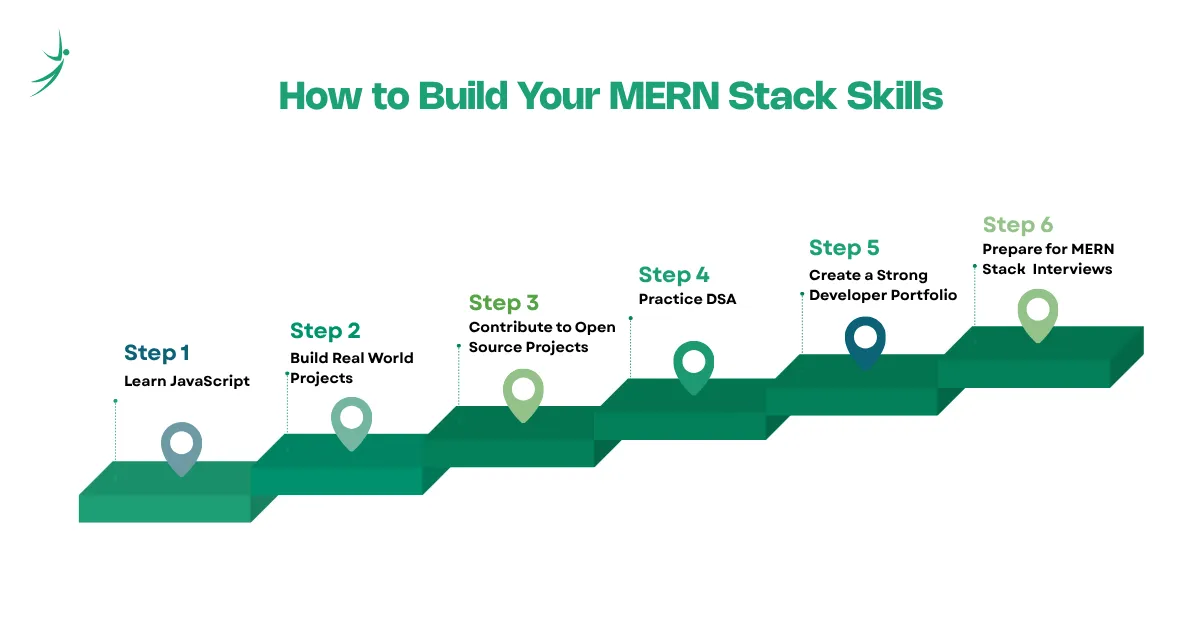
- Learn JavaScript Before Everything Else: Do not rush directly into React or Node.js. Spend time mastering raw JavaScript fundamentals first. New learners often wonder about the core architectural path, and evaluating frontend vs backend vs full stack processing parameters clarifies how JavaScript bridges both sides. Understand scopes, closures, prototype inheritance, and asynchronous execution models. Building a rock solid JavaScript foundation makes learning any modern framework straightforward.
- Build Real World MERN Stack Projects: Tutorial purgatory is the biggest roadblock for beginners. True learning happens when you close the instructional videos and start writing custom code. Focus on building real world applications that solve actual problems, such as a functional e-commerce platform with integrated payment structures, an interactive social network, or a comprehensive project management dashboard.
- Contribute to Open Source Projects: Navigate to GitHub and look for open source repositories with beginner friendly entry labels. Contributing code modifications to real world global projects exposes you to professional peer reviews, large codebases, and collaborative code coordination workflows.
- Practice Data Structures and Algorithms: To clear technical interviews at top tier software companies, your logical thinking skills must be sharp. Dedicate time to practicing data structures and algorithms on competitive coding platforms. Focus on arrays, string manipulations, search or sort paths, and time complexity metrics.
- Create a Strong Developer Portfolio: Your portfolio website is your ultimate digital resume. Host your finest full stack applications live on CDNs, provide direct links to clean code repositories on GitHub, and write clear files that explain the architectural choices, tech stacks used, and deployment processes of each project.
- Prepare for MERN Stack Technical Interviews: As you start applying for full stack roles, dedicate time to reviewing common technical interview questions. Practice explaining your structural coding decisions out loud, white boarding database schemas, and walking through your full stack projects systematically.
Elevate Your Engineering Career with Skill Shikshya
While self guided tutorials are a great starting point, navigating full stack architectures alone can easily lead to confusion, fragmented knowledge, and tutorial purgatory. To establish complete technical authority, it helps to understand alternative technology configurations by reading a structural mern stack vs mean stack comparison.
If you want to break through the noise and acquire professional, industry grade mern stack skills, enrolling in an expert led development program is the fastest accelerator. Joining the industry aligned MERN Stack Course at Skill Shikshya connects you with senior software engineers who provide regular code reviews, architectural guidance, and hands-on portfolio mentorship.
Frequently Asked Questions
What skills are required to become a MERN Stack developer?
Is MERN Stack still worth learning in 2026?
Do I need to learn JavaScript before MERN Stack?
Which MERN Stack skill is the most important?
How long does it take to learn MERN Stack skills?
Is MERN Stack enough to get a job in Nepal?
Can beginners learn MERN Stack without a Computer Science degree?
About Author:

Mr. Asim Chaulagain, Full Stack MERN mentor at SkillShikshya and developer at Vrit Technologies, empowers learners to build real-world web applications. Through hands-on projects, he turns coding skills into practical, career-ready expertise.