What is MERN Stack? A Complete Guide for Beginners | Skill Shikshya
If you've spent any time exploring the tech world lately, you’ve probably heard developers tossing around terms like "full-stack," "JavaScript," and "MERN." But what do they actually mean?
Whether you're a complete tech novice looking for a career change or a student aiming to build dynamic web applications, understanding MERN in web development is one of the most valuable moves you can make. If you're wondering where to begin, our guide on how to get into MERN Stack development outlines the skills, learning path, and career opportunities available for aspiring developers. This guide breaks down everything you need to know about the MERN stack, from its basic definition to career prospects right here in Nepal.
If you're serious about becoming a full stack developer, structured guidance can accelerate your learning curve significantly. Explore our MERN Stack Training Program to gain hands-on experience with MongoDB, Express, React, and Node.js while building real-world projects and receiving mentorship from industry professionals.
What is MERN Stack?
At its core, what is MERN stack? It is a collection of robust, open-source technologies used to build scalable, high-performance web applications. Instead of learning completely different programming languages for handling databases, backend code, and frontend design, the MERN ecosystem allows you to build everything using just one foundational language: JavaScript.
What Does MERN Full Form Actually Mean?
To fully understand the MERN stack meaning, we have to break down its acronym. The MERN full form stands for four distinct technologies working in perfect harmony:
- MongoDB (The Database)
- Express.js (The Backend Framework)
- React.js (The Frontend User Interface Library)
- Node.js (The JavaScript Runtime)
When someone talks about the MERN stack full form, they are referring to this specific combination of software tools designed to work together smoothly.
MERN is Frontend or Backend? What Does It Do?
One of the most common questions beginners ask is: MERN is frontend or backend?
The answer is both. MERN is a classic example of a full-stack framework. This means it handles the client-facing side that users interact with (frontend) as well as the hidden server and database configurations that keep the application alive behind the scenes (backend). A professional MERN developer can build an entire modern web application from top to bottom without relying on external system engineers.
Core Components of the MERN Stack (The 4 Layers)
The beauty of MERN is how cleanly it partitions different layers of web development. Let’s look at how the data travels between these components to create a functioning application.
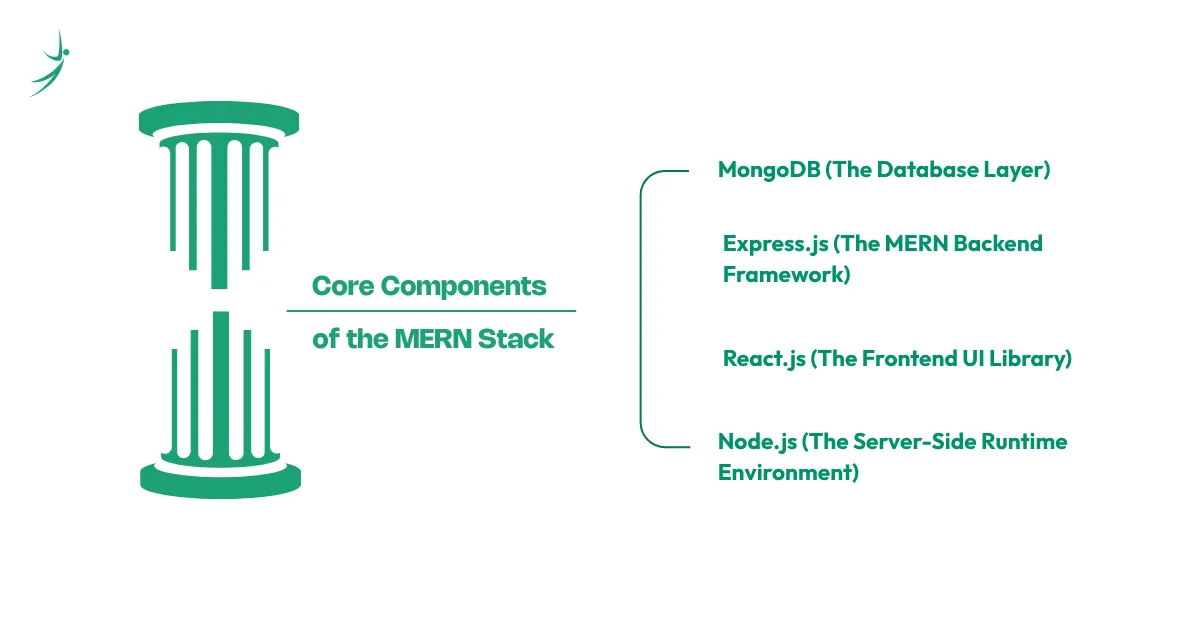
1. MongoDB (The Database Layer)
Unlike older relational databases that store information in rigid tables, MongoDB is a NoSQL, document-oriented database. It stores data in flexible, JSON-like formats called BSON. For web developers, this is incredibly convenient because it means your database speaks the exact same native format as your frontend JavaScript code.
2. Express.js (The MERN Backend Framework)
Express is a minimalist, ultra-fast web application framework designed specifically for Node.js. It acts as the manager for your MERN backend. Express handles your application's routing (making sure clicking a button takes you to the right page) and coordinates how data flows between the user interface and the database.
3. React.js (The Frontend UI Library)
Created and maintained by Meta (Facebook), React is the star player of modern user interfaces. It allows you to build single-page applications (SPAs) where pages update dynamically without needing to reload completely. React splits your webpage into modular, reusable componentsMERNlike a navigation bar, a profile card, or a checkout button MERNmaking your code clean and easy to scale.
4. Node.js (The Server-Side Runtime Environment)
Before Node.js arrived, JavaScript could only run inside a web browser. Node changed the game by allowing JavaScript to execute directly on a server computer. It provides the powerful runtime environment that hosts Express and allows developers to manage complex system processes, file operations, and server connections.
The MERN Stack Web Development Process: Lifecycle
The architecture of MERN relies on a 3-tier web development model. The frontend (React) communicates with the backend server (Express and Node) via an API, which then writes or reads from the database storage (MongoDB).
The Five-Stage MERN Lifecycle
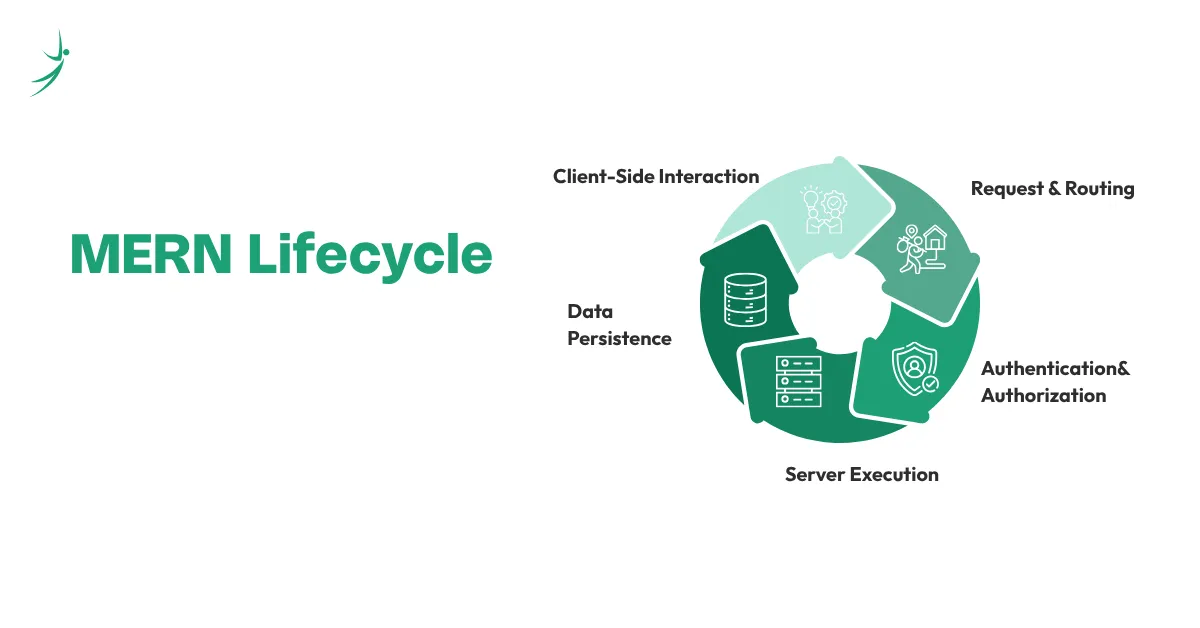
Here is how an interaction flows sequentially through a MERN application:
- Client-Side Interaction (React): A user interacts with the application browser. For example, they type a message into a chat screen and click "Send".
- Request & Routing (Express): The React frontend packages this action into an HTTP API request and passes it back across the internet to the Express backend server.
- Authentication & Authorization (Node.js + Middleware): Before processing the request, the backend verifies the user's identity and permissions. For example, it may validate a JWT token, check session data, or confirm user credentials by reading account information stored in MongoDB. If authentication fails, the request is rejected. If successful, the request proceeds to the application logic.
- Server Execution (Node): Node.js processes the request, computes any required business logic (e.g., verifying user identity or sanitizing input), and prepares to save the data.
- Data Persistence (MongoDB): The backend drops the message data directly into the MongoDB database. MongoDB confirms it is safely saved, and a success message goes all the way back up to update the user's view in React.
The MERN Stack Tooling Ecosystem and Packages
While MongoDB, Express, React, and Node form the core acronym, a real-world stack uses several supplementary packages to run securely.
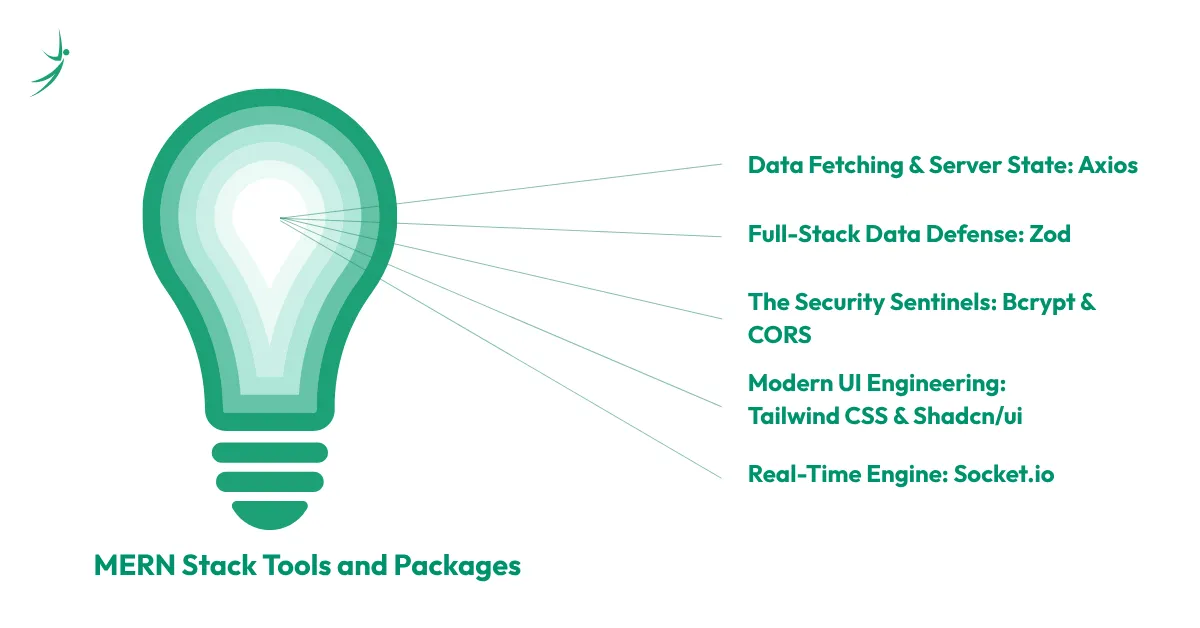
1. Data Fetching & Server State: Axios & TanStack Query
While React's native fetch() works for small projects, real-world apps require a production-grade communication bridge between the client and your Express server.
- Axios: A clean, promise-based HTTP client used to send requests from your React UI to your Node backend. It automatically transforms JSON data, intercepts request errors, and lets you set global security headers effortlessly.
- TanStack Query (React Query): This tool completely eliminates loading glitches on the frontend. It automatically caches server data, handles loading/error states out of the box, and updates data quietly in the background without causing annoying screen flashes for your users.
2. Full-Stack Data Defense: Zod
In modern web development, ignoring data validation is a fast track to security vulnerabilities.
- Zod: A TypeScript-first schema declaration and validation library. It allows you to build strict, unbreakable filters for your incoming API requests. If an attacker tries to send a malicious format or corrupted inputs to your Express backend, Zod catches it instantly at the gate, returning clean, readable error logs before any code executes.
3. The Security Sentinels: Bcrypt & CORS
A database leak can ruin a startup overnight. You must safeguard your backend traffic and user credentials using these foundational packages:
- Bcrypt: Never store plain-text passwords in MongoDB. Bcrypt uses an advanced, slow-hashing cryptographic algorithm to turn a password like mySecret123 into an unreadable, salted string of 60 characters. Even if hackers breach your database, they cannot reverse-engineer the hashes.
- CORS (Cross-Origin Resource Sharing): By default, web browsers block web pages from making API requests to a completely different domain name. The CORS middleware for Express acts as a security whitelist, allowing your specific React frontend URL to safely talk to your Node.js backend.
4. Modern UI Engineering: Tailwind CSS & Shadcn/ui
No one wants to buy or hire a tool that looks like it was built in 1998. To spin up stunning, responsive dashboards quickly:
- Tailwind CSS: A utility-first CSS framework that lets you style your React components directly inside your HTML classes, completely eliminating massive, messy external stylesheets.
- Shadcn/ui: The premier UI layout component methodology. Instead of installing heavy, unchangeable npm design libraries, Shadcn provides beautifully engineered, fully accessible copy-and-paste components (buttons, dropdowns, tables) that adapt beautifully to your Tailwind design system.
5. Real-Time Engine: Socket.io
If you plan to build chat applications, live notifications, or collaborative project boards (like Trello), traditional HTTP requests won't cut it because the server can't push updates to the client whenever it wants.
- Socket.io: A library that enables low-latency, bidirectional, real-time event communication between the browser and your server. It opens a continuous, active tunnel so data flashes onto your users' screens instantly without requiring page reloads.
What is a Full-Stack MERN Project?
You can’t learn development just by reading textbooks. To prove yourself as a competent MERN stack developer, you must build comprehensive applications that showcase all four layers interacting cleanly.
Top Portfolio Project Ideas for MERN Learners:
- E-Commerce Hub: Build an online storefront featuring category sorting, automated cart state syncs, and integrated payment processors like Khalti or eSewa.
- Real-Time Collaboration App: Create an online workspace or chat client using WebSockets that updates instantly for all users.
- Interactive Booking Dashboard: Design a system allowing users to check real-time seat availability, reserve spots, and see changes update instantly across database logs.
What is a MERN Stack Developer? Roles and Responsibilities
A professional MERN stack developer bridges the gap between design and system architecture. On a normal day, your responsibilities will look like this:
- Designing responsive user interfaces using React hooks and functional components.
- Building secure, reliable RESTful APIs using Express routing patterns.
- Designing scalable database schemas within MongoDB.
- Optimizing application speed, security patches, and server response performance.
MERN Development in the Age of GenAI: Will It Be Replaced?
With the rapid emergence of advanced Generative AI tools, many aspiring developers and programming students are asking the same question: Will AI replace MERN developers? The short answer is no. While AI is transforming the software industry, it is changing how developers work rather than eliminating the need for them.
The demand for skilled MERN developers continues to grow because businesses still need professionals who can design application architecture, solve complex problems, ensure security, optimize performance, and create exceptional user experiences. In fact, the rise of AI in web development is creating new opportunities for developers who understand both modern web technologies and AI-powered workflows.
How Full-Stack Code Generation Benefits From AI and ML
AI-powered development tools such as GitHub Copilot, Cursor, and ChatGPT are becoming valuable productivity assistants for modern development teams. These tools can generate standard Express routes, create React components, draft MongoDB queries, and suggest code improvements in seconds.
For MERN AI workflows, developers can leverage these tools to automate repetitive tasks, accelerate debugging, generate documentation, and improve code quality. This allows teams to spend less time on boilerplate coding and more time focusing on business logic, scalability, and innovation.
Why Human Developers Are Still Essential
Despite advances in web development AI, artificial intelligence lacks the business context, critical thinking, and strategic decision-making required to build production-ready applications. AI can generate code, but it cannot fully understand client requirements, design scalable system architectures, or make nuanced technical decisions without human oversight.
Successful modern developers are increasingly using AI as a productivity multiplier rather than viewing it as a competitor. The future belongs to developers who can combine strong MERN Stack fundamentals with AI-assisted development practices.
The Future of MERN and AI
Rather than replacing the MERN stack, AI is making it more powerful. Developers are now building AI-enhanced applications using React frontends, Express APIs, Node.js backends, and MongoDB databases while integrating technologies such as large language models, chatbots, recommendation engines, and intelligent automation systems.
As AI in web development continues to evolve, the most valuable professionals will be those who understand both traditional full-stack development and how to effectively incorporate AI into modern applications. This makes learning the MERN stack an even stronger investment for future-ready developers.
How to Start Your MERN Journey: Training & Courses
Ready to stop planning and start building? Here is how to map your approach.
Following the Ultimate MERN Stack Roadmap
To avoid overwhelming yourself, take this structured MERN stack roadmap phase-by-phase:
The Foundations: Master semantic HTML, CSS styling paradigms, and responsive design layouts.
- Core JavaScript: Deep dive into modern ES6+ concepts, asynchronous behavior, and working with asynchronous Fetch requests.
- Frontend Architecture: Learn React state mechanics, context management, component nesting, and lifecycle hooks.
- Backend Operations: Study Node.js system routing alongside Express middleware implementations.
- Database Mastery: Learn NoSQL querying models, data relations, and Mongoose structure modeling.
Choosing the Best MERN Course: Free vs. Paid MERN Crash Courses
You can find thousands of free standalone videos on the internet. A free MERN crash course on YouTube is excellent for testing your initial interest. However, self-studying often hits a wall when you run into complex, ungooglable bugs. A structured, in-person MERN stack course gives you access to physical code mentoring, industry-guided code reviews, and structural discipline that self-study simply can't provide.
Industry-Recognized MERN Certification
Completing an academy-backed MERN course and earning an official MERN certification acts as proof for employers. It validates that you haven't just memorized tutorials, but have passed code assessments and deployed live web platforms.
Why MERN Stack is Popular: The Primary Benefits
There are plenty of competitive framework variations (like the MEAN stack with Angular, or the MEVN stack with Vue). However, why MERN stack is popular comes down to distinct strategic wins:
- Pure JavaScript Consistency: You use a single programming language across the entire application stack, reducing development complexity and making collaboration between frontend and backend teams much easier.
- Massive Community Support: React, Node.js, Express, and MongoDB have large global communities, providing extensive documentation, tutorials, plugins, and solutions for common development challenges.
- High-Speed Performance: Node.js uses a non-blocking, event-driven architecture that efficiently handles thousands of concurrent requests, making MERN applications highly responsive and scalable.
- Rapid Development and Faster Time-to-Market: The abundance of reusable libraries, components, and open-source tools allows developers to build, test, and deploy applications much faster than with many traditional technology stacks.
- Scalability for Modern Applications: The MERN stack is well-suited for everything from small startups to enterprise-level platforms. MongoDB's flexible schema and Node.js's scalability make it easier to accommodate growing user bases and evolving business requirements.
The Primary Challenges of MERN Stack (and How to Overcome Them)
Every framework has trade-offs. Knowing how to face these challenges will set you apart from average candidates:
- JavaScript Fatigue and Asynchronous Logic: Because JavaScript evolves rapidly, packages update constantly. Beginners often get confused managing shifting syntax variants. Focus heavily on absolute core JavaScript fundamentals before you begin importing frameworks.
- State Management Complexity: As a React application expands, passing down global values through dozens of nested UI elements becomes tedious. Learn tools like Redux Toolkit early to keep your UI data architecture organized.
- The MERN Stack Talent Gap: The entry-level job market is packed with tutorial-clones. MERN students who copied a tutorial video exactly but can't change features independently. Overcome this by taking pieces of code and modifying them drastically to prove you understand the underlying engineering.
- Security Bottlenecks: Because NoSQL databases are flexible, they can introduce loose security structures. Learn proper parameter sanitization, JWT authorization handling, and secure database encryption rules early in your education.
Conclusion
The MERN stack remains an industry-standard choice for modern web production due to its agility, language uniformity, and sheer execution speed. While artificial intelligence is fundamentally changing how we write boilerplate files, the market continues to reward human developers who can translate business needs into scalable web engines.
If you're ready to transition from a consumer of technology into an active creator, stop reading tutorials and start writing code. Explore the full-stack course at Skill Shikshya today, connect with expert local mentors, and build the structural portfolio that will launch your software engineering career.
Frequently Asked Questions
Can I learn MERN stack in 1 month?
How much time to learn MERN stack?
Is MERN stack still in demand?
Is MERN stack a good career choice?
About Author:

Mr. Asim Chaulagain, Full Stack MERN mentor at SkillShikshya and developer at Vrit Technologies, empowers learners to build real-world web applications. Through hands-on projects, he turns coding skills into practical, career-ready expertise.