Scope of MERN Stack in 2026: Opportunities & Growth
The tech landscape is shifting at a breakneck pace, and web applications have evolved from simple static pages into complex, AI-integrated digital ecosystems. In 2026, full-stack JavaScript development remains the dominant force driving modern business engineering. For anyone entering the tech sector, understanding the mern stack scope is the first step toward building a highly lucrative, future-proof career.
Whether you are an aspiring developer looking for a mern stack intern position or an experienced coder looking to upgrade your tech stack, choosing the right MERN Stack Course in Nepal can help you build job-ready skills, real-world projects, and industry experience faster. This ultimate guide will break down the entire career architecture, market size, salary thresholds, and future trends of the MERN stack ecosystem.
If you're completely new to this technology stack, start by understanding what is MERN stack and how its four technologies work together before exploring its career opportunities.
How Big Is the MERN Stack Industry in 2026?
The modern digital economy relies entirely on agility, speed, and real-time processing capabilities. Today, the JavaScript ecosystem powers over 98% of the web. Within this massive ecosystem, MERN (MongoDB, Express.js, React.js, Node.js) stands as the premier choice for scaling corporate platforms, hyper-growth SaaS architectures, and high-performance mobile-responsive systems.
The industry demand for skilled developers has broken past traditional boundaries. Companies no longer want fragmented teams split between multiple legacy programming languages. They prefer streamlined engineering units capable of building end-to-end features rapidly. This shift has supercharged the mern stack developer future scope, turning full-stack JavaScript specialists into some of the most sought-after professionals across the global tech market.
What is MERN Stack? Why Is It So Popular?
Before exploring its vast commercial potential, it is essential to understand the technological synergy that makes this stack unparalleled. MERN is an acronym for four interconnected JavaScript-based technologies designed to manage the entire lifecycle of web engineering from database queries to visual renders.
- Understanding MongoDB: MongoDB is a NoSQL, document-oriented database that stores data in flexible JSON-like documents. Its scalable structure makes it ideal for modern web applications and cloud environments.
- Understanding Express.js: Express.js is a lightweight backend framework for Node.js that simplifies routing, API development, and server-side functionality. It helps developers build robust web applications with less code.
- Understanding React.js: React.js is a popular frontend library used to create interactive and responsive user interfaces. Its component-based architecture and Virtual DOM enable fast and seamless user experiences. If you want to understand why React dominates modern frontend development, read our complete guide on what React is.
- Understanding Node.js: Node.js is a JavaScript runtime that allows developers to run JavaScript on the server side. Its event-driven, non-blocking architecture delivers high performance and handles multiple requests efficiently. Since Node.js powers the backend layer of MERN applications, it is important to understand what is Node.js and how it handles server-side development.
Key Benefits of MERN Stack
- Full-Stack Development with JavaScript: Use a single language (JavaScript) for frontend, backend, and database operations, making development faster and simpler.
- High Demand in Startups and Enterprises: MERN is widely used for building scalable applications, making it valuable for both startups and large organizations.
- Fast Development and Deployment: React components and thousands of NPM packages help developers build and launch applications quickly.
- Strong Community Support: A large developer community provides extensive documentation, tutorials, and solutions to common issues.
- Scalability and Performance: MongoDB and Node.js enable applications to handle growing traffic and large amounts of data efficiently.
- Excellent Career Flexibility: MERN skills open opportunities in frontend, backend, full-stack development, and related tech roles.
To become job-ready, developers should focus on acquiring essential MERN stack skills that employers actively look for.
Types of MERN Stack Career Paths
The versatility of this stack opens up a wide variety of specialized professional trajectories.
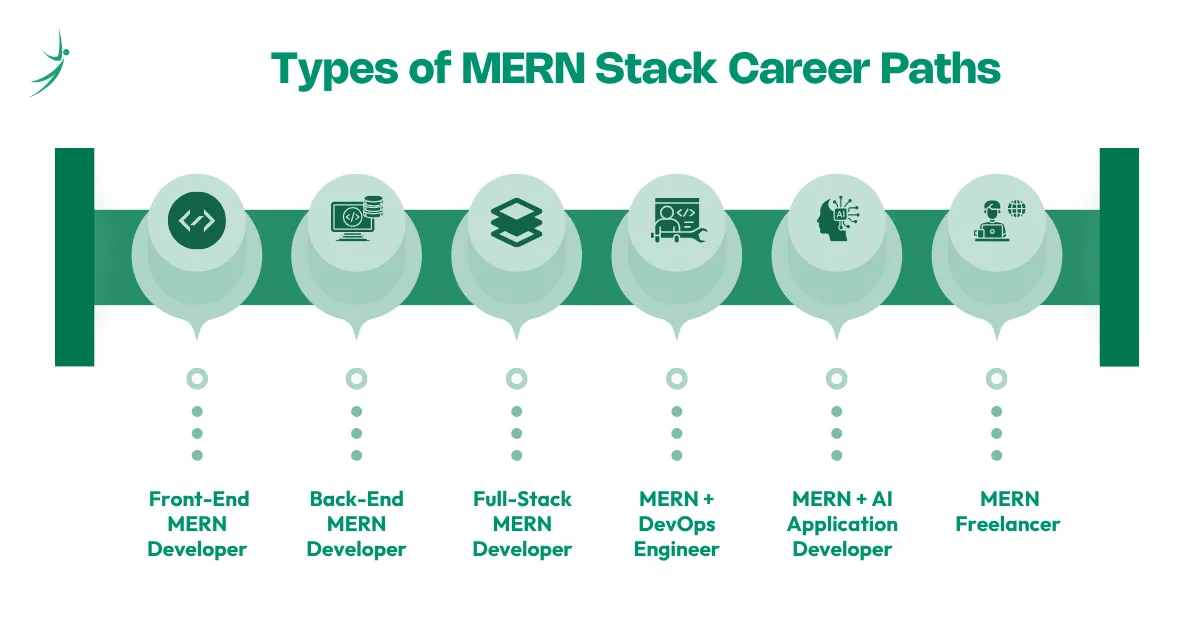
Understanding the difference between frontend, backend, and full-stack roles can help you choose the right specialization path.
1. Front-End MERN Developer
Specialists in this path focus heavily on the React.js layer. They are responsible for implementing pixel-perfect UI/UX layouts, managing complex local application state via Redux or TanStack Query, optimizing client-side performance, and handling seamless data fetching pipelines from backend APIs.
2. Back-End MERN Developer
These engineers specialize in the Node.js, Express.js, and MongoDB ecosystems. Their responsibilities include designing scalable database schemas, securing server networks with JWT and OAuth encryption, engineering performant RESTful or GraphQL APIs, and managing server-side caching mechanics.
3. Full-Stack MERN Developer
The ultimate versatile engineer. These professionals orchestrate entire features end-to-end. They build client interfaces, map database migrations, code the middle server logic, and tie everything together into a functional deployment pipeline.
4. MERN + DevOps Engineer
This high-paying multi-disciplinary hybrid path focuses on deployment, CI/CD pipelines, and infrastructure management. These engineers containerize MERN apps using Docker, orchestrate microservices via Kubernetes, and host full setups across cloud solutions like AWS, Azure, or Google Cloud.
5. MERN + AI Application Developer
The newest cutting-edge specialization in 2026. These developers use Node.js and React to integrate advanced Large Language Models (LLMs), machine learning APIs, and vector databases (like Pinecone) directly into full-stack web applications, engineering smart, contextual SaaS platforms.
6. Freelance MERN Developer
For those prioritizing personal autonomy, independent freelancing offers a fast track to global monetization. Freelancers leverage their comprehensive MERN skills to design, build, and deploy complete, production-grade applications for independent international clients.
The Real Scope of MERN Stack – What It Actually Covers
To understand the macro impact of this stack, we must look at how its architecture stretches across diverse business verticals and functional domains.
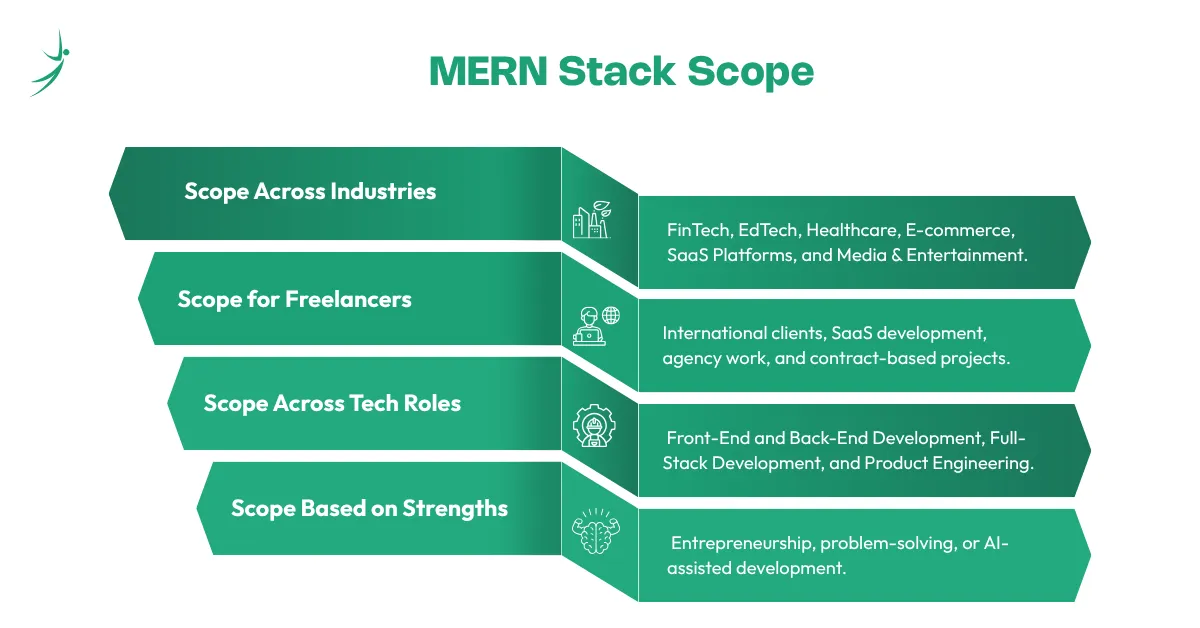
Scope Across Industries
- FinTech: Powers real-time transaction ledgers, digital payment gateways, and predictive analytics dashboards requiring immediate data synchronicity.
- EdTech: Used to build complex Learning Management Systems (LMS), real-time streaming classrooms, and interactive student valuation portals.
- Healthcare: Drives secure patient records portals, telemedicine platforms, and automated medical scheduling networks adhering to strict regulatory protocols.
- E-commerce: Underpins high-traffic digital marketplaces requiring scalable inventories, instantaneous search engines, and multi-currency checkouts.
- SaaS Platforms: The golden standard for multi-tenant subscription tools, data analytics dashboards, and B2B cloud productivity software.
- Travel & Hospitality: Runs advanced reservation engines, live pricing matrices, and dynamic route mapping applications.
- Media & Entertainment: Drives modern media platforms, social connection feeds, and live messaging boards processing massive real-time content feeds.
Scope Across Tech Roles & Business Functions
- Front-End Development: Architecting responsive layouts, ensuring cross-browser stability, and maintaining accessible client frameworks.
- Back-End Development: Writing server logic, enforcing cross-origin resource sharing (CORS) security, and fine-tuning database indexing.
- Full-Stack Development: Linking client layouts with structural data vaults to maintain product consistency.
- Product Engineering: Translating corporate business logic into clean, structured, and modular system features.
- Software Consulting: Auditing legacy code corporate infrastructure and advising corporations on architectural migration paths.
- Technical Project Management: Leading developer sprints, mapping out technical dependencies, and translating executive needs into engineering objectives.
Scope for Freelancers and Remote Workers
- International Clients: Accessing premium web construction markets globally right from your personal desk.
- SaaS Development: Partnering with overseas entrepreneurs to construct functional prototypes or scale live subscription products.
- Agency Work: Accepting dedicated outsourcing contracts from prominent global digital marketing and engineering agencies.
- Contract-Based Projects: Providing specialized technical assistance for short-term corporate migrations or performance tuning sprints.
- Remote Startup Opportunities: Joining early-stage international development squads that operate entirely through asynchronous digital spaces.
Scope Based on Your Strengths
- UI/UX-Oriented Developers: Focusing on React, micro-interactions, animation frameworks, and accessible front-end structures.
- Logic-Oriented Developers: Immersing yourself in Node server performance, complex database queries, and data encryption.
- Entrepreneurs: Building full software products single-handedly to validate startup hypotheses at minimum cost.
- Problem Solvers: Diving deep into algorithms, performance debugging, and resolving API latency bottlenecks.
- AI-Assisted Developers: Leveraging AI coding setups like Cursor or v0 alongside deep technical fundamentals to scale development velocity ten-fold.
Global Scope of MERN Stack
The geographical footprint of MERN is truly borderless, creating a global playground for qualified full-stack professionals.
MERN Stack Salaries Around the World
The financial compensation for full-stack capability is exceptionally high. Globally, remote MERN developers regularly command impressive financial packages:
| Region / Type | Average Annual Salary Range |
|---|---|
| United States | $83,000 – $142,000+ (top earners up to ~$180,000) |
| United Kingdom | £23,000 – £62,000 |
| Australia | AU$88,000 – AU$133,000+ (top earners up to ~AU$150,000) |
| United States (Remote) | $83,000 – $142,000+ |
The above data is taken form the official site of glassdoor.
Scope of MERN Stack in Nepal (2026)
Nepal’s domestic IT industry is currently undergoing a phenomenal digital renaissance, turning the country into a vibrant outsourcing hub and creating massive localized opportunities.
| Experience Level / Type | Average Monthly Salary (NPR) |
|---|---|
| Entry-Level / Fresher | NPR 25,000 – 40,000 |
| Mid-Level | NPR 40,000 – 1,20,000 |
| Senior-Level | NPR 1,20,000 – 1,50,000+ |
| Remote (International Clients) | NPR 3,00,000 – 5,00,000+ |
The above table data is taken form the official site of KumariJob.
MERN Stack vs Other Development Technologies
How does MERN stack up against alternative engineering paradigms in 2026? Let's take a look at a comparative breakdown:
MERN Stack vs PHP
PHP is widely used for traditional websites and CMS platforms, while MERN is better suited for modern, real-time, and interactive web applications.
MERN Stack vs Python Django
Django is ideal for data-driven and machine learning projects, whereas MERN uses JavaScript across the entire stack, simplifying development.
MERN Stack vs Java Spring Boot
Spring Boot excels in large enterprise systems, but MERN offers faster development, easier maintenance, and greater flexibility for modern applications.
MERN Stack vs .NET
.NET is popular in enterprise environments, while MERN is open-source, cross-platform, and optimized for cloud-native application development.
MERN Stack vs MEAN Stack
Both use MongoDB, Express, and Node.js, but MEAN uses Angular while MERN uses React. React's flexibility and ease of learning make MERN a popular choice among developers.
You can explore a detailed comparison of MERN stack vs MEAN stack to understand which technology stack is better suited for your goals.
Future Trends in MERN Stack
Where is the industry heading? Staying relevant means aligning your skills with these key emerging technological waves:
- AI-Powered Web Development: AI integration is no longer a futuristic concept. Modern MERN applications are built from the ground up to communicate with AI models. This means building React interfaces that display streaming AI responses and configuring Node.js backends that manage contextual prompts, automated workflows, and vector embeddings.
- Serverless Architecture: The industry is moving away from managing permanent virtual servers. Developers are increasingly deploying Node/Express backend logic as serverless functions across platforms like AWS Lambda or Vercel. This approach allows APIs to scale instantly based on traffic and reduces cloud infrastructure costs to zero when idle.
- Cloud-Native MERN Applications: Production-grade applications are built to be cloud-native. This means moving beyond simple hosting to building application architectures specifically designed for the cloud, using containerized environments, managed databases, and microservices automated through robust CI/CD pipelines.
- Microservices Adoption: Monolithic, all-in-one codebases are being broken down into decentralized, highly specialized microservices. Node.js is uniquely optimized for this architecture, allowing teams to run independent, lightweight server routines that communicate smoothly via lightweight protocols or event buses.
- React Server Components & Modern Frameworks: The React ecosystem has evolved with the widespread adoption of React Server Components (RSC). Frameworks like Next.js build directly on top of React, allowing developers to choose where components render on the server for blazing-fast initial load speeds and SEO, or on the client for fluid user interactivity.React continues to dominate the frontend ecosystem despite competition from Angular and Vue.
- Full-Stack AI Applications: We are seeing a massive surge in full-stack AI platforms ranging from predictive automated business tools to smart content generation spaces. Developing these applications requires a rock-solid understanding of full-stack data handling, real-time webSockets, and performant API pipelines.
- Low-Code and AI-Assisted Coding: AI code editors like Cursor and generative frontend engines like v0 are rapidly accelerating development speeds. However, these tools do not replace human engineers; they empower them. The future belongs to developers who pair a deep foundational understanding of full-stack architecture with AI tools to build applications ten times faster than traditional methods.
Skills Required to Become a MERN Stack Developer in 2026
To confidently capitalize on this market scope, you need to build a modern, well-rounded technical skill set:
Core Technical Skills
- JavaScript & TypeScript: Deep mastery of asynchronous programming, closures, ES6+ syntax, and strict typing architectures.
- React ecosystem: Component lifecycles, advanced Hooks (useState, useEffect, useContext), and state management systems.
Database Skills
- MongoDB: Document modeling, indexing optimization, aggregation pipelines, and secure cloud connection management via Mongoose ODM.
API Development Skills
- Express & Node.js: Architecting secure RESTful routes, structuring middleware validation layers, and integrating real-time communication engines like Socket.io.
Git & Version Control
- Git & GitHub: Master clean branching workflows, pull requests, merge conflict resolutions, and collaborative repository management.Beginners should learn git version control early because Git is a mandatory skill in almost every software development role.
Deployment & Cloud Basics
- Cloud Hosting: Practical familiarity with hosting frontends on Vercel or Netlify, servers on Render or AWS, and managing cloud databases via MongoDB Atlas.
AI Tools for Developers
- AI Pair Programming: Learning to effectively prompt and audit code outputs generated by advanced AI assistants like Cursor, Copilot, and v0 to maximize development velocity safely.
How to Enter This Field: MERN Stack Course & Training in Nepal
Stepping into this lucrative field requires a clear, practical roadmap and hands-on guidance.
If you're unsure where to start, follow a complete guide to get into MERN stack designed for beginners.
What Beginners Should Learn First
Before diving into frameworks, focus on HTML5, CSS3, and JavaScript fundamentals. A strong foundation makes learning what is MERN stack development and building full-stack applications much easier.
- Building Real Project: The best way to master the MERN stack is by building real-world projects. Create applications like e-commerce websites, chat apps, or task management systems to gain practical experience.
- Creating a Portfolio: A professional portfolio showcases your skills to employers. Include your best MERN stack projects, GitHub repositories, and project descriptions to demonstrate your development abilities.
- Getting Internships and Jobs: Applying for a mern stack intern, mern intern, or mern developer internship role helps you gain hands-on industry experience. Internships often provide mentorship and can lead to full-time opportunities.Preparing common MERN stack interview questions can significantly improve your chances of securing internships and full-time positions.
- Certifications and Industry Training: Structured training programs and certifications can accelerate your learning journey. They help you develop job-ready skills and improve your chances of landing a MERN stack developer role
Ready to transform your technical skills into a high-paying career? Explore the professional full-stack training programs at the best IT training institute in Nepal. Our comprehensive curriculum is built around hands-on, project-based learning under the guidance of working industry experts, taking you from complete beginner to a job-ready full-stack engineer.
Conclusion
The mern stack scope in 2026 presents an unmatched career opportunity for aspiring software engineers. By unifying frontend interfaces, backend logic, and cloud databases under a single programming language, MERN remains the absolute gold standard for modern, agile web engineering.
The path to success is clearly mapped out: build solid technical fundamentals, create a powerful portfolio of real-world projects, and gain practical experience through targeted internships. The global demand for versatile developers is waiting start your full-stack journey today!
If you're searching for the best MERN stack course in Nepal, choose a program that focuses on real projects, mentorship, and job-ready skills.
Frequently Asked Questions
What is MERN?
How much time does it take to learn MERN Stack?
What is MERN Stack Development?
What is MERN used for?
What is the future of MERN?
Does AI replace MERN Stack Developers?
About Author:

Mr. Asim Chaulagain, Full Stack MERN mentor at SkillShikshya and developer at Vrit Technologies, empowers learners to build real-world web applications. Through hands-on projects, he turns coding skills into practical, career-ready expertise.