Scope of DevOps in 2026: Opportunities & Growth
The global tech landscape is evolving faster than ever, and at the absolute center of this transformation is DevOps. If you are a software developer, system administrator, or a student looking to step into a highly lucrative tech career, Before exploring the current scope of DevOps, it helps to understand what DevOps is and why modern organizations are rapidly adopting DevOps practices.
In 2026, building software is no longer just about writing code; it is about deploying that code securely, rapidly, and at scale. This article breaks down the complete devops scope, career opportunities, local trends in Nepal, and how you can get started through a practical DevOps Course designed to build real-world cloud and automation skills.
How Big Is the DevOps Industry in 2026?
Before understanding the scope, it helps to see the size of what we are talking about:
- Global DevOps market: $24.30 billion in 2026, growing at a rapid 22.73% annually.
- Global DevSecOps platform market size projected to cross $11.72 billion in 2026.
- Cloud-native applications command a dominant 48% share of all modern software development environments.
- Elite DevOps teams achieve 973x more frequent code deployments than low-performing peers.
- Implementing standardized automation pipelines enables up to 60% faster software release cycles.
This is one of the fastest-growing industries in the world, and it is still accelerating year on year.
What is DevOps? Key Benefits of DevOps
At its core, DevOps is a cultural, engineered approach that merges software development with IT operations. It is not just a tool you download; it is a collaborative philosophy designed to shorten the software development lifecycle (SDLC) while delivering high-quality updates continuously.
Key Benefits of DevOps
Why are companies completely restructuring their IT divisions to build dedicated platform teams? The organizational advantages are undeniable:
- Accelerated Time-to-Market: Speeds up software delivery cycles by up to 60% compared to traditional waterfall or basic agile teams.
- Unmatched System Reliability: Continuous monitoring and automated testing drastically cut down down-time and broken production releases.
- Improved Team Collaboration: Bridges the historic, frustrating operational gap between software engineers (Dev) and IT administration (Ops).
- Lower Infrastructure Costs: Cloud-native engineering and smart automated provisioning prevent businesses from over-paying for inactive server power.
The ability to automate deployments, manage cloud infrastructure, and improve collaboration depends heavily on developing the right DevOps skills that organizations actively seek.
Types of DevOps
While DevOps is not categorized into rigid, official software classifications, it naturally branches into several specialized practices. These approaches are tailored to distinct organizational needs, project requirements, and technology stacks.
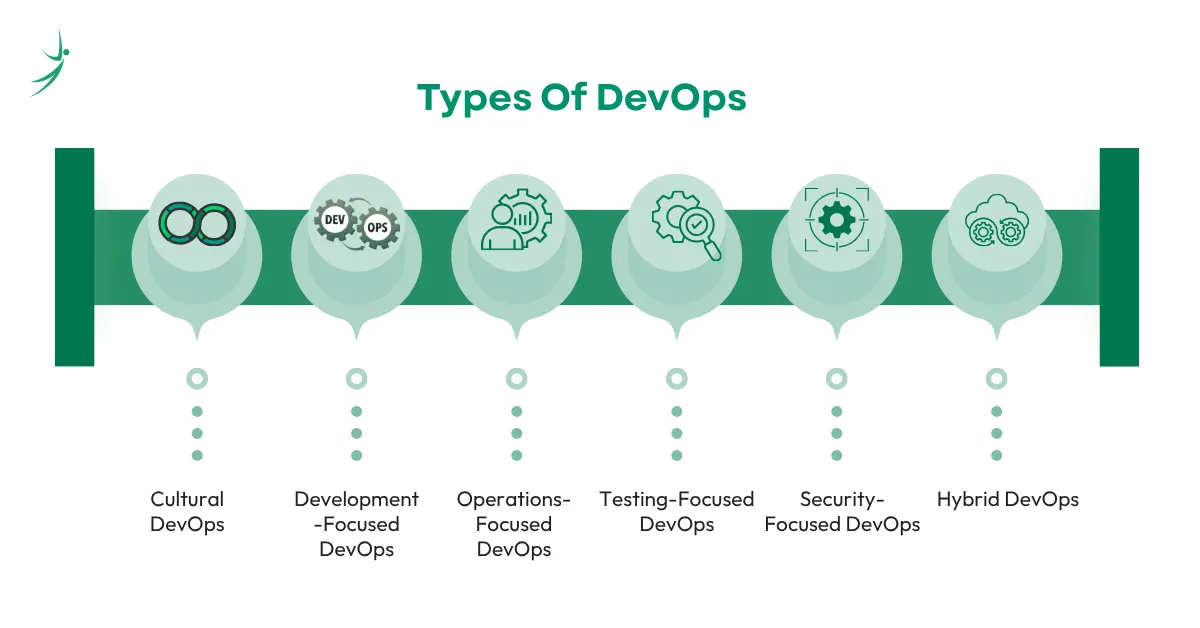
To help you understand how modern engineering teams operate, here is a breakdown of the broad types of DevOps practices implemented in the industry today.
1. Cultural DevOps
- Core Focus: Improving collaboration, empathy, and communication between development (Dev) and operations (Ops) teams.
- Key Practices: Breaking down organizational silos, fostering a shared-responsibility mindset, and establishing transparent feedback loops.
- Essential Tools & Frameworks: Agile methodologies, Scrum, Kanban, and cross-functional team structures.
- Why It Matters: Without a cultural shift, technical DevOps tools fail. Cultural DevOps ensures that human workflows align with automated pipelines.
2. Development-Focused DevOps (CI)
- Core Focus: Accelerating the software development lifecycle (SDLC) and improving code quality.
- Key Practices: Continuous Integration (CI), automated code linting, strict version control, and frequent code commits.
- Popular DevOps Tools: Git, GitHub, Jenkins, GitLab CI, and Travis CI.
- Why It Matters: It prevents "integration hell" by ensuring that multiple developers can merge their code into a central repository daily without breaking the application.
3. Operations-Focused DevOps (CD & IaC)
- Core Focus: Streamlining infrastructure management, system reliability, and cloud deployment.
- Key Practices: Continuous Delivery (CD), Infrastructure as Code (IaC), containerization, and automated deployment pipelines.
- Popular DevOps Tools: Docker, Kubernetes, Terraform, Ansible, and AWS CloudFormation.
- Why It Matters: It allows teams to spin up entire server environments automatically using code, eliminating human error during manual cloud setups.
4. Testing-Focused DevOps (DevTestOps)
- Core Focus: Ensuring software quality, performance, and stability through automated testing.
- Key Practices: Continuous testing within the CI/CD pipeline, regression testing, and Test-Driven Development (TDD).
- Popular DevOps Tools: Selenium, TestNG, JUnit, and Cypress.
- Why It Matters: By shifting testing "left" (earlier in the development cycle), bugs are caught and fixed before they ever reach production.
5. Security-Focused DevOps (DevSecOps)
- Core Focus: Injecting security protocols seamlessly into every stage of the DevOps lifecycle.
- Key Practices: Continuous security audits, automated vulnerability scanning, dependencies checking, and compliance-as-code.
- Popular DevOps Tools: Snyk, Aqua Security, SonarQube, and OWASP ZAP.
- Why It Matters: Traditional security happens at the very end of development, creating bottlenecks. DevSecOps ensures application security is baked into the code from day one.
6. Monitoring and Feedback-Focused DevOps
- Core Focus: Maintaining high system availability, tracking user experience, and gathering actionable system data.
- Key Practices: Application Performance Monitoring (APM), centralized log analysis, and real-time alerting systems.
- Popular DevOps Tools: Splunk, Prometheus, Grafana, Datadog, and the ELK Stack (Elasticsearch, Logstash, Kibana).
- Why It Matters: It gives operations teams a crystal-clear window into how production apps are performing, allowing them to fix server crashes or slowdowns before users even notice.
7. Hybrid DevOps
- Core Focus: Custom-blending multiple DevOps practices to suit complex, enterprise-level environments.
- Common Use Cases: Large enterprises dealing with legacy systems alongside modern cloud apps. They will often blend DevSecOps, multi-cloud IaC, and strict CI/CD pipelines simultaneously.
- Why It Matters: DevOps is not one-size-fits-all. A hybrid approach gives enterprises the flexibility to innovate at scale while managing compliance and technical debt.
The Real Scope of DevOps - What It Actually Covers
A comprehensive look at the cultural shifts, tools, and workflows that drive modern software delivery.
As the field continues to expand across industries, many aspiring engineers are exploring DevOps learning options in Nepal to gain practical experience with cloud platforms, automation tools, and CI/CD pipelines used by modern organizations.
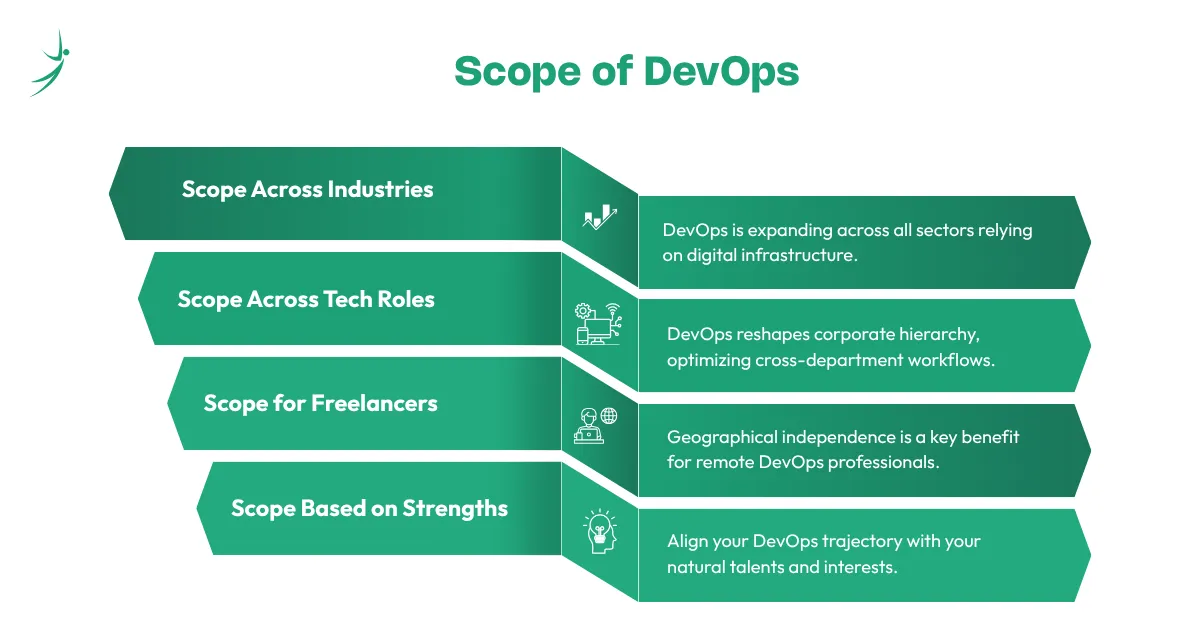
Scope Across Industries
DevOps is no longer limited to niche Silicon Valley tech giants. In 2026, the scope of devops in future stretches massively across every single sector that relies on digital infrastructure:
- Banking & Fintech: Enabling high-frequency, completely secure online banking deployments, automating regulatory compliance (like PCI-DSS) within pipelines, and ensuring zero-downtime transaction processing.
- E-commerce & Retail: Keeping massive retail platforms stable by configuring auto-scaling server groups to handle extreme traffic surges during major holiday flash sales (e.g., Black Friday or local Dashain festival sales).
- Healthcare & HealthTech: Delivering highly secure, HIPAA-compliant data pipelines and zero-downtime electronic health record (EHR) systems that doctors rely on instantly.
- Entertainment & Streaming (OTT): Powering automated content delivery networks (CDNs) and microservices that allow millions of users to stream high-definition video simultaneously without buffering.
- Automotive & Smart Mobility: Managing the continuous delivery systems that push seamless over-the-air (OTA) software and navigation updates to connected electric vehicles.
Scope Across Tech Roles & Business Functions
Inside an organization, the devops scope fundamentally reshapes the traditional corporate hierarchy, breaking down silos and optimizing cross-department workflows:
- Traditional Software Developers: Shift from dealing with local environment setup frustrations to using self-service developer platforms, allowing them to spin up testing environments in minutes.
- System Administrators (SysAdmins): Transition from manually logging into servers via SSH to writing declarative Infrastructure as Code (IaC) using Terraform and Ansible, effectively becoming automation architects.
- Quality Assurance (QA) Engineers: Move away from slow, repetitive manual UI testing toward embedding automated regression and performance testing directly into live CI/CD pipelines.
- Product Managers: Gain the ability to launch features to a tiny fraction of live users using "feature flags" and canary deployments, allowing real-time market testing without risking a total site crash.
- Security Teams: Evolve from acting as a late-stage bottleneck into collaborative partners who automate vulnerability scans early in the code-writing process.
Scope for Freelancers and Remote Workers
One of the most exciting aspects of this career track is the geographical independence it provides. Because infrastructure lives in the cloud, automation specialists can work from anywhere:
- High-Ticket Cloud Migrations: Companies frequently hire independent contract engineers to architect and execute the transition of legacy on-premise apps over to AWS or Google Cloud.
- CI/CD Pipeline Troubleshooting: Freelancers are heavily recruited for short-term gigs to audit and rebuild slow, broken deployment pipelines—speeding up delivery times from hours to minutes.
- Kubernetes Cluster Optimization: Small-to-medium enterprises often outsource the complex task of designing, securing, and scaling containerized environments rather than hiring a full-time engineer.
- Cloud Cost Optimization (FinOps): Independent consultants step into tech companies to analyze resource waste, tune automated scaling metrics, and instantly slash thousands off the client’s monthly cloud bill.
Scope Based on Your Strengths
The beauty of this career path lies in its versatility. You do not have to know everything; instead, you can align your trajectory with what you naturally enjoy doing:
- If You Love Pure Coding & Scripting: You can specialize in Platform Engineering, writing internal software tools, APIs, and CLI portals that abstract away infrastructure complexities for other internal teams.
- If Your Strength is Network Design & Security: You can excel in DevSecOps, focusing your energy on access control management, automated encryption keys, and pipeline vulnerability defenses.
- If You Have a Knack for System Resilience: You can build an incredible career in Site Reliability Engineering (SRE), focusing on system uptime, disaster recovery simulation, real-time logging, and deep-dive emergency debugging.
- If You Enjoy Visualizing Data & Trends: You can step into Observability & Monitoring Engineering, setting up advanced metrics dashboards (using Prometheus and Grafana) to give corporate leadership a bird’s-eye view of application health.
Global Scope of Devops
Because DevOps engineers bridge the critical gap between software development and live infrastructure operations, they command some of the highest tech compensations worldwide. Below is a comprehensive look at how annual salaries vary by experience level across major global tech regions.
| Experience Level | Typical Experience | Average Annual Salary (USD) | Average Hourly Rate (USD) |
|---|---|---|---|
| Intern | 0 yrs · Student or Freshers | $90,465 | $43/hr |
| Entry-Level / Junior | 0–2 Years | $118,198 | $57/hr |
| Mid-Level | 3–6 Years | $144,228 | $84/hr |
| Senior | 7+ Years | $180,503 | $87/hr |
The salary listed above reflects actual market averages for 2026 collected from Glassdoor.
Scope of DevOps in Nepal (2026)
Is DevOps in demand inside Nepal? Absolutely. Nepal’s tech ecosystem is undergoing a massive cloud migration wave. Local fintech pioneers (like F1Soft and Khalti) and international IT hubs (including Leapfrog, Cotiviti, and Fusemachines) are aggressively replacing legacy manual workflows with automated pipelines.
Because domestic demand for infrastructure and automation specialists heavily outpaces the available local talent pool, it has created an exceptionally high-paying job market for new entrants. Ready to step in? Explore our comprehensive DevOps Course to master Linux, Docker, Kubernetes, AWS, and Terraform, and build your job-ready portfolio today.
Career Scope: Jobs & Salaries in Nepal (2026)
Because of the rare skillset required to manage both code and complex cloud systems, professionals in this field command some of the highest salaries across the entire domestic IT hierarchy.
| Experience Level | Average Monthly Salary (NPR) | Essential Skill Expectations |
| Entry-Level (0–2 years) | NPR 40,000 – NPR 80,000 | Linux foundations, Git, basic AWS cloud, and initial CI/CD setups. |
| Mid-Level (2–5 years) | NPR 80,000 – NPR 150,000 | Production Docker/Kubernetes management, automated Terraform scripts. |
| Senior-Level (5+ years) | NPR 150,000 – NPR 350,000+ | Multi-cloud architecture design, global pipeline security, team leadership. |
The salary listed above reflects actual market averages for 2026 collected from domestic job portals (Kumari Job).
Salaries increase significantly when you can demonstrate hands-on experience with cloud platforms, automation, and deployment pipelines. Follow our complete DevOps Career Guide to understand job roles, growth opportunities, certifications, and the skills employers expect from modern DevOps professionals.
Future Trends in DevOps
To fully answer what is the future of devops, we must look closely at current tech revolutions. The next few years will be defined by three massive evolutionary shifts:
- AI-Driven DevOps (AIOps): Machine learning models are being embedded into workflows to automatically predict system anomalies, optimize cloud costs, and write automated IaC scripts.
- GitOps Supremacy: Using Git repositories as the absolute single source of truth for all infrastructure definitions, automating changes straight from code commits.
- Serverless Platforms: Moving beyond managing persistent virtual servers into purely event-driven architecture, reducing infrastructure management friction even further.
How to Enter This Field: DevOps Course & Training in Nepal
If you want to know how to become a devops engineer, you must accept that self-learning can occasionally feel completely overwhelming due to the sheer quantity of DevOps tools available, ranging from Docker and Kubernetes to Terraform, Jenkins, and cloud platforms. Enrolling in a structured devops course is the most reliable way to fast-track your progression.
When searching for the best devops course in Nepal, ensure the training institute provides comprehensive hands-on labs rather than just reading off theoretical presentation slides. Look for specialized devops training in Kathmandu that guides you through building a portfolio containing actual real-world projects:
- Building multi-stage containerized CI/CD pipelines.
- Deploying live web applications onto AWS or Google Cloud.
- Writing modular Terraform scripts to spin up infrastructure dynamically.
Acquiring a global certification such as the AWS Certified DevOps Engineer or the Certified Kubernetes Administrator (CKA)alongside your local training will make your resume instantly stand out to local and international recruiters alike.
Conclusion
The scope of devops in future is exceptionally bright. As software engineering teams globally and across Nepal strive for faster, safer, and completely automated software releases, the need for these specialists will only intensify.
If you have a strong passion for automation, cloud infrastructure, and solving complex system challenges, now is the absolute perfect time to invest in your training. Start looking into industry-recognized courses today, build your practical labs, and secure your place in one of the highest-paying professions in the modern tech economy.
Not sure where to begin? Start with our step-by-step DevOps Roadmap to understand which tools, technologies, and concepts you should learn first before moving into advanced cloud and automation practices.
Frequently Asked Questions
Is DevOps in demand?
What is the future of DevOps?
What is the scope of DevOps in the future?
What is the starting salary for an entry-level DevOps engineer in Nepal?
About Author: