DevOps Skills - Complete Guide for Beginners | Skill Shikshya
The tech landscape is shifting rapidly. As we navigate the complexities of cloud-native ecosystems, platform engineering, and AI-driven automation, the role of a DevOps professional has become more critical than ever. Whether you are looking to break into the industry or level up your existing career, understanding the complete DevOps journey is essential. Our DevOps Career Guide explains the roles, growth path, and opportunities available in the industry.
This comprehensive guide breaks down the essential DevOps engineer skills you need to master, spanning core technical competencies, automated workflows, and the vital soft skills that bridge the gap between development and operations. Many of these competencies are taught in our comprehensive DevOps Course, designed to prepare aspiring engineers for real-world cloud and automation environments.
Why DevOps Skills Matter
Before diving into the technical stack, it is crucial to understand what DevOps is and why acquiring DevOps skills is one of the most future-proof career moves you can make. Understanding the core principles behind DevOps helps explain why organizations increasingly rely on automation, collaboration, and continuous delivery to build modern software systems.
- High Demand, Short Supply:Organizations globally are migrating to hybrid and multi-cloud architectures. The demand for professionals with certified DevOps skills far outstrips the available talent pool, with nearly 37% of IT leaders identifying DevOps as their absolute largest technical skill gap. If you're wondering about the long-term opportunities, explore the Scope of DevOps and how organizations are increasingly adopting cloud-native infrastructure.
- Accelerated Delivery and Efficiency: Companies utilizing mature DevOps practices deploy code significantly faster and recover from unplanned downtime thousands of times faster than low-performing peers. Transitioning to a structured DevOps environment cuts software time-to-market by an average of 49%. Businesses will always pay a premium for that level of operational efficiency.
- Career Longevity and Evolution: DevOps is not a static role; it is an evolving philosophy. The fundamental principles you learn here seamlessly transition into modern disciplines like Platform Engineering, Site Reliability Engineering (SRE), and DevSecOps. With research firms indicating that 80% of major software engineering organizations are actively establishing centralized platform engineering teams, your foundational DevOps skillset acts as an unbreakable safety net for your long-term career.
- The Critical Foundation for AI Success (AIOps): As companies rush to implement artificial intelligence, mature DevOps workflows have become the primary anchor for stable software delivery. The 2026 State of DevOps Report reveals that 70% of global technology organizations state that DevOps maturity materially impacts their AI success. Without automated pipelines and robust data orchestration networks, complex AI tools simply introduce system instability rather than business value.
- Enhanced Software Quality and Risk Mitigation: DevOps is not just about moving fast; it is about building resilient systems. Introducing automated testing frameworks and moving security parameters to the earliest stages of the build track (shifting left) improves final deliverable quality by 61%. High-performing DevOps environments experience minor deployment failure rates and protect consumer trust by catching bugs long before they hit a production server.
Core Technical Skills Every DevOps Engineer Needs
Whether you're starting your DevOps journey or advancing your career, understanding these essential technical skills will help you build, deploy, and manage applications more effectively.
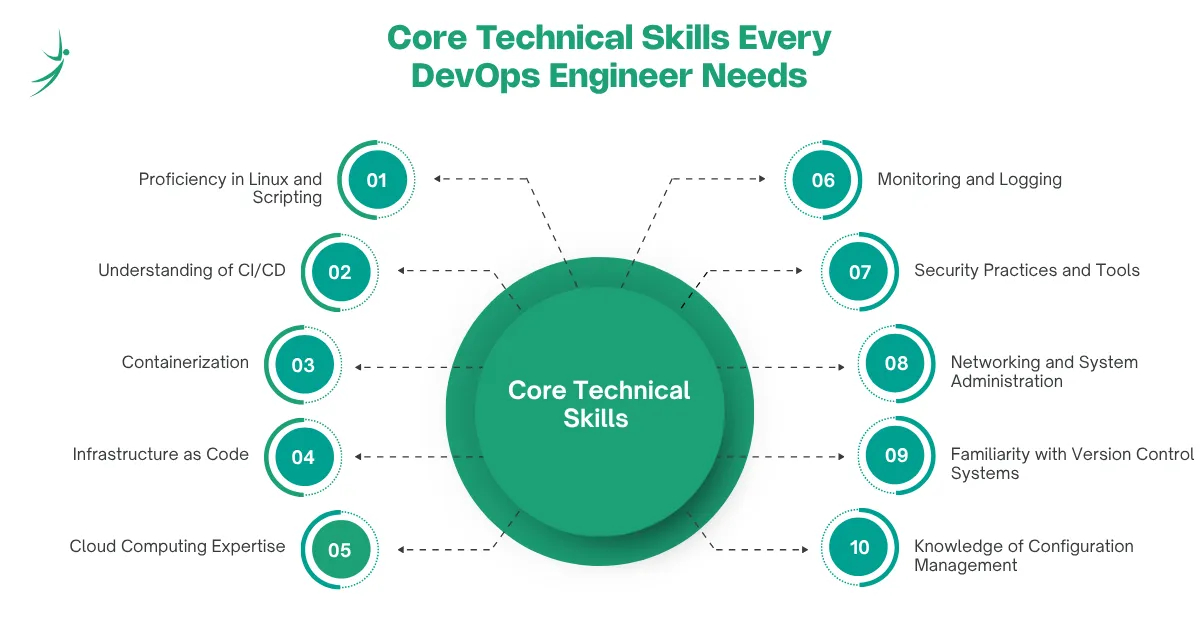
1. Proficiency in Linux and Scripting
The foundation of almost all modern cloud infrastructure is built on Linux. If you want to master the devops engineer skills that matter, you must start at the operating system level.
Operating systems like Ubuntu, CentOS, and Red Hat Enterprise Linux (RHEL) power the vast majority of cloud servers, containers, and mainframes. A competent engineer must understand file systems, process management, user permissions, and resource monitoring tools (top, htop, systemd).
Automation is the beating heart of DevOps. Without scripting, you are just performing manual operations at scale. You should be proficient in:
- Bash/Shell: For quick OS-level automation, cron jobs, and environment setups.
- Python or Go: For building robust automation tools, interacting with cloud APIs, and handling complex data manipulation.
2. Understanding of Continuous Integration and Continuous Deployment (CI/CD)
CI/CD is the engine that drives modern software delivery. It eliminates the old paradigm of massive, infrequent, and high-risk software releases.
Understanding CI/CD
- Continuous Integration (CI): The practice of automatically building and testing code changes every time a developer commits code to a central repository. This catches bugs early in the lifecycle.
- Continuous Deployment/Delivery (CD): Taking those validated code changes and automatically deploying them to staging or production environments with minimal human intervention.
If you're new to deployment automation, start by understanding what is CI/CD, and how continuous integration and continuous deployment accelerate software delivery.
Key Tools for CI/CD
Different teams favor different automation suites. A well-rounded engineer should be familiar with at least one or two of these core platforms:
| Tool | Primary Strength | Ideal For |
| GitHub Actions | Native repository integration | Teams already hosting code on GitHub wanting native automation. |
| GitLab CI/CD | All-in-one DevOps platform | Enterprise teams looking for built-in security scans and container registries. |
| Jenkins | Massive plugin ecosystem | Highly customized, legacy, or self-hosted enterprise infrastructure. |
Jenkins, GitHub Actions, and GitLab are only a few examples of the modern DevOps ecosystem. Explore our complete guide to essential DevOps Tools used by professional engineers.
Best Practices for Setting Up and Managing CI/CD Pipelines
- Keep Pipelines Fast: Optimize build caching and run test suites in parallel. A pipeline that takes an hour kills developer productivity.
- Shift Security Left: Integrate static application security testing (SAST) directly into the early stages of the pipeline.
- Ensure Idempotency: Deployments should produce the exact same environment state no matter how many times they are run.
3. Containerization and Orchestration
The phrase "it worked on my machine" died with the advent of containers. This category represents a mandatory devops required skill for any modern software environment.
Basics of Containerization
Containerization involves packaging an application together with all its dependencies, libraries, and configuration files into a single immutable image. This ensures the application runs identically across local laptops, staging clusters, and public clouds.
Key Containerization Tools
- Docker: The industry standard for creating, managing, and running container images.
- Podman: A popular daemonless alternative to Docker, favored in strict security compliance environments.
Orchestration Tools
While running a few containers on Docker is easy, managing thousands of containers across a cluster of servers requires an orchestrator.
- Kubernetes (K8s): The undisputed industry standard for container orchestration. It automates deployment, scaling, load balancing, and self-healing (restarting failed containers automatically).
- Docker Swarm / AWS ECS: Simpler alternatives used for smaller deployments where the full complexity of Kubernetes isn't warranted.
Docker and Kubernetes is typically learned after mastering Linux, Git, and Docker. Our detailed DevOps Roadmap shows the ideal sequence for learning these technologies.
4. Infrastructure as Code (IaC)
Modern infrastructure is too vast and dynamic to manage by clicking through web consoles. IaC treats server and network provisioning exactly like software source code.
Importance of IaC in Modern DevOps Practices
IaC allows teams to describe their entire infrastructure using declarative or imperative configuration files. This means your infrastructure can be versioned in Git, peer-reviewed via Pull Requests, and automatically torn down or recreated in minutes, eliminating manual configuration drift.
Key IaC Tools: Terraform, Ansible, Chef, Puppet
- Terraform: A declarative tool used to provision the foundational infrastructure (VPCs, virtual machines, databases, managed K8s clusters) across any cloud provider.
- Ansible: An agentless configuration management tool used to configure software and settings inside virtual machines once they are provisioned.
- Chef and Puppet: Older, powerful imperative tools optimized for large-scale configuration management in hybrid data centers.
Best Practices for Writing and Managing Infrastructure Code
- State File Management: Always store your Terraform state files in a secure, remote, and locked backend (like AWS S3 with DynamoDB locking) to prevent state corruption.
- Modularize Your Code: Break infrastructure down into reusable modules (e.g., a standard VPC module) to keep code DRY (Don't Repeat Yourself).
5. Cloud Computing Expertise
You cannot practice modern DevOps without deep familiarity with cloud architectures. Cloud platforms provide the scalable, programmable resources that make automation possible.
Importance of Cloud Platforms in DevOps
Cloud platforms expose their infrastructure via APIs. This API-driven nature allows your CI/CD pipelines and IaC tools to programmatically spin up or scale resources instantly in response to user traffic or deployment needs.
Key Cloud Providers: AWS, Azure, Google Cloud Platform (GCP)
- Amazon Web Services (AWS): The market leader with the deepest catalog of enterprise services.
- Microsoft Azure: The preferred choice for enterprises deeply integrated with the Microsoft ecosystem and Active Directory.
- Google Cloud Platform (GCP): Renowned for its industry-leading data analytics, machine learning tools, and native Kubernetes support (GKE).
Understanding Cloud-Native Tools, Services, and Architectural Patterns
A great DevOps engineer knows when to use managed services over self-hosted solutions. This includes designing microservices architectures, leveraging Serverless computing (like AWS Lambda), and utilizing managed cloud databases to offload operational overhead.
6. Monitoring and Logging
Deploying an application is only half the battle. You must ensure it stays healthy, performant, and secure post-launch.
Importance of Monitoring and Logging for Maintaining System Health
Without robust monitoring, you are flying blind. Effective monitoring and logging systems provide the data observability needed to detect memory leaks, identify slow database queries, and troubleshoot outages before your customers even notice them.
Key Tools for Monitoring: Prometheus, Grafana, Nagios
- Prometheus: A time-series database designed to collect and store metric data via a pull model, built specifically for cloud-native environments.
- Grafana: A visualization engine that connects to Prometheus to build beautiful, real-time dashboards mapping system metrics.
- Nagios: A legacy, host-based monitoring tool still widely utilized for traditional infrastructure alerting.
Logging Tools: ELK Stack (Elasticsearch, Logstash, Kibana), Splunk
- ELK Stack: A powerful open-source suite. Logstash collects and parses logs, Elasticsearch indexes them for rapid searching, and Kibana provides a dashboard interface to query the data.
- Splunk: A premium, enterprise-grade data platform used for complex log analysis and security auditing at a massive scale.
Best Practices for Setting Up Effective Monitoring and Logging Systems
- Define Clear SLOs and SLAs: Only alert your on-call engineers if a Service Level Objective (like an acceptable error rate) is actually breached. Avoid "alert fatigue."
- Centralize Everything: Ensure logs from every microservice and container stream into a single, searchable repository.
7. Security Practices and Tools (DevSecOps)
Security can no longer be an afterthought handled by a separate team at the very end of a development cycle. It must be woven into every single layer of the stack.
Integrating Security into the DevOps Pipeline
DevSecOps means introducing automated security verification at every phase of the CI/CD pipelinefrom writing code to building container images and configuring cloud firewalls.
Key Security Practices
- Vulnerability Scanning: Automatically scanning code dependencies and container base images for known vulnerabilities (CVEs).
- Secret Management: Ensuring API keys, database passwords, and SSH keys are never hardcoded into Git repositories.
- Least Privilege Access: Granting applications and users only the exact permissions they need to function, and no more.
Tools for DevSecOps
- Trivy / Snyk: For container and dependency scanning.
- HashiCorp Vault: For securely storing, encrypting, and rotating dynamic secrets and credentials.
- SonarQube: For static code analysis to catch security flaws before the application is compiled.
8. Networking and System Administration
A weakness in underlying networking concepts will make troubleshooting complex distributed cloud environments almost impossible.Understanding networking is a core requirement because modern DevOps practices focus on building reliable, scalable, and interconnected systems. Learn more about What is DevOps and the responsibilities involved.
Which networking concepts are most relevant to DevOps?
You must thoroughly master the core protocols that govern how systems talk to one another:
- TCP/IP & OSI Model: Understanding how packets travel across networks.
- DNS (Domain Name System): How domain names resolve to IP addresses, and how to manage internal/external DNS routing.
- HTTP/S and SSL/TLS: Securing web traffic and managing cryptographic certificates.
- Load Balancing: Distributing inbound traffic across multiple backend servers using tools like Nginx, HAProxy, or cloud load balancers.
System Administration Tasks and Best Practices
Regular system administration involves managing disk spaces, tuning kernel parameters, auditing user accounts, and patching security updates across server fleets without causing downtime.
Best Practices for Networking and System Administration
- Isolate Networks: Utilize Virtual Private Clouds (VPCs) and private subnets to ensure backend databases never touch the public internet.
- Automate Patching: Use configuration management tools to roll out system updates across your server fleet systematically.
9. Familiarity with Version Control Systems
Version control is the absolute single source of truth for both developers and operations teams in a DevOps environment.
Importance of Version Control in DevOps Workflows
Everythingapplication code, infrastructure configurations, pipeline definitions, and documentation lives in a version control system. This ensures transparency, history tracking, and rollback capabilities when changes cause unexpected issues.
Mastering Git: Key Commands, Workflows, and Best Practices
To collaborate effectively, you must be entirely comfortable navigating Git.
Git Workflows
- Trunk-Based Development: Developers merge small, frequent updates into a single "main" branch. This minimizes long-lived branch divergence and simplifies CI/CD.
- Gitflow: A more structured workflow featuring dedicated branches for development, features, releases, and hotfixes ideal for scheduled enterprise release cycles.
Best practices when using Git
- Write clear, descriptive commit messages.
- Never commit generated binaries, dependencies (node_modules), or unencrypted secrets. Use .gitignore diligently.
- Enforce branch protection rules on production branches to require peer approval and passing pipeline tests before code can merge.
Tools for Managing Version Control: GitHub, GitLab, Bitbucket
These platforms host your Git repositories and wrap them with collaborative code-review platforms, issue trackers, and integrated automation pipelines.
10. Knowledge of Configuration Management
While IaC builds the virtual data center, Configuration Management ensures the applications inside that data center are deployed, updated, and configured correctly.
The Role of Configuration Management in DevOps
Configuration management eliminates snowflake servers servers that are manually configured over time and cannot be easily replicated. It ensures that 5 or 500 servers maintain an identical software configuration.
DevOps Configuration Management Tools to Master
- Ansible: Highly popular due to its simplicity; it connects over standard SSH and uses readable YAML files.
- SaltStack: Optimized for high-speed, event-driven configuration management across massive infrastructures.
Best Practices for Managing Configurations Across Environments
- Separate Config from Code: Store environment-specific variables (like staging vs. production database URLs) outside your application images or scripts.
- Enforce Idempotency: Ensure that running a configuration script multiple times changes things only if a drift from the target state is detected.
Soft Skills for Digital Marketers
Technical DevOps skills get you hired. Soft skills determine how far you go. True DevOps is a cultural shift, separating engineers who merely write automation scripts from leaders who break down institutional silos and guide teams through high-stakes cloud transformations.
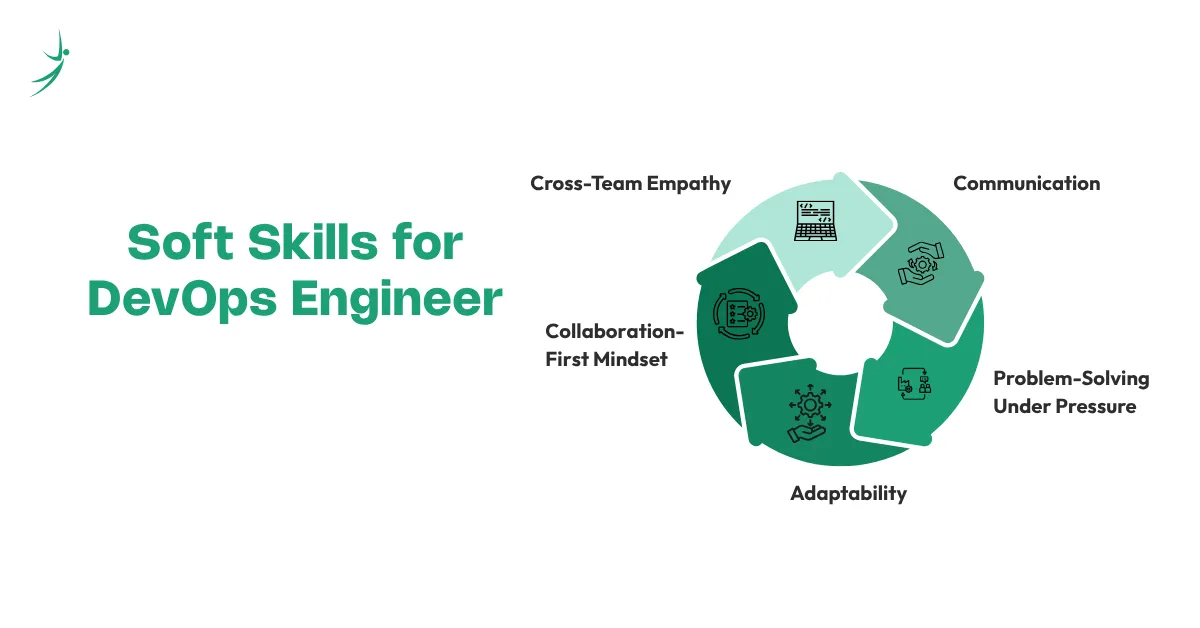
Experienced engineering directors consistently rank collaborative and cognitive soft skills alongside technical excellence when hiring beyond entry-level roles.
1. Cross-Team Empathy
Empathy is the skill that transforms cold automation into organizational efficiency. It shifts teams from defensive, siloed thinking ("your code broke my server") to shared responsibility ("how can we co-design a safer pipeline?"). Without it, developers see operations as a bottleneck, and operations sees developers as reckless.
- How to build it: Sit with a developer and watch them try to deploy code through your pipeline. Do not interrupt. Note every moment they hesitate or encounter a vague error that friction is your optimization roadmap.
2. Communication and Translation
DevOps engineers are organizational translators. You must translate cloud costs for executives, infrastructure constraints for developers, and system vulnerabilities for security teams. Exceptional communication means writing unambiguous documentation, preventing alert fatigue, and running blameless post-mortems.
- How to build it: After an outage is resolved, write a three-sentence summary explaining what happened, why, and the fix. Write it so a non-technical project manager can fully grasp it without looking up jargon.
3. Problem-Solving Under Pressure
When production drops, the financial and operational pressure lands squarely on you. Panic leads to rushed, unvetted patches that often worsen an outage. Resilient DevOps professionals treat failures as data-driven puzzles systematically isolating variables and analyzing metrics rather than pointing fingers.
- How to build it: Participate in or organize "Game Days" (chaos engineering simulations) where a staging environment is intentionally broken without warning. Practicing in a safe sandbox builds calm operational muscle memory.
4. Adaptability (Growth Mindset)
The tooling landscape moves fast. Engineers who tie their identity to a single tool ("I am strictly a Jenkins specialist") risk obsolescence. Adaptable engineers focus on mastering underlying architectural principles like idempotency, immutability, and state management allowing them to pivot to any new tool or cloud provider seamlessly.
- How to build it: Dedicate one hour a week to exploring a tool or cloud service completely outside your daily workflow (e.g., if your company is 100% AWS, spin up a basic project on Google Cloud).
5. Collaboration-First Mindset
Traditional IT operations often acted as the "Gatekeepers of No" to preserve uptime. DevOps flips this. Your job is to be an enabler who builds self-service internal platforms so developers can safely provision resources and test code without human bottlenecks.
- How to build it: Identify a manual task developers constantly ask you to do (like whitelisting an IP or spinning up a database). Write an automated script or a clear guide that empowers them to safely execute it on their own.
Most In-Demand DevOps Skills in Nepal
Technical programming skills get you noticed. Cloud and automation skills determine how far you go. The most in-demand DevOps skills in Nepal's current IT market are what separate professionals who simply maintain servers from those who optimize system architectures, slash downtime for scaling local platforms, and earn trust from both local tech leads and international remote clients.
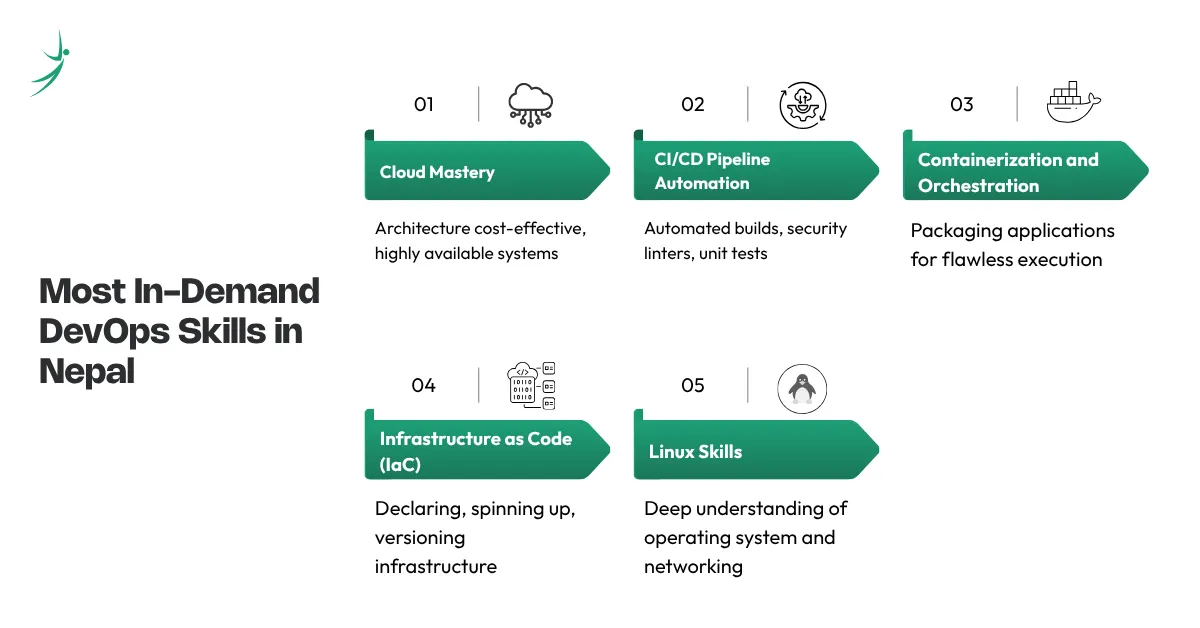
Most DevOps training courses focus entirely on teaching basic tool syntax. But experienced IT hiring managers in Kathmandu and Lalitpur consistently rank architectural execution and pipeline reliability alongside tool familiarity when evaluating candidates especially for roles beyond entry-level and junior positions.
Most in-demand DevOps skills in Nepal: Cloud Platforms Mastery, CI/CD Pipeline Automation, Containerization & Orchestration, Infrastructure as Code (IaC), and Linux Systems Administration.
1. Cloud Platforms Mastery (AWS & Azure)
Cloud platform expertise is the DevOps skill that validates every other automation layer. It is the ability to step away from physical machine constraints and architecture cost-effective, highly available cloud systems that handle unpredictable spikes in web traffic without a hitch.
Without it, your automation operates in a vacuum. In Nepal's rapidly expanding fintech, telecom, and e-commerce landscape, companies are aggressively migrating away from legacy, local on-premise infrastructure. Engineers who can seamlessly navigate AWS or Azure to optimize cloud costs while avoiding regional latency have a massive advantage, opening doors to both premium local corporate roles and highly lucrative international remote opportunities.
- How to build this DevOps skill: Do not just click around the AWS console. Launch a simple web application, intentionally configure an AWS budget alert to monitor spending limits, set up a CloudWatch alarm for CPU spikes, and map a custom domain via Route 53. Experiencing the live configuration loop once a week builds structural cloud fluency faster than any video tutorial.
2. CI/CD Pipeline Automation
Continuous Integration and Continuous Deployment (CI/CD) is the pulse of a healthy engineering team. It removes the stress of massive, manual, high-risk code deployments by running automated builds, security linters, and unit tests every single time a developer commits code.
Weak pipeline execution results in "integration hell" and endless deployment bottlenecks. In Nepal's competitive software outsourcing and digital product sectors, engineering teams must deploy multiple updates daily to keep clients happy. Mastering tools like GitHub Actions or GitLab CI to build fast, self-healing release tracks is what sets high-earning platform professionals apart from traditional system administrators.
- How to build this DevOps skill: Take an existing script or application codebase on GitHub and build an automated workflow using GitHub Actions that runs code lints and unit tests on every single pull request. Optimize your build caching step until your pipeline run-time cuts down by 50%. Seeing how minor configurations speed up software delivery is how you develop production-grade mastery.
3. Containerization and Orchestration (Docker & Kubernetes)
The legendary "it worked on my machine" problem disappears entirely once you master containerization. This skill represents the absolute blueprint for packaging an application with every single file, dependency, and environment variable it requires to run flawlessly across any environment.
While Docker isolates individual applications, scaling multiple microservices requires robust orchestration. As major Nepali fintech systems, banking apps, and digital wallets handle millions of active transactions daily, they rely completely on Kubernetes to automate container scaling and self-healing. Engineers who understand cluster networking, volume management, and container security are desperately sought after by local tech enterprises looking to eliminate single-point-of-failure architectures.
- How to build this DevOps skill: Dockerize a basic multi-tier web application (like a Node.js frontend combined with a MongoDB database). Once that runs smoothly locally with Docker Compose, deploy those identical containers into a local Kubernetes cluster using Minikube or Kind to observe how automated scaling and service discovery behave under artificial load.
4. Infrastructure as Code (IaC)
Managing cloud environments by manually clicking through a web interface is a recipe for operational disaster. Infrastructure as Code (IaC) shifts the balance, allowing you to declare, spin up, and version your entire network infrastructure using readable text configuration files exactly like software source code.
Without IaC, reproducing identical environments across development, testing, and production becomes a manual guessing game prone to configuration drift. Nepali tech firms executing complex international projects use tools like Terraform or Ansible to guarantee infrastructure consistency. Developing this skill means you can peer-review infrastructure changes through standard Git Pull Requests, making you an invaluable asset to any high-velocity DevOps squad.
- How to build this DevOps skill: Choose a basic cloud setup like a Virtual Private Cloud (VPC) with a single virtual instance. Write a clean, modular Terraform configuration script to deploy it. Run terraform destroy, make a minor adjustment to your variable file, and run terraform apply to see how code effortlessly generates physical cloud resources in under two minutes.
5. Linux Systems Administration & Networking
The most advanced automation pipelines in the world will crumble if you do not understand the underlying operating system and core networking protocols. Deep Linux knowledge is what empowers a DevOps professional to look under the hood when a pipeline deployment hangs or a backend cloud server goes unresponsive.
Tooling trends come and go, but Linux remains the undisputed operating system powering the global cloud. In Nepal's expanding tech hub, top IT companies look for candidates who can confidently navigate the Linux CLI, trace network packets via TCP/IP, diagnose internal DNS routing issues, and configure secure load balancers. This foundational system fluency is what keeps critical business applications fast, reliable, and secure.
- How to build this DevOps skill: Ditch standard graphical user interfaces (GUIs) for a week and run a Linux distribution (or use a virtual machine via WSL). Force yourself to manage system processes, analyze resource logs using htop or journalctl, and troubleshoot local network connectivity using basic terminal utilities like curl, dig, and netstat directly from the CLI.
How to Build Your DevOps Skills
Breaking into DevOps can feel overwhelming due to the sheer volume of tools. Use this structured roadmap to focus your learning journey efficiently:
- Step 1: Master the Basics First: Do not jump straight to Kubernetes. Spend dedicated time mastering Linux commands, basic networking, Git, and writing simple automation scripts in Python or Bash.
- Step 2: Learn One Major Cloud Provider: Choose either AWS or Azure. Build a simple web application, host it on a virtual instance, configure the domain name, and set up a basic firewall.
- Step 3: Introduce Infrastructure as Code: Take that manual cloud setup you just created and rewrite it entirely using Terraform. Delete the manual infrastructure and watch Terraform recreate it automatically.
- Step 4: Build a Full CI/CD Pipeline: Set up a GitHub repository. Write a pipeline using GitHub Actions that automatically builds your code, runs a test suite, packs it into a Docker container, and deploys it straight to your cloud setup.
- Step 5: Get Certified: Validate your knowledge with respected industry certifications like the AWS Certified DevOps Engineer, Certified Kubernetes Administrator (CKA), or HashiCorp Certified: Terraform Associate.
Frequently Asked Questions
What are the most important DevOps engineer skills?
Is DevOps a good skill to learn in 2026?
Do I need to be an expert developer to learn DevOps skills?
How long does it take to learn the required DevOps skills?
About Author: