What is DevOps? A Complete Guide for Beginners | Skill Shikshya
If you have spent any time around modern software teams, you have likely heard the term DevOps. But what is DevOps exactly? Is it a tool, a job role, or a methodology?
DevOps was created to bridge the gap between software development and IT operations, helping teams build, test, and deploy applications faster through collaboration and automation.
Let's explore what DevOps means, how it works, and why it has become one of the most in-demand technology careers in Nepal. If you're looking to enter this field, a structured DevOps training course in Nepal can help you develop practical skills in CI/CD, Docker, Kubernetes, cloud computing, and Infrastructure as Code (IaC).
What is DevOps? Definition and Core Meaning
To grasp the true meaning of devops, you have to look at it as a combination of two historically separate worlds: Development (Dev) and Operations (Ops).
What Does DevOps Actually Mean?
At its core, DevOps is a cultural, engineered approach that merges software development with IT operations. It is not just a tool you download; it is a collaborative philosophy designed to shorten the software development lifecycle (SDLC) while delivering high-quality updates continuously.
What Does DevOps Do?
So, what does devops do on a practical level? Instead of writing code for months and hoping it works when deployed, teams using a DevOps model release code in tiny, frequent increments. The core idea is simple: by automating repetitive infrastructure setups and testing processes, companies can launch features faster, discover bugs instantly, and keep systems stable.
Types of DevOps
While DevOps is not categorized into rigid, official software classifications, it naturally branches into several specialized practices. These approaches are tailored to distinct organizational needs, project requirements, and technology stacks.
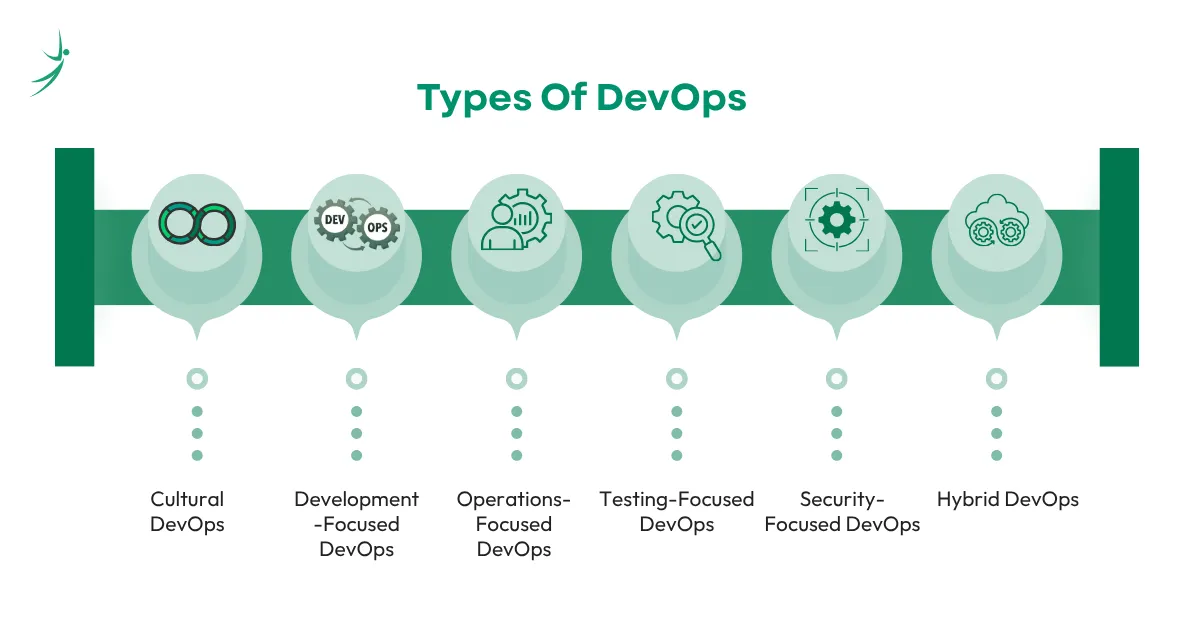
To help you understand how modern engineering teams operate, here is a breakdown of the broad types of DevOps practices implemented in the industry today.
1. Cultural DevOps
- Core Focus: Improving collaboration, empathy, and communication between development (Dev) and operations (Ops) teams.
- Key Practices: Breaking down organizational silos, fostering a shared-responsibility mindset, and establishing transparent feedback loops.
- Essential Tools & Frameworks: Agile methodologies, Scrum, Kanban, and cross-functional team structures.
- Why It Matters: Without a cultural shift, technical DevOps tools fail. Cultural DevOps ensures that human workflows align with automated pipelines.
2. Development-Focused DevOps (CI)
- Core Focus: Accelerating the software development lifecycle (SDLC) and improving code quality.
- Key Practices: Continuous Integration (CI), automated code linting, strict version control, and frequent code commits.
- Popular DevOps Tools: Git, GitHub, Jenkins, GitLab CI, and Travis CI.
- Why It Matters: It prevents "integration hell" by ensuring that multiple developers can merge their code into a central repository daily without breaking the application.
3. Operations-Focused DevOps (CD & IaC)
- Core Focus: Streamlining infrastructure management, system reliability, and cloud deployment.
- Key Practices: Continuous Delivery (CD), Infrastructure as Code (IaC), containerization, and automated deployment pipelines.
- Popular DevOps Tools: Docker, Kubernetes, Terraform, Ansible, and AWS CloudFormation.
- Why It Matters: It allows teams to spin up entire server environments automatically using code, eliminating human error during manual cloud setups.
4. Testing-Focused DevOps (DevTestOps)
- Core Focus: Ensuring software quality, performance, and stability through automated testing.
- Key Practices: Continuous testing within the CI/CD pipeline, regression testing, and Test-Driven Development (TDD).
- Popular DevOps Tools: Selenium, TestNG, JUnit, and Cypress.
- Why It Matters: By shifting testing "left" (earlier in the development cycle), bugs are caught and fixed before they ever reach production.
5. Security-Focused DevOps (DevSecOps)
- Core Focus: Injecting security protocols seamlessly into every stage of the DevOps lifecycle.
- Key Practices: Continuous security audits, automated vulnerability scanning, dependencies checking, and compliance-as-code.
- Popular DevOps Tools: Snyk, Aqua Security, SonarQube, and OWASP ZAP.
- Why It Matters: Traditional security happens at the very end of development, creating bottlenecks. DevSecOps ensures application security is baked into the code from day one.
6. Monitoring and Feedback-Focused DevOps
- Core Focus: Maintaining high system availability, tracking user experience, and gathering actionable system data.
- Key Practices: Application Performance Monitoring (APM), centralized log analysis, and real-time alerting systems.
- Popular DevOps Tools: Splunk, Prometheus, Grafana, Datadog, and the ELK Stack (Elasticsearch, Logstash, Kibana).
- Why It Matters: It gives operations teams a crystal-clear window into how production apps are performing, allowing them to fix server crashes or slowdowns before users even notice.
7. Hybrid DevOps
- Core Focus: Custom-blending multiple DevOps practices to suit complex, enterprise-level environments.
- Common Use Cases: Large enterprises dealing with legacy systems alongside modern cloud apps. They will often blend DevSecOps, multi-cloud IaC, and strict CI/CD pipelines simultaneously.
- Why It Matters: DevOps is not one-size-fits-all. A hybrid approach gives enterprises the flexibility to innovate at scale while managing compliance and technical debt.
The DevOps Methodology: Principles, Lifecycle, and How It Works
Understanding devops fundamentals requires looking at the operational rules that govern how successful tech teams build systems.
Core DevOps Principles
- Automation of the software development lifecycle: Human error is the biggest bottleneck in tech.DevOps prioritizes automating everything from running code tests to spinning up cloud servers.
- Radical collaboration and open communication: Developers and operations engineers work together from day one, sharing goals, metrics, and problems rather than passing blame.
- Continuous improvement and minimization of waste: Teams constantly analyze their pipelines to eliminate slow processes, reduce downtime, and optimize code efficiency.
- Hyperfocus on user needs with short feedback loops: By launching small changes frequently, teams can see exactly how consumers interact with software and pivot immediately based on real-world data.
The 5-Stage DevOps Lifecycle
Unlike traditional software development models, DevOps follows a continuous cycle where planning, development, testing, deployment, and monitoring work together to deliver software faster and more reliably.
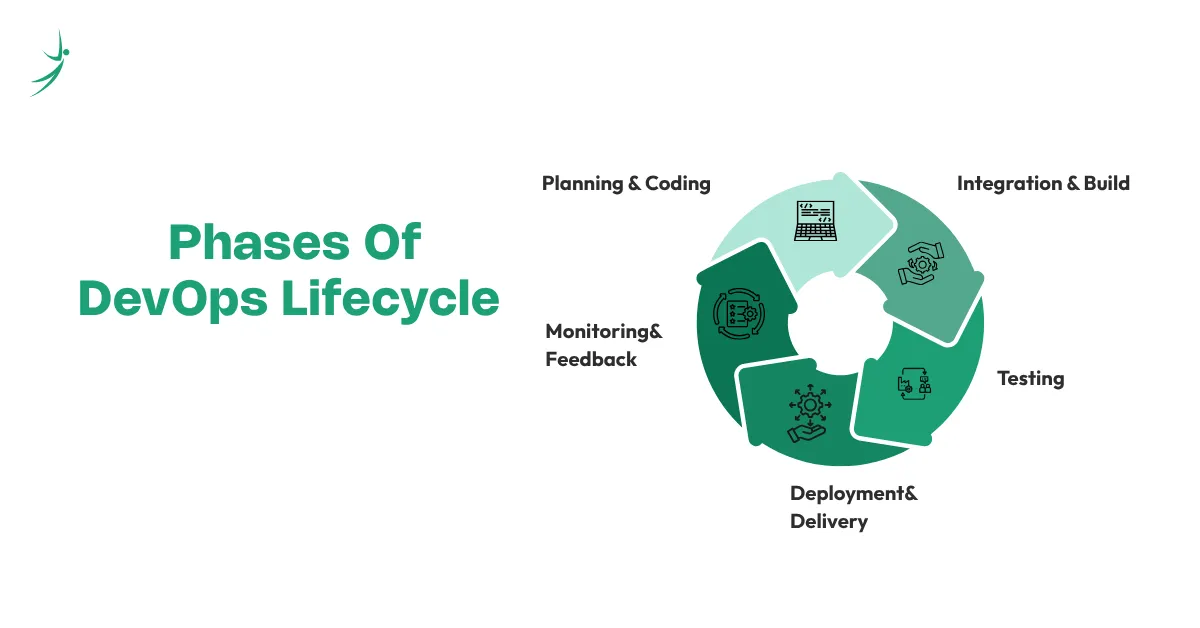
1: Planning & Coding
Every DevOps project begins with defining business requirements, planning features, and writing code. Developers use version control systems such as Git to track changes, collaborate efficiently, and maintain a reliable source of truth throughout development.
2: Integration & Build
Once code is committed, it is automatically merged into a central repository. Build tools compile the application, resolve dependencies, and package the software into deployable artifacts or containers, ensuring that new code integrates smoothly with existing systems.
3: Testing
Automated testing frameworks validate the application by checking functionality, performance, and security. By identifying issues early in the development cycle, teams can fix problems before they impact production environments or end users.
4: Deployment & Delivery
After successful testing, validated code is automatically deployed to staging or production environments. Automated release pipelines help organizations deliver updates, new features, and bug fixes quickly while minimizing downtime and deployment risks.
5: Monitoring & Feedback
Once applications are live, teams continuously monitor system performance, server health, security events, and user experience. Insights gathered from monitoring tools feed directly back into the planning phase, creating a continuous cycle of improvement and optimization.
The DevOps Tooling Ecosystem and Infrastructure
You cannot build an efficient software machine without the right tools. Modern tech infrastructure relies heavily on automated, interconnected architectures.
Beginners should also familiarize themselves with the most widely used DevOps tools such as Docker, Kubernetes, Jenkins, Terraform, Git, and Ansible, as these technologies form the foundation of modern automation workflows.
Core Concepts: Understanding CI/CD, DevSecOps, and Cloud-Native Systems
Three foundational systems define how modern infrastructure functions:
- CI/CD (Continuous Integration / Continuous Deployment): This is the engine room of DevOps. Continuous Integration ensures multiple developers can merge their code daily into a central repository where automated builds run. Continuous Deployment takes it a step further by launching those builds directly to live servers automatically if they pass testing blocks.
- DevSecOps: Historically, security auditing occurred at the very end of development, often delaying launches. DevSecOps embeds automated security checks directly into the early stages of development, guaranteeing that code remains secure from the first line written.
- Cloud-Native Approach: Modern applications are architected to live entirely in the cloud. DevOps relies heavily on cloud environments because cloud instances can be built, scaled, or torn down automatically via software instructions.
What is a DevOps Platform?
A DevOps platform is a centralized interface or suite of tools that integrates all phase-level tasks into a single dashboard. Instead of jumping across isolated apps, engineers use a platform (such as GitLab or AWS DevOps tools) to orchestrate everything from code tracking to server health metrics.
What is a DevOps Engineer? Roles and Responsibilities
If DevOps is fundamentally a cultural mindset, what is devops engineer as an actual job profile?
A DevOps engineer is a IT generalist who bridges the gap between software code and network infrastructure. They know how to code, but their primary focus is organizing the automated tracks that allow software to run smoothly across thousands of computers.
When analyzing everyday devops roles and responsibilities, an engineer's task checklist usually centers around these core domains:
- Infrastructure as Code (IaC): Writing scripts to configure and launch virtual machines or servers automatically, removing manual server setup entirely.
- Pipeline Management: Building and maintaining robust CI/CD pipelines so code flows cleanly from a developer's machine to the live internet.
- Monitoring and Logging: Setting up real-time dashboards to watch for traffic spikes, server crashes, or cyber threats.
DevOps in the Age of GenAI: Will It Be Replaced?
With generative artificial intelligence automating code production at breakneck speeds, an obvious question surfaces: will devops be replaced by ai in the coming years?
How DevOps Infrastructure Benefits From AI and ML
AI is not destroying DevOps; it is supercharging it. Modern AI tools are exceptional at recognizing patterns within massive systemic environments. Engineering teams leverage AI to instantly look over log data, predict server crashes before they happen, and auto-generate basic scripting configurations.
The 2026 Reality: Why AI Explains the Evolution (Not the Elimination) of DevOps
While AI can write individual scripts or point out small code issues, it cannot design complex, secure system architectures or understand unique business workflows. In 2026, AI is operating as a powerful assistant. The demand for skilled humans to verify, secure, and organize these AI-accelerated frameworks has actually increased.
DevOps Career Paths & Jobs Market in Nepal
The tech ecosystem in Nepal is experiencing massive growth. Local companies are abandoning old, slow development methods to keep pace with international engineering standards.
Before entering the field, it is helpful to understand the complete DevOps career path, including job roles, growth opportunities, certifications, and long-term industry demand.
Who is Hiring DevOps Talent in Kathmandu and Beyond?
A quick search for devops jobs in Nepal reveals high demand across several local industries:
- Fintech Leaders: Major digital wallet platforms and payment ecosystems (such as F1Soft, eSewa, and Khalti) require bulletproof, automated architecture to handle millions of transactions securely.
- Global Outsourcing Hubs: Software exporters based in Nepal (like Leapfrog Technology, Cotiviti, and Fusemachines) build systems for international clients, making world-class DevOps pipelines standard practice.
DevOps Engineer Salary in Nepal (2026 Benchmarks)
Because the skill set requires a deep understanding of both software design and networking, professionals pull in premium pay rates. Let's look at the current market reality for a devops salary in Nepal:
| Experience Level | Average Monthly Salary Range (NPR) | Expected Skill Set Focus |
| Junior DevOps Engineer | रू 45,000 – रू 80,000 | Git basics, Linux administration, fundamental Shell scripting |
| Mid-Level Engineer | रू 85,000 – रू 1,80,000 | Containerization (Docker), CI/CD pipelines, Cloud basics (AWS/Azure) |
| Senior DevOps Architect | रू 1,90,000 – रू 4,00,000+ | Kubernetes orchestrations, Infrastructure as Code (Terraform), System design |
Source: KumariJobs
Market Insight: Because experienced talent is scarce locally, a professional devops engineer salary in Nepal at the senior tier ranks among the highest compensations across the entire domestic tech market.
How to Start Your DevOps Journey: Training & Courses
If you want to secure a spot in this field, you need an organized study path. Because the topic covers multiple domains, jumping in without a plan can feel overwhelming.
If you prefer a structured learning path with hands-on cloud labs, mentorship, and real-world projects, enrolling in a professional DevOps course in Nepal can help you build industry-ready skills faster.
Choosing the Best DevOps Course: Free vs. Paid Routes
When searching for a what is devops course plan, evaluate your learning style:
- The Free Route: If you are self-disciplined, you can easily build your foundation via a devops free course track online. Platforms like freeCodeCamp, Coursera (Financial Aid), and YouTube channels like TechWorld with Nana offer top-tier structural introductions.
- Local Bootcamps: For structured, hands-on environments, local institutions like Broadway Infosys, TechAxis, or Genese Cloud Academy offer dedicated devops training in Nepal. When choosing a local center, prioritize options that offer live labs using real AWS or Azure cloud servers over pure lecture slides.
Industry-Recognized DevOps Professional Certification
While local portfolio projects prove your capability, having a global devops professional certification on your resume will help you clear HR screening filters instantly. Highly respected starter certifications include:
- AWS Certified Cloud Practitioner / DevOps Engineer Associate
- CKA (Certified Kubernetes Administrator)
- HashiCorp Certified: Terraform Associate
The Benefits of DevOps
When successfully integrated, DevOps transforms the speed, quality, and reliability of your software delivery pipeline.
- Faster Time-to-Market: By automating code integration, testing, and deployment workflows, development teams can ship new features, hotfixes, and system updates to customers in minutes or hours rather than
- Enhanced Collaboration and Shared Accountability: DevOps actively dismantles traditional "us vs. them" organizational silos. When developers and IT operations engineers share the same goals, metrics, and software pipelines, communication improves, and blame-shifting stops.
- Early Bug Detection (Shifting Left): Automating tests early within the Continuous Integration (CI) loop allows teams to uncover and patch defects during the early coding phases. Catching issues early prevents costly engineering overhauls down the line.
- Reduced Downtime and Rapid Recovery: Because production environments are managed as reproducible code (Infrastructure as Code), diagnosing server configuration drift becomes simple. If a bug manages to slip past staging, teams can instantly roll back deployments or patch live bugs with zero friction.
The Primary Challenges of DevOps (and How to Overcome Them)
Despite the massive upside, moving to DevOps is notoriously complex. Organizations frequently stumble over these common transition barriers:
1. Cultural Resistance
- Impact: Teams accustomed to traditional, siloed environments may push back against shared tools, open communication, and collective operational responsibilities.
- How to Overcome It: Drive cultural adoption from top leadership down. Treat mindset shifts and team empathy as a high priority before buying or forcing new automated software tools.
2. Toolchain Complexity
- Impact: Stitching together completely separate platforms like Git, CI/CD engines, Docker containers, Kubernetes, and monitoring software can quickly create massive technical bloat and configuration confusion.
- How to Overcome It: Intentionally standardize software choices across departments and avoid over-engineering early-stage deployment pipelines. Keep it simple before scaling up.
3. The DevOps Talent Gap
- Impact: Finding rare, cross-functional engineers who are highly fluent in both software coding and cloud infrastructure management is incredibly difficult and expensive in today's market.
- How to Overcome It: Invest heavily in upskilling your internal IT staff and software developers through continuous learning stipends and structured cloud certification paths.
4. Security Bottlenecks
- Impact: Rapidly accelerating your automated deployments can accidentally cause teams to bypass standard security reviews, introducing critical vulnerabilities directly into live, production applications.
- How to Overcome It: Transition to a true DevSecOps model by baking automated security scanning, dependency checks, and vulnerability testing directly into the core build pipeline.
Conclusion
DevOps has evolved from a software development practice into one of the most valuable disciplines in modern IT. By combining development, operations, automation, cloud computing, and continuous delivery, DevOps helps organizations build and deploy software faster, more securely, and with greater reliability.
As businesses across Nepal and around the world continue to adopt cloud-native technologies, the demand for skilled DevOps professionals is expected to grow even further in 2026 and beyond. Whether you are a student, aspiring engineer, system administrator, or software developer, learning DevOps can open the door to rewarding career opportunities in cloud infrastructure, platform engineering, automation, and Site Reliability Engineering (SRE).
Ready to start your DevOps journey? Explore our DevOps Training Course and gain hands-on experience with Linux, Git, Docker, Kubernetes, CI/CD pipelines, cloud platforms, and Infrastructure as Code (IaC) through practical, industry-focused training.
Frequently Asked Questions
What is the primary goal of DevOps?
Can I learn DevOps as a complete beginner with zero coding background?
What is a DevOps Engineer?
Will DevOps Be Replaced by AI?
Why is DevOps Important?
What Skills Are Required for DevOps?
Is DevOps a Good Career in 2026?
Is DevOps Difficult to Learn?
Does DevOps Require Coding?
About Author: