Python Developer Roadmap Nepal 2026: From Basics to Job-Ready
Every few months, another Kathmandu company posts a "Backend Developer (Python)" opening and gets a flood of applicants who know Python syntax but can't explain why a request hits a database or how a Django view actually returns a response. That gap, between "I know Python" and "I can build a backend", is exactly what Skill Shikshya's Python Django training program and a real python developer roadmap are built to close.
This guide lays out the complete path: what to learn, in what order, which frameworks actually get you hired in Nepal's market, what junior roles pay, and where most self-taught learners get stuck. It's written for students, career switchers, and self-taught coders in Nepal who want a straight answer instead of a 40-topic syllabus with no sequence.
Why a Python Developer Roadmap Matters in Nepal Right Now
Python isn't just popular in theory. According to Stack Overflow's 2025 Developer Survey the largest annual survey of working developers, with over 49,000 respondents across 177 countries Python's adoption jumped 7 percentage points year over year, a rise the survey attributes directly to its role in AI, data work, and back-end development. The same survey flagged FastAPI's growth as one of the most significant shifts in the entire web framework space this year.
For Nepal specifically, this shows up as three overlapping trends:
- Fintech and banking platforms need reliable backends, and Python's Django framework is a common choice because it ships with authentication, database handling, and admin tooling out of the box fewer moving parts for a small engineering team to maintain.
- Data and AI companies operating out of Nepal the kind hiring for CloudFactory, Fusemachines, and similar firms use Python across the entire stack, so backend skills and data skills reinforce each other instead of competing.
- Remote and freelance backend work has genuinely opened up. A Python backend developer with a working portfolio can realistically pick up contract work from Upwork or direct international clients without leaving Kathmandu or Pokhara.
None of this means Python is an easy shortcut to a job. It means the demand is real but only for developers who follow a full backend developer roadmap instead of stopping at "I finished a Python course."
What Is a Python Backend Developer?
A Python backend developer builds the part of an application users never see directly: the server logic, database interactions, authentication, and APIs that power what shows up on a screen. If frontend developers build the dashboard, backend developers build the engine underneath it.
So is Python a backend language? Yes, functionally. Python itself is general-purpose, but paired with a web framework (Django, Flask, or FastAPI), it becomes a full backend development language capable of handling routing, databases, authentication, and API responses at production scale. It's not the only backend language Node.js, Java, and PHP all compete in the same space but it's consistently one of the most requested, and Nepal's job market reflects that.
A working Python backend developer typically handles:
- Designing database schemas and writing queries (usually PostgreSQL or MySQL)
- Building REST APIs that a frontend, mobile app, or third-party service can call
- Handling user authentication, permissions, and session management
- Writing business logic the rules that decide what happens when a user submits a form, places an order, or requests data
- Working with caching (Redis), background tasks (Celery), and performance tuning as an app grows
- Deploying and maintaining the application using Docker, Linux, and a cloud platform
Key Benefits of Following a Structured Python Developer Roadmap
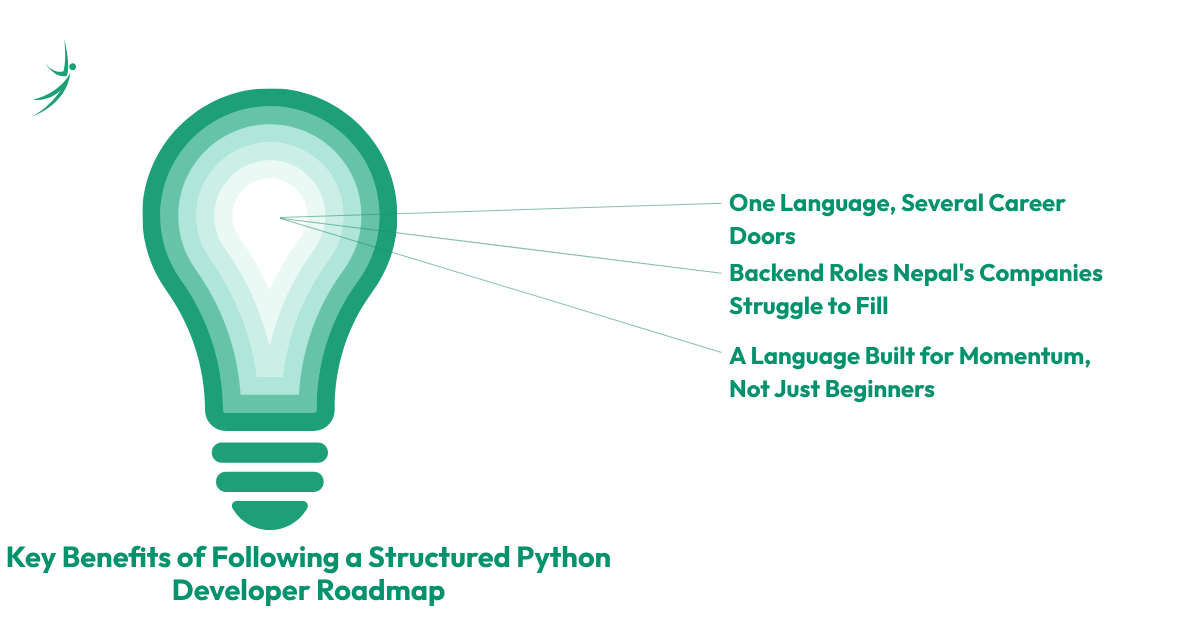
One Language, Several Career Doors
A Python learning roadmap doesn't lock you into one lane. The same core language skills branch into backend web development, data analytics, automation, and AI/ML, so a developer who starts in backend work can pivot toward data engineering later without starting from zero. If testing and process rigor appeal to you more than pure backend logic, a full breakdown of QA as an adjacent tech career is worth a look too, since QA and backend skills overlap more than most beginners expect.
Backend Roles Nepal's Companies Struggle to Fill
Local companies consistently report a shortage of backend developers who can actually design a database schema and reason about API structure not just follow a Django tutorial. A python developer roadmap followed properly, with real projects instead of copied code, puts you ahead of a crowded field of Python-syntax-only applicants.
A Language Built for Momentum, Not Just Beginners
Python's readable syntax makes it approachable early on, but companies like Instagram, Spotify, and Dropbox have run large parts of their production backend on Python for years proof that the language scales well past the beginner stage rather than being something you "graduate out of."
The Complete Python Roadmap: Basics to Job-Ready
This is the full python learning roadmap, in the order that actually works a full python roadmap, not a partial topic list. If you searched roadmap python or learn python roadmap looking for the exact stage-by-step order rather than a general overview, this is it. Skipping stages especially SQL and Git, is the single biggest reason self-taught learners stall out before their first job.
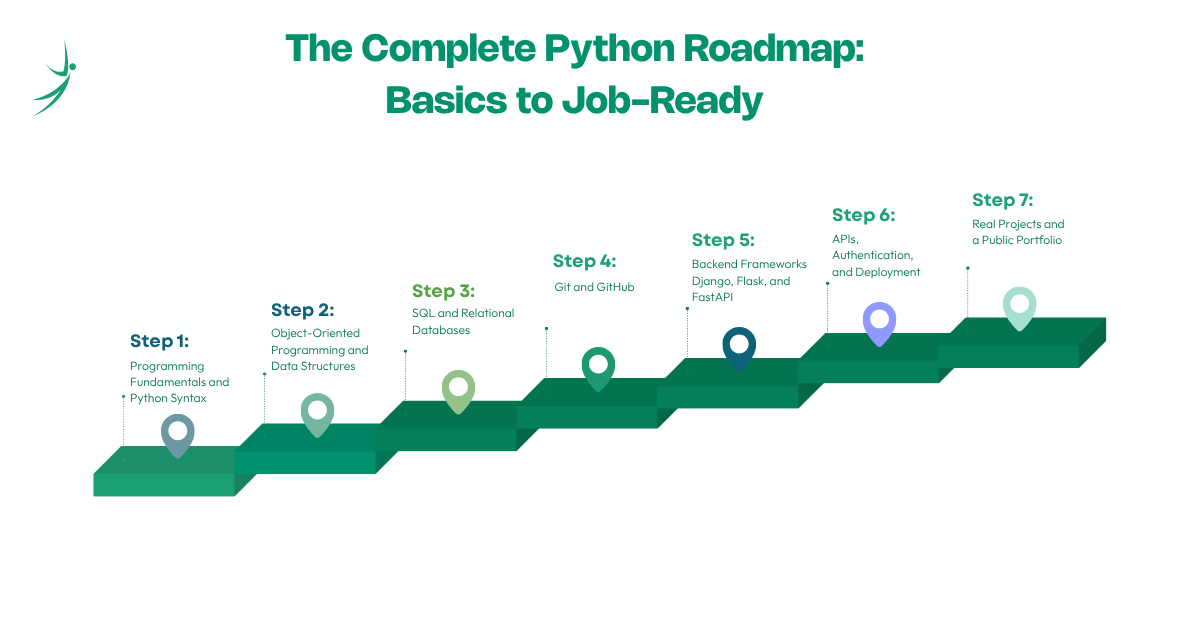
Stage 1: Programming Fundamentals and Python Syntax
Before frameworks, get genuinely comfortable with: variables and data types, conditionals, loops, functions, lists, dictionaries, tuples, string handling, and basic file I/O. Don't rush this stage weak fundamentals show up immediately once you touch Django.
Stage 2: Object-Oriented Programming and Data Structures
Classes, objects, inheritance, and encapsulation aren't academic exercises Django's entire model system is built on OOP concepts, so skipping this stage makes every framework topic afterward harder to understand than it needs to be.
Stage 3: SQL and Relational Databases
This is where most beginner roadmaps get thin, and it's a mistake. Learn SQL fundamentals directly SELECT, JOIN, GROUP BY, indexes, foreign keys using PostgreSQL, since it's the most common production database paired with Python backends and topped Stack Overflow's 2025 survey as the most-used database among professional developers. Understanding raw SQL before relying on Django's ORM makes you dramatically better at debugging slow queries later.
Stage 4: Git and GitHub
Version control isn't optional professional hygiene it's how every Nepali IT company evaluates junior candidates before an interview. Learn to branch, commit with meaningful messages, resolve merge conflicts, and keep a public GitHub history that shows consistent work, not one final upload.
Stage 5: Backend Frameworks Django, Flask, and FastAPI
This is the core of any python backend developer roadmap, and it's worth understanding all three rather than picking blind:
- Django is the "batteries-included" framework authentication, admin panel, and ORM built in. It's the framework behind Instagram's original scale-up from a PHP backend, and it remains the most commonly taught Python framework in Nepal's training institutes.
- Flask is lightweight and unopinionated good for smaller services or when you want control over every architectural decision.
- FastAPI is the newest of the three and built specifically for high-performance, async APIs. Its adoption has grown sharply enough that Stack Overflow's 2025 survey called out its framework growth by name a signal that "modern Python backend" increasingly means Django or Flask for the main app, paired with FastAPI for performance-critical services.
For a first job in Nepal, Django remains the safest primary choice because of how many local job listings name it directly; treat FastAPI as the framework you add once Django fundamentals are solid.
Stage 6: APIs, Authentication, and Deployment
Learn REST API design, JSON handling, token-based authentication (including JWT), and how to containerize and deploy an application with Docker. This stage is what separates "I can code" from "I can ship something a real user can access."
Stage 7: Real Projects and a Public Portfolio
Three to five complete projects not five copies of the same to-do app demonstrate three distinct skills: database design, API integration, and authentication. A blog platform with user accounts, a small inventory or booking system with real CRUD operations, and one project that consumes a public API are a stronger portfolio than a dozen tutorial clones.
Python Backend Technologies and Tools You'll Actually Use on the Job
Beyond the frameworks themselves, a working python backend developer in Nepal is expected to know a broader stack of backend python technologies:
- PostgreSQL or MySQL for relational data storage
- Redis for caching and session storage
- Celery for background and scheduled tasks (sending emails, processing files)
- Docker for consistent deployment environments
- Nginx as a reverse proxy in production setups
- Git/GitHub for version control and collaboration
- Postman or Insomnia for testing APIs during development
- pytest for writing automated tests, which more Nepali employers now expect even at the junior level
Knowing the difference between these tools and when each one is actually needed matters more in interviews than simply listing them on a CV.
Backend Development With Python: The Many Ways People Search For It
Whether you type it as backend development with python, back end development with python, or simply back end in python, you're describing the same underlying skill: building the server-side logic behind a web application using Python instead of Node.js, Java, or PHP. The same is true for back end development python, backend development using python, and building a backend using python these phrasings describe the same core discipline of designing APIs, models, and database logic, just worded differently depending on how someone learned to search.
A back end developer roadmap and a backend development roadmap follow the same underlying sequence described above, whether you frame it as a general back end development roadmap or a python backend developer roadmap specifically for Python. This backend python roadmap works the same way whether your starting point is complete beginner or someone pivoting over from frontend work. If your goal is to become a backend developer with python sometimes searched as backend python developer the sequence doesn't change: fundamentals, SQL, one framework, APIs, deployment, then real projects.
When people search how to become a backend developer roadmap-style, or look up back end development with python step by step, they're usually looking for exactly the stage list covered above. The same applies to broader searches for a backend development guide without "python" attached the underlying fundamentals are largely language-agnostic even though the implementation (Django, Flask, FastAPI) is Python-specific here.
If you're wondering how to build backend with python from absolute zero, or searching how to use python for backend development for the first time, start with Stage 1 through Stage 5 above, in order that sequence is the practical answer to both questions. Learners who search create website with python backend are usually ready for Stage 5 through Stage 7: pick Django, build a small CRUD site, and deploy it as a python web backend that a real user could open in a browser.
For teams on the hiring side, the question flips. Companies that want to hire backend python developer talent in Nepal increasingly look past certificates toward GitHub activity and at least one deployed project exactly the outcome this roadmap is built to produce.
Is Python Good for Backend Development? Common Questions Answered
These are the questions beginners search most often when deciding whether to commit to backend python development. Here are direct answers.
- Can Python be used for backend development? Yes. Paired with Django, Flask, or FastAPI, Python handles routing, database access, authentication, and API responses at a production level the same core responsibilities as any other backend language.
- Can I use Python for backend, even with zero prior programming background? Yes, though it takes longer. Python back end development is one of the more approachable entry points into programming precisely because the syntax is readable, so beginners asking "can i use python for backend" with no coding background at all are usually better served starting here than with a lower-level language.
- Can you use Python for backend, or is it only good for scripting and data work? Both are true simultaneously. Python's flexibility is exactly why so many Nepali companies use it a team can build a backend for Python-based data pipelines and a full web application using overlapping skills instead of maintaining two separate tech stacks. Whether you frame it as back end with Python or backend for Python, the answer is the same: production-ready, not a compromise.
- How is Python used in backend systems in practice? A typical request flow looks like this: a client sends an HTTP request, a Python web framework routes it to a view or endpoint function, that function queries the database (often through an ORM), and the framework returns a JSON or HTML response. Django, Flask, and FastAPI each implement this pattern with different levels of built-in structure.
- How do you build a backend with Python, starting from zero? Install Python, set up a virtual environment, install a framework (Django is the standard starting point), define your data models, connect a database, build your first API endpoint, and test it with Postman before connecting any frontend. This is genuinely the fastest way to learn how to create a Python backend without getting lost in theory.
- Can I create a website with a Python backend today, without years of experience? Yes a basic CRUD website (create, read, update, delete) using Django and SQLite is realistically buildable within a few weeks of consistent learning, and it's the standard first "real" project in most structured courses.
Junior Python Backend Developer: Getting Your First Job in Nepal
Most job listings for a junior python backend or backend python dev role in Nepal ask for the same core combination: Python fundamentals, one framework (usually Django), basic SQL, Git, and at least one deployed project. Very few expect deep FastAPI or Celery knowledge at entry level those are things you pick up on the job.
What separates candidates who get hired quickly:
- A GitHub profile with actual commit history, not a single upload the week before applying
- At least one project connected to a real, working API proof you understand request/response flow, not just Django's admin panel
- Basic comfort explaining your own code out loud. Interviewers frequently ask "why did you structure it this way," and a rehearsed but honest answer beats a perfect-looking project you can't explain
- Some exposure to deployment, even a simple one hosting a Django app on Render or Railway shows initiative most other junior applicants skip
A realistic first-job timeline for a disciplined learner following this roadmap is four to six months of structured, project-based learning, occasionally longer for fully self-taught learners without any mentorship or code review along the way.
Best Practices for a Python Backend Developer Roadmap
- Learn SQL before leaning entirely on Django's ORM. Understanding what the ORM generates under the hood makes you dramatically better at fixing slow queries later.
- Build projects that touch a real database and a real API, not isolated script exercises. Employers hire for applied skill, not syntax memorization.
- Read other people's Django code on GitHub once you're past the basics it teaches project structure faster than most tutorials.
- Write tests early, even simple ones. It's a habit that's much harder to build later than it is to start with.
- Deploy something small early, rather than waiting until you feel "ready." A live, working project even a simple one is worth more to a recruiter than a polished project sitting only on your laptop.
Challenges New Python Backend Developers Face and How to Overcome Them
- Tutorial hell. Endless tutorial-watching without independent building is the most common trap. Fix: after any tutorial, immediately rebuild the same type of project without watching from memory and documentation only.
- Jumping to frameworks before fundamentals are solid. Django feels productive early, which tempts learners to skip deeper Python and OOP concepts. Fix: if you can't explain what a Django model actually does under the hood, pause the framework and go back to fundamentals.
- Underestimating databases. Many self-taught learners can build a working app but can't explain why a query is slow or how to design a schema properly. Fix: deliberately practice SQL outside of Django's ORM, using a tool like PostgreSQL directly.
- No deployment experience. A project that only runs on localhost doesn't prove much to an employer. Fix: deploy at least one project publicly, even using a free-tier host, so you understand the full path from code to live application.
- Isolation while learning solo. Bad habits go uncorrected without feedback. Fix: get code reviewed by a mentor, an online community, or a structured backend python course, even if you're mostly self-taught otherwise.
Real Career Paths: Python Developers in Nepal
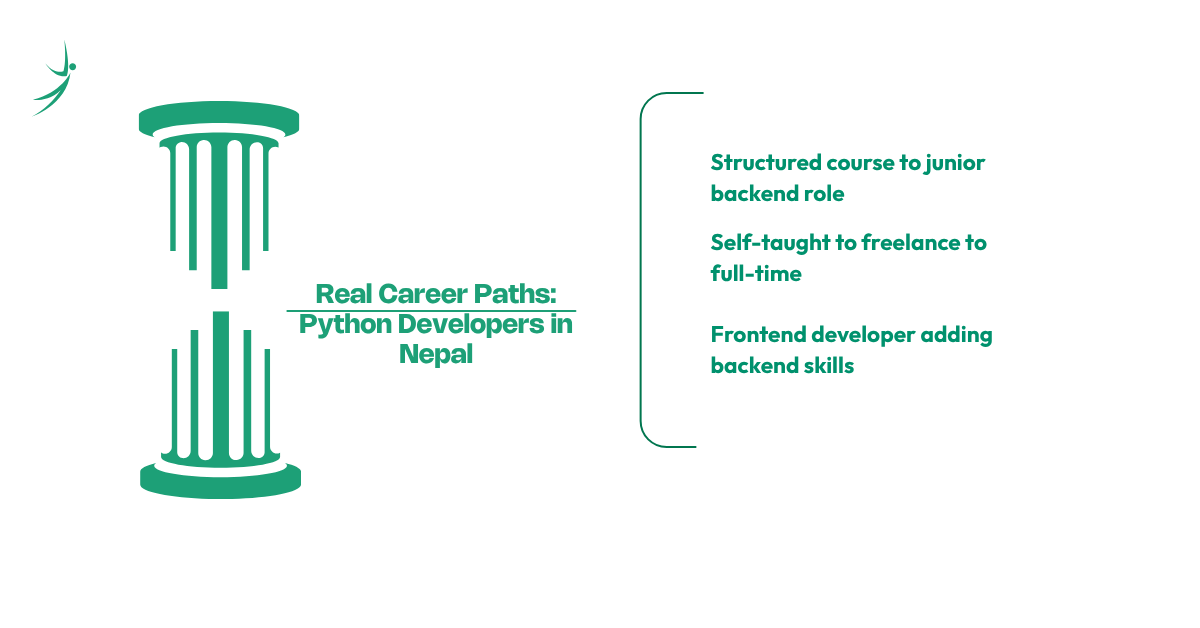
Path 1 — Structured course to junior backend role
A BCA or CSIT graduate with basic coding exposure completes a project-based Python Django course, builds three working applications with real database and API integration during training, and converts a guaranteed internship into a junior backend developer offer within three to four months of finishing.
Path 2 — Self-taught to freelance to full-time
A self-taught developer spends several months building small Django projects and studying SQL independently, picks up small backend fixes and API integration jobs on Upwork to build a client rating, and eventually converts a repeat client relationship into a stable remote contract.
Path 3 — Frontend developer adding backend skills
A developer already comfortable with JavaScript learns Python and Django specifically to become a stronger full-stack candidate, using existing understanding of HTTP and APIs as a shortcut into backend concepts rather than starting from zero. If JavaScript is already your stronger language, how the MERN stack compares as a full-stack path is worth reading side by side with this guide before you commit either direction.
Each path follows the same underlying sequence fundamentals, database understanding, one solid framework, real projects just in a different order depending on where the person starts.
Future Trends in Python Backend Development (2026 and Beyond)
- FastAPI's growth is no longer a niche trend. Stack Overflow's own 2025 data flagged it as one of the most significant framework shifts of the year, driven by demand for fast, async-friendly APIs increasingly relevant as AI-powered features get bolted onto existing backends
- AI-assisted coding is now a standard workflow input, not a novelty. Backend developers are expected to use AI tools to speed up boilerplate code and debugging, while still understanding what that code actually does. Reviewing AI output critically is quickly becoming its own core skill.
- Async Python is becoming a baseline expectation, not an advanced topic, as more backends need to handle concurrent requests efficiently without blocking.
- Python's role in AI backends is deepening the language's value, since teams building AI-powered features often prefer a single Python codebase across both the web backend and the machine learning components, rather than maintaining two separate stacks. This is also where backend work and data analytics skills increasingly overlap, since both draw on the same Python foundation. If dashboards and business intelligence tools interest you more than pure backend logic, a hands-on look at Power BI is a useful next read.
- Django continues evolving rather than aging out, with async view support and ongoing performance work keeping it relevant well past its reputation as an "older" framework.
The practical takeaway for a python developer roadmap in 2026: build your foundation on Django, treat FastAPI as a genuine second framework rather than an afterthought, and get comfortable using AI coding tools without becoming dependent on them.
How to Choose the Right Python Backend Developer Course
Not every backend python course delivers the same outcome, and the gap shows up fastest in whether graduates actually get hired. A python backend development course worth paying for should function as the best python backend course available to you locally not just the most convenient one. When evaluating a python backend developer course, check for:
- A project-based curriculum, not just recorded lectures you should be building real applications from the first few weeks, not watching for ten weeks before touching code.
- Coverage of the full stack a job actually requires: Python, Django (and ideally an introduction to FastAPI), SQL/PostgreSQL, Git, REST APIs, and basic deployment not just syntax and a single framework.
- Mentors with real backend experience, ideally people who've shipped production Django applications, not only taught from a fixed slide deck.
- A tangible portfolio outcome three or more working, deployed projects and an active GitHub history you can actually show a recruiter.
- Internship or placement support, since converting a completed course into a first job is usually the hardest step for beginners, not the learning itself.
If you're comparing options in Kathmandu specifically, Skill Shikshya's Python Django training program is built around exactly this structure core Python, Django, REST APIs, and deployment basics, with guided projects instead of a syntax-only lecture series. For a broader look at how this fits alongside other backend paths worth comparing, this breakdown of what separates DevOps and software engineering career tracks is a useful companion read once your Python fundamentals are solid.
If you're searching for a free starting point before committing to a paid course, the official Django documentation and FastAPI's official tutorial are both maintained directly by the frameworks' own teams and stay current with each release a stronger foundation than most third-party "python backend developer tutorial GitHub" repos, which are frequently outdated or abandoned mid-project.
Salary bands vary meaningfully by company type, specialization, and whether you're paid locally or through an international/remote contract. These figures reflect a realistic composite of current Nepal job market data a planning range, not a guarantee.
| Experience Level | Typical Monthly Salary (NPR) | Notes |
|---|---|---|
| Entry-level / Junior (0–2 yrs) | 20,000 – 35,000 | Django + SQL + basic API work expected |
| Mid-level (2–5 yrs) | 40,000 – 70,000 | DRF/FastAPI, database optimization, some DevOps exposure |
| Senior (5+ yrs) | 70,000 – 130,000+ | Architecture decisions, mentoring, system design |
| Remote / freelance (international clients) | 160,000 – 500,000+ | Often billed hourly in USD, highly variable by client |
A few things consistently shape where you land within these bands:
- Backend developers who also know AI/ML or data tooling (Pandas, basic model deployment) tend to sit at the higher end of each band, since Nepal's supply of Python developers with that crossover skill set is still limited relative to demand.
- Companies serving international clients or MNC subsidiaries typically pay noticeably more than local service companies for equivalent experience.
- Freelance and remote work consistently out-earns local full-time roles once a developer has two or more years of experience and a track record of delivered projects.
Python Developer Salary Worldwide (2026)
Nepal's salary bands sit at a fraction of global pay, which matters directly if you're weighing remote or freelance work against a local role.
| Country | Typical Annual Salary (USD) | Notes |
|---|---|---|
| United States | $99,700 – $172,300 (median roughly $114,000–130,000) | Highest in fintech, telecom, and healthcare sectors; Bay Area averages run $145,000–190,000 for experienced developers |
| United Kingdom | Roughly $96,900 | About 15% below the US median |
| Germany | Roughly $85,500 | About 25% below the US median |
| India | Roughly $51,300 median overall; $16,000–24,000 at product companies and GCCs | Entry-level roughly $7,000–13,000/year at top employers; senior roles with AI/ML specialization can exceed $65,000 |
| Nepal | $2,700 – $18,700/year (NPR 20,000–130,000+/month) | See the full Nepal breakdown above |
| Remote / international clients | Highly variable, commonly $18,000–150,000+/year | Location-agnostic pay is increasingly common; remote roles often pay 80–100% of in-office rates for the same employer |
What this means practically: the single biggest lever on a Nepali Python developer's income isn't years of experience, it's whether the work is billed locally or internationally. A mid-level developer earning NPR 50,000/month locally (roughly $4,500/year) can realistically double or triple that through remote contract work with the same skill set, provided they have a deployed portfolio and a working process for handling client communication across time zones.
Measuring Your Progress: Roadmap Milestones
Rather than vaguely "getting better," track concrete markers so you can tell whether your learning is converting into job-readiness:
- Month 1–2: You can write working Python programs including basic OOP without constantly referencing documentation for core syntax.
- Month 2–3: You understand SQL well enough to write your own JOIN and GROUP BY queries without relying purely on an ORM.
- Month 3–4: You've built and deployed at least one Django application with a real database and at least one working API endpoint.
- Month 4–6: Your GitHub shows consistent commit activity across multiple projects, not a single large upload, and you can explain any part of your code in an interview setting.
- Post-training: You can articulate why you chose Django over Flask or FastAPI for a specific project not just that you used it.
These aren't official certification benchmarks they're a practical way to notice if you're stalling at a specific stage before it becomes a longer-term pattern.
Conclusion and Action Steps
A python developer roadmap only works if you follow the full sequence fundamentals, OOP, SQL, Git, a real framework, deployment, and genuine projects rather than jumping straight to Django tutorials and hoping the gaps fill themselves in later. Python's continued growth in Stack Overflow's own developer data, combined with steady backend demand across Nepal's fintech, outsourcing, and startup sectors, makes this one of the more dependable technical paths available right now but only for developers who actually build, not just watch.
If you're starting today: get comfortable with Python and SQL before touching a framework, learn Django properly before branching into FastAPI, deploy something real even if it's small, and get your code reviewed by someone who already works in the field. The backend roles are there. The developers who land them are the ones who treated building as the actual skill, not a side effect of finishing a course.
Frequently Asked Questions
Is Python good for backend development?
Is Python a backend language on its own?
How long does it take to become a job-ready Python backend developer in Nepal?
Do I need a computer science degree to get a Python backend job in Nepal?
What's the difference between a python developer roadmap and a python backend developer roadmap?
Should I learn Django, Flask, or FastAPI first?
About Author:

Yugan Dashaudi is a Python and Django mentor with years of experience in web development. He is a Python and Django mentor with 3+ years of experience in web development. Based in Kathmandu, Nepal, he specializes in Python, Django, REST APIs, PostgreSQL, and application deployment.