Data Analytics vs Data Science: Key Differences, Salary & Career Guide for Nepal (2026)
Search "data analytics vs data science" and you'll get hundreds of definitions, dozens of comparison tables, and almost no answer to the question that actually matters if you live in Kathmandu, Pokhara, or anywhere else in Nepal: which one should you actually learn first, and will it get you a job?
Most existing content on data science vs data analytics is written for the US or Indian market. Salary numbers are in dollars. Job market context assumes Silicon Valley hiring patterns. None of it tells you what a data analyst in Nepal earns, which Kathmandu companies are hiring, or whether data science jobs in Nepal even exist outside a handful of fintech startups.
This guide fixes that. We compare data science and data analytics meaning, skills, tools, qualifications, and critically real Nepal salary data alongside global benchmarks, so you can make an informed decision instead of guessing.
If you want the deeper picture of data analytics as a standalone discipline first, our guide on what data analytics is and how it works covers the four types of analytics, tools, and career paths in detail. If you're ready to start building skills immediately, our Business Data Analytics with AI Course in Nepal takes you from zero to job-ready analyst with hands-on projects.
Data Science vs Data Analytics Meaning: The Core Difference
Before the comparison table, here's the one-line version of data science vs data analytics meaning that most articles bury under jargon: data analytics explains what already happened in your data; data science predicts what will happen next and builds the systems that act on that prediction automatically.
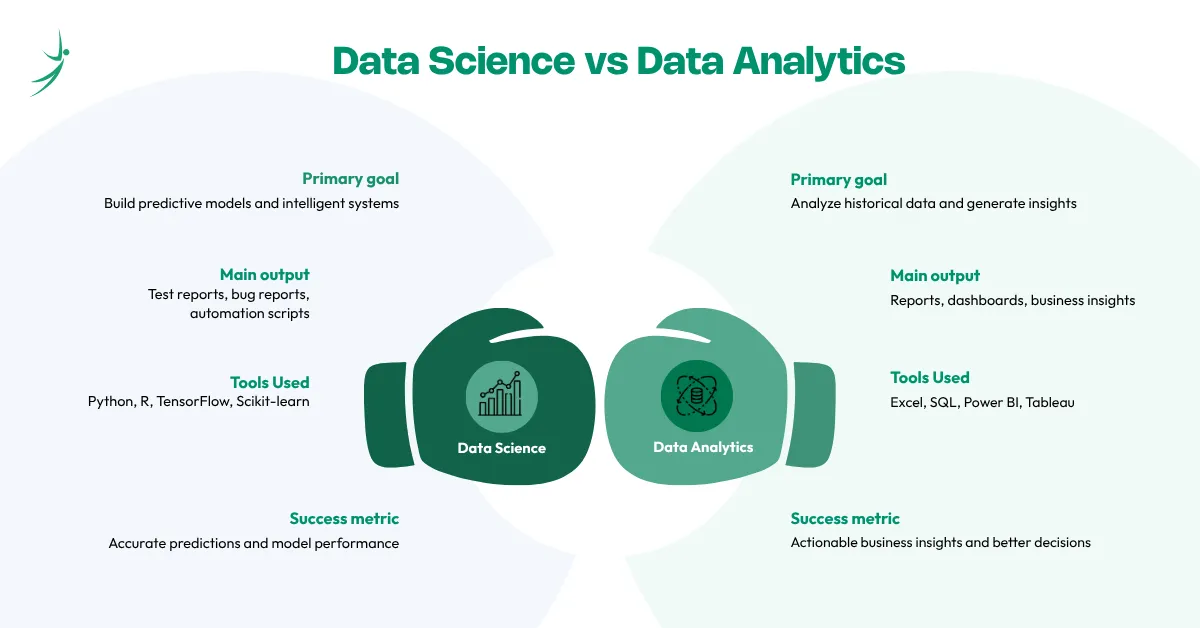
That's it. Everything else the math, the tools, the salaries, the job titles — flows from that single distinction. Data analytics meaning centers on interpretation and communication. Data science meaning centers on prediction and automation. Neither is "harder" in some abstract sense; they require different kinds of effort applied to different kinds of problems.
What is Data Analytics?
Data analytics is the process of examining existing, structured data to answer specific business questions, uncover patterns, and support better decision-making. It focuses on what has already happened, why it happened, and what action a business should take next. To learn more and understand data analytics we have our full article.
A data analyst working at a commercial bank in Kathmandu might spend their day writing SQL queries to pull transaction data, cleaning it in Python or Excel, building a Power BI dashboard showing customer churn by region, and presenting findings to a branch manager. The output is a clear, actionable recommendation: these customers are leaving, here's why, and here's what to do about it.
The primary tools in data analytics are SQL, Excel, Python, Power BI, and Tableau. The primary output is insight, delivered in a format non-technical decision-makers can act on immediately.
What is Data Science?
Data science is a broader discipline that uses advanced mathematics, machine learning, and programming to build predictive models and automated systems that process both structured and unstructured data. It focuses on what is likely to happen in the future, and how to build systems that act on that knowledge without a human reviewing every decision.
A data scientist at a Nepali fintech company might spend their day building a machine learning model that predicts which loan applicants are most likely to default, training it on years of historical transaction data, evaluating its accuracy, and deploying it into the company's approval system so decisions happen automatically. The output isn't a report it's a system.
The primary tools in data science are Python, R, TensorFlow, Scikit-learn, Spark, and cloud platforms like AWS and Google Cloud. The primary output is a model or algorithm that runs independently and produces predictions at scale.
Data Analytics vs Data Science: Full Comparison Table
The difference between data analytics and data science runs deeper than tools and job titles. Here's a side-by-side comparison across every major factor, including the Nepal-specific context most comparison articles skip entirely.
| Factor | Data Analytics | Data Science |
|---|---|---|
| Primary focus | Understanding what happened and why | Predicting what will happen and automating responses |
| Data type | Structured, organized data (tables, databases) | Both structured and unstructured data (text, images, audio) |
| Core tools | SQL, Excel, Power BI, Tableau, Python (pandas) | Python, R, TensorFlow, Scikit-learn, Spark, Hadoop |
| Math requirement | Basic to intermediate statistics | Advanced statistics, linear algebra, calculus |
| Programming depth | Basic to intermediate (SQL + Python fundamentals) | Advanced (object-oriented programming, ML frameworks) |
| Use of machine learning | Rarely used; descriptive and diagnostic focus | Central to the work; builds and deploys ML models |
| Output | Dashboards, reports, business recommendations | Models, algorithms, automated prediction systems |
| Time horizon | Past and present | Future |
| Data science qualification / education | Bachelor's degree or professional certification | Bachelor's, often plus an advanced degree |
| Entry difficulty | More accessible, shorter learning curve | More technical, steeper entry requirements |
| Nepal job market | High local demand: banking, telecom, e-commerce | Limited local demand; mostly remote or product companies |
| Remote work scope | Strong; dashboarding and reporting roles are remote-friendly | Very strong; ML and AI roles are globally remote |
| Entry salary in Nepal | NPR 30,000 – 55,000/month | NPR 50,000 – 90,000/month |
| Senior salary in Nepal | NPR 1,30,000 – 3,00,000+/month | NPR 2,00,000 – 5,00,000+/month |
Data Analytics vs Data Science: Real-World Examples in Nepal
- Data analytics — Nepal banking sector: A commercial bank in Kathmandu wants to understand why credit card usage dropped last quarter. A data analyst pulls transaction records using SQL, cleans the data in Python, segments customers by age, location, and spending category, and builds a Power BI dashboard for the retail banking team. Finding: customers aged 25–35 in Pokhara reduced spending after a competitor launched a cashback program. Recommendation: match the offer for that segment. Decision made, action taken.
- Data science — Nepal fintech company: The same bank wants to flag fraudulent transactions automatically the moment they happen, without a human reviewing each one. A data scientist builds a classification model trained on five years of transaction history, labels fraudulent and legitimate transactions, trains a gradient boosting algorithm in Python using Scikit-learn, evaluates false positive rates, and deploys it to a real-time API. This isn't a report; it's an automated intelligence system running 24 hours a day.
- Data analytics — e-commerce in Nepal: A Kathmandu-based online retailer wants to know which product categories drive repeat purchases. A data analyst queries the order database, calculates repurchase rates by category and customer cohort, and builds a dashboard showing the marketing team exactly where to focus retention budget.
- Data science — telecom in Nepal: A telecom provider wants to predict which subscribers will cancel their plan next month before they actually do. A data scientist builds a churn prediction model using call data, payment history, and usage patterns. The model runs nightly and outputs a ranked list of at-risk customers for the retention team.
Advantages and Disadvantages of Data Analytics
Advantages
- Lower entry barrier: Excel, SQL, and Power BI can be learned by anyone with logical thinking skills, regardless of academic background.
- High local job market demand: banks, telecom, e-commerce, IT firms, and government organizations in Kathmandu are actively hiring data analysts right now.
- Faster time to employment: most structured learners reach entry-level job readiness in five to eight months.
- Cross-industry relevance: every industry that collects data needs data analysts.
- Clear business impact: analysts directly influence decisions affecting revenue, costs, and operations, with results visible almost immediately.
- Strong remote work opportunity: dashboard and reporting roles are fully remote-compatible, with international clients accessible from Nepal.
Disadvantages
- Lower ceiling without upskilling: analysts who don't add Python, statistics, and machine learning to their skill set over time hit a career plateau faster than data scientists.
- More repetitive work at entry level: junior analysts often spend significant time on data cleaning and standard report maintenance before moving to deeper analytical work.
- Tools evolve constantly: Power BI, Tableau, and cloud BI platforms update frequently, requiring continuous learning.
Advantages and Disadvantages of Data Science
Advantages
- Higher earning potential: data scientists command significantly higher salaries than data analysts at every experience level, both locally and in remote international roles.
- Work on cutting-edge problems: building machine learning models, recommendation systems, and AI applications is among the most technically stimulating work in any industry.
- Strong remote and global demand: Nepal-based data scientists can access high-paying remote roles with companies in the US, Europe, and Southeast Asia.
- Future-proof specialization: as AI adoption accelerates globally, demand for data scientists who understand machine learning fundamentals is growing faster than supply.
Disadvantages
- Steeper learning curve: advanced mathematics, programming, and machine learning require significantly more time to master than data analytics fundamentals.
- Limited local job market currently: while the global market is strong, most data science jobs in Nepal are concentrated in a small number of product companies and fintech startups; the local market is still maturing.
- Higher education requirement: Many senior roles expect advanced degrees or equivalent demonstrated experience with complex ML projects.
- Results take longer to show: building and validating a model is a long-cycle process, so the impact of data science work is often less immediately visible than a business dashboard.
Data Analytics Roadmap vs Data Science Roadmap: Skills and Tools Breakdown
Data Analytics Roadmap and Tools
The data analytics roadmap builds in a logical sequence:
- SQL: The foundation; every analyst uses it daily to pull and aggregate data from databases.
- Excel and Google Sheets: Handle structured manipulation and quick analysis.
- Python: Adds automation, advanced cleaning, and statistical analysis.
- Power BI and Tableau: The most widely used data analytics tools; turn analytical output into dashboards stakeholders can use.
- Basic statistics: Mean, median, correlation, hypothesis testing; gives analysts the vocabulary to interpret patterns correctly.
- Communication skills: ies everything together, because insight that can't be explained clearly is insight that never gets acted on.
This roadmap typically takes five to eight months for a structured, project-based learner to reach entry-level job readiness, which is why most data analytics courses in Nepal are built around that timeline.
Data Science Roadmap and Tools
The data science roadmap is deeper and more mathematically demanding:
- Advanced Python or R: For building and evaluating models, not just analyzing data; this is why so many learners search specifically for "data science with Python" as their starting point.
- Statistical learning theory: Regression, classification, clustering, and neural networks.
- Machine learning frameworks: Scikit-learn, TensorFlow, and PyTorch for building and training models.
- Big data platforms: Apache Spark and Hadoop, for processing datasets at a scale a single laptop can't handle.
- Cloud platforms: AWS SageMaker, Google Vertex AI, Azure ML, for deploying models into production.
- MLOps knowledge: Increasingly needed for monitoring and maintaining deployed models over time.
This roadmap typically takes twelve to twenty-four months of structured learning before a beginner reaches employment-ready depth, which is one of the most important data science requirements to plan around realistically.
Data Analytics Salary vs Data Science Salary in Nepal and Globally
Salary numbers online are inconsistent because they come from different sources, sample sizes, and currencies. Here's a consolidated, cross-checked range pulling from Nepal job market reporting, Glassdoor, PayScale, and India/US industry salary guides, so you're working from a realistic picture rather than one outlier number.
| Role | Nepal (NPR/month) | India (INR/year) | USA (USD/year) |
|---|---|---|---|
| Data Analyst — Entry (0–1 yrs) | NPR 30,000 – 55,000 | ₹4 – 7 LPA | $65,000 – $85,000 |
| Data Analyst — Mid (2–4 yrs) | NPR 70,000 – 1,30,000 | ₹9 – 16 LPA | $90,000 – $120,000 |
| Data Analyst — Senior (5+ yrs) | NPR 1,30,000 – 3,00,000+ | ₹18 – 28 LPA | $130,000 – $170,000+ |
| Data Scientist — Entry (0–1 yrs) | NPR 50,000 – 90,000 | ₹6 – 12 LPA | $95,000 – $115,000 |
| Data Scientist — Mid (2–4 yrs) | NPR 1,00,000 – 2,00,000 | ₹12 – 25 LPA | $130,000 – $160,000 |
| Data Scientist — Senior (5+ yrs) | NPR 2,00,000 – 5,00,000+ | ₹25 – 45 LPA | $160,000 – $210,000+ |
A few honest notes on this data, because salary transparency matters more than a clean-looking table:
- The data scientist salary in Nepal figures above sit consistent with reporting from multiple Nepal-focused career sites, which place entry-level data scientists and data analysts in a broadly similar starting band (roughly NPR 50,000–80,000) before the gap widens significantly with experience.
- Senior data scientists with strong ML, modeling, and leadership experience can cross NPR 200,000/month, while senior data analysts handling complex business-critical work can cross NPR 130,000–150,000/month.
- Remote roles for international clients from Nepal typically pay significantly above these local ranges for both roles, especially for professionals with specialized ML, cloud, or AI expertise some Nepal-based data analysts working remotely for foreign clients report earning NPR 150,000–300,000/month
- For data science salary in Nepal and data analytics salary in Nepal both, location matters: Kathmandu-based roles and international remote contracts consistently pay more than smaller-city or NGO-sector roles in the same titles.
Data Science Company in Nepal: Where Are the Jobs?
One question almost no global comparison article answers honestly: do data science jobs in Nepal actually exist? The answer is yes, but the market is smaller and more concentrated than the global data science conversation suggests.
Data science in Nepal today is concentrated in a few categories:
- Fintech and digital payment companies building fraud detection and credit scoring models.
- IT outsourcing and software product companies serving international clients.
- Telecom operators experimenting with churn prediction and network analytics.
- Startups building AI-powered tools for sectors like agriculture, health, and e-commerce.
Outside these pockets, most "data" hiring in Nepal across banking, telecom, e-commerce, and government is data analytics hiring, not data science hiring. This is exactly why the Nepal job market row in the comparison table above shows analytics roles as far more abundant locally than data science roles, which lean heavily on remote and international demand instead.
Can a Data Analyst Become a Data Science Specialist?
Yes, and it's one of the most natural career transitions in the data profession. Many of the most successful data scientists started as data analysts.
A data analyst who has mastered SQL, Python, and statistics already has roughly 60 to 70 percent of the foundation required for data science work. The gap is primarily in machine learning theory, advanced Python for model building, and experience deploying models into production systems.
The typical analyst-to-scientist transition takes one to two years of deliberate upskilling while working in an analyst role:
- Deepen Python beyond pandas into Scikit-learn and model building.
- Work through a structured machine learning curriculum.
- Build two or three ML projects documented on GitHub.
- Begin applying for junior data scientist or ML engineer roles that value analyst experience.
In Nepal's current market, analysts who add predictive modeling and machine learning to their portfolio are in an exceptionally strong position. Local companies are beginning to invest in AI-powered systems, and the people best placed to build those systems are the analysts who already understand the data, the business context, and the stakeholders.
The Impact of AI on Data Analytics and Data Science
Will AI replace data analysts and data scientists? No, for both roles, but AI is changing how each works in fundamentally different ways.
- For data analytics: AI-powered BI tools like Microsoft Copilot for Power BI and Google Gemini in Looker Studio are automating the most repetitive parts of analyst work, generating standard SQL queries, producing first-draft reports, summarizing data in plain language, and flagging anomalies automatically. This shifts the job away from routine report generation toward higher-value interpretation, stakeholder communication, and strategic recommendation. The analysts who thrive combine business judgment with AI-assisted speed.
- For data science: AutoML platforms like Google AutoML and AWS SageMaker Autopilot automate parts of the model-building process, including feature engineering, hyperparameter tuning, and model selection. This shifts data science work toward higher-level architecture decisions: which problem is worth a model, how to evaluate model fairness, how to interpret results responsibly, and how to integrate model outputs into business systems. The data scientists who thrive understand the fundamentals deeply enough to know when an AutoML solution is sufficient and when it isn't judgment that can't be automated.
Which Should You Choose: Data Analytics or Data Science?
Here's an honest decision framework for professionals and students in Nepal.
Choose data analytics if:
- You're a complete beginner with no programming or advanced math background.
- You want to reach employment within five to eight months through a structured program.
- You're targeting local jobs in Nepal's banking, telecom, e-commerce, or IT outsourcing sectors.
- You want to work cross-functionally with business teams and see visible, immediate impact.
- You prefer clear business communication over deep technical modeling.
- You're more interested in data analytics tools like Power BI, Tableau, SQL, and Python for analysis than in ML model building.
Choose data science if:
- You already have a solid foundation in Python, statistics, and mathematics.
- You're comfortable with a longer learning path, typically twelve to twenty-four months, before reaching employment.
- You want to work on predictive modeling, machine learning, or AI systems.
- You're targeting remote international roles or product companies rather than local corporate positions.
- You're willing to invest in advanced education or a significant self-directed learning program.
- You find building systems that learn from data more motivating than communicating insights from data.
Choose both, sequentially, if:
- You're a current data analyst looking to grow into data science over the next one to two years.
- You want to maximize long-term earning potential while staying employed throughout your learning journey.
- You want to position yourself for Nepal's emerging AI and data science market as it matures.
If you're starting from zero, the path is clear: build your data analytics foundation first. It gets you employed faster, gives you real business context that makes your eventual data science learning far more meaningful, and puts you in the rooms where data-driven decisions are made the exact experience that distinguishes good data scientists from great ones.
Learn Data Analytics at Skill Shikshya
Reading about data science vs data analytics is the starting point. Building actual skills is what creates a career.
At Skill Shikshya, our Business Data Analytics with AI Course in Nepal takes you from complete beginner to job-ready analyst through hands-on, project-based training. Whether you prefer classroom sessions in Kathmandu or online learning on your own schedule, the program is built around what Nepal's job market and international remote roles actually require.
- Practical, project-based learning: Build real dashboards, run full analysis cycles, and work with live datasets, so every module ends with something you can show an employer.
- Expert instructors: Learn from professionals with industry experience in data analytics, business intelligence, and Python-based analysis, not just theory.
- Career support: Get guidance on certifications, portfolio building, and landing your first data analytics role locally or as a remote analyst
- Flexible schedule: Designed for students, working professionals, and career switchers equally.
Start your data career with structured training, real projects, and expert mentorship at Skill Shikshya.
Frequently Asked Questions
What is the main difference between data analytics and data science?
Is data science better than data analytics?
Which pays more, a data analyst or a data scientist in Nepal?
Can I switch from data analytics to data science?
Which should a complete beginner learn first in Nepal?
Do data scientists use the same tools as data analysts?
Is there a free way to start learning data analytics or data science?
What is the best data science course or data analytics course to start with?
About Author: