DevOps vs Software Engineer: Key Differences, Skills & Which Career to Choose
Every week, we talk to students at Skill Shikshya who ask the same question: "Should I go into software engineering or DevOps?"
Both careers pay well. Both are in demand across Nepal and globally. And from the outside, they look almost the same; you sit at a laptop, work with code, and solve technical problems.
But once you get inside the roles, they are very different paths. A software engineer builds the product. A DevOps engineer makes sure that product reaches users reliably, every single day, without breaking. If you want to get started in DevOps, here is a complete guide.
This guide breaks down exactly what separates the two roles; their daily work, the skills they need, what the salary looks like in Nepal and abroad, and how to figure out which one fits you better.
What Is a Software Engineer?
A software engineer designs, builds, tests, and maintains software applications. That covers everything from a mobile banking app to the website you're reading right now to the enterprise systems that run large organizations.
Think of software engineers as the architects and builders of the digital world. When a product manager says "we need a feature that lets users reset their password," a software engineer turns that requirement into working code.
There are two broad types of software engineers:
- Application engineers focus on user-facing software. They work directly on the features and interfaces that end users interact with login pages, dashboards, payment flows, and everything in between.
- System engineers work deeper in the stack; designing and maintaining the underlying computer systems, servers, and internal IT infrastructure that keep software running.
Software engineering is a well-defined field with decades of established practices. It gives you a strong foundation in programming, problem-solving, and system design, skills that transfer to almost every area of tech.
What Is a DevOps Engineer?
A DevOps engineer sits between the development team and the IT operations team. Their job is to make sure that software moves from a developer's laptop to a production server quickly, safely, and automatically.
Students usually ask the same question, “What is DevOps?” The term DevOps itself is a blend of Development and Operations and that's exactly the space these engineers occupy. They don't typically build the product features. They build the systems and pipelines that let those features ship without disaster.
DevOps is also a culture, not just a job title. A DevOps engineer promotes collaboration, automation, and continuous improvement across the entire software delivery process.
DevOps engineering is a younger discipline than software engineering, but it has grown into one of the most valuable roles in any technology team. Without DevOps, even the best code never reaches users reliably.
If you want to start your career in DevOps, getting started with a DevOps training programme can be your first step to your new career journey.
DevOps vs Software Engineer: Responsibilities Side by Side
| Area | Software Engineer | DevOps Engineer |
|---|---|---|
| Primary Focus | Build features and applications | Automate and manage delivery pipelines |
| Code Written | Business logic, APIs, user interfaces | Automation scripts, IaC, CI/CD configs |
| Main Tools | IDEs, frameworks, databases | Docker, Kubernetes, Terraform, Jenkins |
| Daily Goal | Working, scalable software | Fast, reliable, automated deployments |
| Collaborates With | Product managers, designers, QA | Developers, SREs, security teams |
| SDLC Stage | Design → Build → Test | Build → Deploy → Monitor → Feedback |
| On-Call Duty | Rare | Very common |
Both roles work inside the same software development lifecycle but they operate at different stages. Software engineers work upstream, focused on building. DevOps engineers work downstream, focused on delivering and keeping things running.
Skills and Tools: A Detailed Comparison
This is where the two careers diverge most visibly. The skillsets overlap in places: both roles use Git, both write code, both work in cloud environments but the depth and direction of those skills are very different. The skill breakdowns below are drawn from PW Skills and 86 Agency's detailed skills comparison.
Skills Every Software Engineer Needs
- Programming Languages: Python, Java, JavaScript and TypeScript, C#, and C++ are the most common. You need to go deep in at least one, usually two.
- Frameworks: On the frontend: React, Angular, Vue.js. On the backend: Spring Boot, Django, Express.js, Laravel. Most software engineers specialize in either frontend, backend, or both (full-stack).
- Data Structures and Algorithms: This is non-negotiable. DSA sits at the heart of software engineering interviews and day-to-day problem-solving.
- Database Management: You need to understand relational databases (MySQL, PostgreSQL) and at least one NoSQL option (MongoDB, DynamoDB).
- API Development: Building and consuming REST APIs is a core skill. GraphQL experience is a bonus.
- Version Control: Git, GitHub, and GitLab are standard. You'll use these every single day.
- Testing Frameworks: Jest, JUnit, pytest, Selenium. Good software engineers write tests, not just code.
- Design Patterns: MVC, microservices, SOLID principles. These help you write software that scales and stays maintainable.
Skills Every DevOps Engineer Needs
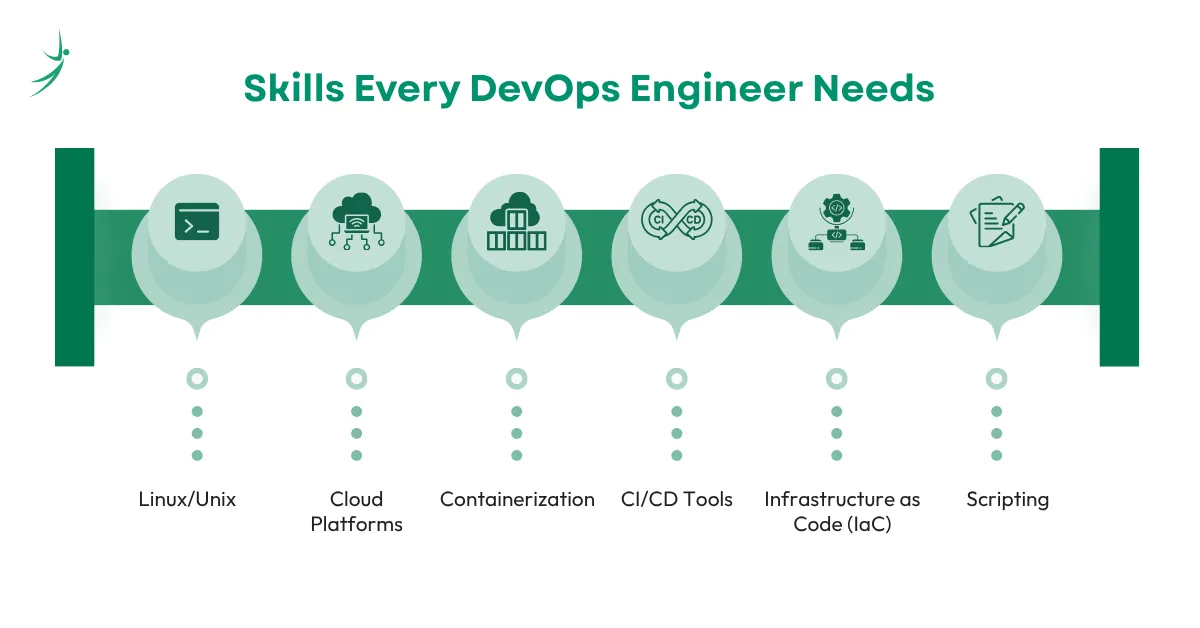
- Linux/Unix: This is the foundation. If you're not comfortable on the command line, you can't be an effective DevOps engineer. Shell scripting in Bash is essential.
- Cloud Platforms: AWS is the most in-demand globally, followed by Azure and GCP. You need to understand core services: EC2, S3, IAM, VPC, load balancers, and auto-scaling.
- Containerization: Docker is mandatory. Kubernetes is quickly becoming mandatory too. You'll use these to package and run applications in consistent, scalable environments.
- CI/CD Tools: Jenkins, GitHub Actions, GitLab CI, CircleCI. Building and maintaining automated pipelines is one of the core functions of the role.
- Infrastructure as Code (IaC): Terraform and Ansible let you define infrastructure in code files rather than clicking through dashboards. This is now a standard skill, not an advanced one.
- Monitoring and Logging: Prometheus, Grafana, the ELK Stack (Elasticsearch, Logstash, Kibana), Datadog. You can't fix what you can't see.
- Scripting: Python and Bash for automation. PowerShell if you work in Windows environments.
- Networking and Security: DNS, TCP/IP, firewalls, SSL certificates, VPNs, and tools like HashiCorp Vault for secrets management.
Salary for Software Engineer vs DevOps Engineer
Salary is one of the biggest factors when students choose a career path, so let's look at the real numbers. The figures below draw on ShiftToTech's 2026 India salary data, PW Skills' role comparison, and Futurense's 2026 career guide.
Software Engineering Salary and DevOps Engineer Salary in Nepal
| Experience Level | Software Engineer (NPR/month) | DevOps Engineer (NPR/month) |
|---|---|---|
| Entry (0–2 yrs) | NPR 45,000 – 70,000 | NPR 55,000 – 85,000 |
| Mid (3–5 yrs) | NPR 80,000 – 1,40,000 | NPR 1,00,000 – 1,80,000 |
| Senior (6+ yrs) | NPR 1,50,000+ | NPR 1,80,000+ |
Note: Salaries at Nepal-based IT companies and outsourcing firms vary. Engineers working remotely for international clients often earn significantly more than these local benchmarks.
Software Engineering Salary vs DevOps Engineer Salary in India
Many Nepal graduates target remote roles at Indian companies or Indian-headquartered global firms. Here's the comparison:
| Experience Level | Software Engineer | DevOps Engineer |
|---|---|---|
| Entry (0–2 yrs) | ₹6–10 LPA | ₹8–12 LPA |
| Mid (3–5 yrs) | ₹12–25 LPA | ₹15–30 LPA |
| Senior (6–10 yrs) | ₹25–45 LPA | ₹30–55 LPA |
Software Engineering Salary vs DevOps Engineer Global Salary (USD/year)
| Experience Level | Software Engineer | DevOps Engineer |
|---|---|---|
| Entry | $75,000 – $100,000 | $90,000 – $110,000 |
| Mid | $110,000 – $145,000 | $125,000 – $160,000 |
| Senior | $150,000 – $200,000 | $170,000 – $220,000 |
That said, senior software engineers at product companies, especially those working on AI, distributed systems, or platform infrastructure can match or exceed DevOps salaries.
Career Paths: Where Each Role Takes You
Software Engineer Career Path
The progression paths below reflect role structures documented by 86 Agency and PW Skills.
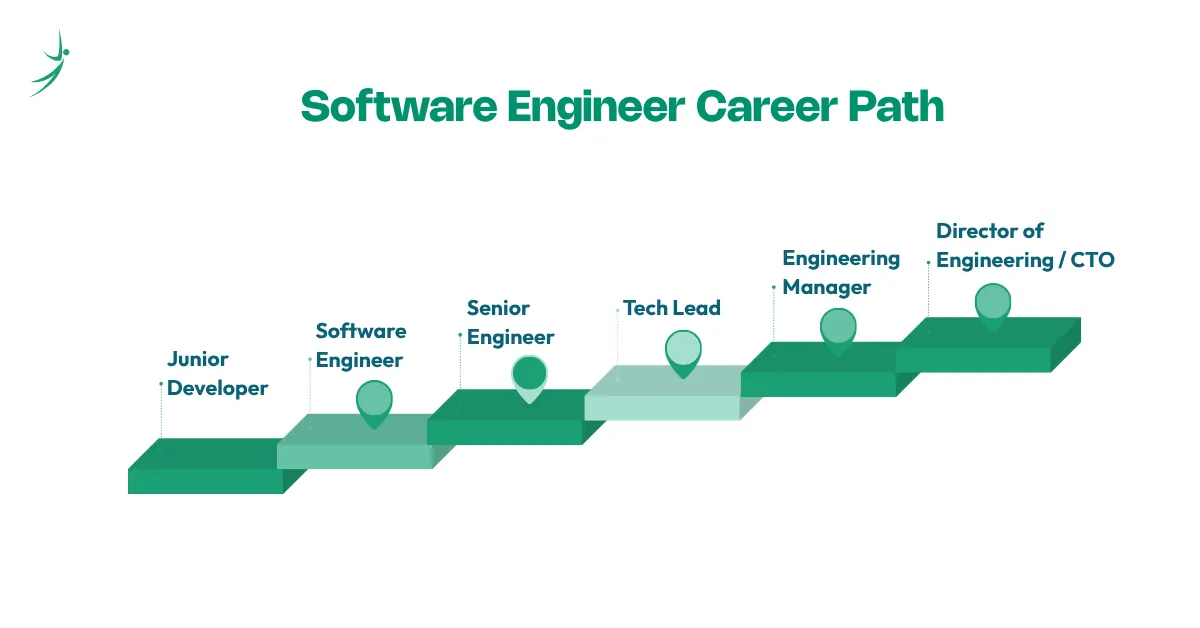
As you grow in software engineering, you move toward either technical depth (becoming an architect or principal engineer) or people leadership (moving into management). Many engineers do both at different points in their careers.
Specialization branches:
- Frontend specialist (UI/UX-focused product engineer)
- Backend specialist (API, microservices, distributed systems architect)
- Full-stack developer (Product engineer or startup CTO)
- Mobile developer (React Native, Flutter, Swift, Kotlin)
- AI/ML engineer (increasingly relevant in 2025)
DevOps Engineer Career Path
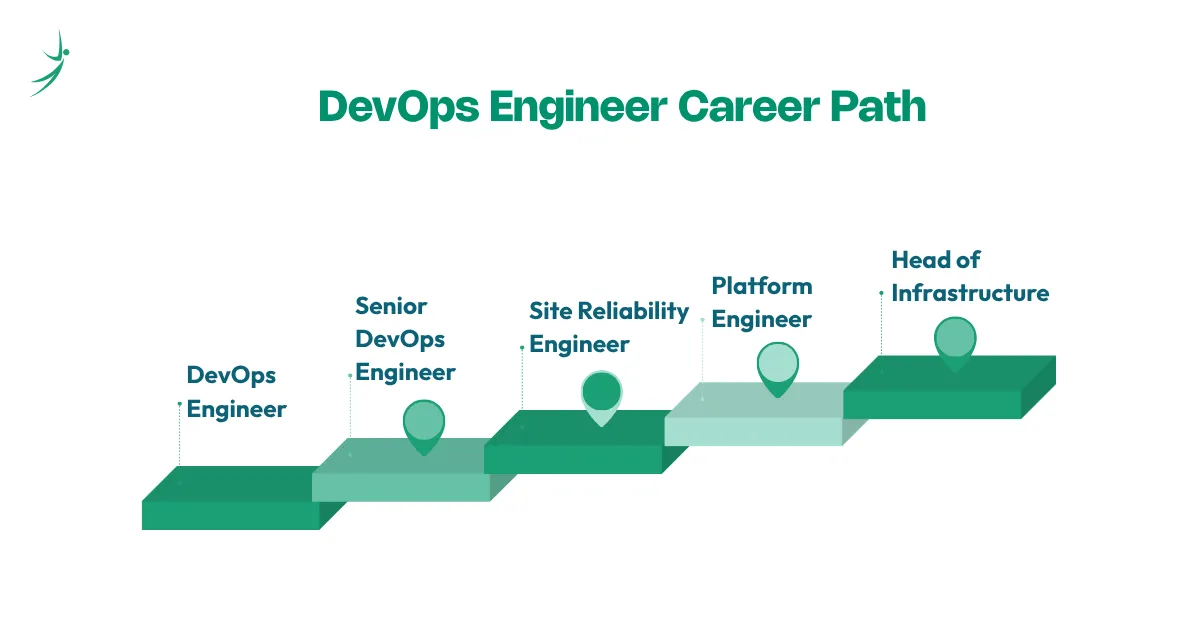
Specialization branches:
- Cloud Architect (AWS/Azure/GCP certifications open this path quickly)
- DevSecOps Engineer (security integrated into pipelines)
- SRE Lead (reliability engineering as a formal discipline)
- MLOps/AIOps Engineer (emerging and well-paid)
- Platform Engineering Lead (the fastest-growing adjacent role in 2025)
A word on Platform Engineering: this is where the two careers converge at the top. Platform engineers build the internal developer platforms that software engineers use every day. The role requires deep DevOps skills and enough software engineering depth to understand what developers actually need. According to ShiftToTech's hybrid role analysis, mid-level platform engineers in India currently earn ₹35–60 LPA, and the role is growing at roughly 20% year-on-year.
Where the Two Roles Overlap
Students often treat these as completely separate careers. They aren't. Both roles share significant common ground:
- Both work inside the software development lifecycle
- Both write code, just different kinds
- Both use Git and version control daily
- Both need strong problem-solving and communication skills
- Both work in Agile or CI/CD-aligned environments
- Both increasingly work with cloud platforms and containerization
- Both require constant learning, the tech landscape moves fast in both directions
- In smaller companies and startups, one engineer frequently handles both roles
Many of the strongest DevOps engineers started as software engineers. When you understand how software gets built, you understand exactly what a deployment pipeline needs to support. That perspective is hard to teach, you have to earn it through real development experience.
Core Differences at a Glance
| Factor | Software Engineer | DevOps Engineer |
|---|---|---|
| Core objective | Build working software products | Deliver software reliably and fast |
| Approach | Feature-driven, Agile sprints | Process-driven, continuous improvement |
| Code focus | Business logic, algorithms, UIs | Automation scripts, IaC, pipeline configs |
| Primary question | "Does this feature work?" | "Can we deploy this safely at 2am?" |
| On-call rotation | Uncommon | Very common |
| Learning curve | Deep (DSA, design patterns, architecture) | Broad (cloud + infra + ops + security) |
| Market demand (2025) | High (~10% YoY growth) | Very high (~15% YoY growth) |
| Typical entry background | CS degree, bootcamp, or self-taught | Sysadmin, developer, or IT background |
DevOps vs Software Engineer in Nepal: What the Job Market Looks Like
Nepal's IT industry is growing fast, and both roles are in demand but in different ways.
- Software engineering has the largest entry-level job pool in Nepal. Companies like Vrit Technologies, Leapfrog Technology, Cotiviti Nepal, Fusemachines, Deerwalk, and dozens of smaller IT firms actively hire junior and mid-level software engineers for web and application development work.
- DevOps engineering has fewer entry-level local roles, but competition is also lower. More importantly, DevOps skills unlock remote work for international clients and remote DevOps work pays significantly more than local salaries. If you have solid AWS, Docker, and Kubernetes skills, you can realistically target remote roles from Kathmandu.
The most common career path we see among Skill Shikshya students: start as a software engineer, spend two to three years getting real production experience, then transition into DevOps. That path works well because the development background makes you a stronger DevOps engineer from day one.
For students who know they want DevOps from the start, a structured DevOps training program covering Linux, Docker, Kubernetes, CI/CD, and cloud gets you job-ready faster than trying to piece it together alone.
If your goal is to land your first local job quickly, software engineering gives you more options. If your goal is remote work for international clients and higher long-term earning potential, DevOps is worth the investment.
How to Switch Between the Two Roles
One of the most common questions we hear: "What if I choose one and then want to switch?"
You can. Both transitions are doable with focused effort. The timelines below come from ShiftToTech's switching guide.
Developer to DevOps (6–12 months with structured learning)
- Get comfortable with the Linux command line and write Bash scripts
- Containerize a real project using Docker
- Get your first cloud certification, AWS Cloud Practitioner or Azure Fundamentals (AZ-900)
- Build a working CI/CD pipeline using Jenkins or GitHub Actions
- Learn Kubernetes fundamentals, deploy and manage containers in a cluster
- Write your first infrastructure code using Terraform
DevOps to Software Engineer (8–18 months)
- Pick one language and go deep, Python, Java, or JavaScript
- Build a full-stack project using a real framework (React + Node.js or Django)
- Study data structures and algorithms, this unlocks most software engineering interviews
- Learn design patterns and how to structure maintainable code
- Build three to four projects and put them on GitHub with documentation
The transition from developer to DevOps is slightly faster because your existing programming knowledge gives you a head start. The transition from DevOps to developer takes longer because DSA and system design require sustained practice.
Which Career Is Right for You?
There's no universally correct answer here. Both paths lead to strong, well-paying careers. The right choice depends on what kind of work you enjoy every day.
Choose software engineering if you:
- Love writing code and building features users interact with
- Enjoy going deep into algorithms, system design, and architecture
- Prefer predictable working hours without on-call rotations
- Want to grow toward product ownership or engineering management
- Are starting from zero IT experience (software engineering has a clearer beginner path)
Choose DevOps engineering if you:
- Get satisfaction from making systems efficient and automated
- Like variety — working across cloud, security, infrastructure, and deployment
- Handle pressure well and don't mind being on-call
- Want a broader skillset that touches every part of the tech stack
- Already have some development or system administration background
- Want higher salary potential at mid and senior levels
If you're genuinely unsure, start with software engineering basics. A solid programming foundation makes you better at both paths and gives you the experience to make an informed switch to DevOps after a year or two.
Ready to Start Your DevOps Journey in Nepal?
If DevOps feels like the right path or you're a developer who wants to make the switch, Skill Shikshya's DevOps training gives you the hands-on skills to get there.
The course covers Linux, Docker, Kubernetes, AWS, CI/CD pipelines, Terraform, and monitoring, everything you need to land your first DevOps role or make the move from software engineering.
It's built for IT beginners, working developers, and CS students who want a structured path to a DevOps career rather than months of guesswork.
Not sure which path is right for you? Talk to a counsellor.
Want to go deeper first? Read our full guide: How to Get Into DevOps: A Complete Career Guide for Beginners in Nepal
Frequently Asked Questions
Is DevOps harder to learn than software engineering?
Can a software engineer become a DevOps engineer?
Do DevOps engineers write code?
Which has more job opportunities in Nepal, DevOps or software engineering?
What is the difference between a DevOps engineer and an SRE?
Should I learn DevOps or software development first?
What is the DevOps meaning in simple terms?
About Author: