Frontend vs Backend vs Full Stack: Differences, Skills, Salary & Which Career Is Best in 2026?
The tech industry is evolving rapidly in 2026, making the choice between frontend, backend, and full stack development more critical than ever for aspiring engineers. Whether you want to build stunning user interfaces or architect secure server-side logic, enrolling in a professional MERN Stack Training in Nepal is the fastest way to acquire job-ready development practices. Understanding the unique boundaries of each engineering role will help you choose a path that fits your logical reasoning style and professional long term goals.
What Is Frontend Development?
Frontend development focuses on building the client-side elements of a web application that users directly see and interact with. The core mission of a frontend developer is to translate visual designs into highly responsive, accessible, and high-performance user interfaces. Every clickable button, form layout, and animation is a direct product of modern frontend web development, demanding a mastery of state management and device compatibility.
What Is Backend Development?
Backend development refers to building and optimizing the behind the scenes server-side architecture that powers a software application. A backend developer writes the core logic that processes user requests, handles secure authentication, routes data safely, and manages database transactions. Without robust backend development, the user interface remains an empty shell with no access to permanent data storage or external computing systems.
What Is Full Stack Development?
Full stack development represents the complete unification of both client-side and server-side engineering layers. An engineer working in fullstack development possesses the comprehensive skills required to build an entire web platform from scratch, from crafting the visual user interface to modeling databases and deploying to cloud environments. These cross-functional workflows allow single developers to handle features efficiently from concept to production.
Frontend vs Backend vs Full Stack
Core Differences at a Glance
The fundamental differences across these three options are summarized in the structured overview below.
| Category | Frontend Development | Backend Development | Full Stack Development |
| Primary Focus | User Interface and Client Experience | Server Logic and Data Management | End-to-End Product Engineering |
| User Interaction | Direct Visual Engagement | Behind the Scenes Processing | Combines Both Worlds |
| Programming Languages | JavaScript, TypeScript | Python, Java, PHP, Node.js | Multi-Language and Unified JS |
| Frameworks | React, Vue, Angular | Express, Django, Laravel | Matches Frontend and Backend |
| Databases | Client-Side Storage, Local Storage | MongoDB, PostgreSQL, MySQL | Complete Database Management |
| APIs | Consumes REST and GraphQL APIs | Designs and Deploys API Routes | Connects Frontend and Backend |
| Salary | NPR 20,000 to NPR 250,000+ | NPR 25,000 to NPR 300,000+ | NPR 25,000 to NPR 500,000+ |
| Demand | Strong in Web and Creative Agencies | High in Data and Enterprise Firms | Highest Overall Across Startups |
| Difficulty | Moderate to Advanced State Logic | High Abstract Architectural Logic | Highest Overall Learning Curve |
| Best For | Creative and Visual Programmers | Logical and System-Focused Thinkers | Adaptable and Complete Builders |
| Career Growth | Reaches Frontend Architect | Reaches Principal Systems Engineer | Reaches Technical Lead and CTO |
Which Career Is Right for You?
Choose Frontend Development If You:
- Love creating highly visual digital products and styling responsive interfaces.
- Enjoy interacting with user experience concepts and design tools like Figma.
- Want to see your code changes render visually in a browser instantly.
Choose Backend Development If You:
- Prefer building data architectures and working with data patterns over layouts.
- Enjoy solving complex logical algorithms and optimizing database query speeds.
- Want to focus heavily on system security, data encryption, and server stability.
Choose Full Stack Development If You:
- Want to understand how every part of a modern web application integrates.
- Enjoy building full software features independently from database to UI.
- Aim to work as a technical leader or startup engineer who adapts to any problem.
Roles and Responsibilities Compared
To understand how these roles function in production environments, it helps to look at their everyday operational responsibilities.
Frontend Developer Responsibilities
- Converting Design Files into Code: Transforming visual mockups from tools like Figma into semantic, functional markup.
- Ensuring Platform Consistency: Verifying cross-browser rendering consistency so the interface looks and functions correctly everywhere.
- Optimizing UI Performance: Minimizing bundle sizes to boost asset delivery and improve search engine indexing speeds.
Backend Developer Responsibilities
- Building Core Middleware Logic: Writing application middleware to validate incoming API payloads and configuring server caching mechanisms.
- Designing Database Schema Models: Structuring and designing schema files to process robust, high-volume transactions reliably.
- Managing Infrastructure Pipelines: Setting up automated continuous integration pipelines to handle behind-the-scenes architectural execution.
Full Stack Developer Responsibilities
- Refining Multi-Tier Components: Developing visual features directly on the client side, such as refining a user profile component.
- Tuning Performance Latency: Adjusting backend database indexes to reduce server latency and improve query speed.
- Configuring Cloud and Versioning Workflows: Configuring cloud environments to handle sudden traffic spikes while using version control tools like Git and GitHub to manage file histories cleanly.
Skills and Technologies: A Complete Comparison
Frontend Developer Skills
A successful frontend engineer must possess a unique blend of analytical programming skills and design sensibilities. They need a deep knowledge of semantic markup, accessible layouts, and programmatic styles. Beyond basic styling, an advanced frontend developer must master modular component structures, declarative programming concepts, client-side state management, and real-time data streaming. They also rely on platforms like frontend mentor to solve real-world design problems and build professional portfolios.
The top five core skills required for this role include:
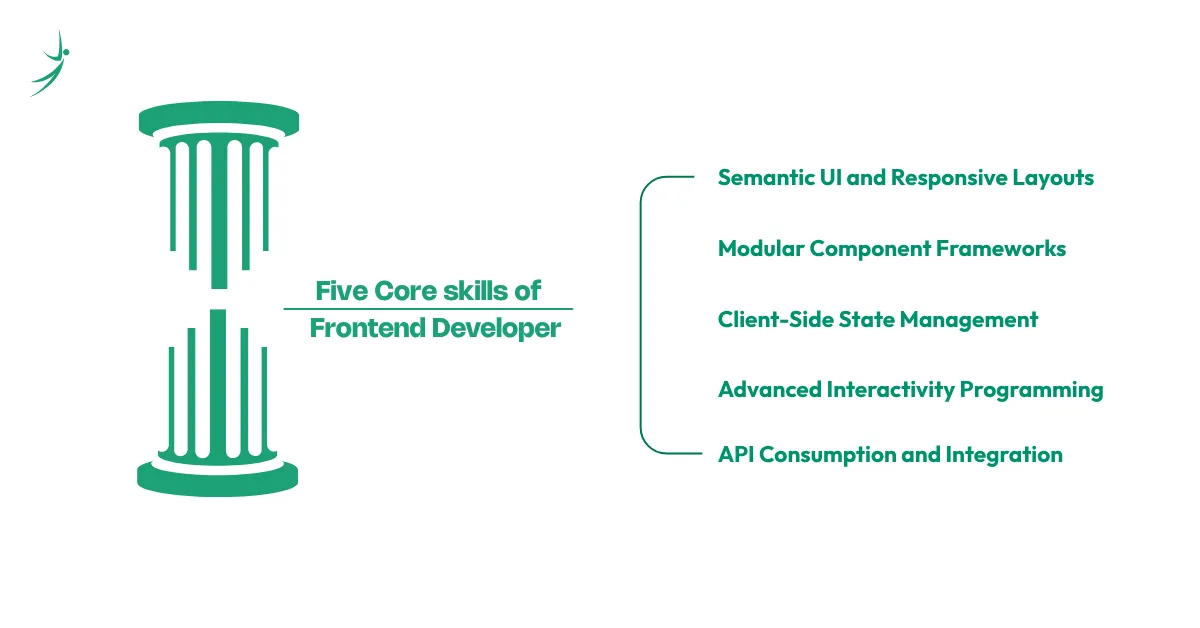
- Semantic UI and Responsive Layouts: Mastering structural markup and styling rulesets to build accessible, fluid web designs across all screen resolutions.
- Modular Component Frameworks: Building dynamic and scalable client-side user views using structured architectures like React, Angular, or Vue.
- Client-Side State Management: Efficiently handling and tracking local or global application data changes across multiple nested components.
- Advanced Interactivity Programming: Utilizing JavaScript or TypeScript to orchestrate real-time data flows, programmatic events, and asynchronous UI changes.
- API Consumption and Integration: Successfully connecting frontend views to backend servers by fetching, processing, and rendering data from RESTful or GraphQL endpoints.
Backend Developer Skills
A backend specialist must think in terms of system architecture, security, data integrity, and throughput. Essential skills include a firm grasp of object-oriented and functional programming paradigms, server routing, and asynchronous data operations. They must know how to build secure RESTful and GraphQL APIs, configure relational or NoSQL database patterns, implement role-based access controls, and prevent common vulnerabilities such as SQL injection or cross-site scripting attacks.
The top five core skills required for this role include:
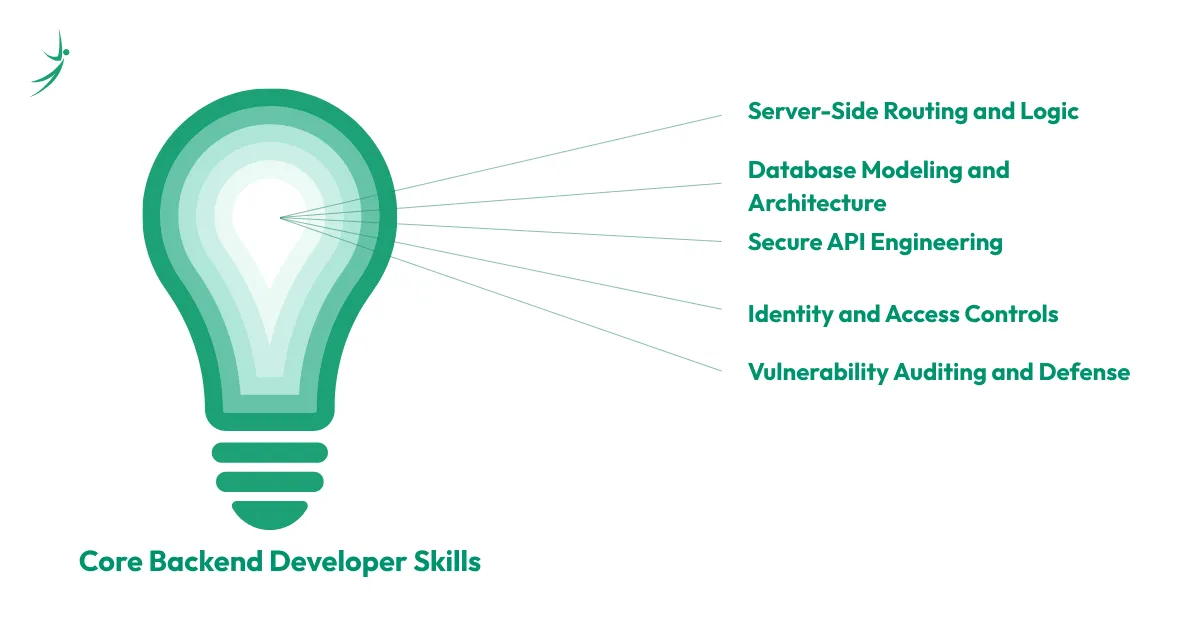
- Server-Side Routing and Logic: Directing network traffic and creating high-performance computation rules using runtimes and languages like Node.js, Python, or Java.
- Database Modeling and Architecture: Designing relational or NoSQL database patterns to manage high-volume data transactions while keeping strict data integrity.
- Secure API Engineering: Writing clean, accessible, and high-throughput RESTful or GraphQL communication pipelines for client usage.
- Identity and Access Controls: Setting up encrypted authentication layers, authorization middleware, and role-based access levels to guard private resources.
- Vulnerability Auditing and Defense: Protecting application networks from critical online security threats like SQL injections and cross-site scripting attacks.
Full Stack Developer Skills
To manage end-to-end features, a full stack professional requires a balance of versatility and depth. They must master database design, server configurations, and advanced UI concepts simultaneously. Rather than learning every single framework in existence, they focus on combining specific technologies that complement each other. Additionally, possessing strong MERN stack skills allows them to build unified JavaScript applications where code patterns stay consistent from the browser to the database server.
The top five core skills required for this role include:
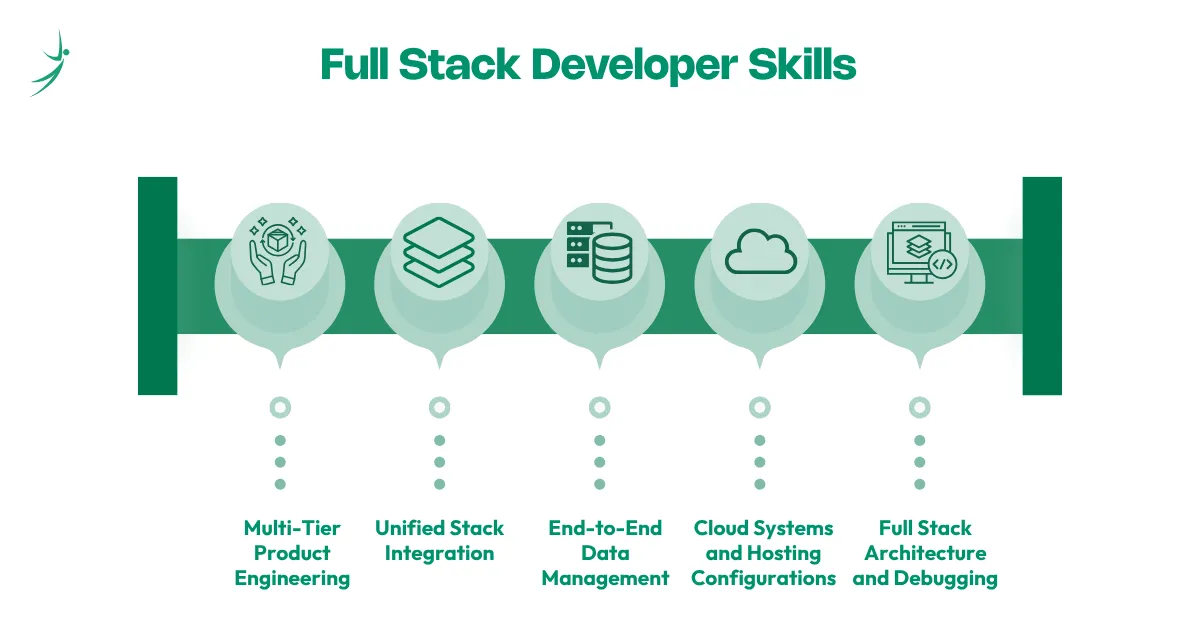
- Multi-Tier Product Engineering: Demonstrating cross-functional agility by seamlessly transitioning between visual user experience styling and abstract server computing.
- Unified Stack Integration: Knowing how to combine complementary software setups, such as the MERN stack, to write consistent programming patterns across all development layers.
- End-to-End Data Management: Mapping out how database tables or collections sync cleanly with frontend interface structures via intermediary API gateways.
- Cloud Systems and Hosting Configurations: Deploying entire applications onto modern web servers and managing system variables securely in production environments.
- Full Stack Architecture and Debugging: Identifying performance bottlenecks, handling code dependencies, and troubleshooting runtime bugs across any layer of the software application.
Programming Languages and Frameworks
Frontend Technologies
The modern client-side ecosystem relies on a combination of foundational systems and specialized compilation engines.
- HTML: The structural backbone of any web page, providing semantic meaning and accessible hierarchies to screen readers and search bots.
- CSS: The styling ruleset responsible for visual layouts, responsive grids, and adaptive media queries across diverse viewport resolutions.
- JavaScript: The primary programming language that adds real-time interactivity, event handling, and dynamic behavior to the browser.
- TypeScript: A typed superset of JavaScript that catches syntax and reference errors during compilation, bringing enterprise stability to frontend languages.
- React: A declarative, component-based frontend framework used globally for crafting stateful views. Developers eager to learn this system should check the clear tutorial on what is React.
- Vue: An approachable and progressive framework specializing in dual-way data binding and modular templates.
- Angular: A robust, TypeScript-driven MVC framework ideal for building highly structured corporate software.
- Tailwind CSS: A utility-first styling utility that allows developers to compose responsive designs directly inside component code.
Choosing between these engineering utilities can feel overwhelming, which is why reviewing a comprehensive analysis of React vs Angular vs Vue helps clarify which option fits your style.
Backend Technologies
Server engineering utilizes a wider variety of programming languages and frameworks depending on the underlying performance requirements.
- Node.js: An open-source, single-threaded JavaScript runtime built on the Chrome V8 engine that allows developers to run backend code using the same language as the frontend. You can learn its structural mechanics by exploring what is Node.js.
- Express.js: A lightweight, unopinionated routing framework designed to construct fast RESTful APIs on top of Node.js.
- Python: A clean, highly readable programming language heavily favored for data manipulation, scripting, and backend web logic.
- Django: A secure Python framework that follows a batteries-included philosophy to accelerate application development.
- Java: A compiled, strongly typed language engineered for multi-threaded performance and cross-platform enterprise systems.
- Spring Boot: A popular Java framework that streamlines the configuration and deployment of standalone microservices.
- PHP: A time-tested server scripting language that powers a massive percentage of modern content management platforms.
- Laravel: An elegant PHP web framework featuring expressive syntax, object-relational mapping, and robust queue management.
- .NET: A high-performance framework developed by Microsoft for building scalable, compiled cloud applications.
Reviewing a collection of professional backend languages will show you how these options differ in computing power.
Full Stack Technology Stacks
Choosing a technology stack involves pairing frontend frameworks with matching backend systems to streamline development.
- MERN: Comprising MongoDB, Express, React, and Node.js, this stack uses pure JavaScript across all development layers. You can learn more about how this ecosystem operates by evaluating what is MERN stack.
- MEAN: Replacing React with Angular, this combination offers a highly prescriptive architecture suitable for formal corporate systems.
- PERN: Utilizing PostgreSQL, Express, React, and Node.js, this stack matches a powerful relational database with a flexible modern frontend.
- Django + React: A popular architecture that combines Python analytical backend capabilities with React dynamic client-side rendering.
- Laravel + Vue: A common stack in modern web agencies, using Laravel for database and security features and Vue for responsive user views.
- Spring Boot + React: An enterprise-grade pairing that joins a highly secure Java backend with an agile React frontend UI.
For an extensive architectural comparison, reading a deep dive on MERN stack vs MEAN stack reveals how changing your client framework impacts system scaling.
Additionally, you can look at specialized MERN stack frameworks to see how pre-built systems accelerate fullstack engineering.
Frontend vs Backend vs Full Stack: Salary Comparison
Frontend Developer Salary in Nepal
In Nepal, compensation for client-side engineers reflects the growing local tech scene. A frontend developer intern or trainee can expect to earn between NPR 5,000 and NPR 25,000 per month during their training phase. Upon transitioning to a junior frontend developer role, salaries rise to a range of NPR 20,000 to NPR 50,000 per month. Mid-level developers with proven experience handling complex state management earn between NPR 50,000 and NPR 100,000 per month. Senior professionals who guide teams and design complex visual architectures regularly secure salaries starting at NPR 150,000 to well over NPR 250,000 per month.
| Experience Level | Monthly Salary Range (NPR) |
| Intern / Trainee | NPR 5,000 to NPR 25,000 |
| Junior Frontend Developer | NPR 20,000 to NPR 50,000 |
| Mid Level Frontend Developer | NPR 50,000 to NPR 100,000 |
| Senior Frontend Developer | NPR 150,000 to over NPR 250,000 |
Backend Developer Salary in Nepal
Server-side engineers in Nepal earn competitive rates due to the technical complexity of database and security management. A backend intern often starts with a stipend of NPR 10,000 to NPR 20,000 per month. Junior backend developers earn between NPR 25,000 and NPR 55,000 per month. Mid-level server engineers receive compensation ranging from NPR 60,000 to NPR 120,000 per month. Senior backend engineers with specialized database tuning and microservices experience easily earn between NPR 160,000 and NPR 300,000 per month.
| Experience Level | Monthly Salary Range (NPR) |
| Backend Intern | NPR 10,000 to NPR 20,000 |
| Junior Backend Developer | NPR 25,000 to NPR 55,000 |
| Mid Level Server Engineer | NPR 60,000 to NPR 120,000 |
| Senior Backend Engineer | NPR 160,000 to NPR 300,000 |
Full Stack Developer Salary in Nepal
Because full stack engineers manage both software layers, they command a premium in the Nepali market. Entry-level full stack positions pay around NPR 25,000 to NPR 45,000 per month. Mid-level full stack professionals earn between NPR 70,000 and NPR 140,000 per month. Senior full stack developers earn from NPR 150,000 to NPR 300,000 per month in traditional offices. For individuals who secure remote international positions while based in Nepal, monthly incomes frequently reach between NPR 300,000 and NPR 500,000 or more.
| Position / Placement Type | Monthly Salary Range (NPR) |
| Entry Level Full Stack | NPR 25,000 to NPR 45,000 |
| Mid Level Full Stack Professional | NPR 70,000 to NPR 140,000 |
| Senior Full Stack (Traditional Office) | NPR 150,000 to NPR 300,000 |
| Remote International Position | NPR 300,000 to NPR 500,000 or more |
Frontend vs Backend vs Full Stack Global Salary (USD/Year)
On the global stage, Western markets offer premium compensation packages.
The below data is taken from theGlobal Tech Market Analytics.
| Developer Role | Entry / Junior Level | Mid Level | Senior Level | |
| Frontend Developer | Around $65,000/year | Average $105,000/year | Exceeds $150,000/year | |
| Backend Developer | Around $70,000/year | Average $115,000/year | Over $165,000/year | |
| Full Stack Developer | Around $75,000/year | Average $120,000/year | Upwards of $180,000/year |
Career Paths for Frontend, Backend and Full Stack Developers
Frontend Developer Career Path
The path for client-side engineers moves from basic user interface layouts to complete frontend system architecture. Practitioners advance by deep-diving into specific modern environments, perfecting user experience patterns, and managing large scale build pipelines. To progress efficiently, following a structured frontend roadmap or a dedicated frontend developer roadmap provides a clear guide on what to learn next.
Specialization Branches
- React Developer: Specializing in building modular web components, managing global application states, and server-side rendering using Next.js.
- Angular Developer: Engineering structured, scalable, type-safe enterprise products within rigid corporate development ecosystems.
- Vue Developer: Designing fast, light web tools using progressive patterns and optimized template architectures.
- UI Developer: Bridging the gap between creative visual layouts and clean code, focusing on fluid animations and responsive interactions.
- Frontend Architect: Planning the global organization, styling rulesets, build tools, and performance benchmarks for massive multi-app networks.
- Mobile Frontend (React Native): Extending web development competencies into native mobile platforms to deploy iOS and Android applications from a single codebase.
Backend Developer Career Path
Server-side career paths prioritize data integrity, communication latency, and infrastructure automation. Engineers advance from writing simple database routes to managing distributed, high-availability networks. Reviewing a backend roadmap or a backend developer roadmap helps clarify how to balance security requirements with execution speeds.
Specialization Branches
- API Developer: Designing, documenting, and securing high-speed RESTful and gRPC communication pathways for client consumption.
- Database Engineer: Structuring schemas, managing complex replication pipelines, and tuning slow queries to maintain data speeds.
- Cloud Backend Engineer: Configuring serverless functions, cloud storage containers, and virtual private clouds inside platforms like AWS or Azure.
- Microservices Engineer: Decoupling large, monolithic applications into independent, isolated service layers that communicate using message brokers.
- Security Engineer: Implementing automated encryption systems, identity configurations, and firewalls to defend data infrastructure.
- Platform Engineer: Creating internal tools, infrastructure models, and deployment setups to support active software engineering teams.
Full Stack Developer Career Path
Cross-functional engineers focus their progression on system integration, technical leadership, and complete product lifecycle management. You can study the holistic progression steps by reviewing a fullstack roadmap. To see how these paths unfold over time, reviewing expert curated career guides offers extensive industry insights.
Specialization Branches
- MERN Stack Developer: Creating unified applications using MongoDB, Express, React, and Node.js for rapid software deployment.
- MEAN Stack Developer: Building highly typed, corporate web systems using Angular and server-side JavaScript environments.
- SaaS Developer: Creating cloud-hosted software products that feature subscription billing, tenant isolation, and multi-user configurations.
- Startup Full Stack Engineer: Operating as an adaptable generalist who can rapidly prototype new features and pivot technology directions as a business scales.
- Technical Lead: Guiding development teams, performing code reviews, and resolving complex technical challenges across both software layers.
- Solution Architect: Designing the high-level infrastructure blueprints, stack selections, and integration rules for enterprise applications.
For a comprehensive guide on transitioning into this career, reading about how to get into MERN stack provides step-by-step career milestones.
Frontend vs Backend vs Full Stack: Learning Difficulty Compared
- Frontend development: Highly intuitive at the initial stage due to immediate visual feedback, though mastering changing frameworks and advanced state engines can be challenging.
- Backend development: Features an abstract entry point with no visual interface, requiring logical thinking around server cycles, yet profits from predictable and stable architectural patterns.
- Full stack development: Commands the steepest learning curve because it requires managing both disciplines simultaneously without falling behind in either tier.
Which Developer Role Has Better Job Opportunities in Nepal?
- Frontend developer jobs in Nepal: Consistently high demand driven by digital agencies, e-commerce startups, and tech houses creating user interfaces for global clients.
- Backend developers: Strongly sought after by local companies to protect internal system architectures and optimize secure financial networks.
- Fullstack development: Remains the single most demanded capability among software firms and fintech startups, highlighting the profitable market scope of MERN stack in the private sector.
Frontend vs Backend vs Full Stack: Which Is Easier to Learn?
- Frontend engineering: Provides the easiest and most accessible route for beginners because editing visual layouts creates an immediate browser feedback loop.
- Backend Engineering: Demands handling abstract system processes from day one, which can be initially intimidating for individuals without a technical background.
- Full Stack Route: Highly complex due to the sheer volume of information, but becomes significantly smoother if you enroll in a structured fullstack web development course utilizing a unified language like JavaScript.
Can You Switch Between Frontend, Backend and Full Stack?
- Frontend to Backend: Transitioning from client-side layouts to server-side systems is a highly achievable career move. A frontend professional already understands how web applications send data requests and read API responses. To make the switch, they should start by securing a frontend developer intern position to observe backend data connections in a professional environment, or apply directly for a specialized backend intern role. From there, they can expand into database modeling, routing structures, and data security mechanisms.
- Backend to Frontend: Moving from server architecture to client-side programming requires a shift toward user experience principles. A backend engineer already has strong computational logic and programmatic problem-solving habits. If they want to cross-train, they can start by working on basic frontend projects, focusing on visual layout systems, CSS responsive structures, and modern single-page application state flows using frameworks like React or Vue.
- Frontend or Backend to Full Stack: Evolving into a full stack position is the natural progression for many single-layer developers. A frontend specialist can achieve this by mastering server logic, authentication protocols, and database schema design. A backend engineer can reach full stack status by securing a backend internship in Nepal that provides exposure to frontend teams, allowing them to build clean, responsive user interfaces that consume their existing APIs.
Frontend vs Backend vs Full Stack: Pros and Cons
Frontend Development Pros and Cons
Pros:
- Immediate visual feedback makes debugging and learning highly rewarding.
- High demand across all modern creative agencies and product startups.
- Opportunities to shape the direct user experience and interface accessibility.
Cons:
- Cross-browser variations and device compatibility issues require constant troubleshooting.
- The frontend tooling ecosystem changes rapidly, requiring continuous upskilling.
- Performance tuning across slow client devices can be highly tedious.
Backend Development Pros and Cons
Pros:
- Core server logic and database patterns remain stable for many years.
- Focuses on pure logic and data processing without visual design worries.
- Higher starting salaries due to the specialized nature of data security.
Cons:
- Abstract workflows can make debugging difficult without direct visual cues.
- High pressure to maintain server uptime and protect database records from leaks.
- System errors can crash the entire application infrastructure instantly.
Full Stack Development Pros and Cons
Pros:
- Maximum career flexibility and the highest volume of open job listings.
- Deep understanding of how complete software systems integrate and function.
- Excellent path toward becoming a technical founder or startup engineer.
Cons:
- High risk of burnout due to the need to maintain two distinct skill sets.
- Hard to become a true expert in any single technical subfield.
- Responsible for troubleshooting problems across the entire application stack.
Ready to Become a Full Stack Developer in Nepal?
Choosing your engineering specialization is the first step toward building a rewarding career in software. If you want to bypass the confusion of self-directed paths and build an elite portfolio, structured local guidance provides the perfect solution. Joining an intensive academy allows you to gain deep web development fluencies and master end-to-end applications.
Take control of your future today by exploring the highest-rated industry training options. Learn more about the top-tier educational path by viewing the comprehensive resource on the best MERN stack course in Nepal to jumpstart your full-stack coding journey.
Frequently Asked Questions
What is full stack development?
What does a full stack developer mean?
What is a full stack developer?
What is a full stack developer salary, and how much do they earn?
How much does a front end developer earn?
How much does a backend developer earn?
Will frontend be replaced by AI?
Which backend language should I learn?
Can I learn backend without frontend?
About Author:

Mr. Asim Chaulagain, Full Stack MERN mentor at SkillShikshya and developer at Vrit Technologies, empowers learners to build real-world web applications. Through hands-on projects, he turns coding skills into practical, career-ready expertise.