DevOps Projects: From Beginner Builds to Job-Ready Portfolio (2025 Guide)
If you're serious about landing a DevOps job in Nepal or anywhere, your portfolio is what actually gets you through the door. Knowing the theory is one thing. Having a working DevOps project on GitHub that recruiters can click through? That's a different story.
This guide covers everything: beginner builds you can finish this weekend, intermediate projects that show real understanding, and advanced setups that mirror what production teams actually run. Whether you're still figuring out where to place DevOps in your overall skill progression or you're already midway through training and need something portfolio-worthy, the projects here will give you something concrete to show.
What Makes a DevOps Project Worth Building?
Not all projects are equal. A project worth your time should:
- Use at least one real tool from the DevOps toolchain (Docker, Jenkins, Terraform, etc.)
- Solve an actual problem even a simple one end to end
- Be something you can explain clearly in a DevOps interview
- Show up well on GitHub (readme, commit history, working pipelines)
Companies hiring for DevOps jobs in Nepal and globally want to see that you can automate, monitor, and ship not just list tools on a resume. If you're unsure what technical abilities employers actually test for when hiring, that's worth reading before you pick your first project.
DevOps Projects for Freshers: Start Here
If you're new to DevOps fundamentals, these projects give you a solid foundation without overwhelming you
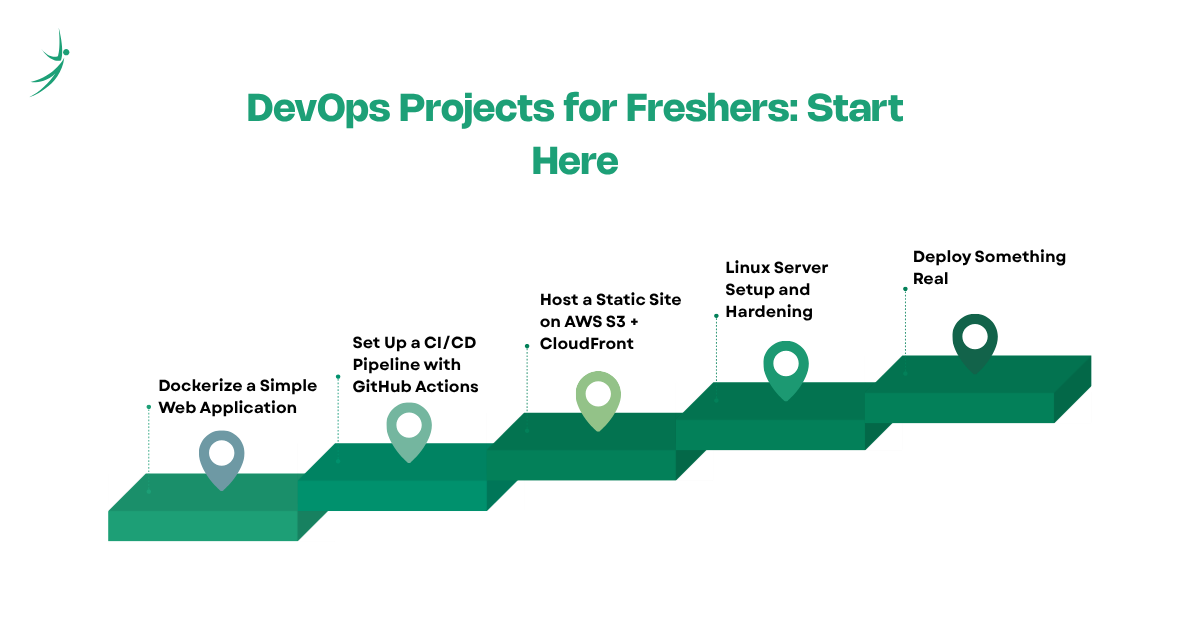
1. Dockerize a Simple Web Application
What you build: Take any basic app a Python Flask API or a Node.js app and containerize it using Docker.
What you learn:
- Writing a Dockerfile from scratch
- Building and running Docker images locally
- Pushing images to Docker Hub
- Environment variables and port mapping
Why it matters: Docker is at the center of modern deployment. Every DevOps engineer junior or senior works with containers daily. If you haven't yet gotten comfortable with how images, layers, and container runtimes actually work under the hood, build that understanding alongside this project it'll save you a lot of debugging time.
- Tools: Docker, Docker Hub, VS Code
- Time to complete: 4–6 hours
- Difficulty: Beginner
2. Set Up a CI/CD Pipeline with GitHub Actions
What you build: A workflow that automatically runs tests and deploys your app whenever you push code to GitHub.
What you learn:
- Writing YAML workflow files
- Triggering builds on push/pull requests
- Running automated tests in a pipeline
- Deploying to a free service like Render or Railway
Why it matters: CI/CD pipelines are the backbone of DevOps roles and responsibilities. This is one of the most common topics in DevOps basic interview questions.
- Tools: GitHub Actions, GitHub, any web framework
- Time to complete: 6–8 hours
- Difficulty: Beginner–Intermediate
3. Host a Static Site on AWS S3 + CloudFront
What you build: Deploy a static website to AWS S3 and serve it through CloudFront for fast global delivery.
What you learn:
- AWS S3 bucket policies and static hosting
- CloudFront distribution setup
- IAM roles and access management
- Basic cost estimation on AWS
Why it matters: AWS remains the most in-demand cloud platform. Even this small project introduces you to real cloud infrastructure thinking.
- Tools: AWS S3, CloudFront, AWS CLI
- Time to complete: 3–5 hours
- Difficulty: Beginner
4. Linux Server Setup and Hardening
What you build: Spin up an Ubuntu server on a free tier VPS (like AWS EC2 or DigitalOcean), configure it securely, and deploy a simple app.
What you learn:
- SSH key management
- UFW firewall rules
- Nginx as a reverse proxy
- Automated updates with cron jobs
Why it matters: Strong Linux skills are non-negotiable for any DevOps engineer. This project covers the fundamentals that most DevOps training programs start with.
- Tools: Ubuntu, Nginx, SSH, UFW
- Time to complete: 5–7 hours
- Difficulty: Beginner
Intermediate DevOps Projects: Build Real Understanding
Once you're comfortable with the basics, these projects introduce orchestration, infrastructure-as-code, and monitoring.
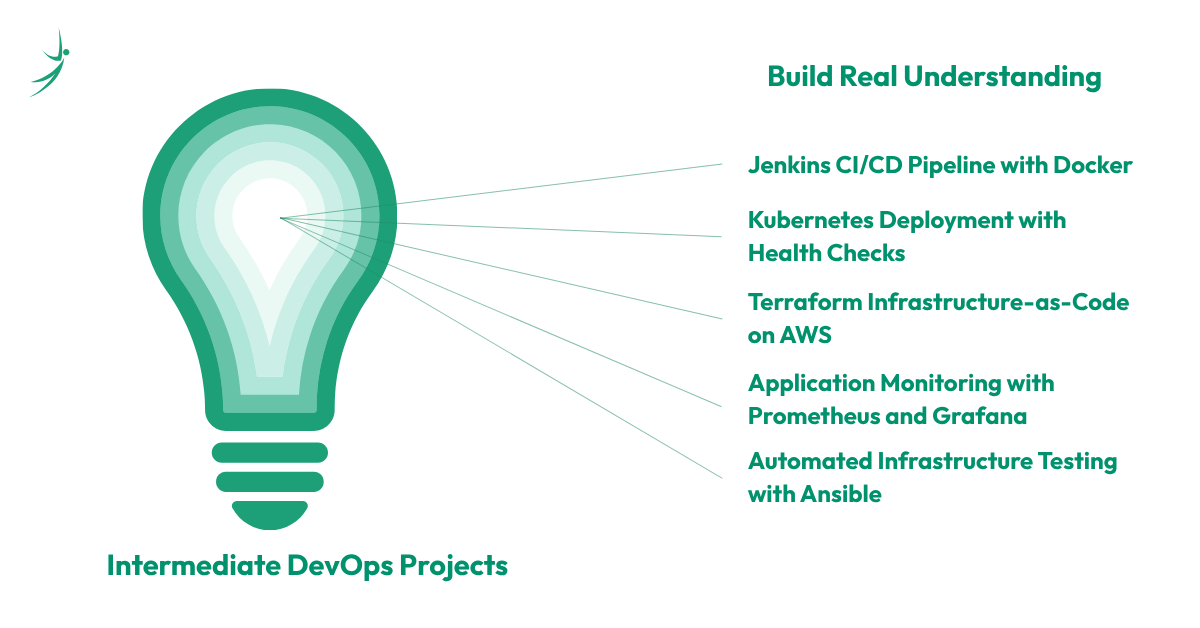
5. Jenkins CI/CD Pipeline with Docker
What you build: A full pipeline where Jenkins builds a Docker image, runs tests, and pushes the image to a registry automatically.
What you learn:
- Installing and configuring Jenkins
- Creating Jenkinsfiles (declarative pipeline syntax)
- Integrating Jenkins with GitHub webhooks
- Building and pushing Docker images from a pipeline
Why it matters: Jenkins is still widely used in DevOps teams across Nepal and globally. Knowing it well is a genuine differentiator in interviews.
- Tools: Jenkins, Docker, GitHub, Docker Hub
- Time to complete: 8–12 hours
- Difficulty: Intermediate
6. Kubernetes Deployment with Health Checks
What you build: Deploy a containerized application to a local Kubernetes cluster (using Minikube or kind), configure liveness/readiness probes, and scale it horizontally.
What you learn:
- Kubernetes Pods, Deployments, and Services
- ConfigMaps and Secrets
- Horizontal Pod Autoscaling
- kubectl commands for real-world operations
Why it matters: Kubernetes is the industry standard for container orchestration. Understanding it properly separates junior DevOps engineers from mid-level ones. Before diving in, make sure you have a working mental model of how pods, nodes, and cluster networking fit together this project will make far more sense with that foundation in place.
- Tools: Kubernetes, Minikube, kubectl, Docker
- Time to complete: 10–15 hours
- Difficulty: Intermediate
7. Terraform Infrastructure-as-Code on AWS
What you build: Provision a full AWS environment (VPC, EC2, S3, Security Groups) entirely through Terraform code.
What you learn:
- Terraform state management
- Variables, outputs, and modules
- Remote state with S3 backend
- Plan → Apply → Destroy workflow
Why it matters: Infrastructure-as-code (IaC) is a core DevOps skill. This project directly maps to what DevOps engineers do daily in cloud-heavy teams.
- Tools: Terraform, AWS, AWS CLI, VS Code
- Time to complete: 10–15 hours
- Difficulty: Intermediate
8. Application Monitoring with Prometheus and Grafana
What you build: Instrument a running application, collect metrics with Prometheus, and build a Grafana dashboard showing request rates, error rates, and latency.
What you learn:
- Prometheus scraping and metric types (counters, gauges, histograms)
- PromQL query basics
- Grafana panel and dashboard setup
- Alerting rules configuration
Why it matters: Monitoring and observability are core DevOps roles and responsibilities. Teams that can't see what their systems are doing can't fix them quickly.
- Tools: Prometheus, Grafana, Docker Compose
- Time to complete: 8–12 hours
- Difficulty: Intermediate
9. Automated Infrastructure Testing with Ansible
What you build: Write Ansible playbooks that provision a web server, deploy an application, and run automated configuration checks.
What you learn:
- Ansible inventory and playbook structure
- Roles and task organization
- Idempotency testing
- Integration with a CI pipeline
Tools: Ansible, Ubuntu/CentOS, YAML
Time to complete: 8–10 hours
Difficulty: Intermediate
Advanced DevOps Projects: Portfolio-Level Builds
These are the projects that get noticed by senior engineers and hiring managers. They require combining multiple tools into one working system.
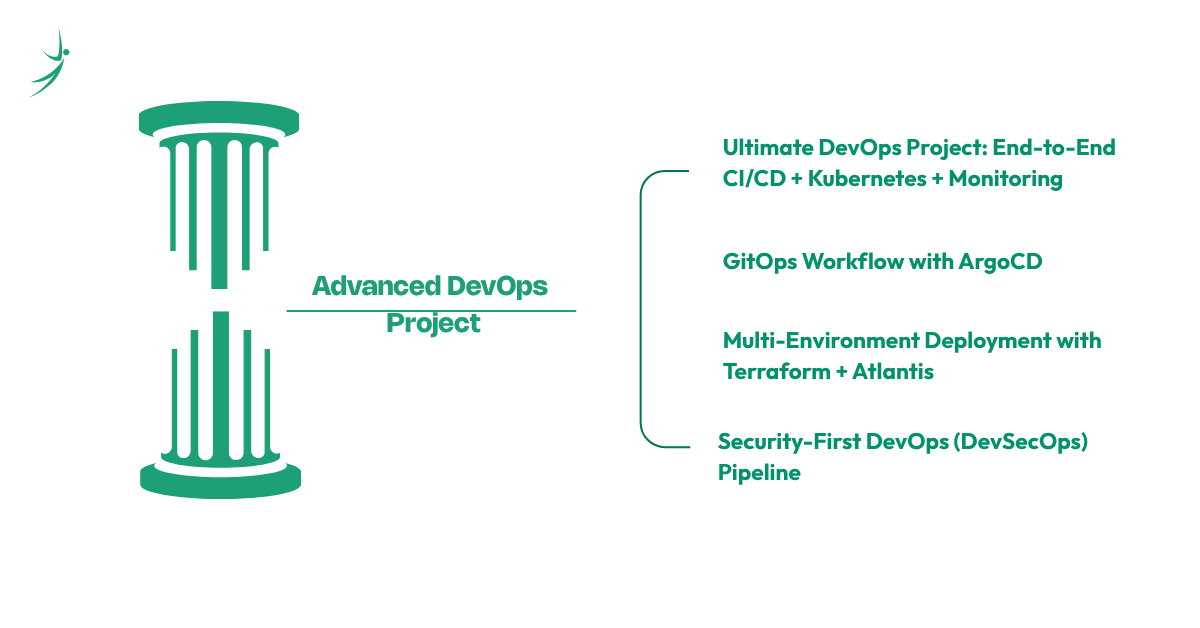
10. Ultimate DevOps Project: End-to-End CI/CD + Kubernetes + Monitoring
What you build: A production-style setup where:
- Code is committed to GitHub
- GitHub Actions (or Jenkins) builds and tests the app
- Docker image is pushed to ECR or Docker Hub
- Kubernetes (EKS or local) deploys the new image automatically
- Prometheus and Grafana monitor the live application
- Alerts fire when error rates spike
What you learn: Every major concept in the DevOps lifecycle version control, CI/CD, containerization, orchestration, monitoring, and alerting working together.
This is the ultimate DevOps project implementation that most DevOps courses point toward. Building it end to end proves you understand the whole picture, not just individual tools.
- Tools: GitHub Actions, Docker, Kubernetes (EKS/Minikube), Prometheus, Grafana, Terraform
- Time to complete: 3–5 days
- Difficulty: Advanced
11. GitOps Workflow with ArgoCD
What you build: A GitOps pipeline where every change to a Git repository triggers an automatic sync to your Kubernetes cluster through ArgoCD.
What you learn:
- GitOps principles (Git as the source of truth)
- ArgoCD app-of-apps pattern
- Kustomize or Helm for environment-specific configs
- Rollback strategies through Git history
Why it matters: GitOps is becoming the standard deployment model in 2025. Companies using Kubernetes almost universally adopt this approach.
- Tools: ArgoCD, Kubernetes, Helm, GitHub
- Time to complete: 2–3 days
- Difficulty: Advanced
12. Multi-Environment Deployment with Terraform + Atlantis
What you build: Terraform code that manages three environments (dev, staging, production) with pull-request-based infrastructure review and approval through Atlantis.
What you learn:
- Terraform workspaces and environment separation
- Atlantis for collaborative IaC workflows
- Infrastructure PR review processes
- State locking and remote backends
Tools: Terraform, Atlantis, GitHub, AWS
Time to complete: 2–3 days
Difficulty: Advanced
13. Security-First DevOps (DevSecOps) Pipeline
What you build: Integrate security scanning directly into a CI/CD pipeline using Trivy for container scanning, Snyk for dependency checks, and SAST tools for code analysis.
What you learn:
- Shift-left security principles
- Container vulnerability scanning
- OWASP dependency checks
- Automated security gates in CI pipelines
Why it matters: DevSecOps is one of the fastest-growing areas in DevOps. Adding security awareness to your portfolio sets you apart. Most teams are still running pipelines that treat security as an afterthought. Understanding what separates a standard DevOps pipeline from one built with security embedded from the start gives you a real edge when interviewing for roles at security-conscious companies.
- Tools: Trivy, Snyk, GitHub Actions, Docker
- Time to complete: 2–3 days
- Difficulty: Advanced
How to Present Your DevOps Projects (That Recruiters Notice)
Building the project is half the work. How you present it matters equally.
GitHub repository checklist:
- Clear README.md explaining what the project does, the architecture, and how to run it
- An architecture diagram (draw.io or Miro works fine)
- Clean commit history not 10 commits all saying "fix"
- Working code that actually runs
- Screenshots or a short screen recording of the project in action
What to include in your portfolio write-up:
- The problem you were solving
- Tools you chose and why
- Challenges you hit and how you worked through them
- What you'd do differently next time
This framing is exactly what interviewers ask about. It also prepares you for DevOps basic interview questions like "walk me through a project you've built."
DevOps Projects in the Nepal Job Market Context
The DevOps job market in Nepal has grown steadily over the past few years. Companies in Kathmandu from fintech startups to IT service firms are now actively hiring DevOps engineers, and the DevOps engineer salary in Nepal reflects that demand. If you want a clearer picture of how DevOps career opportunities are distributed across Nepal and where the growth is actually coming from, the data there might surprise you.
For freshers entering the market, having even three solid projects on GitHub dramatically improves callback rates. Many students who completed the DevOps training in Nepal at Skill Shikshya have landed their first DevOps roles after building portfolio projects during their course.
If you're looking for a DevOps internship in Nepal, projects are often more valuable than certifications at the entry level. A working pipeline speaks louder than a badge.
Matching Projects to Your Learning Stage
| Your Stage | Projects to Build |
|---|---|
| Complete beginner | Dockerize an app, Linux server setup, S3 hosting |
| Learning CI/CD | GitHub Actions pipeline, Jenkins + Docker |
| Moving to cloud | Terraform on AWS, Kubernetes basics |
| Building a full portfolio | End-to-end CI/CD + K8s + monitoring, GitOps with ArgoCD |
| Specializing in security | DevSecOps pipeline, Trivy + Snyk integration |
Tools You'll Use Across These Projects
Understanding the ecosystem matters. Here are the core tools that appear repeatedly:
- Version Control & CI/CD: Git, GitHub, GitLab, Jenkins, GitHub Actions, CircleCI
- Containers: Docker, Docker Compose, Docker Hub
- Orchestration: Kubernetes, Helm, ArgoCD, Kustomize
- Infrastructure-as-Code: Terraform, Ansible, AWS CloudFormation
- Cloud Platforms: AWS (EC2, S3, EKS, ECR, IAM), Azure DevOps, GCP
- Monitoring & Observability: Prometheus, Grafana, ELK Stack, Datadog
- Security: Trivy, Snyk, SonarQube, OWASP ZAP
- Scripting: Bash, Python
DevOps Certifications That Complement Your Projects
Certifications validate your knowledge, but projects prove you can apply it. The two work best together.
Worth considering alongside your project work:
- AWS Certified DevOps Engineer Professional the gold standard for cloud-native DevOps
- Certified Kubernetes Administrator (CKA) hands-on, project-driven exams
- HashiCorp Terraform Associate proves IaC competence
- GitLab Certified CI/CD Associate pipeline-focused
If you're in Nepal, the DevOps course in Nepal at Skill Shikshya covers the fundamentals you need before attempting professional-level certifications. The course is structured around building real projects, so by the end you're not just exam-ready you're job-ready.
What Hiring Managers Look for in DevOps Project Candidates
Based on how DevOps teams actually hire, here's what gets attention. One thing that comes up often in interviews is whether candidates understand how DevOps thinking differs from and connects to Agile delivery. It's not a trick question; teams run both, and knowing how they interact shows product-aware thinking.
- End-to-end thinking: Can you connect code to deployment to monitoring? Not just configure one tool.
- Problem-solving evidence: A project where something went wrong and you fixed it is more valuable than a perfect tutorial clone.
- Documentation habit: Engineers who document clearly are easier to work with. Show this on GitHub.
- Cloud awareness: Even beginner-level AWS or Azure experience matters.
- Security awareness: Knowing about secrets management, least-privilege IAM, and container scanning is increasingly expected even at junior level.
Getting Started This Week
You don't need to build all 13 projects. Pick one that matches your current level and finish it properly.
If you're a complete beginner: start with Dockerizing a simple app. It's achievable in a day, and every other project builds on it.
If you already know Docker and basic Linux: jump into the GitHub Actions CI/CD pipeline. You'll see immediate results.
If you want to fast-track your DevOps learning path with structured guidance, mentorship, and a curriculum built around real projects, the DevOps training at Skill Shikshya is designed exactly for that. Students go from DevOps fundamentals to job-ready in a matter of months with projects to show for it.
Frequently Asked Questions
Which DevOps project is best for freshers?
How many projects should I have on my portfolio?
Do DevOps projects help with getting a DevOps internship in Nepal?
What's the best DevOps project to showcase for a senior role?
Is there a free DevOps course I can use to build these projects?
About Author: