Cybersecurity Salary in Nepal 2026: How Much Can You Actually Earn?
If you've been searching for a straight answer on what cybersecurity professionals earn in Nepal, you're not alone. Most blogs throw out numbers without context, and freshers end up more confused than when they started. The truth is, cybersecurity is one of the few IT fields in Nepal where the salary curve is steep enough to matter. A fresher earning NPR 30,000 today can realistically be at NPR 1,00,000 within three years if they're building the right skills and picking up certifications along the way.
To fast-track this journey, enrolling in a structured cybersecurity training course in Nepal can give you the hands-on lab experience local employers actively look for. If you think it's the right direction for you, you can get started in cybersecurity right away.
So here's the honest picture; salaries, roles, certifications, and what actually moves the needle on your pay.
How much does a Cybersecurity Professional Earn in Nepal?
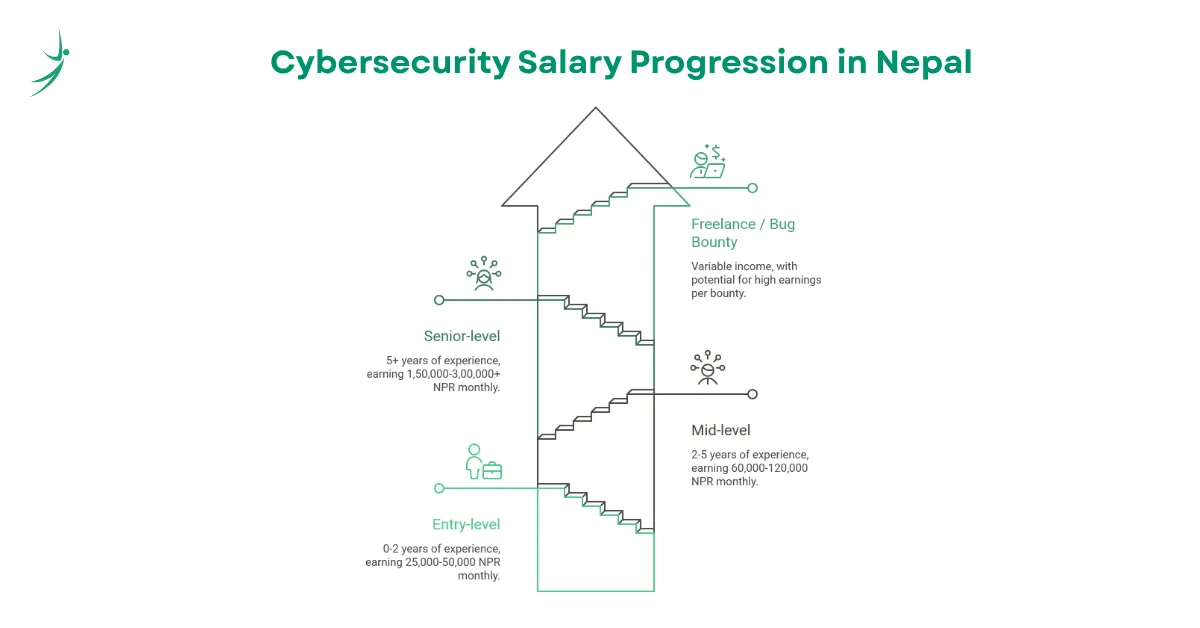
Let's get straight to the numbers. According to KumariJob's 2026 salary research and CyberSamir's Nepal scope report, here's how cybersecurity salaries break down by experience:
| Experience Level | Monthly Salary (NPR) |
|---|---|
| Entry-level (0–2 years) | 25,000 – 50,000 |
| Mid-level (2–5 years) | 60,000 – 120,000 |
| Senior-level (5+ years) | 1,50,000 – 3,00,000+ |
| Freelance / Bug Bounty | Variable, some earn lakhs per single bounty |
A few things worth noting here. Banking and fintech companies consistently pay at the higher end of these ranges because they deal with financial data and simply can't afford a breach. Startups and smaller firms tend to sit at the lower end. Your industry matters as much as your experience level does.
It's also worth knowing that cybersecurity pays more at every level compared to general IT roles in Nepal. A fresher software developer might start at NPR 20,000-30,000. A fresher in cybersecurity typically starts higher because the skills are harder to find and the stakes are higher for the employer.
Ethical Hacking Salary in Nepal
Ethical hacking sits at the premium end of cybersecurity pay. These professionals don't just monitor systems, they actively try to break into them to find weaknesses before real attackers do. It's a specialized skill, and the market pays accordingly.
According to NecoJobs' ethical hacking salary guide, here's what ethical hackers earn in Nepal:
| Level | Monthly Salary (NPR) |
|---|---|
| Entry-level | 30,000 – 50,000 |
| Mid-level | 60,000 – 1,20,000 |
| Senior (local) | 1,50,000+ |
| Remote (international clients) | 1,30,000 – 6,50,000+ |
The remote earning potential is where it gets interesting. A mid-level ethical hacker in Nepal who lands a remote contract with a foreign company can earn more in a single month than most senior local roles pay in three. The key is building a portfolio that proves what you can actually do; certifications open the door but demonstrated skill keeps you in the room.
Bug bounty programs are another angle worth mentioning. Platforms like HackerOne and Bugcrowd pay researchers for finding vulnerabilities in company systems. Some Nepali security researchers earn lakhs from a single valid submission. It's not a stable income stream on its own, but it's a real way to build reputation and earn while you learn. If you're still sorting out how ethical hacking differs from cybersecurity broadly, that's worth reading before you decide which path to focus on.
Cybersecurity Jobs in Nepal: What Roles Are Actually Hiring
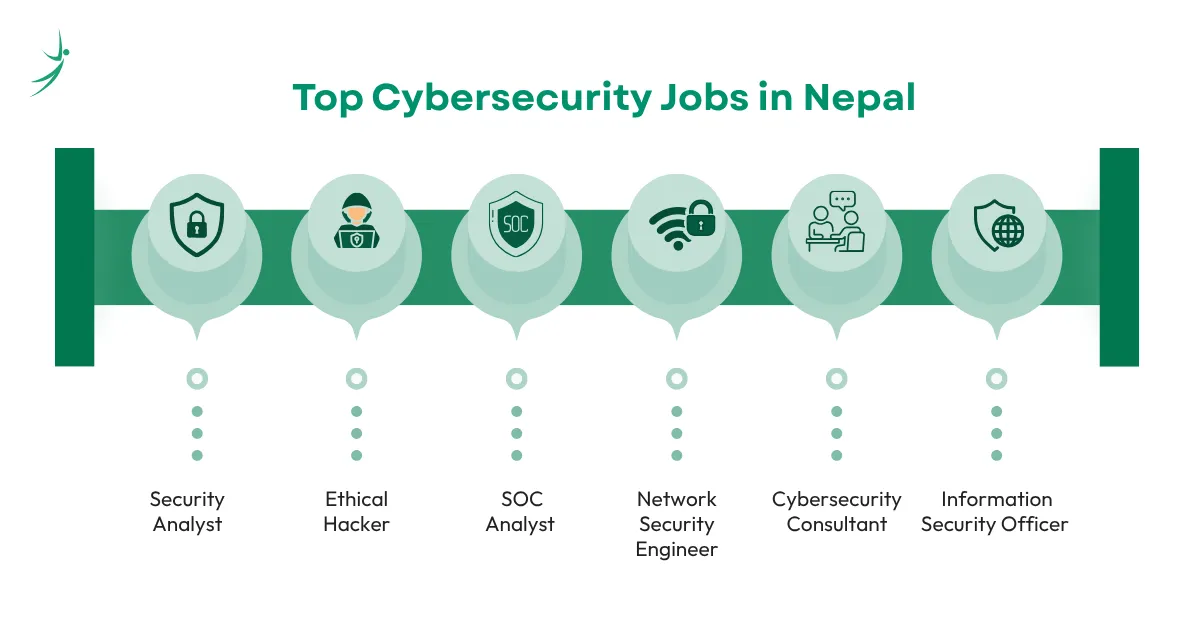
The field isn't just "cybersecurity analyst." There are several distinct roles, each with different responsibilities and pay scales. Knowing which one fits your strengths helps you target your learning more effectively.
- Security Analyst: Monitors threats, reviews system logs, and responds to security incidents. This is the most common entry point into the field. Banks, IT companies, and telecoms hire heavily for this role.
- Ethical Hacker / Penetration Tester: Gets paid to find vulnerabilities in systems before attackers do. Requires strong technical skills and usually a CEH or OSCP certification. One of the highest-paying roles in the field.
- SOC Analyst (Security Operations Center): Works inside a Security Operations Center on a shift basis, monitoring for threats in real time. It's hands-on, fast-paced, and a great way to build experience quickly.
- Network Security Engineer: Secures the infrastructure; firewalls, routers, VPNs, and communication systems. Common in telecoms and large enterprises.
- Cybersecurity Consultant: Advises organizations on their security posture and helps them build or improve their security strategy. Usually a senior role requires both technical knowledge and business communication skills.
- Information Security Officer (ISO): Ensures a company's data policies comply with laws and regulations including Nepal's Electronic Transactions Act. Mid-to-senior role found in banks and government bodies.
- Cyber Forensics Investigator: Works with law enforcement to investigate digital crimes. Nepal Police Cyber Bureau is one of the main employers for this specialized role.
Banks, fintech companies, telecom providers, IT firms, and government agencies are all actively hiring across these roles. The demand is growing, the ISC2 2024 workforce study found a global gap of 4.8 million unfilled cybersecurity positions, and Nepal reflects that same shortage at a local level. For a deeper look at where the field is heading locally, the scope of cybersecurity in Nepal covers the industry and sector breakdown in more detail.
How CEH Certification Changes Your Salary
CEH(Certified Ethical Hacker) is the most recognized certification you'll see in cybersecurity job listings across Nepal and internationally. It's issued by EC-Council and it signals to employers that you know how to think like an attacker, not just a defender.
Here's what the data says about its salary impact. According to Zoe Talent Solutions' 2026 ethical hacking salary report, professionals with CEH see salary increases of 10–20% over their non-certified peers. iCert Global's CEH benefits report puts that premium at around 20% for senior roles specifically.
That's not a small difference when you're already earning NPR 80,000–1,00,000 a month. A 15% bump on NPR 90,000 is an extra NPR 13,500 every single month, which adds up fast.
CEH is particularly valued for roles like SOC Analyst, Penetration Tester, and Security Analyst. Employers see it as a filter that proves practical expertise beyond theoretical knowledge. That said, CEH alone isn't enough. Employers increasingly want to see that you can actually demonstrate the skills in a lab or real environment, the certification gets you the interview, your hands-on ability gets you the job.
How CEH compares to other top certifications:
| Certification | Best For | Difficulty | Salary Impact |
|---|---|---|---|
| CompTIA Security+ | Beginners entering the field | Low | Moderate |
| CEH | Mid-level ethical hacking roles | Medium | 10–20% increase |
| CISSP | Senior and management roles | High | Significant |
| OSCP | Advanced penetration testing | Very High | Premium |
If your roadmap included using CEH to reduce the CISSP experience requirement, that pathway no longer exists so it's worth revisiting how to plan your cybersecurity certification path in Nepal and updating your timeline accordingly.
What Actually Affects Your Cybersecurity Salary
Experience and certifications get most of the attention, but several other factors shape what you'll actually take home every month.
- Industry: Banking and fintech companies pay the most because a security breach for them means direct financial loss and regulatory consequences. Government roles offer stability but lower pay. IT companies vary widely, those working with international clients tend to pay closer to global rates.
- Technical Skills in Demand: SIEM tools, cloud security, malware analysis, and AI-based threat detection are what employers are willing to pay extra for right now. According to StationX's 2026 cybersecurity job statistics, over 64% of cybersecurity job listings globally now require AI, machine learning, or automation skills. That trend is starting to shape hiring in Nepal too. Roles without AI exposure are increasingly paid below market averages.
- Soft Skills: The ability to explain a security incident clearly, write a proper incident report, and coordinate a response under pressure makes you significantly more valuable than your technical peers who can't communicate. Most cybersecurity professionals underestimate how much this matters for promotions.
- Company Size: Large enterprises and MNCs pay substantially more than local startups. If you're early in your career, a lower-paying role at a large firm that gives you real exposure to enterprise-scale security infrastructure is usually worth more in the long run than a higher-paying role at a small company with limited scope.
- Remote Work: Landing a remote contract with an international company is the fastest way to multiply your income without leaving Nepal. The barrier to entry is higher; you need strong skills, a solid portfolio, and good English communication but the payoff is substantial. The technical and soft skills that increase your cybersecurity salary breakdown covers exactly which ones to prioritize at each stage of your career.
Types of Cyber Attacks Driving Demand for Professionals
One reason cybersecurity jobs keep growing is that the threats keep evolving. Employers aren't just hiring to tick a compliance box, they're hiring because attacks are genuinely increasing in frequency and sophistication.
Nepal has seen a significant rise in cyber incidents over the last few years; from phishing attacks targeting banking customers to ransomware hitting government systems. Each incident creates awareness, urgency, and ultimately, job openings.
The most common attack types shaping what employers look for in 2026:
- Phishing and social engineering: still the #1 entry point for most breaches
- Ransomware: increasingly targeting healthcare, government, and financial institutions
- Man-in-the-middle attacks: especially relevant for fintech and digital payment platforms
- Insider threats: a growing concern as more companies shift to hybrid work
- Cloud misconfigurations: as more Nepali companies move workloads to AWS and Azure
Understanding these attack types isn't just useful knowledge, it directly shapes which skills employers pay premium rates for. If you want a proper breakdown of each one, the most common types of cyber attacks targeting businesses in Nepal covers them in detail along with how defenders respond.
Nepal vs International Cybersecurity Salaries
According to multiple sources like US Bureau of Labor Statistics, KumariJob and NecoJobs, the gap between local and international salaries is real but remote work is closing it faster than most people realize.
| Role | Nepal (NPR/month) | USA (NPR/month) | Europe (NPR/month) |
|---|---|---|---|
| Entry-level Analyst | 25,000 – 50,000 | 5,00,000 – 7,00,000 | 3,50,000 – 5,00,000 |
| Mid-level Analyst | 60,000 – 1,20,000 | 7,00,000 – 10,00,000 | 5,00,000 – 7,50,000 |
| Senior / Specialist | 1,50,000 – 3,00,000 | 10,00,000 – 17,00,000+ | 7,00,000 – 12,00,000 |
| Penetration Tester | 60,000 – 1,50,000 | 8,00,000 – 13,00,000 | 6,00,000 – 10,00,000 |
The numbers make the case clearly. A mid-level analyst in Nepal earns roughly 6–8x less than their counterpart in the US doing the same work. But a Nepal-based professional who breaks into remote contracts can close that gap significantly, earning more than most senior local roles without leaving the country.
What remote clients look for:
| Requirement | Why It Matters |
|---|---|
| CEH or OSCP certification | Proves hands-on, verified skill, not just theory |
| Portfolio of real projects or CTF writeups | Shows you can execute, not just explain |
| English communication, written and verbal | Most remote engagements run entirely in English |
| Ability to work across time zones | International clients expect async-first delivery |
The BLS projects 29% growth for information security analysts through 2034. Globally, cybersecurity job postings grew 18–22% year over year in 2026, far outpacing general IT hiring. The demand is structural, not a trend, it's not going away.
If you want to understand which sectors in Nepal are hiring cybersecurity professionals and why, that breakdown is worth reading before you decide where to focus your job search.
How to Start and Actually Grow Your Salary
Here's the honest roadmap, not the idealized version, the one that actually works:
- Year 0-6 months, Build the foundation: Learn networking fundamentals, Linux basics, and how operating systems work. These aren't glamorous topics, but they're the foundation everything else sits on. Without them, CEH prep will feel like memorizing words in a language you don't speak.
- 6-12 months, Get CompTIA Security+: It's the most beginner-friendly certification in the field and is recognized globally. It validates that you understand core concepts; network security, threats, cryptography, and access control. Many employers in Nepal list it as a minimum requirement for junior roles.
- Year 1-2, Work an entry-level role or internship: Real experience compounds faster than any certification. Even an internship at a local IT company or bank gives you exposure to how security incidents actually play out, which tools teams use, and how decisions get made under pressure. This experience is what makes your CV credible.
- Year 2-3, Get CEH certified: By now you have enough practical context to make CEH prep meaningful rather than rote memorization. The certification opens mid-level roles and adds 10–20% to your salary immediately. Combined with 2 years of experience, it positions you well for SOC analyst, penetration tester, and security analyst roles.
- Year 3-5, Specialize: Cloud security, AI-driven threat detection, and penetration testing are where salaries are heading. Pick one, go deep, and build a visible track record; GitHub writeups, CTF results, or a portfolio of real projects all help here.:
- Year 5+: Consider CISSP CISSP is the gold standard for senior and management roles. It requires 5 years of documented experience and covers a wide range of security domains. It's what gets you into CISO, Security Manager, and Director-level conversations.
The Tools You'll Actually Use on the Job
Knowing the tools matters both for the job and for the salary conversation. Employers pay more for professionals who can work with industry-standard tools from day one.
Here are the tools that come up most in cybersecurity roles in Nepal:
- Wireshark: network traffic analysis, a must-know for any security role
- Nmap: network scanning and host discovery
- Metasploit: penetration testing framework, heavily used in ethical hacking
- Burp Suite: web application security testing
- SIEM platforms (Splunk, IBM QRadar): security monitoring and log management
- Kali Linux: the standard operating system for ethical hackers and pen testers
You don't need to master all of these before your first job. But being able to speak confidently about how and when you've used two or three of them will separate you from candidates who only know the theory. The tools used by cybersecurity professionals in Nepal breakdown goes deeper into each one; what it does, when to use it, and how to get started.
Is This the Right Time to Get Into Cybersecurity in Nepal?
Honestly, yes. But not because it's trendy. Because the fundamentals are genuinely in your favor right now.
Nepal is in the middle of a digital shift that isn't slowing down. More transactions are moving online. More businesses are storing sensitive data in the cloud. More government services are going digital. Every one of those shifts creates a new surface area that needs protecting and right now, there simply aren't enough trained professionals to cover it.
The BLS projects 29% growth for information security analysts through 2034. Globally, cybersecurity job postings grew 18–22% year over year in 2026. These aren't optimistic forecasts from training institutes trying to sell you a course, they're labor market numbers from credible sources. Nepal sits within that global trend, not outside it.
What makes this moment particularly good for someone starting out is that the field still rewards people who learn through doing. You don't need a decade of experience to land a solid entry-level role. You need demonstrable skills, a relevant certification like CEH or Security+, and critically hands-on project experience that shows an employer you can actually execute.
The salary curve makes the investment worthwhile too. Going from NPR 30,000 at entry level to NPR 1,00,000+ within three years is realistic in cybersecurity. That kind of growth in that timeframe is hard to find in most other fields in Nepal.
And if remote work is part of your plan, which it should be, the ceiling gets significantly higher. Nepali professionals who break into international freelance or contract work in security are earning incomes that simply weren't accessible five years ago.
The window is open. The question is whether you're building the skills to walk through it.
If you're still figuring out where to start, how to build a cybersecurity career from scratch in Nepal breaks the path down step by step from foundations to CEH to specialization. And if you want to see what a structured training environment looks like, Skill Shikshya's hands-on cybersecurity training program is built specifically around the Nepal job market with real projects and industry exposure.
Train with Skill Shikshya
Skill Shikshya's cybersecurity training is built around actual execution not slideshows. You work on real projects, prep for CEH, and get hands-on with the tools employers actually use. The training is led by industry professionals actively working in security, backed by Vrit Technologies, which means the projects you work on reflect real industry workflows.
Through Skill Shikshya's network of 200+ industry partners, graduates get direct exposure to how cybersecurity operates inside real organizations. That kind of experience is what turns a CV from a list of certifications into proof of capability.
Frequently Asked Questions
What is the cybersecurity salary in Nepal in 2026?
Is cybersecurity a good career in Nepal?
What is CEH and how does it affect my salary?
What is the ethical hacking salary in Nepal?
Which certification should I get first: CEH, Security+, or CISSP?
Can I work remotely in cybersecurity from Nepal?
How long does it take to become a cybersecurity professional in Nepal?
What skills increase cybersecurity salary the most in Nepal?
About Author: