Top Cybersecurity Tools to Use in 2026 (Complete Guide)
Cyber threats are becoming faster, smarter, and increasingly automated. In 2026, organizations are no longer relying on a single antivirus or firewall solution to stay protected. Modern enterprise security now depends on layered cybersecurity architectures that combine AI-driven monitoring, endpoint defense, cloud security, identity management, and automated incident response.
Understanding how these cybersecurity tools work is becoming an essential skill for aspiring security professionals, ethical hackers, and IT learners. If you're interested in building practical knowledge, exploring a cyber security course can help you gain hands-on experience with real-world security concepts and industry tools.
This guide explores the most important cybersecurity tools used by modern organizations, how AI is reshaping enterprise defense strategies, and how businesses can build a scalable security stack for the future. If you're new to the field, understanding about cyber security and why it matters can help you better understand how these tools protect systems, networks, and sensitive data.
What Are Cybersecurity Tools?
Cybersecurity tools are software platforms, cloud services, and hardware systems designed to protect networks, applications, endpoints, identities, and sensitive business data from cyber threats.
Modern organizations use multiple categories of cybersecurity tools together to create a defense-in-depth security strategy. These tools help security teams:
- Detect suspicious behavior
- Prevent malware and ransomware attacks
- Monitor cloud infrastructure
- Protect sensitive data
- Identify vulnerabilities
- Automate incident response
- Maintain regulatory compliance
As businesses move toward cloud-native environments and remote work infrastructure, cybersecurity tools have become essential operational requirements rather than optional IT investments.
Why Businesses Need a Multi-Layered Security Stack
Modern cyberattacks rarely target a single weakness. Attackers often combine identity theft, cloud exploitation, phishing, ransomware, and lateral movement techniques during one coordinated attack.
A multi-layered security stack is important because:
Expanded Attack Surfaces
Organizations now manage:
- Cloud platforms
- Remote employees
- SaaS applications
- APIs
- Mobile devices
- Hybrid infrastructure
Single Tools Cannot Detect Everything
A firewall alone cannot detect:
- insider threats
- cloud misconfigurations
- credential abuse
- fileless malware
- suspicious user behavior
Compliance Requirements Are Increasing
Frameworks such as:
- GDPR
- HIPAA
- ISO 27001
- PCI DSS
require organizations to implement multiple layers of protection and monitoring.
Compliance requirements are increasing, with frameworks like GDPR, HIPAA, ISO 27001, and PCI DSS requiring stronger security measures. As cyber threats evolve, the scope of cybersecurity continues expanding across cloud security, AI, compliance, and digital infrastructure, increasing demand for cybersecurity professionals.
Quick Comparison Table of Top Cybersecurity Tools
Compare the top cybersecurity tools at a glance and find the best fit for your security needs.
| Category | Primary Purpose | Popular Solutions |
|---|---|---|
| SIEM | Centralized log monitoring | Splunk, QRadar, Sentinel |
| EDR | Endpoint threat detection | CrowdStrike, SentinelOne |
| XDR | Cross-platform threat correlation | Cortex XDR, Cisco XDR |
| NDR | Network traffic analysis | Vectra AI, ExtraHop |
| CSPM | Cloud misconfiguration detection | Wiz, Prisma Cloud |
| IAM | Identity & access management | Okta, Entra ID |
| Vulnerability Management | Vulnerability scanning & patch management | Tenable, Qualys |
| Penetration Testing | Security validation & attack simulation | Metasploit, Burp Suite |
| SAST/DAST | Application security testing | Snyk, Veracode |
| DFIR | Incident response & digital forensics | EnCase, FTK |
| TIPs | Threat intelligence aggregation | Recorded Future, ThreatConnect |
| DLP | Data protection & monitoring | Forcepoint, Symantec |
| SASE | Secure remote connectivity | Netskope, Zscaler |
| Container Security | Kubernetes & container protection | Aqua, Sysdig |
| Encryption & Key Management | Encryption & secret management | HashiCorp Vault, AWS KMS |
Top 15 Cybersecurity Tools in 2026
Discover the top cybersecurity tools in 2026 that are shaping the future of digital defense and online safety.
1. SIEM (Security Information and Event Management) Tools
What SIEM Tools Do
SIEM platforms collect and analyze logs from across enterprise systems to detect suspicious activities and security threats in real time.
Why Organizations Use SIEM
Organizations deploy SIEM solutions to centralize security visibility, automate alerting, correlate threat indicators, and support compliance monitoring.
Common Enterprise Use Cases
- detecting unusual login behavior
- insider threat investigations
- suspicious authentication tracking
- compliance reporting
Leading SIEM Platforms
- Splunk Enterprise Security
- Microsoft Sentinel
- IBM QRadar
- Expert Insight
Many organizations struggle with SIEM alert fatigue because poorly configured correlation rules generate excessive false positives. Effective tuning is critical for long-term success.
2. Endpoint Detection & Response (EDR) Tools
What EDR Tools Do
EDR platforms continuously monitor endpoints such as laptops, servers, and workstations for malicious behavior and active cyber threats.
Why Organizations Use EDR
Organizations use EDR solutions to improve ransomware protection, monitor suspicious processes, and isolate compromised devices quickly.
Common Enterprise Use Cases
- stopping ransomware attacks
- investigating malicious scripts
- isolating infected devices remotely
- analyzing endpoint activity
Leading EDR Platforms
- CrowdStrike Falcon
- SentinelOne Singularity
- Microsoft Defender for Endpoint
3. Extended Detection & Response (XDR) Platforms
What XDR Platforms Do
XDR solutions combine security telemetry across endpoints, cloud environments, identities, and networks into a centralized detection platform.
Why Organizations Use XDR
Organizations deploy XDR to eliminate security silos and improve visibility across multi-stage attacks.
Common Enterprise Use Cases
- cross-platform threat correlation
- centralized threat investigations
- automated incident response
- cloud-to-endpoint attack tracking
Leading XDR Platforms
- Palo Alto Cortex XDR
- Cisco Secure XDR
- Trend Micro Vision One
4. Network Detection & Response (NDR) Tools
What NDR Tools Do
NDR solutions analyze network traffic patterns to identify hidden threats, suspicious communications, and lateral movement.
Why Organizations Use NDR
Organizations use NDR tools to improve internal network visibility and detect advanced threats that bypass traditional defenses.
Common Enterprise Use Cases
- detecting unauthorized scanning
- identifying covert data exfiltration
- monitoring east-west traffic
- command-and-control detection
Leading NDR Platforms
- Vectra AI
- ExtraHop Reveal(x)
- Zeek
- Suricata
5. Cloud Security Posture Management (CSPM) Tools
What CSPM Tools Do
CSPM platforms continuously monitor cloud environments to identify security misconfigurations and compliance risks.
Why Organizations Use CSPM
Organizations deploy CSPM tools to improve cloud visibility and reduce exposure caused by insecure cloud settings.
Common Enterprise Use Cases
- detecting exposed storage buckets
- identifying over-permissioned accounts
- monitoring cloud compliances
- discovering shadow cloud assets
Leading CSPM Platforms
- Wiz
- Orca Security
- Prisma Cloud
6. Identity & Access Management (IAM) Tools
What IAM Tools Do
IAM platforms manage user identities, authentication processes, and access permissions across enterprise systems.
Why Organizations Use IAM
Organizations use IAM solutions to strengthen authentication security and enforce least-privilege access policies.
Common Enterprise Use Cases
- enabling single sign-on (SSO)
- implementing multi-factor authentication (MFA)
- managing privileged access
- identity governance
Leading IAM Platforms
- Okta Workforce Identity
- Microsoft Entra ID
- Ping Identity
7. Vulnerability Management Tools
What Vulnerability Management Tools Do
These tools identify software vulnerabilities, missing patches, and security weaknesses across enterprise infrastructure.
Why Organizations Use Vulnerability Management Tools
Organizations use these platforms to prioritize patching efforts and reduce exposure to exploitable vulnerabilities.
Common Enterprise Use Cases
- identifying missing patches
- vulnerability scanning
- CVE tracking
- compliance assessments
Leading Platforms
- Tenable.io
- Qualys VMDR
- Rapid7 InsightVM
8. Penetration Testing Tools
What Penetration Testing Tools Do
Penetration testing frameworks simulate real-world attacks to validate security controls and identify exploitable weaknesses.
Why Organizations Use Penetration Testing Tools
Organizations use these tools to assess security readiness and uncover vulnerabilities before attackers exploit them.
Common Enterprise Use Cases
- web application testing
- network exploitation simulations
- API security assessments
- red team exercises
Leading Platforms
- Metasploit
- Burp Suite Professional
- Cobalt Strike
9. Application Security Testing Tools (SAST/DAST)
What Application Security Testing Tools Do
SAST and DAST platforms identify software vulnerabilities during development and runtime testing.
Why Organizations Use Application Security Testing Tools
Organizations use these tools to secure applications before deployment and reduce software-related security risks.
Common Enterprise Use Cases
- source code analysis
- runtime vulnerability testing
- dependency scanning
- API security validation
Leading Platforms
- Snyk
- Veracode
- Checkmarx One
- SonarQube
10. Digital Forensics & Incident Response (DFIR) Tools
What DFIR Tools Do
DFIR tools help organizations investigate cyber incidents, preserve digital evidence, and analyze compromised systems.
Why Organizations Use DFIR Tools
Organizations use DFIR platforms to accelerate incident response and improve post-breach investigations.
Common Enterprise Use Cases
- ransomware investigations
- forensic disk analysis
- memory analysis
- breach timeline reconstruction
Leading Platforms
- EnCase
- FTK
- Magnet AXIOM
- Autopsy
11. Threat Intelligence Platforms (TIPs)
What Threat Intelligence Platforms Do
TIPs aggregate external threat intelligence feeds and attack indicators from multiple sources.
Why Organizations Use TIPs
Organizations use TIPs to improve threat awareness and proactively defend against emerging attack campaigns.
Common Enterprise Use Cases
- malicious IP tracking
- threat feed aggregation
- IOC correlation
- attack trend monitoring
Leading Platforms
- Recorded Future
- ThreatConnect
- Anomali ThreatStream
12. Data Loss Prevention (DLP) Tools
What DLP Tools Do
DLP platforms monitor and protect sensitive data from unauthorized access, sharing, or exfiltration.
Why Organizations Use DLP
Organizations deploy DLP tools to prevent data breaches and maintain compliance with data protection regulations.
Common Enterprise Use Cases
- preventing sensitive file transfers
- monitoring insider threats
- securing cloud data
- protecting customer information
Leading Platforms
- Forcepoint DLP
- Symantec DLP
- Digital Guardian
13. Secure Access Service Edge (SASE) Platforms
What SASE Platforms Do
SASE combines cloud networking and security controls into a unified architecture for distributed workforces.
Why Organizations Use SASE
Organizations deploy SASE platforms to secure remote access and improve cloud connectivity performance.
Common Enterprise Use Cases
- securing remote employees
- cloud traffic inspection
- zero-trust access control
- SaaS application protection
Leading Platforms
- Netskope One
- Zscaler Internet Access
- Prisma SASE
14. Container & Kubernetes Security Tools
What Container Security Tools Do
These platforms secure cloud-native workloads, Kubernetes clusters, and containerized applications.
Why Organizations Use Container Security Tools
Organizations use these tools to protect modern cloud infrastructure and reduce container-related risks.
Common Enterprise Use Cases
- container vulnerability scanning
- Kubernetes runtime monitoring
- image security validation
- cluster policy enforcement
Leading Platforms
- Aqua Security
- Sysdig Secure
- Prisma Cloud Compute
15. Encryption & Key Management Tools
What Encryption & Key Management Tools Do
These tools manage encryption keys and secure sensitive enterprise data across applications, databases, and cloud environments.
Why Organizations Use Encryption & Key Management Tools
Organizations deploy these platforms to strengthen data protection and maintain encryption compliance standards.
Common Enterprise Use Cases
- encryption key rotation
- database encryption
- certificate management
- secure secret storage
Leading Platforms
- HashiCorp Vault
- AWS KMS
- Thales CipherTrust
AI and Cybersecurity: How Artificial Intelligence Is Transforming Digital Defense
The relationship between AI and cybersecurity has become one of the most important developments in enterprise security architecture. Modern organizations now rely on machine learning systems to analyze enormous volumes of log data, detect abnormal behaviors, automate incident response workflows, and identify sophisticated attack patterns before they escalate into large-scale breaches.
As attack surfaces continue expanding across cloud infrastructure, remote workforces, APIs, and connected devices, traditional rule-based systems alone are no longer sufficient. AI-powered cybersecurity tools help organizations improve detection speed, reduce analyst workload, and respond to evolving threats more efficiently.
Artificial intelligence is rapidly changing threat detection, automation, and incident response. Learn more about how AI is transforming cybersecurity and future security careers in our detailed guide.
What Is AI in Cyber Security?
AI in cyber security refers to the use of machine learning algorithms, neural networks, behavioral analytics, and intelligent automation systems to detect, analyze, and respond to cyber threats automatically.
Unlike traditional security systems that rely mainly on predefined signatures, AI systems continuously learn from:
- user behavior
- network traffic
- cloud activity
- login patterns
- malware characteristics
This allows AI-driven cybersecurity platforms to identify suspicious activities in real time, even when attacks have never been seen before.
Network Security Tools List for Modern Enterprises
Organizations use multiple network security tools to monitor traffic, prevent unauthorized access, and detect malicious activities across enterprise infrastructure.
A modern network security tools list typically includes:
- Firewalls
- Intrusion Detection Systems (IDS)
- Intrusion Prevention Systems (IPS)
- SIEM platforms
- Network Detection and Response (NDR) tools
- VPN solutions
- Secure Web Gateways (SWG)
- DNS filtering systems
- Zero Trust Network Access (ZTNA) tools
- Threat intelligence platforms
Popular enterprise network security tools include:
- Palo Alto Networks
- Cisco Secure
- Fortinet
- Vectra AI
- ExtraHop
- Zeek
- Suricata
Best Open Source Network Security Monitoring Tools
Many organizations also deploy network security monitoring tools open source solutions to improve visibility and reduce operational costs.
Popular open-source network monitoring tools include:
- Zeek
- Suricata
- Snort
- Security Onion
- Wazuh
These platforms help security teams:
- inspect packet traffic
- detect anomalies
- analyze network behavior
- investigate suspicious activities
Cybersecurity Testing Tools Used by Security Teams
Cybersecurity testing tools help organizations identify weaknesses before attackers can exploit them.
These tools are commonly used for:
- penetration testing
- vulnerability scanning
- web application testing
- API security testing
- cloud security assessments
Popular cybersecurity testing tools include:
- Metasploit
- Burp Suite
- Nessus
- Nmap
- OWASP ZAP
- Nikto
- Qualys
- Rapid7
Security teams use these platforms to validate defenses and improve organizational resilience against cyberattacks.
Best AI-Powered Cybersecurity Tools
Artificial intelligence is transforming how organizations detect and respond to threats. Modern AI-powered security tools analyze massive datasets in real time, automate remediation workflows, and reduce alert fatigue.
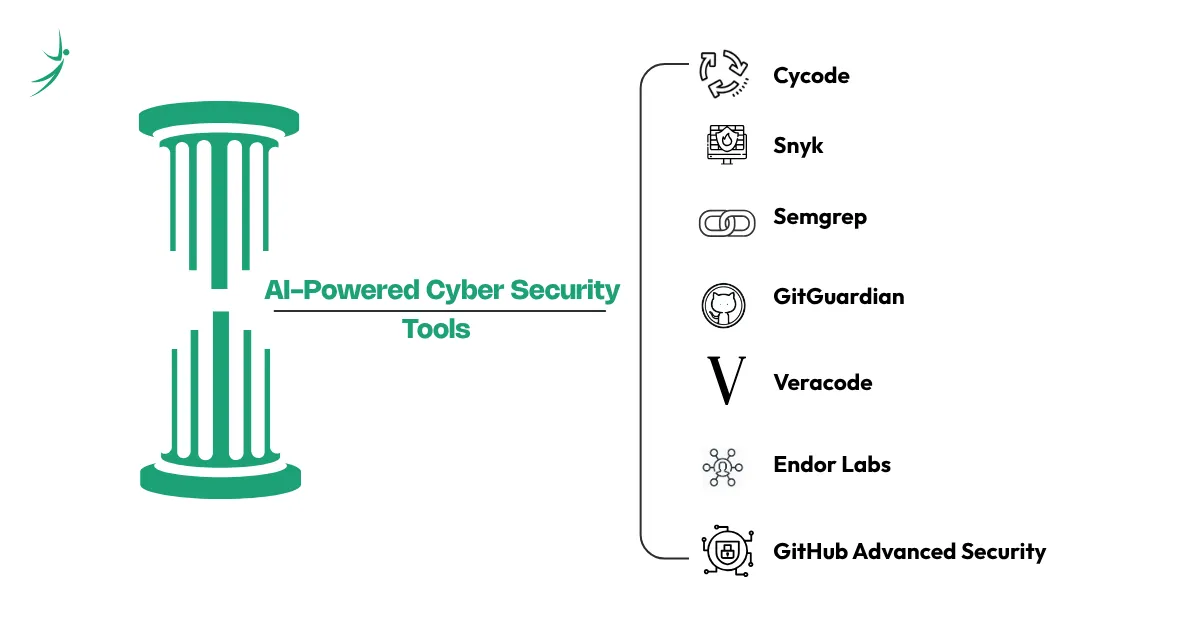
| Platform | Focus Area | Key AI Capabilities |
| Cycode | Application Security | AI exploitability analysis |
| Snyk | Developer Security | AI vulnerability prioritization |
| Semgrep | Code Security | AI noise reduction |
| GitGuardian | Secrets Detection | AI-based leak detection |
| Veracode | AppSec | AI-assisted remediation |
| Endor Labs | Dependency Security | Reachability analysis |
| GitHub Advanced Security | Workflow Security | Copilot Autofix |
How AI Is Transforming Cybersecurity
AI-driven security systems help organizations:
- detect abnormal behavior faster
- reduce manual analysis workloads
- automate remediation tasks
- prioritize critical vulnerabilities
- improve phishing detection accuracy
Key Areas Where AI Is Used
- AI-Powered Threat Detection: Machine learning analyzes live binary execution behavior rather than static file signatures. This allows modern infrastructure defense networks to identify, flag, and isolate completely unseen zero-day mutations instantly at the moment of execution.
- Behavioral Analytics: AI continuously tracks user and device metrics to establish an operational baseline. Any sudden anomaly—such as unusual late-night data transfers or unmapped administrative queries—triggers immediate, automated access restrictions to limit potential exposure.
- Automated Vulnerability Prioritization: Instead of forcing security operations teams to sort through thousands of static CVE alerts manually, AI calculates live runtime reachability. This filters out harmless system noise, allowing developers to focus patches directly on exploitable code paths.
- AI-Based Phishing Protection: Natural Language Processing (NLP) models parse incoming emails for semantic urgency, look-alike domains, and subtle tone changes. This blocks hyper-realistic social engineering and corporate credential harvesting attempts before they reach employee screens
Challenges of AI in Cybersecurity
- The Operational Cost of False Positives: Over-sensitive behavioral engines frequently mistake safe developer testing or irregular administrative scripts for active security breaches. This floods management dashboards with false alarms, causing severe alert fatigue that can blind analysts to real threats.
- Model Poisoning and Adversarial Exploitation: Attackers can execute long-term campaigns that feed corrupted telemetry logs into an organization's collection pipelines. This systematically skews the AI's baseline thresholds, teaching the engine to accept malicious lateral movements as normal traffic.
- Shadow AI and Sensitive Data Leaks: Unauthorized team members often copy confidential enterprise code bases or customer records into unvetted public generative systems for troubleshooting. This bypasses corporate data loss prevention configurations and risks exposing proprietary corporate data.
- High Infrastructure and Tuning Costs: Deploying robust machine learning models requires massive cloud computing architectures and continuous data ingestion channels. Beyond software fees, organizations face steep budget demands to recruit specialized engineering talent to maintain model alignment.
- Overdependence on Algorithmic Automation: Running fully autonomous threat isolation systems without human-in-the-loop checkpoints creates dangerous points of failure. A minor algorithmic error or misread baseline shift could mistakenly isolate critical production databases, disrupting live operations.
Conclusion
Cybersecurity tools have evolved far beyond traditional antivirus software. Modern organizations now rely on SIEM platforms, EDR solutions, cloud security tools, AI-powered monitoring systems, and identity management frameworks to defend against increasingly sophisticated threats.
As AI continues transforming threat detection and incident response, understanding cybersecurity tools is becoming valuable not only for businesses but also for individuals exploring careers in cybersecurity, ethical hacking, and digital defense.
Whether you're interested in network security, penetration testing, cloud protection, or AI-driven security systems, learning how these technologies work can help build a stronger foundation in the field.
Want to move beyond theory and develop practical cybersecurity skills? Explore Skill Shikshya's Cyber Security Course in Nepal to learn industry concepts, hands-on tools, and cybersecurity fundamentals used in real-world environments.
Frequently Asked Questions
Can AI replace cybersecurity professionals?
Will AI take cybersecurity jobs?
Which is best: AI or cyber security?
What are the future trends in cybersecurity?
What are cybersecurity tools?
What is AI in cybersecurity?
What are the most important cybersecurity tools?
Which cybersecurity tools are best for cloud security?
Why is a multi-layered security stack important?
About Author: