Scope of Cybersecurity in Nepal: Career Opportunities, Salaries & How to Get Started (2026)
Nepal's banks got hacked. Government websites went offline. A telecom company lost thousands of customer records. These are not hypothetical scenarios; they already happened, and the list keeps growing every year.
Yet, despite all this, Nepal has very few trained cybersecurity professionals. Companies post cybersecurity jobs on Merojob and sit on them for months because they cannot find the right people. That gap between the growing number of attacks and the shortage of people who can stop them is exactly what makes cybersecurity one of the most promising career paths in Nepal right now.
If you have been trying to understand the real scope of cybersecurity in Nepal, not just the buzzwords, but the actual jobs, salaries, industries, and paths, this article lays it all out. And if you are already ready to start, check out the cybersecurity course in Nepal at Skill Shikshya.
What Is Cybersecurity?
Cybersecurity is the practice of protecting computers, networks, servers, applications, and data from unauthorized access, damage, or attacks. It covers everything from locking down a company's internal network to hunting for vulnerabilities in web applications before attackers find them first.
The field includes roles like ethical hacking, penetration testing, network security, threat analysis, digital forensics, cloud security, and compliance management. It is not just one job, it is an entire industry with dozens of specializations.
At its core, cybersecurity answers one question: how do you protect digital systems from people trying to break them?
If you are completely new to the field, this guide on what is cybersecurity covers all the basics, types of threats, how defenses work, and career paths in one place.
How Big Is the Cybersecurity Industry Globally?
Before getting into Nepal specifically, it helps to understand the size of what we are talking about.
- The global cybersecurity market stands at $217 billion in 2026, growing at over 12% annually.
- Cybercrime costs the global economy an estimated $8 trillion per year, more than the GDP of most countries.
- According to the report from ISC2, there is a worldwide shortage of 3.5 million cybersecurity professionals, a gap that has stayed open for years despite growing demand.
- The average cybersecurity salary crosses $112,000 per year in the US and while Nepal numbers are lower, the cybersecurity salary in Nepal is among the highest across all local IT roles, with senior professionals and freelancers earning NPR 200,000-600,000+ per month.
- Fortune 500 companies now allocate 15–20% of their entire IT budgets to security.
This is not a niche field anymore. Every company that runs a website, stores customer data, or processes online payments needs cybersecurity, which is essentially every company operating today.
The Real Scope of Cybersecurity in Nepal
Nepal's cybersecurity problem is real, and it is getting bigger. Here is what the ground situation actually looks like:
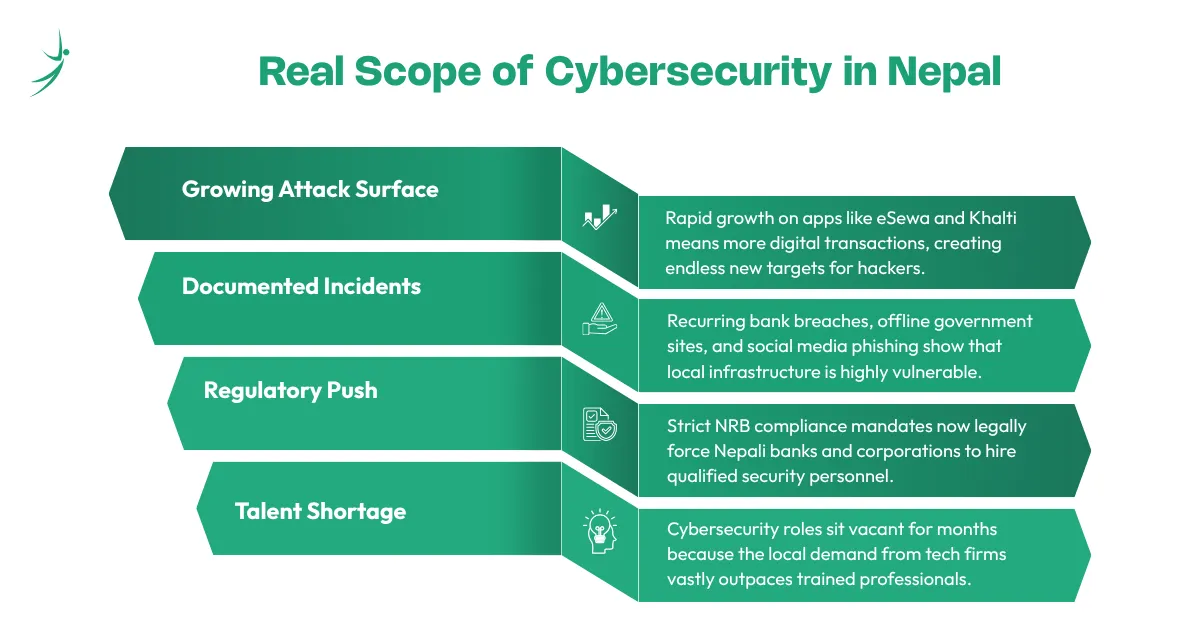
Growing attack surface
- Nepal has over 20 million internet users and smartphone penetration is rising fast.
- E-commerce platforms, fintech companies, digital wallets (eSewa, Khalti, ConnectIPS), and government services process millions of transactions daily.
- Every new digital service that launches is a potential target.
Documented incidents
- Multiple Nepali banks and financial institutions have faced data breaches and fraud in recent years.
- Government websites have been defaced and taken offline by hackers.
- Phishing attacks targeting Nepali users across Facebook and email platforms have become routine.
Regulatory push
- The government's Digital Nepal Framework is expanding the country's digital infrastructure but more infrastructure means more security responsibility.
- Organizations now face legal and regulatory pressure to hire qualified security professionals.
Talent shortage
- Demand for trained cybersecurity professionals in Nepal far exceeds supply.
- Most IT companies, banks, and government agencies either hire undertrained staff or outsource security work abroad.
- Cybersecurity jobs in Nepal sit open for months because qualified candidates are that scarce.
That last point is the opportunity. When a field has high demand and low supply, people who build real skills win.
Cybersecurity Career Scope: Jobs & Salaries in Nepal (2026)
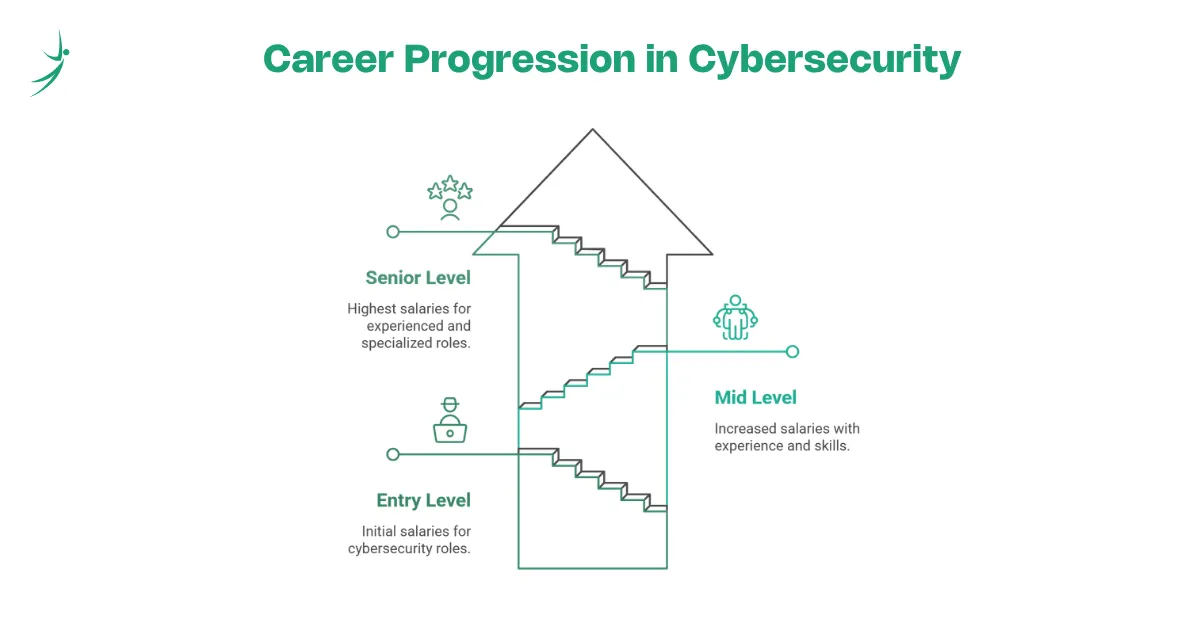
Cybersecurity is among the highest-paying IT careers in Nepal. Here is a realistic salary breakdown for 2026, based on active job listings and cybersecurity salary data in Nepal:
| Role | Entry Level (NPR/month) | Mid Level (NPR/month) | Senior Level (NPR/month) |
|---|---|---|---|
| Cybersecurity Analyst | 35,000 – 55,000 | 60,000 – 100,000 | 110,000 – 180,000 |
| Ethical Hacker / Penetration Tester | 40,000 – 65,000 | 70,000 – 120,000 | 130,000 – 200,000+ |
| Network Security Engineer | 35,000 – 60,000 | 65,000 – 110,000 | 120,000 – 190,000 |
| SOC Analyst | 30,000 – 50,000 | 55,000 – 90,000 | 100,000 – 160,000 |
| Digital Forensics Analyst | 35,000 – 55,000 | 60,000 – 100,000 | 110,000 – 175,000 |
| Cloud Security Specialist | 45,000 – 70,000 | 75,000 – 130,000 | 140,000 – 220,000+ |
| Cybersecurity Freelancer | 40,000 – 80,000 | 100,000 – 200,000 | 250,000 – 600,000 |
Remote and freelance work adds a completely separate layer. Nepali cybersecurity professionals with solid penetration testing or cloud security skills regularly earn $25–$80 per hour working with clients in the US, UK, Australia, and Europe, entirely from Nepal. At $30/hour for 20 hours a week, that works out to roughly NPR 320,000 per month. Very few local job categories come close to that.
Which Industries Hire Cybersecurity Professionals in Nepal?
The short answer: every industry that uses computers and stores data, which is all of them now.
- Banking & Financial Services: This is the most active hiring sector for cybersecurity in Nepal. NRB regulations require banks to maintain security teams, conduct regular audits, and have incident response capabilities. Every major bank in Nepal, Nabil, Standard Chartered, Himalayan Bank, and others needs security staff.
- Telecom Companies: Nepal Telecom and Ncell manage the data of millions of customers. Network security engineers and threat analysts are in constant demand at this scale.
- Government & Public Sector: Ministries, Nepal Police, the Army, and public institutions are slowly building internal security teams as cyberattacks on government infrastructure increase.
- E-commerce & Fintech: Platforms like Daraz, Sastodeal, eSewa, and Khalti handle payment data from millions of users. They need application security specialists who understand how payment fraud and web vulnerabilities work.
- IT Companies & Consultancies: Nepali IT firms that build software for international clients increasingly need developers who understand secure coding and dedicated security testers who can audit applications before deployment.
- Healthcare: Hospitals and health data systems are now digital targets. This sector is just beginning to hire cybersecurity staff in Nepal.
- Education: Universities and schools now face ransomware attacks and data breaches. IT security roles are starting to appear in this space too.
Cybersecurity Career Paths: Which Direction Is Right for You?
One of the best things about cybersecurity is that it fits different types of people. You do not need to be one particular kind of person to succeed in this field.
- If you enjoy breaking things to understand how they work: Ethical hacking and penetration testing is the path. You get paid to attack systems legally; finding vulnerabilities before real attackers do.
- If you prefer analysis and investigation: Digital forensics and incident response suits you. You investigate breaches after they happen, figure out what went wrong, and build systems to prevent it next time.
- If you like systems and infrastructure: Network security and cloud security focus on building and maintaining the defenses, firewalls, VPNs, IDS/IPS systems, and cloud security architecture.
- If you like the policy and governance side: Cybersecurity compliance and risk management roles exist in almost every large organization. Understanding frameworks like ISO 27001, NIST, and GDPR puts you in demand at banks, insurance companies, and large enterprises.
- If you want to code: Application security and secure development combine programming with security thinking, a combination that is extremely rare and highly paid.
Not sure which path to take? This cybersecurity roadmap breaks down every specialization with timelines and certifications.
What Does a Cyber Security Course in Nepal Actually Teach You?
A structured cybersecurity course covers the full stack of skills employers look for. Here is exactly what Skill Shikshya's Cyber Security course covers:
- Introduction to Cybersecurity: understanding cyber threats, attack vectors, and how organizations protect systems and data.
- Networking Fundamentals for Security: TCP/IP, firewalls, VPNs, IDS/IPS, and how networks get compromised.
- Operating System and System Security: securing Windows and Linux environments at the system level.
- Ethical Hacking and Penetration Testing: using Kali Linux, Nmap, Metasploit, and Burp Suite to find vulnerabilities legally.
- Web Application Security and OWASP: SQL injection, cross-site scripting (XSS), and the full OWASP Top 10.
- Malware and Ransomware Analysis: understanding how malicious software works and how to defend against it.
- Digital Forensics and Incident Response: investigating attacks, collecting evidence, and recovering from breaches.
- Security Operations Center (SOC) Fundamentals: real-time threat monitoring, alert triage, and response workflows.
- Basic Cryptography: encryption, SSL/TLS, hashing, and how organizations secure sensitive data.
- Cloud Security and Infrastructure Protection: securing AWS, Azure, and Google Cloud environments.
- Governance, Risk, and Compliance (GRC): ISO 27001, NIST, GDPR, and what they mean in practice.
- Career and Practical Guidance: portfolio building, penetration testing reports, and interview preparation.
The key difference between a good course and a mediocre one comes down to hands-on lab work. Reading about SQL injection does nothing. Running it against a practice environment and learning how to fix it, that builds actual skill.
Cybersecurity vs. Other IT Careers in Nepal
People often weigh cybersecurity against software development, data science, or networking. Here is a direct comparison:
- Cybersecurity vs. Software Development: Software development has more entry-level jobs in Nepal right now. Cybersecurity pays higher at mid and senior levels and has far less competition for qualified candidates. Both fields overlap, developers who understand security are extremely valuable.
- Cybersecurity vs. Networking: Networking provides the foundation for security work. Many cybersecurity professionals start in networking. If you already work in networking, cybersecurity is a natural and lucrative upgrade.
- Cybersecurity vs. Data Science: Both are strong career paths globally. In Nepal specifically, cybersecurity has more immediate, local employer demand. Data science roles in Nepal are more concentrated in large tech companies and research institutions.
The honest answer: cybersecurity has one of the best combinations of local demand, global freelance opportunity, salary growth, and talent shortage across all IT fields available in Nepal today.
How to Start Learning Cybersecurity in Nepal
Free starting points:
- Google Cybersecurity Certificate (on Coursera): free to audit, well-structured for beginners.
- Cybrary: free cybersecurity courses covering fundamentals, ethical hacking, and CompTIA prep.
- TryHackMe: hands-on hacking labs for beginners; one of the best free platforms for building practical skills.
- HackTheBox: more advanced, but free to start; widely respected by employers globally.
Certifications to target:
- CompTIA Security+: the most widely recognized entry-level cybersecurity certification internationally.
- Certified Ethical Hacker (CEH): highly respected for penetration testing roles in Nepal and globally.
- CompTIA PenTest+: focused specifically on penetration testing.
- OSCP (Offensive Security Certified Professional): the gold standard for penetration testers; difficult but extremely well respected.
Structured training in Nepal:
Training institutes in Kathmandu; across Baneshwor to Putalisadak now offer full cybersecurity diploma programs covering ethical hacking, network security, penetration testing, and career preparation. A cybersecurity course with hands-on labs and real project work gives you the portfolio and guided structure that self-study alone cannot replicate.
Future Trends Shaping Cybersecurity in Nepal
- AI-powered attacks and defenses: Attackers now use AI to write more convincing phishing emails and automate vulnerability scanning at scale. Defenders use the same tools to detect threats faster. Security professionals who understand how AI changes attack and defense dynamics are in high demand.
- Cloud security growth: As Nepali companies move their infrastructure to AWS, Azure, and Google Cloud, cloud security specialists become critical. This specialization is currently undersupplied in Nepal.
- Ransomware targeting SMEs: Large enterprises have security teams. Small and medium businesses often do not, which makes them increasingly attractive targets. This creates a real opportunity for freelance security consultants and small security firms in Nepal.
- Zero Trust Security: The traditional "trust everything inside the network" model is dead. Zero Trust architecture, where every user and device must prove identity before accessing anything, is becoming the standard. Professionals who understand this framework are in growing demand.
- Bug Bounty Programs: International companies; Google, Microsoft, Facebook, and hundreds of others pay cash rewards to people who find vulnerabilities in their systems. Nepali ethical hackers already participate in these programs and earn substantial income. This trend will only grow.
Frequently Asked Questions
Is cybersecurity a good career in Nepal in 2026?
What is the cybersecurity salary in Nepal?
Can I learn cybersecurity with no technical background?
What are the best cybersecurity certifications?
How long does it take to learn cybersecurity?
Can I do cybersecurity freelance work from Nepal?
The Bottom Line
Nepal's digital economy is growing, and so is its attack surface. Banks process digital payments. Government systems store citizen data. E-commerce platforms handle millions of transactions. Every one of those systems needs people who know how to protect them.
The demand is real. The jobs are open. The salaries are strong. And right now, there are simply not enough trained professionals in Nepal to fill the gap.
That will not always be the case. The window to enter cybersecurity while the talent shortage is this severe will not stay open forever. The people who build these skills now, get certified, and build actual hands-on experience will be the ones who land the best roles in Nepal and the best freelance contracts globally.
Where to start:
- Take a free course on TryHackMe or Cybrary to test your interest.
- Enroll in a structured cybersecurity course in Nepal for hands-on, lab-based training.
- Pick a specialization; ethical hacking, network security, or cloud security.
- Work toward CompTIA Security+ or CEH certification.
- Build a portfolio of real penetration testing reports and security projects.
- Start applying to security analyst roles or build a freelance profile on Upwork.
About Author: