Corporate Training Cost in 2026: Complete Pricing Guide
Budgeting for corporate training costs is harder than it sounds. Ask five HR leaders what they spent last year and you'll likely get five different formulas, three different definitions of "cost," and at least one shrug. That's the problem this guide solves.
By the end, you'll know what corporate training programs actually cost by format and company size, what the number hides (hidden hours, turnover, replacement hires), how that stacks up against the average cost of hiring and training a new employee to replace someone who leaves, and how to build a budget that finance will approve on the first pass. We'll also walk through the related business costs from the cost of business name registration to corporate body fees and company insurance that founders and HR heads usually have to plan for in the same budgeting cycle.
Why Corporate Training Cost Matters in 2026
Money spent on employees who leave within a year, or on a course nobody finishes, is money a finance team will ask about at the next budget review.
Here's what the numbers show for 2026:
- Training Magazine's 2025 Training Industry Report puts average corporate training cost at $874 per learner, up from $774 the year before a 4.9% year-over-year rise, adding up to roughly $102.8 billion spent across US organizations.
- The Association for Talent Development's 2026 State of the Industry report puts direct learning spend at $846 per employee for 2025, with 16.7 formal learning hours used per person. The figure moves noticeably year to year (it was $1,254 in 2024), which tells you how much company size, industry mix, and survey sample can shift the "average."
- In the UK, the 2024 Employer Skills Survey recorded roughly £1,700 per employee in training spend, down from about £1,960 in 2022.
- 75% of L&D organizations expect to raise AI-related training spend in the coming fiscal year, and a quarter name AI training a top funding priority for 2026 (LMSPedia, citing Training Magazine and Rcademy Global data).
- None of these figures will match your own spreadsheet exactly, and that's the point: a published average is a starting reference, not your budget. The rest of this guide shows you how to build your own number.
None of these figures will match your own spreadsheet exactly, and that's the point: a published average is a starting reference, not your budget. The rest of this guide shows you how to build your own number.
What Actually Makes Up Corporate Training Cost
Whether you call it corporate training cost, business training costs, or the cost of training employee groups department by department, the underlying formula is the same. Most businesses only track the invoice they pay a vendor the real total is wider than that.
Direct costs
- These are the line items you can point to on a purchase order:
- Instructional design, scripting, and content development
- Facilitator, trainer, or coach fees
- Software, authoring tools, and learning management system (LMS) licenses
- Venue rental, travel, and printed materials for in-person sessions
Indirect (hidden) costs
These rarely show up in the training budget line, but they hit the P&L just as hard:
- Employee time: hours spent in a session, multiplied by each person's fully loaded hourly rate (a common formula: base salary × 1.25–1.4, divided by 2,080 working hours a year)
- Manager and subject-matter-expert time spent reviewing content or coaching afterward
- Administration: scheduling, tracking, and reporting
- Content upkeep: refreshing material so it stays accurate, which typically adds 10–15% to the annual total
A simple way to put a number on it: (Total direct costs + total indirect costs) ÷ number of employees trained = cost per employee. Fifty staff trained on a $4,000 direct budget plus $6,000 in wages and coverage during training time comes out to $200 per head — a formula you can rerun for every program you run.
Corporate Training Programs and Formats: Where the Money Goes
Format decides price more than almost anything else. The table below compares the major delivery methods for corporate training programs, based on Blue Carrot's 2026 pricing guide and Training Magazine's format-split data:
| Format | Approx. share of training hours | Typical price |
|---|---|---|
| Instructor-led training (ILT) | 24% | $3,000–$7,000 per finished 60-minute session (US) |
| Virtual instructor-led (VILT) | 28% | 10–30% less than in-person delivery |
| Asynchronous e-learning | 34% | $3,300–$15,800 per 30 minutes of finished content |
| Blended (mixed formats) | 22% | Varies by ratio of live to self-paced content |
Cost also swings by training type. TrainingCost.com's 2026 per-hour figures show why compliance and leadership programs shouldn't sit in the same budget line:
- Compliance e-learning: $20–$80 per delivered hour
- Technical/IT training: $200–$500 per hour
- Sales training: $300–$800 per hour
- Leadership development with outside coaches: $500–$2,000 per hour
Two categories sit at opposite ends of that spread: broad communication and teamwork skill-building for entire teams costs far less per hour than specialized programs like security-awareness training for engineering and IT staff. That's roughly a 25x spread between the cheapest and priciest training types a strong argument for pricing programs individually rather than applying one flat number across the whole L&D calendar.
Corporate Training Cost by Company Size and Region
Company size changes the per-head number more than most other variables, because fixed costs (LMS platform, instructional design time) get spread across more or fewer people.
US per-employee spend, Training Magazine 2025:
| Company size | Employees | Spend per learner |
|---|---|---|
| Large | 10,000+ | $468 |
| Midsize | 1,000–9,999 | $782 |
| Small | 100–999 | $1,091 |
Smaller organizations often spend more per head, not less they can't spread fixed content and platform costs across a large workforce.Z
Corporate training pricing in India (KnowledgeHut, 2026) is a useful reference point for South Asian teams budgeting in local currency:
| Category | Typical range |
|---|---|
| Standard group workshop | ₹1,000–₹1,500 per participant/day |
| Instructor-led program | ₹20,000–₹1.5 lakh per program |
| Premium/executive training | ₹30,000–₹3 lakh+ per day |
| Annual cost per employee | ₹15,000–₹50,000 |
| Enterprise LMS access | $25–$50 per user, per month |
Vendor rates by geography (Clutch's Corporate Training & Coaching Pricing Guide, 2026): USA $150–$199/hour, Canada and Australia $200–$300/hour, Mexico $100–$149/hour, Poland and Spain $50–$99/hour, Ukraine $25–$49/hour, and under $25/hour for providers based in India or the Philippines. Offshore development can cut project costs by 50–80% compared with onshore agencies, which is a large part of why many corporate training programs now mix a local strategy partner with an offshore content team.
Smart Ways to Manage Business Training Costs
Lowering corporate training cost doesn't have to mean cutting quality most of the tips below raise it while lowering the invoice.
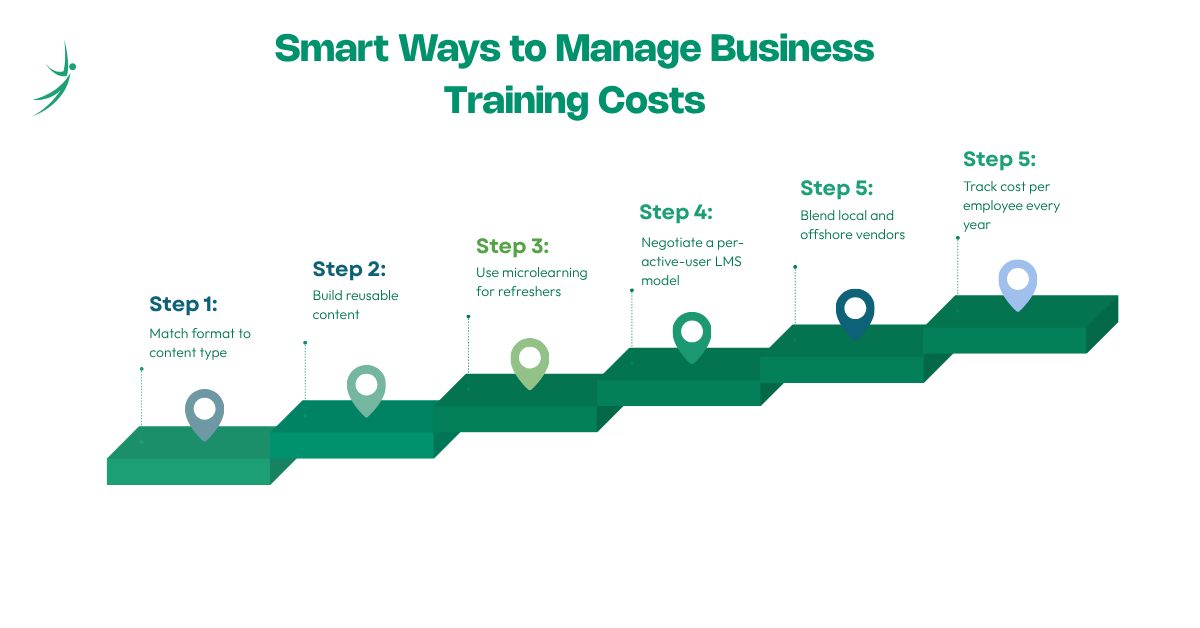
- Match format to content type. Standardized, low-stakes material (compliance, product basics) suits asynchronous e-learning. Save live facilitation for skills that genuinely need human coaching or practice.
- Build reusable content. A course developed once and reused across cohorts drops in cost per learner every time it's reassigned — the opposite of paying a trainer's day rate every session.
- Use microlearning for refreshers. Short 5–15 minute modules cost less to produce and cut the productivity loss of pulling staff into a full-day session.
- Negotiate a per-active-user LMS model instead of paying for every seat, whether or not someone logs in.
- Blend local and offshore vendors. Keep strategy and stakeholder work local; move e-learning production and video work to a lower-cost region.
- Track cost per employee every year, not just total spend, so you can see whether your program is getting more efficient as headcount grows.
A concrete example: iSpring's case study on Jazz, Pakistan's largest mobile operator, found that switching from in-person software training to video and screen-capture content let the company train five times more representatives while cutting training cost by 30%.
Common Corporate Training Cost Challenges (and How to Solve Them)
- Challenge: Leadership sees training as a cost, not an investment. Solution: Tie the number to a business outcome. Synthesia's L&D blog notes that even a 2% lift in sales conversion on a $10 million book of business is worth $200,000 a year a number that reframes a training line item as a return calculation.
- Challenge: You can't compare your spend to public numbers. Solution: Public figures (ATD, Training Magazine) mix industries, regions, and company sizes together. Calculate your own cost per employee using the formula above, then use published numbers only as a rough reference point, not a target.
- Challenge: Costs balloon mid-year. Solution: Separate fixed costs (content, tools, administration) from variable ones (travel, facilitation, headcount). Blue Carrot's scenario modeling shows moving a program from fully in-person to a blended format can cut cost per employee by 38%, mostly by removing travel, not by cutting facilitation.
- Challenge: You're spending on compliance but not on skills that grow the business. Solution: Set aside a fixed share of the budget for future-facing skills data and analytics upskilling, AI tools, leadership rather than letting mandatory compliance training absorb the whole year's spend.
Real Numbers: Case Studies and Examples
- Onboarding, at scale (Synthesia, 2026). A company modeled three versions of a new-hire onboarding program for 500 hires: fully in-person ($2,576 per employee), a blended one-day-on-site plus virtual model ($1,466 per employee), and a fully async program ($876 per employee). Moving from in-person to blended alone saved $1,588 per hire driven mostly by cutting travel, not by cutting instruction time.
- Course development, cost per learner (iSpring). An instructional designer estimated 200 work hours at $50/hour ($10,000 total) to build three 20-minute modules, then divided that by 1,200 learners expected to take the course over six months landing at $8.30 per learner. Any learner who takes the course after that point is effectively free.
- Video training at scale (Jazz, iSpring case study). By replacing face-to-face software training with screen-capture videos, Jazz trained 2,000+ representatives across multiple locations, reaching five times more staff while cutting spend by 30%.
The Full Picture: Cost of Training an Employee vs. Cost of Hiring a New One
This is the comparison that changes how leadership sees a training budget request.
What it costs to train someone: as covered above, somewhere between $468 and $1,091 per employee per year on average in the US, depending on company size (Training Magazine, 2025).
What it costs to hire and train a new employee instead: SHRM's 2025 Benchmarking Report puts the average cost per hire at $5,475 for non-executive roles and $35,879 for executive roles and that's before payroll taxes, benefits, and the ramp-up period are added in. Once you add those, the fully loaded first-year cost of a new employee on a $60,000 salary lands between $83,000 and $108,000.
That total usually breaks down into:
- Recruitment: ~$5,475 (SHRM 2025)
- Payroll taxes: 7.65%+ FICA
- Benefits: roughly 30% of compensation
- Onboarding: around $1,830–$4,100
- Training: $774–$1,800
- Lost productivity during ramp-up: 3–8 months at reduced output
Gallup research puts the cost of replacing an employee at 50% to 200% of their annual salary, with the figure rising sharply for senior roles. And turnover compounds the problem: roughly 31% of new hires leave within about six months, meaning a training investment can walk out the door before it pays for itself.
What this means for a budget memo: a modest yearly spend on the corporate training cost of developing people you already have is consistently cheaper than the average cost of hiring and training a new employee to replace someone who leaves. LinkedIn's 2025 Workplace Learning Report found organizations with a strong learning culture see 57% higher retention which is exactly the lever that keeps the more expensive number (hiring) from firing in the first place.
Beyond the Training Budget: Corporate Body Fees, Business Registration, and Company Insurance
Training is rarely the only new cost on a growing company's plate. If you're standing up a training function, a new department, or a new legal entity to run it, a few adjacent costs tend to land in the same budgeting cycle.
- Cost of business name registration and company setup (Nepal). For a standard private limited company registered with the Office of the Company Registrar, name reservation runs about NPR 100–500, and total registration government fees plus stamp duty, notarization, and miscellaneous charges typically falls between NPR 15,000 and 25,000 for a straightforward setup, or NPR 30,000–40,000 including professional filing support. A sole proprietorship is cheaper: roughly NPR 1,500–12,000 once you add the municipal trade license.
- Corporate body fees. Once a company is registered, Nepal's Companies Act requires an annual renewal filing (locally known as Adyawadik) with the Office of the Company Registrar. This corporate body fee is tied to paid-up capital and generally runs NPR 500–10,000 a year, with a late penalty of NPR 100 per day if it's missed a small recurring line item that's easy to forget until it isn't. Companies that handle this in-house often put their accounts staff through training built specifically around Office of the Company Registrar and IRD compliance workflows rather than learning the filing process by trial and error.
- Cost of company insurance. In the US market, a small business typically pays $40–$100 a month for general liability cover, or $57–$221 a month for a bundled Business Owner's Policy that adds property and interruption cover. Workers' compensation, where required, adds roughly $45–$99 a month per employee. Annually, most small companies land between $400 and $5,000 depending on industry, payroll, and location.
None of these figures are training costs, but they belong in the same conversation: a founder budgeting for corporate training programs is usually the same person budgeting for registration, renewal, and insurance in the same fiscal year.
Future Trends in Corporate Training Cost
Cost isn't the only thing shifting it's worth keeping an eye on where corporate learning is heading more broadly as these numbers move.
- AI is becoming a budget line of its own. 75% of L&D teams plan to raise AI-related training spend, more of them are building in-house AI capability rather than buying finished tools outright, and AI-personalized learning paths are already being credited with reducing the cost per effective learning hour (LMSPedia, 2026).
- Per-active-user pricing is replacing flat LMS licenses, so companies stop paying for seats nobody uses.
- Offshore and blended vendor models keep expanding, with content development shifting to lower-cost regions while strategy and stakeholder work stays local.
- Microlearning keeps growing as a share of training hours, driven by both cost and the fact that 61% of employees say they prefer short-form content (ATD-summarized consumer behavior data, 2026).
- Healthcare and other high-turnover sectors are seeing their real training cost roughly double the industry average once continuous onboarding and mandatory recertification are counted in.
How to Choose the Right Corporate Training Approach for Your Budget
There's no single right answer the right approach depends on what you're solving for.
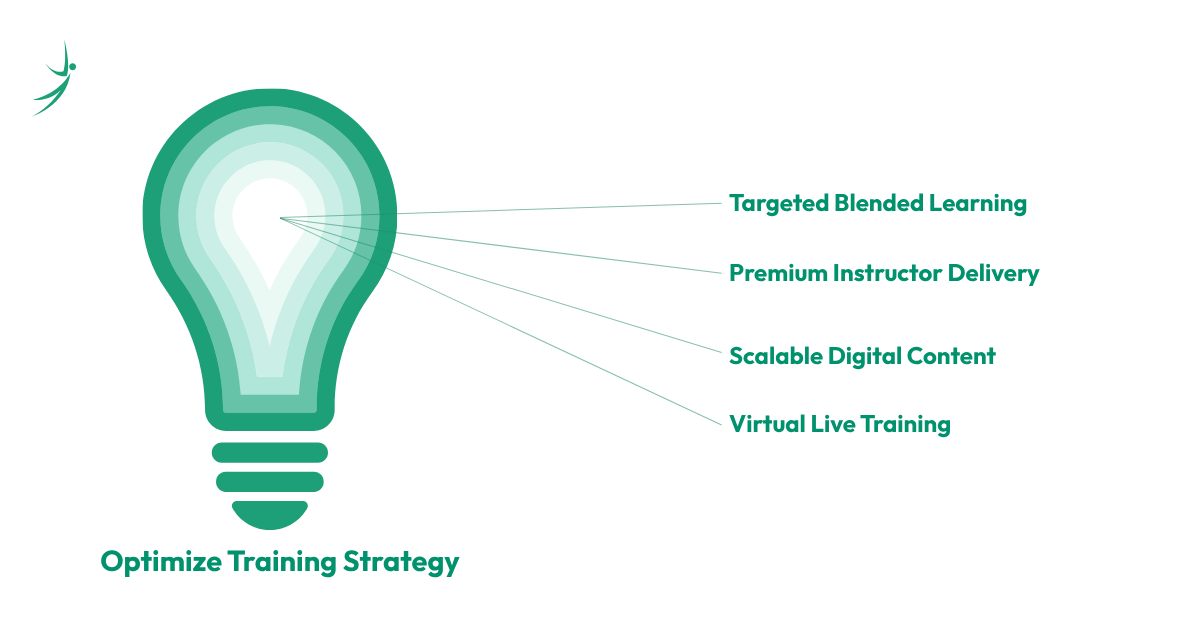
- Tight budget, large audience: asynchronous e-learning or microlearning, reused across cohorts.
- Complex or regulated skills: instructor-led or blended, even at a higher day rate, because the cost of getting it wrong is higher than the training itself.
- Distributed, remote-first team: virtual instructor-led training, which runs 10–30% cheaper than in-person delivery while keeping live interaction.
- Fast-scaling headcount: content built once (video, e-learning modules) that can be assigned to 10 or 10,000 people at close to the same marginal cost.
Whichever mix you land on, compare vendors on the same pricing model hourly against hourly, or project against project so you're not comparing apples to day rates. For a longer checklist on evaluating vendors beyond price, see what to look for when picking a training partner.
Measuring ROI and Success Metrics of Corporate Training
Cost only tells half the story. Pair every corporate training program with a small set of numbers you actually track:
- Completion and pass rates on assessments tied to the training
- Time-to-productivity for new hires before and after a program change
- Retention rate among trained staff versus untrained peers
- Business metrics tied to the skill conversion rate for sales training, error rate for compliance training, and so on
- Cost per employee, year over year, to confirm the program is getting more efficient, not just bigger
A short formula worth keeping on hand: if a training program improves a measurable business number (sales conversion, defect rate, safety incidents) even by a couple of percentage points, multiply that improvement against the relevant revenue or cost base that's the return your training budget needs to justify. For a fuller walkthrough of this math, see how training investment pays back over time.
Conclusion and Action Steps
Corporate training cost isn't one number it's a direct cost, an indirect cost, a company-size adjustment, and a comparison against the far larger cost of losing and replacing the people you already trained. The businesses that get the most from their training budget are the ones that measure their own cost per employee instead of copying an industry average, and that weigh training spend against the real cost of hiring and training a new employee from zero.
If you're planning a training budget for the year ahead:
- Calculate your actual cost per employee using last year's direct and indirect spend.
- Compare that number against the format and company-size figures in this guide.
- Set aside a fixed share of the budget for skills that grow the business, not just compliance.
- Track retention and productivity alongside spend, so the number you report next year tells a fuller story than "we spent X."
Frequently Asked Questions
What is the average corporate training cost per employee?
Is training an existing employee cheaper than hiring and training a new one?
What's included in corporate training cost?
How much do corporate training programs cost by delivery format?
What is a corporate body fee in Nepal?
How much does business name registration cost in Nepal?
How much does company insurance cost for a small business?
How is corporate training cost calculated per employee?
About Author: