Corporate Cybersecurity Training in Nepal: Why Every Company Needs It in 2026
Corporate cybersecurity training has moved from a once-a-year compliance checkbox to one of the most searched HR and IT decisions in Nepal. Banks are pushing more services online, government offices are digitizing records, and even small retail chains now run their billing through cloud software. Every one of those systems has a person sitting in front of it, and that person is usually the easiest way in for an attacker.
This guide is written for the company side of that problem, not the individual one. If you are a job seeker asking how to become a cyber security analyst, our hands-on ethical hacking and penetration testing program covers that path in full. Corporate Cybersecurity Training in Nepal is a different exercise. It is about getting an entire staff, not one specialist, ready for the threats hitting Nepali organizations right now.
Why Corporate Cybersecurity Training Matters in Nepal in 2026
Nepal's digital shift happened fast. Mobile banking users have crossed well past 20 million, e-governance services keep expanding, and fintech apps now move money that used to sit in cash drawers. Each new system is also a new door for someone trying to break in.
The attack numbers back this up. Industry trackers following Nepali organizations have reported increases in cyber incidents running into the hundreds of percent over the past few years, touching banks, hospitals, schools, and small retail businesses alike. None of these are edge cases anymore.
The uncomfortable part is where most of these incidents start. Independent security research consistently finds that more than eight in ten successful breaches trace back to a person clicking a link, reusing a password, or approving a request that looked routine. Firewalls and endpoint tools cannot fix that. Staff-level training can, because it works on the one part of the system that technology alone never covers.
Nepal-specific pressure is building too. Banks answer to Nepal Rastra Bank's information security expectations, and any company handling card payments eventually runs into PCI DSS. None of that gets easier without a staff that already knows the basics before an auditor or an attacker tests them.
For organizations looking to strengthen their first line of defense, Skill Shikshya's Corporate Training delivers practical cybersecurity awareness and technical upskilling programs tailored to business needs. Explore the available corporate training programs.
Key Benefits of Corporate Cybersecurity Training
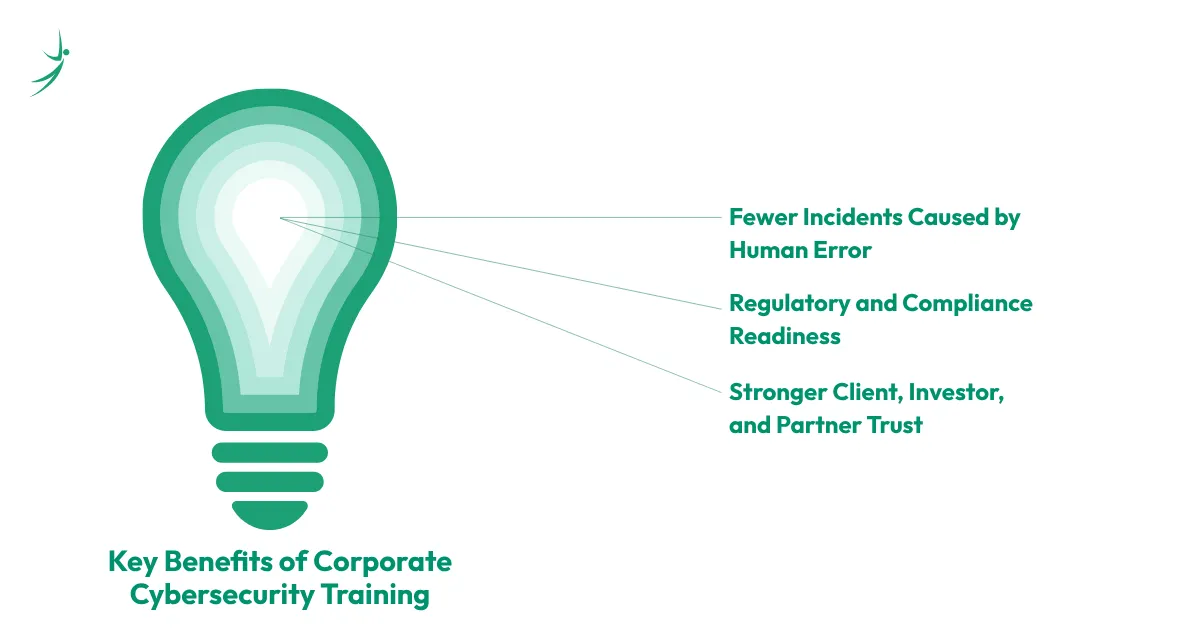
Fewer Incidents Caused by Human Error
A trained employee pauses before clicking. They check a sender's address, they question an unusual payment request, and they know who to call when something feels off. That single habit closes the gap that technical defenses cannot.
Regulatory and Compliance Readiness
Standards such as ISO 27001, PCI DSS, and Nepal Rastra Bank's banking directives all expect staff-level security awareness, not just IT department controls. A structured training record also becomes evidence during an audit, instead of a scramble to prove compliance after the fact.
Stronger Client, Investor, and Partner Trust
International clients and payment gateways increasingly ask vendors about their security posture before signing a contract. A company that can show a running staff security training program answers that question before it is even asked, which shortens due-diligence cycles with foreign partners.
Role-Based Training: What Each Team Actually Needs
Most cybersecurity training companies still hand every department the same generic slide deck. A finance officer and a junior developer face completely different risks, so a single one-size-fits-all session leaves gaps on both sides. Role-based training closes those gaps by matching the content to the actual job.
- Leadership and executives: incident decision-making, board-level risk reporting, and what to say publicly during a breach.
- Finance teams: invoice fraud, payment fraud, and CEO impersonation scams, which remain the costliest category for Nepali SMEs.
- HR: employee data protection, secure onboarding and offboarding, and background verification red flags.
- Sales and marketing: CRM data handling, safe use of customer lists, and social media account security.
- Developers: secure coding, the OWASP Top 10, and API security basics.
- IT and operations: network monitoring, endpoint protection, incident response, and SIEM fundamentals.
Splitting training this way also shortens each session. A finance team does not need forty minutes on secure coding, and a development team
How to Roll Out Corporate Cybersecurity Training the Right Way
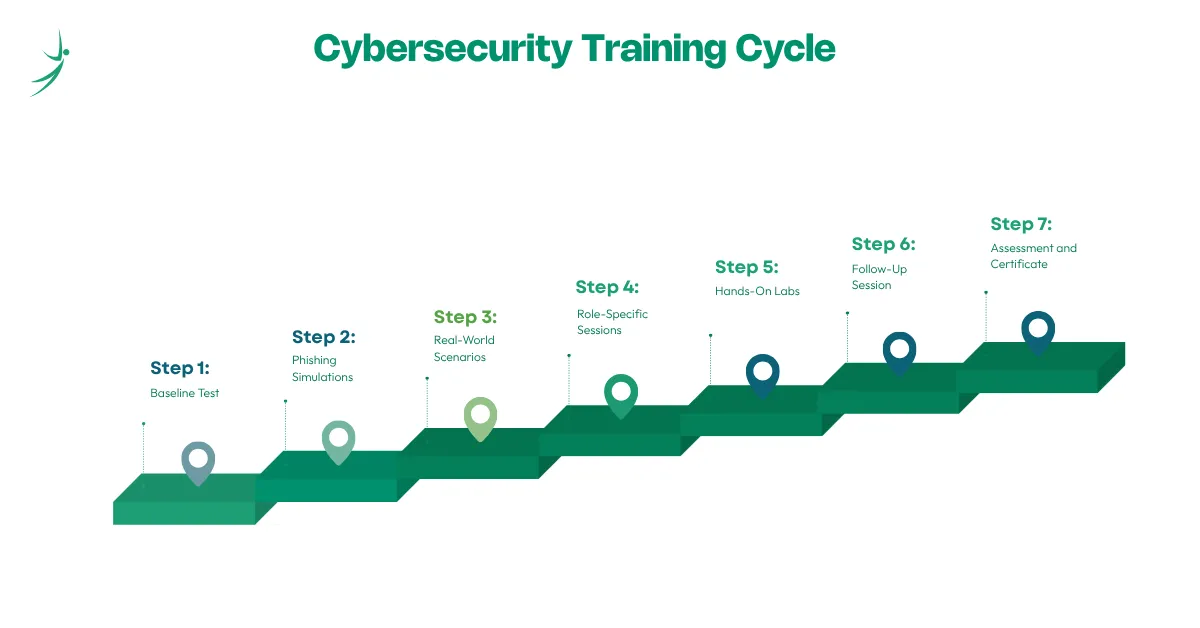
- Start with a short baseline test so you know where the real gaps sit before building the curriculum.
- Run phishing simulations monthly, not once a year, since recognition skills fade quickly without repetition.
- Use scenarios built from real threats hitting Nepali companies, not generic international case studies.
- Keep sessions short and role-specific rather than one long all-staff lecture.
- Add a hands-on lab component wherever possible; watching a slide about phishing is not the same as spotting one in a simulated inbox.
- Schedule a follow-up session four to six weeks after the first one to check whether the habits actually stuck.
- Close every track with an assessment and a certificate, so the training shows up in HR and compliance records.
Common Challenges and How to Overcome Them
- Challenge 1: Staff treat training as a formality and forget it within weeks. This is solved by monthly micro-sessions and recurring phishing tests instead of one long annual event.
- Challenge 2: Leadership sees training as a cost center with no visible return. A short baseline-versus-follow-up comparison, like phishing click rates before and after training, usually settles this within one cycle.
- Challenge 3: Remote and hybrid staff get skipped because in-person sessions are easier to schedule. Recorded modules plus a live Q&A block close this gap without excluding anyone.
- Challenge 4: One department (usually IT) gets trained well while the rest of the company lags behind. A phased, company-wide rollout across a few months fixes this instead of training whichever team asks first.
Case Example: A Kathmandu Fintech's Training Rollout
A Kathmandu-based digital payments company was facing repeated phishing attempts targeting its finance and customer support teams. Before training, roughly one in three staff clicked on a simulated phishing email during a baseline test.
After a role-based training program, split across finance, support, and engineering, followed by monthly phishing simulations, that click rate dropped to under five percent within three months. Reported (caught and flagged) phishing attempts rose sharply over the same period, which is the actual sign of success: staff were not just avoiding mistakes, they were actively reporting suspicious activity before it reached IT.
Future Trends Shaping Corporate Cybersecurity Training in 2026
- AI-driven attacks: phishing emails written by AI tools are harder to spot by grammar alone, and deepfake voice calls impersonating executives are now a real training topic, not a hypothetical one.
- Zero Trust habits: staff are being trained to verify every request, even ones that appear to come from inside the company, instead of assuming internal traffic is automatically safe.
- Cloud-native security awareness: as more Nepali companies move to Microsoft 365, Google Workspace, and AWS, training now covers safe file sharing and cloud permission settings, not just email hygiene.
- Security automation freeing up training time: automated detection tools handle more routine alerts, which shifts staff training toward judgment calls the automation cannot make on its own.
Budgeting training alongside AI tooling. A related, high-intent question we hear from corporate leaders is how much ai agent cost, since many companies are now rolling out AI assistants and security automation at the same time as staff training. Off-the-shelf AI copilots for a team typically run in the range of $20 to $30 per user per month, custom-built workflow agents for a specific business process can run from roughly $75,000 to $300,000 to build, and enterprise-grade AI security platforms often sit between $5,000 and $50,000 or more per month. Whatever a company spends on AI agents, a security awareness budget for the humans supervising those tools deserves a line item of its own; a well-trained team is what keeps an AI-assisted workflow from becoming a new blind spot.
How to Choose the Right Cyber Security Training Company in Nepal
Not all cyber security training companies build their curriculum the same way. A few questions separate a real corporate program from a repackaged individual course:
- Does the curriculum split by department, or is it one identical session for the whole company?
- Are simulations and labs built from real Nepali threat examples, or generic international slides?
- Is there a follow-up session weeks later to check whether the training actually changed behavior?
- Do the trainers hold recognized credentials such as CEH, CompTIA Security+, or CISSP, and do they have hands-on industry experience?
- Does the provider offer both individual technical depth, similar to our full cybersecurity course breakdown, and a separate corporate track built for teams rather than individuals?
If you have not settled on a provider yet, our full checklist for vetting a training partner applies just as directly to a cybersecurity engagement as it does to any other corporate training decision, and it is the same approach we use for team-wide Power BI training programs.
Measuring ROI and Training Success Metrics
- Phishing simulation click rate: the clearest before-and-after number, and the easiest one to report to leadership.
- Reporting rate: how many staff actively flag suspicious emails to IT, which should rise even as click rates fall.
- Time to report an incident: shorter reporting time limits how much damage a real attack can do.
- Compliance audit results: fewer findings related to staff awareness during ISO 27001 or banking security audits.
- Reduction in security-related downtime or recovery cost: harder to isolate but worth tracking over a full year.
What Employees Ask During Corporate Cybersecurity Training
Corporate sessions almost always surface a few personal questions once staff realize how deep this field goes. Two come up constantly.
How to become a cyber security analyst after sitting through a company training session is one of the most common follow-ups from curious employees, especially from IT and support staff. The short answer: start with networking and Linux fundamentals, move into a structured, hands-on program, and build a portfolio of real security projects rather than relying on certificates alone. A detailed breakdown of salaries, roles, and entry points in Nepal covers this path in full.
The second common question is how many days required to learn cyber security well enough to be useful at work. For workplace awareness, a single well-structured session covers the essentials in a day. For someone aiming at an actual career shift, a structured technical program usually runs several months of consistent, hands-on study rather than a short course; our course page lists the exact schedule and format.
Conclusion and Action Steps
This kind of training is not a one-time event, and treating it that way is the most common mistake companies make in Nepal today. Before your next training cycle:
- Run a baseline phishing simulation so you know your starting point, not a guess.
- Split the curriculum by department instead of running one all-staff session.
- Book a follow-up check four to six weeks after the initial training, not just the training day itself.
Skill Shikshya delivers this training as part of a broader corporate training program for businesses, colleges, and government agencies across Nepal, alongside our individual ethical hacking and penetration testing course for anyone building a career in the field directly.
Frequently Asked Questions
What does corporate cybersecurity training in Nepal typically include?
How to become a cyber security analyst if I am starting from a non-technical role?
How many days required to learn cyber security basics for general staff awareness?
How much ai agent cost, and should that affect a company's cybersecurity training budget?
What should we look for in cyber security training companies before signing a contract?
How often should corporate cybersecurity training be repeated?
About Author: