Corporate Data Analytics & Power BI Training: A Guide for Nepali Businesses
Power BI training in Nepal has mostly meant one thing: an individual signing up for a course to build a personal skill. Some people still type coporate training instead of corporate training when searching for this both land on the same shift happening across Nepali businesses. This guide is about the other side of that what happens when a company decides its finance team, its marketing team, and its operations team all need to use Power BI well, at the same time, inside their actual jobs.
At Skill Shikshya, we treat that as a genuinely different problem from teaching one person Power BI from scratch. If you're looking for the fundamentals what Power BI is, how to do a Power BI download, or a step-by-step Power BI tutorial for individual learning our separate Power BI for beginners walkthrough covers that in full. This guide is about training a team, not training yourself.
Why Corporate Power BI Training Matters Right Now
Power BI meaning, in short, is a Microsoft business intelligence tool that turns raw data into dashboards a team can actually use to make decisions. That part hasn't changed. What's changed is who's expected to know it. A few years ago, Power BI was a specialist skill. Now, a finance coordinator, a marketing lead, and an operations manager are all expected to read and sometimes build their own dashboards, not just request one from IT.
This shows up in Nepal specifically as a corporate training program problem, not an individual course problem: a company doesn't need one person who's great at Power BI, it needs an entire department that can use it consistently, with a shared standard for how reports are built and read.
What Corporate Training Actually Means for a Tool Like Power BI
Corporate training meaning applied here, is a structured, employer-commissioned program built around your team's actual reporting needs, not a generic Power BI course free online that assumes you're learning for yourself. A real corporate training institute delivering this well will ask what your finance team currently tracks in Excel, what your sales team manually re-builds every month, and design the Power BI training classes around replacing that specific pain, not a fixed syllabus.
If someone on your team asks what is corporate training supposed to add here that a free tutorial doesn't, the answer is consistency: every person on the team learns the same standard, the same shared data model conventions, and the same way of building a dashboard, so five people's reports don't look like five different tools were used.
Key Benefits of Team-Wide Power BI Training
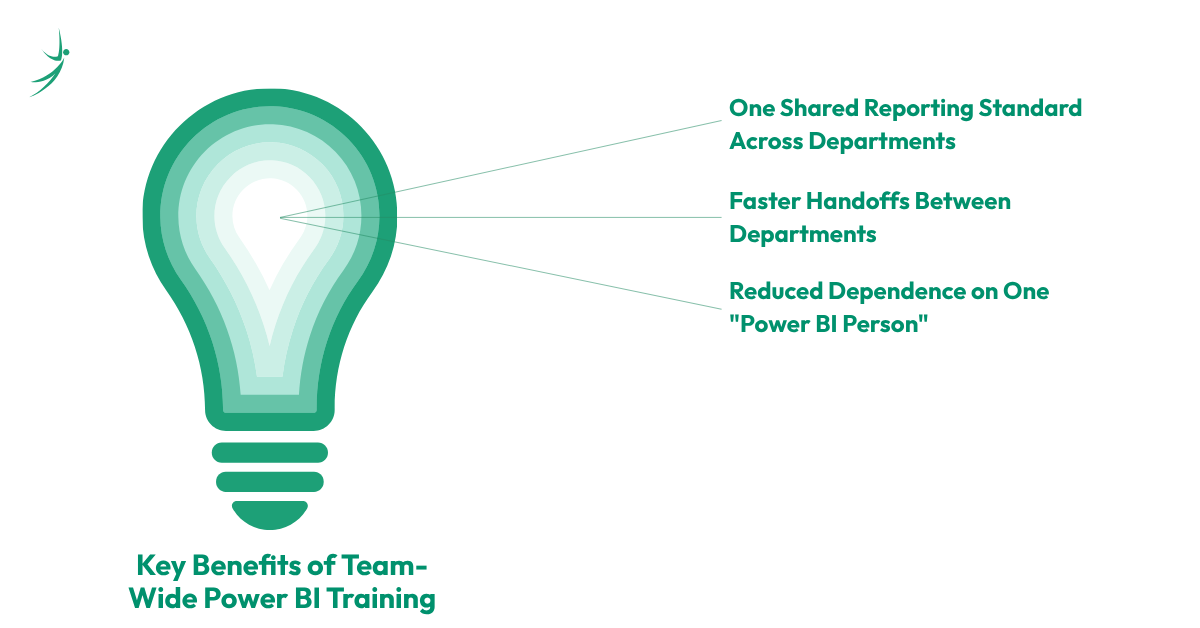
One Shared Reporting Standard Across Departments
When training happens individually, one person watches a Power BI online tutorial, another takes a different course you end up with five different report styles that don't talk to each other. Team-wide training fixes this at the source.
Faster Handoffs Between Departments
A finance analyst and a marketing coordinator trained on the same data modeling approach can hand a report back and forth without re-explaining structure every time a small thing that saves real hours across a quarter.
Reduced Dependence on One "Power BI Person"
Most companies have exactly one employee who's quietly become the unofficial Power BI expert. Corporate training team building around a shared skill removes that single point of failure if that person leaves, the whole team's reporting doesn't stall.
Where Power BI Training Applies Across a Business
- Finance budget tracking, expense dashboards, and monthly variance reports
- Sales and marketing campaign ROI, pipeline tracking, and customer acquisition cost dashboards
- Operations inventory, delivery timelines, and process bottleneck tracking
- HR attrition, hiring pipeline, and headcount dashboards
- Leadership a single executive dashboard pulling from every department instead of five separate email reports
A Brief, Team-Focused Power BI Introduction
For anyone on the team who's never opened the tool, a short power bi introduction is worth covering in the first session: Power BI Desktop is the free application used to build reports, and Power BI Service is the cloud platform where finished reports get published and shared with the rest of the team. Covering power bi how to use at a basic level connecting a data source, building a first chart, publishing it takes less time than most managers expect, usually a single session, before moving into the department-specific work that actually matters.
Beyond that starting point, a genuinely useful corporate session goes further than a basic power bi basic tutorial by working directly with your company's own spreadsheets and reports from day one, rather than a generic sample dataset.
Corporate Training Courses vs a Team-Wide Program
Most corporate training courses and corporate training platforms sell Power BI as a fixed-length individual course a set number of hours, a certificate, done. Browsing corporate training websites and comparing corporate training companies usually turns up the same pattern: a syllabus built once and reused for every client, individual or corporate. If you haven't settled on a provider yet, our breakdown of what actually separates a good training partner from an average one applies just as much to a Power BI-specific engagement as any other corporate training decision. A genuine corporate training program for a team looks different, and some providers now describe this shift as corporate training 2 a version built around your team's real data structure rather than a fixed syllabus, that includes a follow-up session weeks later to check whether people are actually applying it, not just attending.
Why Corporate Training Is Important When the Skill Is Data Literacy
Why corporate training is important here specifically comes down to consistency at scale. A free tutorial teaches one person. Corporate training teaches an entire department the same standard at once, which is the only way a shared dashboard actually works across a company rather than existing as five different personal habits.
Best Practices for Choosing a Power BI Training Provider for Your Team
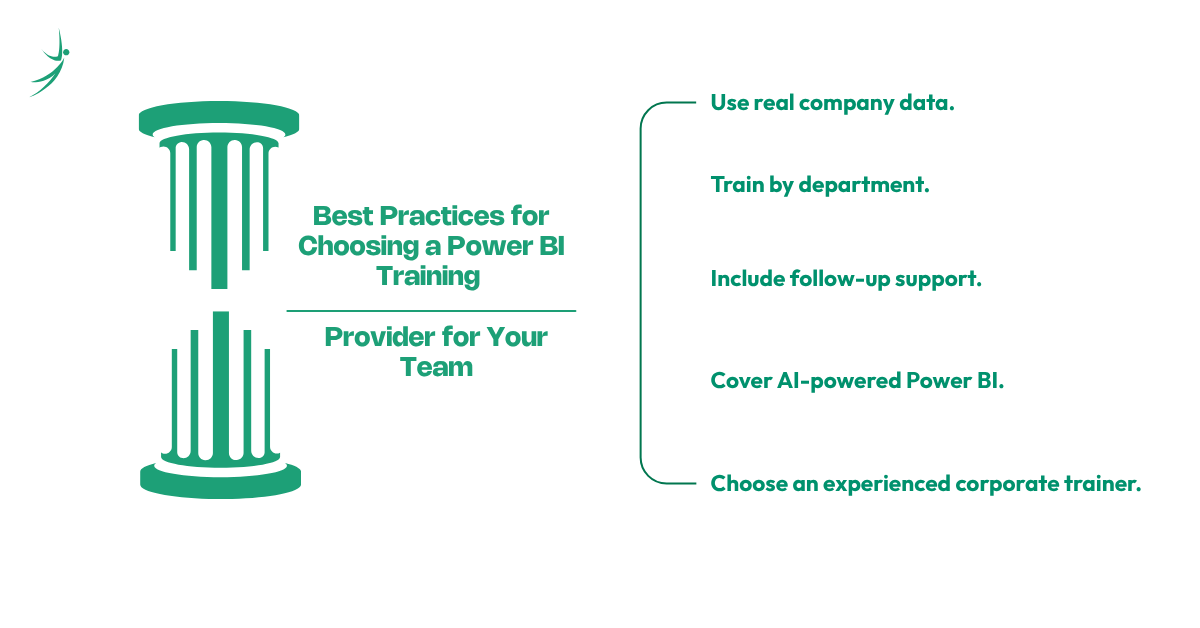
- Ask if the training is built around your data, not a generic sample file every corporate training company reuses.
- Confirm whether departments are trained separately finance and marketing rarely need the exact same dashboards.
- Check for a follow-up session, since one workshop rarely changes daily habits on its own.
- Ask specifically about AI-assisted features power bi with ai (Copilot-style AI summaries and natural-language querying) is increasingly part of real corporate use, not just an add-on demo.
- Confirm the provider is a real corporate training institute or corporate training center with experience training teams, not only individual students.
Common Challenges and How to Overcome Them
- Challenge: Only one department gets trained, and reports still don't match across the company. This is solved by rolling out training company-wide over a few months rather than training whichever department asked first.
- Challenge: Staff learn the tool but keep exporting to Excel out of habit. A short, department-specific follow-up session two to four weeks after initial training consistently fixes this better than a longer single first session.
- Challenge: Leadership wants dashboards but hasn't defined what to track. The fix is a short discovery conversation before training begins the same approach used for any other well-run corporate training session.
Case Example
A Kathmandu-based financial services firm had one analyst manually rebuilding a monthly performance report in Excel that took roughly two full working days each month. After a department-wide Power BI training program built around that exact report rather than a generic dataset the same report became a live, auto-refreshing dashboard that any team member could check without waiting for month-end. The firm reported the two-day manual task was reduced to a task that essentially maintained itself once the initial dashboard was built.
Future Trends in Corporate Power BI Training
- AI-assisted reporting is becoming standard. Power BI's AI-powered features are shifting from a demo highlight to an expected part of any corporate training program.
- Department-specific training is replacing single all-staff sessions, the same shift happening across corporate training more broadly.
- Follow-up sessions are becoming standard practice, not an optional extra, as companies get more disciplined about measuring whether training actually changed behavior.
How to Choose the Right Power BI Training Approach for Your Company
Three questions matter more than any course outline:
- Will the training use our own company's data, or a generic sample file?
- Is it structured by department, or one identical session for everyone?
- Is there a plan to check back in a month later?
Measuring ROI and Success Metrics
- Time saved on recurring reports the clearest, easiest metric to track before and after training
- Reduction in manual Excel rebuilding for reports that are now automated dashboards
- Adoption rate how many trained staff are still using Power BI regularly after 60-90 days
- Consistency across departments whether reports from different teams now follow a shared standard
Conclusion and Action Steps
Power BI training for a company is a different exercise from Power BI training for one person, and treating it the same way is the most common mistake we see. Before your next session:
- Identify the one recurring report costing your team the most manual hours each month.
- Ask your provider to build the first training session around that exact report.
- Schedule a follow-up check-in for four to six weeks after training, not just the training day itself.
Skill Shikshya delivers Power BI training as part of a broader corporate training program for businesses, colleges, and government agencies in Nepal. Visit skillshikshya.com/corporate-training to talk through what a department-by-department rollout would look like for your team, or start with our complete beginner's walkthrough of the tool itself if your team is starting from zero.
What a Corporate Job Actually Looks Like With Power BI in the Mix
A corporate work example helps make this concrete. An example of a corporate job affected by this shift might be a finance officer who used to spend two days a month rebuilding a report in Excel, or an operations coordinator now expected to check a live dashboard every morning instead of waiting for a weekly email. If you're searching for an example of corporate job roles most changed by this shift, finance, operations, and marketing analysts consistently top the list. Corporate Nepal from small startups to large public enterprises increasingly runs on exactly this kind of role, which is why Power BI training now sits inside broader corporate training nepal-wide program planning, not as a standalone extra.
Some teams also run an informal corporate club Nepal-style peer group where staff who've been through Power BI training help colleagues in other departments get comfortable with their first dashboard a useful supplement to formal corporate training courses, not a replacement for them.
Who Needs This: Private, Public, and Social Enterprises in Nepal
Team-wide Power BI training isn't only a private-sector need. Enterprise in Nepal covers a wide range of organization types:
- Private enterprise banks, IT companies, and manufacturing firms tracking sales, operations, and financial performance
- Public enterprise in Nepal government-owned corporations needing dashboards for budget and program reporting
- Social enterprise in Nepal NGOs and development organizations reporting program outcomes to donors, often under real time pressure around grant cycles
What "Best" Looks Like When Data Skills Are Involved
Every list of the best company in Nepal or the best company of Nepal increasingly includes some mention of data-informed decision-making. The same is true internationally top corporate companies in world rankings are as often praised for how they use data as for what they sell. A best corporate company to work for isn't necessarily the one with the biggest Power BI budget; it's the one where staff aren't afraid of their own reporting tools. If the goal is to be seen as a best corporate company in your sector, a team that can build and read its own dashboards is a real, visible part of that reputation.
Where Power BI Fits Inside the Broader Enterprise Software Layer
Power BI training for a corporate team doesn't exist in isolation it usually connects to a wider enterprise system already in place. Depending on the company, that might mean pulling data from an enterprise system for HR or finance, connecting to enterprise software used for daily operations, or working through enterprise application integration between Power BI and a company's existing tools. Financial institutions increasingly connect Power BI to enterprise banking platforms for reporting, and support teams pull metrics from enterprise customer service software into shared dashboards. A working understanding of enterprise computing at a basic level helps non-technical staff make sense of where their data is actually coming from, not just what the finished dashboard looks like.
In simple enterprise meaning, an enterprise is any organized business activity, and enterprise value increasingly includes how well a company's teams can read and act on its own data, not just what shows up on a balance sheet. A company's enterprise life, across its systems and its people, runs more smoothly when a shared tool like Power BI isn't understood by only one person, regardless of its enterprise locations.
Management, Project Management, and Leadership Training Alongside Power BI
Power BI training rarely stands alone in a well-run corporate training program. It pairs naturally with management training in Nepal and project management training in Nepal, since a manager reading a Power BI dashboard still needs the judgment to act on what it shows. Corporate training for leadership increasingly includes a basic data-literacy component for exactly this reason a leadership program that skips dashboard literacy leaves managers dependent on someone else to interpret the numbers for them.
Short, Focused Alternatives to a Full Program
Not every company is ready for a full department-wide rollout immediately. Short term courses in Nepal a single half-day session covering power bi basic tutorial content for one team are a reasonable way to test whether a fuller corporate training program is worth the larger commitment, before scaling it company-wide.
How to Become a Corporate Trainer for Tools Like Power BI
How to become a corporate trainer in Nepal, specifically for a technical tool like Power BI, usually means combining real business analytics experience with the ability to teach non-technical staff without losing them in DAX syntax. What is corporate trainer work like for this specific subject: less about knowing every Power BI feature, and more about knowing which five features actually matter for a given department's job.
Frequently Asked Questions
What is corporate training meaning when the subject is a specific tool like Power BI?
Do we need a corporate training institute, or can staff just use a free Power BI course free option?
Is Power BI training different for corporate teams versus individual learners?
What are corporate training programs supposed to include beyond the software itself?
Why is corporate training important specifically for a tool like Power BI, rather than letting staff learn it individually?
About Author:

Dhiraj Bashyal is a Machine Learning Engineer at Vrit Technologies, with 3 years of hands-on experience in applied AI and machine learning. He brings that industry experience directly into the classroom, teaching Data Science and Machine Learning at Skill Shikshya, where he helps learners build a practical, project-ready foundation in Python, ML workflows, and real-world data problem-solving.