How to Choose the Best Corporate Training Provider in Nepal
Corporate training in Nepal has moved from a once-a-year formality to a regular part of how serious companies operate. At Skill Shikshya, we work with businesses, colleges, and government agencies across Nepal, and the question we hear most often isn't "should we train our staff" it's "how do we choose the right corporate training provider in Nepal without wasting a training budget on something that doesn't work."
This guide answers that question directly. Whether you searched for corporate training or typed the common misspelling corporate training into Google, you landed here for the same reason: you need a practical way to separate a good corporate training company from an average one before you sign a contract.
What Is Corporate Training?
Corporate training is any structured learning program a company arranges for its employees, built around a specific business skill or outcome rather than general classroom learning. It's different from a public course an individual signs up for; corporate training is commissioned by the employer, matched to the company's own tools and workflows, and judged against a business result.
If someone on your team asks what are corporate training programs actually for, the short answer is: closing the gap between what an employee learned in school and what their job requires today. That's the full corporate training meaning in one sentence.
A corporate trainer is the person designing and delivering these programs. If you're wondering how to become a corporate trainer in Nepal, or what is a corporate trainer supposed to know, the honest answer is that most corporate trainers in Nepal combine real industry experience in IT, finance, HR, or a technical field with facilitation skills built through practice, not a teaching degree alone.
Corporate Work Examples: What Does a Corporate Job Look Like?
Before choosing a program, it helps to picture the corporate work example the training is meant to support. An example of a corporate job might be a bank's operations analyst, an IT company's project coordinator, or an HR manager running onboarding for fifty new hires a year. If you're looking for an example of corporate job roles that typically need this kind of training, these are the ones we see most often at Skill Shikshya. Corporate training only works when it's built around real corporate work examples like these, not abstract theory. Corporate Nepal from small startups to large public enterprises runs on exactly these kinds of roles, which is why training has to be grounded in them rather than generic theory.
Some companies also run an internal corporate club Nepal-style peer-learning group alongside formal training informal lunch-and-learn sessions where staff share what they picked up from a corporate training program. These groups work best as a supplement to structured training, not a replacement for it.
Why Corporate Training Is Important in Nepal Right Now
Nepal's job market has a well-known mismatch: many new graduates arrive at their first corporate job without the practical skills the role actually needs. Corporate training Nepal-wide is how companies close that gap without waiting for the education system to catch up.
A few reasons why corporate training is important for Nepali companies specifically in 2026:
- AI tools are now part of ordinary jobs. Marketing, finance, and customer service staff are expected to use AI daily, not just developers.
- Staff turnover in banking, telecom, and IT is faster than five years ago. Onboarding-linked corporate training program cycles now happen more often.
- Government and multinational partners increasingly require documented training records, not informal mentoring.
The Numbers Behind Nepal's Skills Gap
This isn't a vague impression it shows up clearly in the data. The ILO Nepal Skills Survey (2023) found that over 60% of employers report difficulty finding candidates with the skills they actually need, while 45% of graduates end up working in jobs unrelated to what they studied. The Ministry of Education, Science and Technology's Graduate Tracer Study (2024) puts the average transition time from graduation to first formal job at more than 18 months. World Bank and Central Bureau of Statistics data from 2023-2024 shows youth unemployment sitting at 11.4% overall, but climbing to 20-25% specifically among university graduates the group most likely to be hired into the corporate jobs this article is about.
Put together, these numbers describe a labor market where a degree alone is a weak predictor of job readiness. Corporate training in Nepal is one of the few levers a company can pull directly, without waiting for a slower, system-wide fix to Nepal's education pipeline.
Who Needs Corporate Training: Private, Public, and Social Enterprises in Nepal
Corporate training isn't only for private companies. Skill Shikshya works across every kind of enterprise in Nepal:
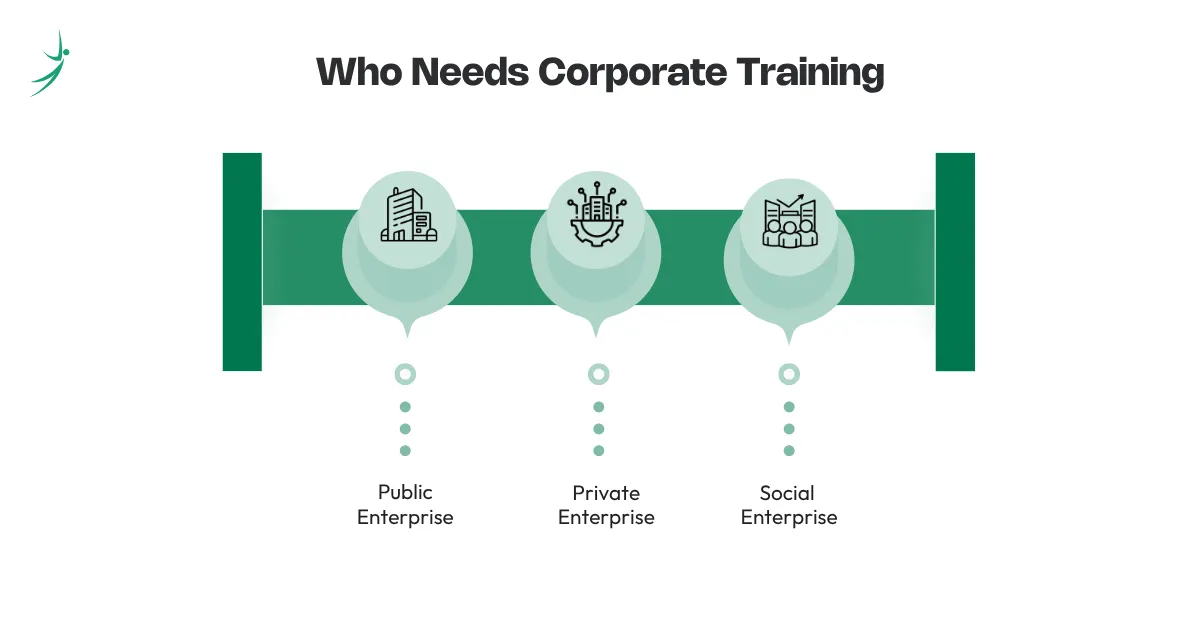
- Private enterprise in Nepal banks, IT companies, manufacturing firms, and retail chains training staff on new tools, compliance, and leadership.
- Public enterprise in Nepal government-owned corporations and agencies that increasingly need documented staff development records for accountability and donor reporting.
- Social enterprise in Nepal NGOs and development organizations that need project management training, monitoring skills, and donor-reporting capability just as much as any private company does.
Whichever category your organization falls into, the same core question applies: does this corporate training provider in Nepal understand your sector well enough to make the program useful on day one?
Key Benefits of Choosing the Right Corporate Training Provider
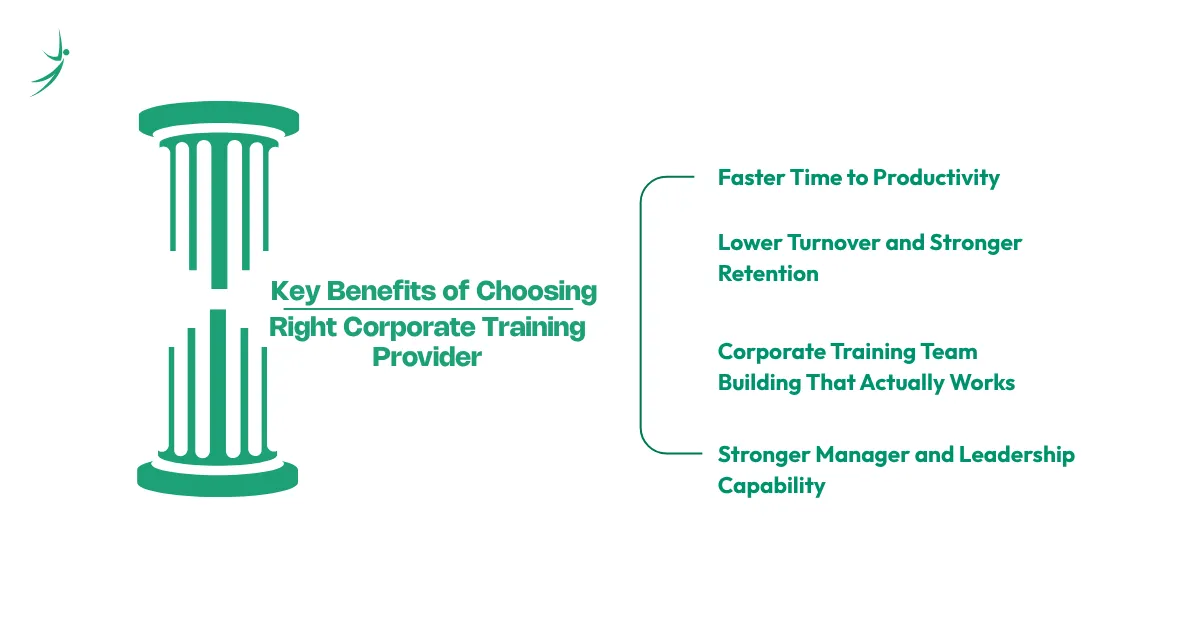
Faster Time to Productivity
When corporate training is matched to the tools your team actually uses, employees apply what they learned the same week, not months later. This is the most immediate, visible benefit of getting a corporate training provider in Nepal right and the easiest one to get wrong. A generic course teaches a skill in the abstract; a well-matched one teaches your team to use the exact software, workflow, or reporting format they'll touch on Monday morning. The difference shows up fast: new hires reach full productivity sooner, and existing staff stop relying on a single "expert" colleague to solve every recurring problem. For a bank rolling out a new compliance system or an IT company adopting an AI-assisted workflow, this single benefit is often what justifies the entire training budget on its own.
Lower Turnover and Stronger Retention
Employees who feel a company is investing in their growth are measurably less likely to leave within the following year, and this isn't a soft HR talking point it shows up consistently in workforce research. Replacing a mid-level employee typically costs 1.5 to 2 times their annual salary once recruiting, onboarding, and lost productivity during the transition are counted, which means a training program that keeps even two or three people from leaving usually pays for itself several times over. In Nepal's banking, IT, and telecom sectors specifically, where skilled staff have more options than they did five years ago, a visible corporate training program is increasingly a retention tool as much as a skills tool; candidates and current employees alike now ask about learning opportunities during hiring and review conversations, not just salary.
Corporate Training Team Building That Actually Works
A good corporate training team-building session does more than trust falls and icebreakers it's built around real friction points inside your team, like poor handoffs between departments or unclear decision-making during a project. The difference between a team-building session people forget by Monday and one that changes how a team actually works comes down to specificity: instead of a generic communication workshop, an effective session names the actual recurring problem a sales team that doesn't loop in support before a handoff, or a project team where decisions stall because no one is clearly accountable and builds the exercises directly around resolving it. Providers who skip this step and run the same team-building format for every client are optimizing for a pleasant afternoon, not a measurable change in how the team collaborates afterward.
Stronger Manager and Leadership Capability
Management training in Nepal is frequently under-prioritized compared to technical skills training, which is a mismatch with what the data actually shows: research from Gallup consistently finds that around 70% of a team's overall engagement level traces back to its direct manager, not company-wide policy or compensation. That's why a growing share of corporate training programs, including a rising share of budget increases reported across the training industry for 2026 are being redirected specifically toward first-time managers and mid-level leadership, rather than only technical or compliance topics. A single well-trained manager influences the output and retention of an entire team, which makes management training one of the highest-leverage categories a company can invest in, even before considering any individual technical skill.
Corporate Training Courses and Programs We Recommend Evaluating
When comparing corporate training courses, look at coverage across these areas:
- Corporate IT training in Nepal cloud tools, cybersecurity awareness, AI-assisted workflows, and data analysis
- Management training in Nepal first-time manager programs, performance reviews, decision-making
- Project management training in Nepal timeline planning, resource allocation, and delivery methods for teams under deadline pressure
- Corporate training for leadership senior-level programs focused on strategic decision-making and team accountability
- Short term courses in Nepal compressed, single-week or weekend formats for teams that can't commit to a multi-month program
How Skill Shikshya Delivers Corporate Training Kathmandu Companies Can Rely On
Skill Shikshya is a corporate training institute based in Nepal/Kathmandu, and our corporate training program is built around three things most corporate training websites and corporate training platforms don't offer together: real industry-experienced trainers, AI-integrated course content, and a documented job-or-internship guarantee through our Job Ready Program.
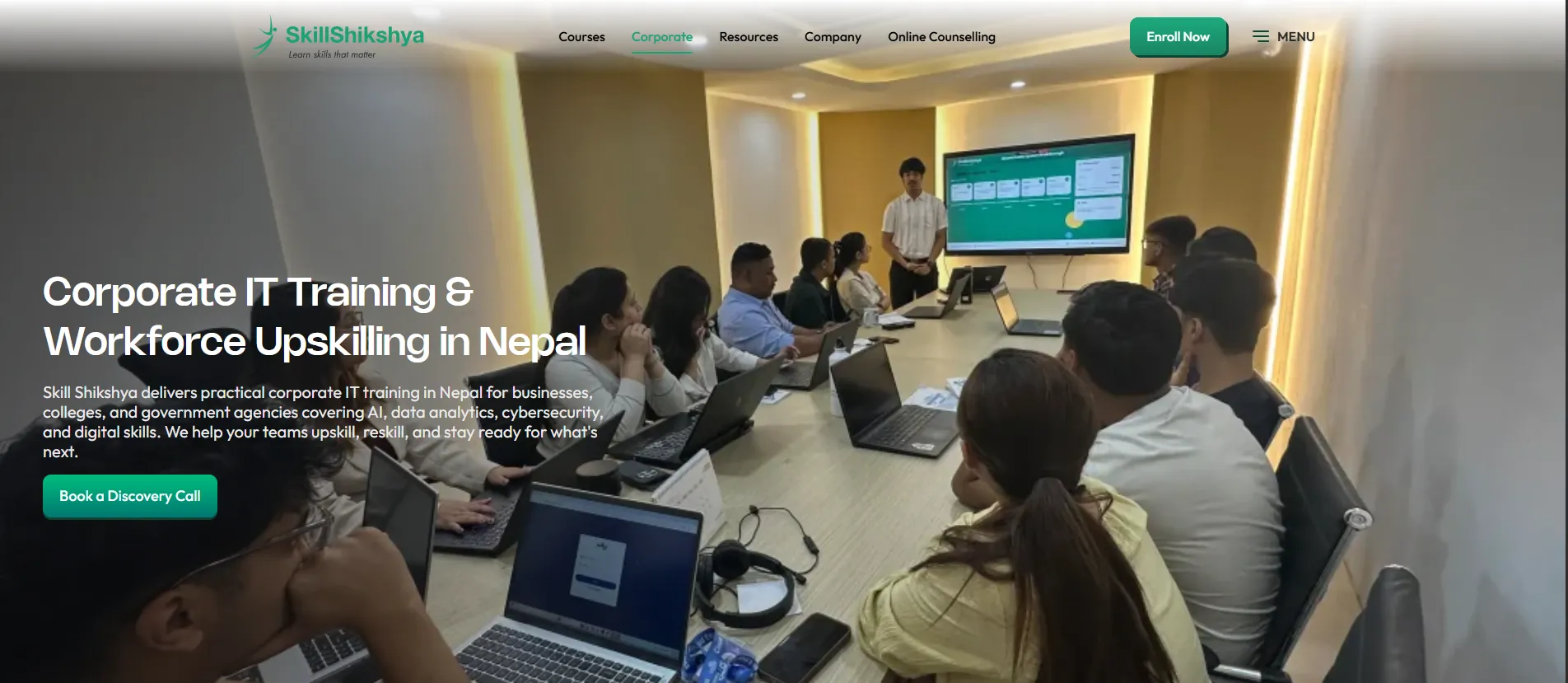
This is corporate training 2 the modern, AI-integrated version of the traditional one-off workshop model many corporate training companies still rely on.
Best Practices for Selecting a Corporate Training Provider in Nepal
- Start with the business problem, not the course catalog. Write down what's actually going wrong before contacting any corporate training provider in Nepal.
- Ask about industry-specific delivery, not just topic coverage. A provider that has only taught retail staff will run a very different leadership session than one that has worked inside banks or telecoms.
- Check who is actually teaching the session. Ask for the trainer's name and background before signing.
- Request a sample session or curriculum outline. A confident corporate training company will show you an actual lesson plan.
- Confirm the delivery format fits your team's schedule. On-site, online, and hybrid formats all have trade-offs.
- Ask what happens after the last session. Follow-up support often matters more than the training day itself.
- Ask for real outcomes, not just testimonials. A placement rate or a specific before-and-after metric tells you more than a quote ever will.
Corporate IT Training in Nepal: Where Enterprise Skills Fit In
A large share of corporate IT training in Nepal today is really about preparing staff for enterprise-level systems. Depending on your sector, this can include training on an enterprise system for finance or HR, enterprise software used for daily operations, enterprise application integration between different company tools, enterprise banking platforms for financial institutions, and enterprise customer service software for support teams. Understanding basic enterprise computing concepts has become as important for non-technical staff as it is for developers, since most mid-sized and large organizations in Nepal now run on some form of enterprise software rather than standalone tools.
In simple enterprise meaning, an enterprise is any organized business activity small or large and enterprise value goes beyond the balance sheet to include how well-trained and adaptable its workforce is. A company's enterprise life, from its systems to its culture, is only as strong as the people running it day to day, wherever its enterprise locations happen to be.
Corporate Training by the Numbers: What the Research Shows
The case for corporate training isn't just anecdotal. Several independent research sources converge on similar findings:
- Retention: LinkedIn's 2025 Workplace Learning Report found that 94% of employees say they would stay at a company longer if it invested in their learning and development. Separate research from ATD found companies with a strong learning culture see a 57% retention rate, nearly double the 27% rate at companies with only moderate learning investment.
- Profitability: Analysis cited by Shift E-Learning found that companies with comprehensive, formalized training programs generate 218% higher income per employee than those without structured programs, alongside 24% higher profit margins.
- Performance: Training-effectiveness research shows measurable performance improvements of roughly 22% within three to six months of a program, when the training targets a real, specific skill gap rather than general awareness.
- Manager impact: Gallup research consistently finds that around 70% of a team's engagement level traces back to its manager which is why 30% of organizations surveyed for the 2025 Training Industry Report are increasing management-training budgets specifically, more than any other single training category for 2026.
- The AI shift: The World Economic Forum's 2025 Future of Jobs report projects that 39% of core workplace skills will be outdated by 2030, and 77% of employers surveyed say they are committed to reskilling staff to work alongside AI rather than replacing them. McKinsey research separately found that roughly 4 in 5 employees want to learn how to use AI in their specific profession, making AI literacy the fastest-growing training priority heading into 2026.
- Market size: Corporate training spending in the US alone reached $102.8 billion in 2025, a 4.9% increase year-over-year, with the broader global corporate training market projected to reach $487.3 billion by 2030.
These numbers matter for a Nepal-based company for one practical reason: the same forces driving this spending internationally AI adoption, tighter retention pressure, and a demand for measurable outcomes are already showing up in Kathmandu's banking, IT, and telecom sectors, just at an earlier stage of the curve.
What Makes a Company One of the Best in Nepal (and the World)
Ask any list of the best company in Nepal or the best company of Nepal what they have in common, and structured staff development shows up almost every time. The same holds for top corporate companies in world lists organizations like Google and Microsoft are known as much for their internal training culture as their products. A best corporate company to work for isn't necessarily the highest-paying one; it's usually the one whose staff feel their skills are growing. If your goal is to be seen as a best corporate company in your industry, corporate training is one of the most direct ways to get there.
Common Challenges Companies Face and How to Overcome Them
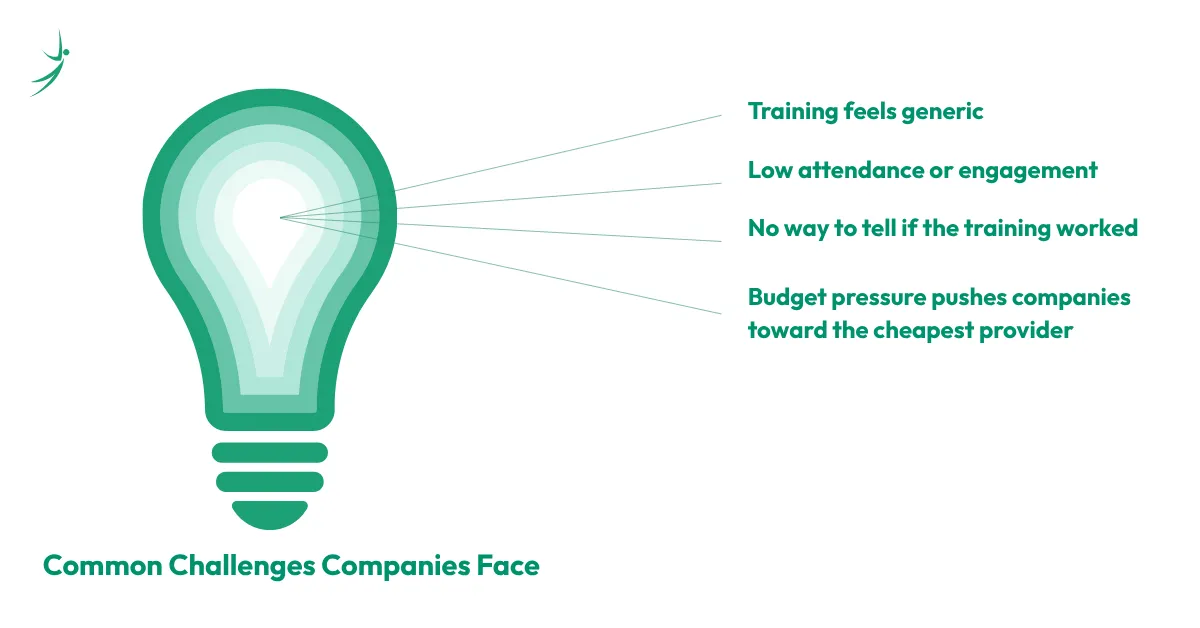
- Challenge: Training feels generic. This happens when a provider reuses the same slide deck for every client. Ask exactly how a corporate training provider in Nepal customizes content to your workflows before signing.
- Challenge: Low attendance or engagement. Scheduling sessions around business-critical timing, not the slowest week of the year, improves attendance sharply.
- Challenge: No way to tell if the training worked. Set one or two measurable markers upfront faster ticket resolution, fewer errors, higher client satisfaction before the program starts.
- Challenge: Budget pressure pushes companies toward the cheapest provider. The cheapest corporate training program on paper is often the most expensive one in practice once you count the cost of skills nobody applies.
Case Examples from Corporate Training in Nepal
A mid-sized Kathmandu-based financial services firm brought in a corporate training provider to run a project management training program for its operations team after repeated delays in system rollouts. The provider spent two weeks studying the firm's actual project timelines before designing the course. Within one quarter, the average project delay on tracked initiatives dropped noticeably.
A growing IT company needed its non-technical staff to become comfortable with AI tools for daily reporting. Rather than one all-staff seminar, short department-specific sessions were run over three weeks, each built around the actual software each department used. Adoption of the new tools was measurably higher than in a previous, one-size-fits-all attempt.
(Corporate training pictures from sessions like these hands-on workshops, small-group breakouts, and certificate handovers are a good addition to this section once you have real photos from your own programs; alt text such as "corporate training pictures Kathmandu Skill Shikshya" helps these images carry search value too.)
Future Trends in Corporate Training
- AI-assisted learning is becoming standard, not a separate specialty course.
- Shorter, more frequent sessions are replacing single long workshops, since adult-learning research consistently shows this improves retention.
- Measurable outcomes are becoming a baseline expectation when companies evaluate any corporate training institute, the same way they'd evaluate any other vendor.
- Hybrid delivery is now assumed, not requested, as teams spread across Kathmandu and regional branches.
How to Choose the Right Corporate Training Provider for Your Company
Before signing with any corporate training provider in Nepal, ask three questions:
- Has this provider worked with a company in a similar sector or size to mine, with specific examples?
- Will the trainer in the room have direct experience relevant to my team's actual work?
- Can this provider show what happened after a past program ended, not just how the session itself went?
Measuring ROI and Success Metrics
- Time-to-productivity for new hires before and after training
- Error or rework rate in the specific task the training targeted
- Employee retention in the 12 months following a program worth tracking closely, since replacing an employee typically costs 1.5 to 2 times their annual salary once recruiting, onboarding, and lost productivity are counted
- Internal promotion rate among staff who completed leadership or management training
- Client satisfaction scores, where training targets customer-facing roles
- Follow-up application rate research on structured training follow-up programs found they produce as much as 92% higher measured ROI compared to one-off sessions with no follow-up, largely because employees who apply a new skill within the first week are far more likely to retain it
Conclusion and Action Steps
A corporate training program is only as good as the provider designing it. Before your next training decision:
- Write down the exact business problem you're trying to solve.
- Ask any provider for a named example from a similar company and the trainer's actual background.
- Agree on one or two measurable outcomes before the first session.
- Confirm what support continues after the program ends.
Skill Shikshya delivers corporate training in Nepal for businesses, colleges, and government agencies, with a Job Ready Program guarantee behind every course. Visit skillshikshya.com/corporate-training to talk to our team about a program built around your company's actual situation.
Frequently Asked Questions
What is corporate training?
What is a corporate trainer, and how do I become one?
Is corporate training only for private companies?
How much does corporate training cost in Nepal?
Can Skill Shikshya actually customize the training to our company, or is it a generic template with our logo on it?
How is corporate training priced per person or as a package?
Can training be delivered on-site, online, or both?
How long does a corporate training program typically run?
Which industries does Skill Shikshya work with for corporate training?
What questions should a good training provider ask us, not the other way around?
How much does corporate training cost in Nepal with Skill Shikshya?
About Author: