Corporate Training ROI in Nepal: The Business Case Backed by Global Research (2026)
Every HR manager who has tried to get a training budget approved has heard some version of the same question from finance: how do we know this actually pays off. It is a fair question, and for years most training providers answered it with testimonials instead of numbers. That is no longer good enough, and it does not need to be. The global research on corporate training ROI is specific, recent, and directly usable in a budget conversation. This piece lays out that case, source by source, so you can walk into that meeting with data instead of a hunch.
Quick answer
- Corporate training ROI is well documented: comprehensive programs are linked to a 17 percent productivity gain and a 21 percent profit margin improvement (Harvard Business School), and 94 percent of employees say they would stay longer at a company that invests in learning and development (LinkedIn).
- Corporate training statistics for 2026 show a shift: ATD's 2026 State of the Industry report found formal learning hours per employee rose to 16.7 in 2025, even as direct learning expenditure per employee fell to 846 US dollars, meaning training budgets are under tighter scrutiny than in prior years.
- The measurement gap is the real problem, not the ROI itself: fewer than a quarter of organizations track whether training hits its intended business outcome, so most training investment goes undefended at budget time.
- For Nepal specifically, the strongest business case sits in retention economics: replacing a mid-level employee costs one to two times their annual salary, so a training program that keeps one person in their seat for an extra year often pays for itself before any productivity gain is even counted.
For a full picture of what corporate training covers, who needs it, and how to choose a provider in Nepal, see everything Nepali businesses need to know before budgeting for staff development. This piece focuses specifically on proving the return.
Why the Corporate Training ROI Conversation Is Different in 2026
Learning and development budgets in 2026 are under a strange kind of pressure:
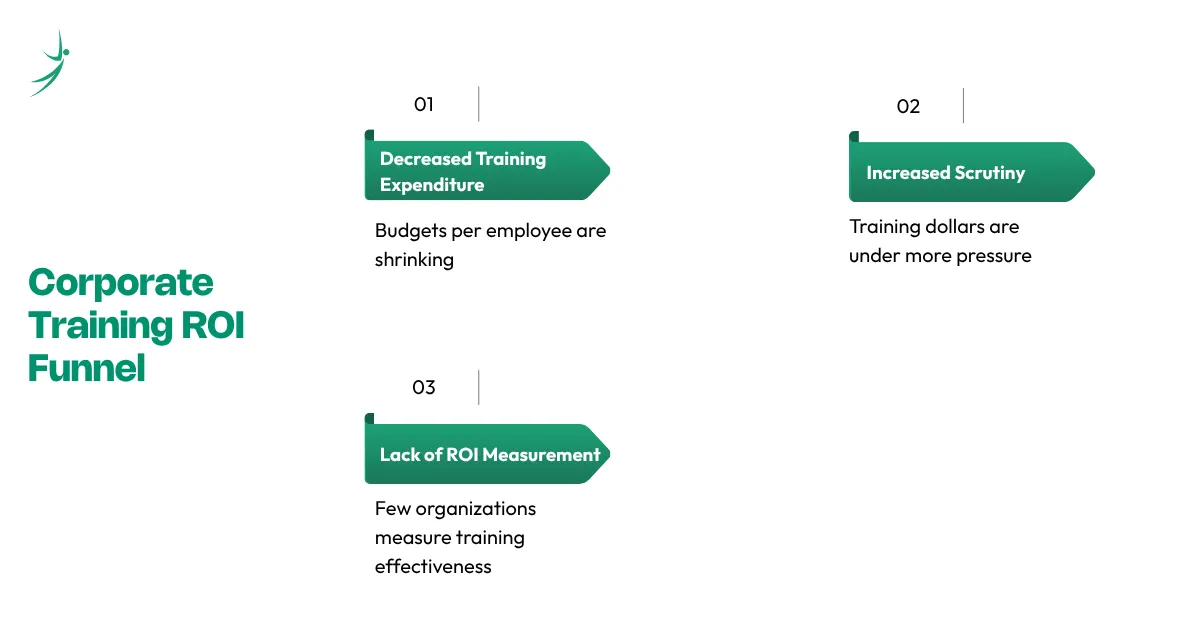
- According to ATD's 2026 State of the Industry report, average formal learning hours used per employee rose to 16.7 in 2025, up from 13.7 the year before, the first increase in five years.
- At the same time, direct learning expenditure per employee fell to 846 US dollars, down sharply from the year prior.
- The net effect: organizations are running more training with a tighter per-employee budget, which means every training dollar is under more scrutiny than it was two years ago.
- Fewer than a quarter of organizations currently measure whether their training programs achieve the organizational goals they were built for, and an even smaller share calculates return on investment directly, per ATD's own research.
Training budgets are being approved and renewed almost entirely on faith. That is the gap this article closes, with a corporate training ROI case built from primary sources you can cite directly to finance.
What Global Research Says About Skills and Talent Development Priorities Right Now
- SHRM's July 2026 research, Skills (R)evolution: Preparing Employees for Tomorrow's Jobs, introduces a "Skills Strategist" model of workforce readiness and found that 72 percent of HR professionals say their organization's learning strategy is driven primarily by the skills employees will need in the next one to two years, while only 4 percent focus primarily on long-term skill needs.
- That short planning horizon signals something important for talent development planning: most organizations are not building five-year training roadmaps anymore. They are solving the skill gap directly in front of them, which is exactly the kind of targeted, outcome-specific training that produces measurable ROI in the first place.
- 82 percent of organizations fund formal training specifically to keep existing skills current
- 80 percent fund training to build new skills
- 79 percent fund certification or recertification programs
- Employer-funded upskilling has reached its highest participation level in at least five years
Training is not a discretionary perk in 2026. It is core operating spend, budgeted the way companies budget for equipment or software licensing, and organizational alignment between L&D strategy and business goals is now the norm rather than the exception.
The Headline Corporate Training ROI Numbers
Multiple independent lines of research converge on the same conclusion: well-designed corporate training produces a measurable financial return, not just a soft engagement benefit.
- Harvard Business School research found that companies with comprehensive training programs see a 17 percent increase in productivity and a 21 percent boost in profitability compared to companies without structured programs.
- Organizations with formalized training programs have separately been shown to generate substantially higher income per employee and a stronger profit margin improvement than organizations without one, a pattern consistent across multiple industry benchmarking studies.
- Corporate learning ROI benchmarks also vary meaningfully by training category, which is worth knowing before you set expectations internally:
- Technical skills training and sales-specific training tend to produce the strongest financial returns of any training category, according to elearning industry benchmarking.
- Onboarding programs deliver more modest but still clearly positive returns.
- The category you invest in changes the return you should expect, which is itself a useful input when prioritizing a limited corporate training budget.
The Employee Retention Training ROI Case, in Numbers
Retention is where corporate training often pays for itself before productivity gains are even counted.
- LinkedIn's Workplace Learning Report found that 94 percent of employees say they would stay at a company longer if it invested in their learning and development.
- SHRM's own L&D research reinforces this from the employer side, noting that continuous learning has become a competitive differentiator for retention rate and workforce agility, not an optional extra.
- For a Nepal-based organization, this translates into a direct cost comparison:
- Replacing a mid-level employee typically costs between one and two times their annual salary once recruiting, onboarding, and lost productivity during the transition are factored in.
- This is the real employee attrition cost most budget conversations leave out.
- A training program that keeps one analyst, officer, or team lead in their seat for one additional year often pays for itself in retention savings alone, before any productivity gain is counted at all.
The Skills Gap Cost and Reskilling ROI
- The World Economic Forum's Future of Jobs Report 2025 projects that 39 percent of workers' core skills will become outdated by 2030, and 85 percent of employers plan to prioritize reskilling their workforce over the next five years.
- This is not a distant forecast. For Nepal's banking, telecom, and IT sectors specifically, it means a meaningful share of the skills teams relied on three years ago are already becoming partially obsolete, and the gap widens every year training is deferred. This is the practical reskilling ROI and upskilling ROI argument in one sentence: the cost of closing a skills gap early is consistently lower than the cost of closing it late.
- McKinsey's research on the broader skills gap found that a large majority of employees want practical guidance on how to use AI specifically in their own role, not generic AI awareness content.
- This is the single fastest-growing training priority organizations are reporting for 2026, and it is also one of the categories where measurable productivity gains show up fastest, because the AI training ROI maps directly onto a daily task rather than a long-term competency.
Why Most Companies Still Cannot Prove Corporate Training Effectiveness
This is the uncomfortable part. As referenced above, ATD's research shows barely a quarter of organizations measure whether training even achieves its intended organizational goal, let alone calculate a hard financial return. The majority of companies making training decisions, including many in Nepal, are doing so without any feedback loop at all. They are neither confirming the ROI numbers above for their own organization, nor catching it when a program simply is not working.
This is fixable, and it does not require an elaborate measurement system. Three things make a training program measurable from day one, and together they form a simple corporate training KPI framework:
- A pre-training baseline (training needs assessment). Measure the current performance level on the specific task the training targets before the program starts. Time to complete a recurring report, error rate on a specific process, or adoption rate of a specific tool are all usable baselines.
- A post-training measurement window. The same metric, measured 30 to 90 days after training ends. Behavioral change in this window is the clearest signal of whether the training content was actually relevant and applied, rather than just attended.
- A retention comparison. Compare trained and untrained cohorts over a 12-month window. Given how strongly learning investment correlates with retention in the LinkedIn and SHRM research above, this is often where the single largest ROI shows up, and it is the easiest of the three metrics for most Nepali organizations to track using data they already have in their HR system.
State the payback period: a specific number of months until the program pays for itself.
That is a business case a finance director can approve on its own logic, rather than a request finance has to take on faith.
Where This Fits With Your Next Decision
The ROI case answers whether to invest. Once that decision is made, the next questions are what to invest in and who to invest with:
- Our framework for vetting a training partner before you sign covers how to choose the right corporate training provider in Nepal in detail.
- What a team-wide Power BI and data analytics rollout actually looks like in practice for banking, IT, and telecom teams specifically.
Skill Shikshya designs corporate training programs around measurable outcomes agreed before the program starts, not generic completion certificates. Visit skillshikshya.com/corporate-training to talk through what a measurable, ROI-tracked program would look like for your organization.
Frequently Asked Questions
What is the ROI of corporate training?
How do you measure corporate training ROI?
Why is corporate training budget under more scrutiny in 2026?
Is corporate training worth the cost for a small team in Nepal?
What training topics are organizations prioritizing right now?
About Author: