AI Training in Nepal for Businesses: A Corporate Guide | Skill Shikshya
AI training in Nepal has quietly split into two very different markets. One side is built for individuals chasing a career switch becoming a prompt engineer, an AI developer, a data scientist. The other side, much thinner, is built for companies that need their existing staff to use AI tools competently in the jobs they already have. This guide is written for that second group: HR leads, department heads, and business owners trying to figure out what actual corporate training looks like when the subject is AI.
At Skill Shikshya, we run AI training in Nepal for businesses, colleges, and government agencies, and this article breaks down what a genuinely useful program covers, what most providers get wrong, and how to tell whether the training actually changed anything once it's over.
Why AI Training Matters for Nepali Businesses Right Now
AI adoption inside ordinary jobs has moved faster than most corporate training programs have caught up with. Marketing coordinators, accountants, and customer service staff are now expected to use AI tools daily, not because their job descriptions changed, but because the tools got good enough that not using them is now a visible gap.
The World Economic Forum's 2025 Future of Jobs report projects that 39% of core workplace skills will be outdated by 2030, and 77% of employers surveyed say they're committed to reskilling staff to work alongside AI rather than replacing them. McKinsey research separately found that roughly 4 in 5 employees want to learn how to use AI in their own profession, not as a separate technical specialty.
For a Nepali business specifically, this shows up in three concrete ways:
- Staff are already using AI tools informally, often without any guidance on accuracy, data privacy, or when not to trust the output.
- Managers don't know what to ask for. Many companies want "AI training" without a clear sense of which department needs what.
- Generic AI courses don't transfer well to daily work. A course built for someone becoming an AI engineer doesn't help a finance team member who just needs to build cleaner reports faster.
What Corporate Training Actually Means When AI Is the Subject
Corporate training, in general, refers to a structured learning program an employer arranges for its staff, built around a specific business skill rather than general theory. Applied to AI specifically, that means the training is built around your team's actual tools your CRM, your reporting software, your communication platforms not a generic AI curriculum repeated for every client. Organizations investing in corporate AI training programs typically see better adoption because the learning is tailored to real business processes rather than generic examples.
A corporate training program built around AI usually breaks down by audience rather than by AI topic:
- Non-technical staff who need AI as a daily productivity tool
- Managers who need to understand AI capabilities and limits well enough to make decisions about it
- Marketing and content teams who need AI folded into existing workflows
- Technical teams who need deeper, hands-on AI and automation skills
Key Benefits of AI Training for Business Teams
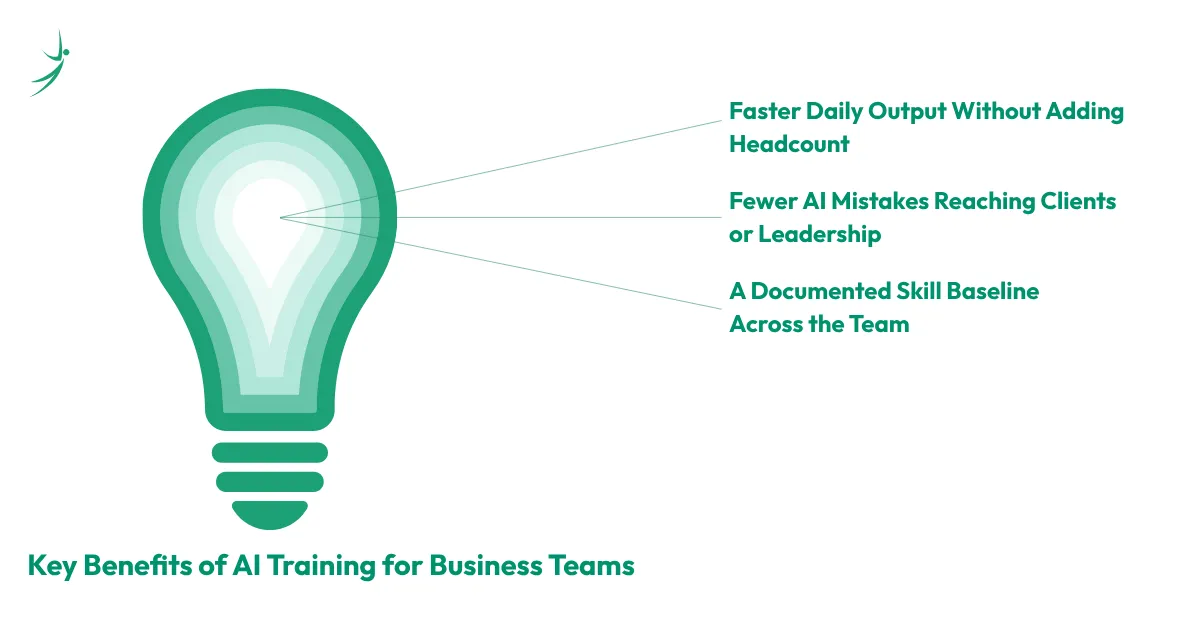
Faster Daily Output Without Adding Headcount
When a corporate training session teaches staff to use AI tools for the exact reports, emails, and documents they already produce, the time saved shows up almost immediately often within the first week of applying what was covered, not months later.
Fewer AI Mistakes Reaching Clients or Leadership
Untrained AI use tends to produce a specific, recurring problem: confident-sounding output that's subtly wrong. A structured program that covers verification habits and tool limitations directly reduces the number of AI-generated errors that make it into client-facing work or leadership reports.
A Documented Skill Baseline Across the Team
Right now, AI skills inside most Nepali companies is unevenly distributed a few staff are advanced, most are informal, and some avoid it entirely. A company-wide corporate training program creates a shared baseline, which matters for onboarding new hires and for any company that needs to show documented training records to a partner or regulator.
Where AI Training Applies Across Departments
AI training delivers the greatest value when it is customized for the specific responsibilities of each department. Rather than teaching the same skills to every employee, organizations can build role-based learning paths using relevant AI and professional development courses that align with day-to-day business operations.
- Marketing and Digital Marketing: Using AI for content drafting, campaign ideation, ad copy variations, SEO assistance, and performance summaries while ensuring human creativity and strategic judgment remain central.
- Finance and Reporting: AI-assisted data cleaning, first-pass financial analysis, report generation, and spreadsheet automation to improve efficiency and reduce manual work.
- HR and Recruitment: AI support for writing job descriptions, screening resumes, drafting internal communications, onboarding documentation, and employee engagement materials.
- Customer Service: AI-assisted response drafting, ticket summarization, knowledge base searches, and faster handling of repetitive customer queries while maintaining service quality.
- Leadership and Governance: Understanding AI capabilities, limitations, data privacy, security risks, compliance requirements, and how corporate governance policies should evolve to support responsible AI adoption across the organization.
By aligning AI training with departmental workflows instead of generic theory, businesses can achieve higher employee adoption, improved productivity, and more consistent outcomes across the organization.
Best Practices for Choosing an AI Training Provider in Nepal
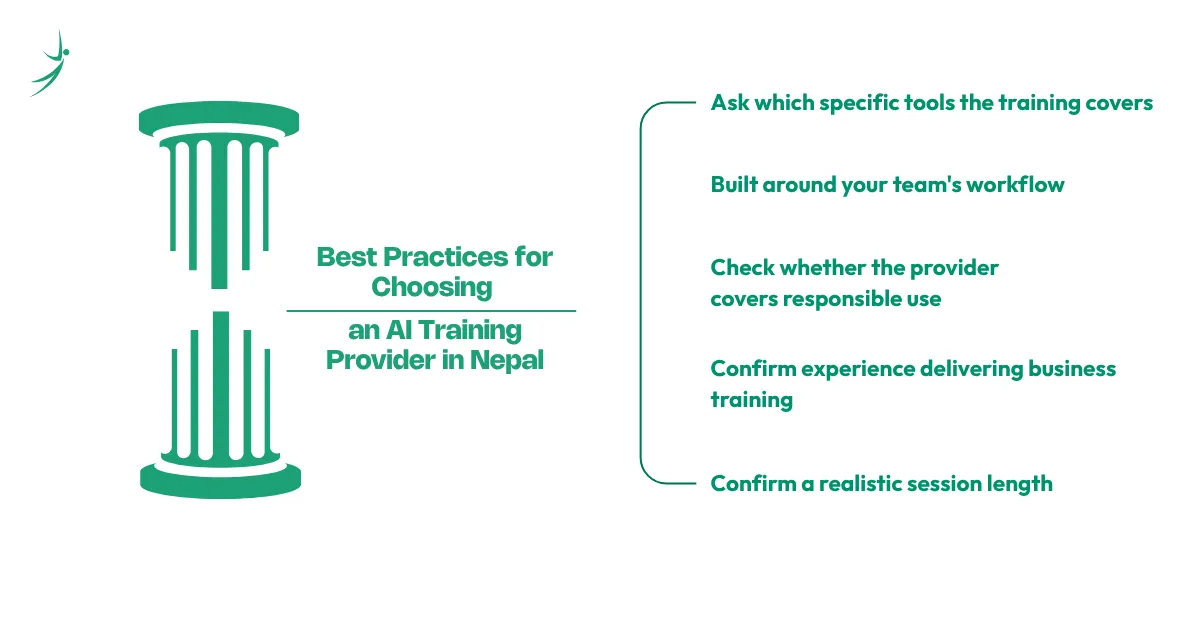
- Ask which specific tools the training covers. ChatGPT, Google Gemini, and Microsoft Copilot behave differently enough that a generic "AI training" label doesn't tell you much on its own.
- Confirm the session is built around your team's actual workflow, not a fixed slide deck reused for every client.
- Check whether the provider covers responsible use, not just capability data privacy, verification habits, and when AI output needs a human check.
- Ask if the corporate training institute or corporate training center has delivered this specifically for businesses, not only for individual career-track students.
- Confirm a realistic session length. A single afternoon rarely covers enough for a full team to change daily habits most useful programs run multiple shorter sessions instead of one long one.
Common Challenges and How to Overcome Them
- Challenge: Staff sees AI training as optional. This fades quickly once the first session is tied to a task people already do weekly, rather than being framed as a general AI overview.
- Challenge: Leadership wants "AI training" without knowing what to ask for. The fix starts with a short needs conversation before any session is booked the same discovery-call approach Skill Shikshya already uses for other corporate training programs.
- Challenge: One-size-fits-all sessions don't stick. Companies that run AI training by department (marketing separately from finance, for example) consistently report better follow-through than a single all-staff seminar, since each group applies different tools to different tasks.
- Challenge: No one measures whether the training worked. Without a specific, agreed-upon metric before the session, it's nearly impossible to tell three months later whether the training changed anything.
Case Examples
A mid-sized IT company in Kathmandu ran a single all-staff AI overview session in 2025 and saw almost no lasting change in daily habits most staff described it afterward as "interesting but not something I use." The following year, the same company split the training by department: a short, tool-specific session for marketing (AI-assisted content drafts), a separate one for finance (AI-assisted reporting in Excel and Power BI), and a governance-focused session for managers. Reported daily AI usage across departments increased noticeably compared to the earlier single-session attempt.
A Kathmandu-based digital marketing team used a corporate training session focused specifically on AI for content ideation and ad copy variations. Within one quarter, the team reported producing significantly more campaign concepts per week without adding staff, while maintaining a manual review step before anything went live.
Future Trends in AI Training for Businesses
- Department-specific AI training is replacing single all-staff sessions, matching what companies are already learning from broader corporate training programs.
- Governance and responsible-use training is becoming a standard module, not an optional add-on, as more companies formalize corporate governance training that explicitly covers AI use.
- Shorter, more frequent sessions are outperforming single long workshops, consistent with adult-learning research on retention.
- AI literacy is increasingly treated as a baseline hiring expectation, similar to basic computer literacy a decade ago.
How to Choose the Right AI Training Program for Your Team
Choosing the right AI training provider is about more than comparing course outlines. The best programs are customized to your organization's goals, workflows, and the way different teams actually use technology. When evaluating corporate AI training services, these three questions can quickly separate tailored solutions from generic training.
- Does the provider ask about your specific tools and workflows before proposing a curriculum, or do they lead with a fixed course outline?
- Does the training separate audiences by department, or is it one generic session for everyone?
- Is there a way to check, a few months later, whether staff actually changed how they work?
A provider that answers all three clearly is worth a longer conversation. A corporate training company that can only describe the training in general capability terms "learn to use AI" without specifics is a weaker signal.
Measuring ROI and Success Metrics
- Time saved per task on the specific report, document, or workflow the training targeted
- Error rate in AI-assisted work reaching clients or leadership, tracked before and after training
- Adoption rate the share of trained staff still using the tool regularly after 60-90 days, not just on the day of the session
- Manager-reported confidence in staff judgment about when to trust AI output and when to double-check it
Conclusion and Action Steps
AI training in Nepal for businesses works best when it's treated as a corporate training program built around real departments and real tools, not a single generic session. Before booking your next one:
- Identify which department needs AI training most urgently, and why.
- Ask any provider what specific tools the session covers and how it's customized to your workflows.
- Agree on one measurable outcome time saved, error reduction, adoption rate before the first session runs.
Skill Shikshya delivers AI training in Nepal as part of a broader corporate training program for businesses, colleges, and government agencies, with sessions built around your team's actual tools rather than a fixed course outline. Visit skillshikshya.com/corporate-training to talk through what this would look like for your team.
Frequently Asked Questions
What's the difference between AI training for employees and training someone to become an AI engineer?
What should employees never share with an AI tool?
Do employees already use AI without training, and is that a problem?
Will AI training make my team over-rely on AI instead of thinking for themselves?
How long does AI training take, and is one session enough?
Should managers be trained differently from general staff?
How do we know if AI training actually worked?
Is AI training worth the cost for a small or mid-sized company, not just large enterprises?
Does AI training need to cover compliance and governance, or just tool skills?
About Author: