How to Write a Bug Bounty Report That Gets Paid
A bug bounty report that gets paid fast follows a clear structure: a specific title, a short summary, exact steps to reproduce, a real impact statement, and proof of concept. Writing it well matters as much as finding the bug itself, since even a real, valid vulnerability gets rejected constantly when the report itself is unclear. Skill Shikshya's bug bounty and web application security training course treats this as a core skill taught alongside testing itself, not an afterthought.
Before You Write Anything, Confirm It's Worth Reporting
A few quick checks before writing a single line save time on both sides:
| Check | Question to ask |
|---|---|
| Scope | Is this asset actually listed as in scope in the program's rules? |
| Duplicate | Has this exact issue already been publicly disclosed on this program? |
| Real impact | Does this actually do something harmful, or is it cosmetic? |
| Reproducibility | Can you reproduce it yourself, from scratch, right now? |
Skipping any one of these four checks is one of the fastest ways to turn a real finding into a rejected report. For the bigger picture of how this fits into a full bug bounty career, the complete roadmap for breaking into this field covers where report quality sits alongside everything else worth learning.
The Anatomy of a Report That Gets Paid Fast
Every strong bug bounty report, regardless of platform, follows roughly the same structure:
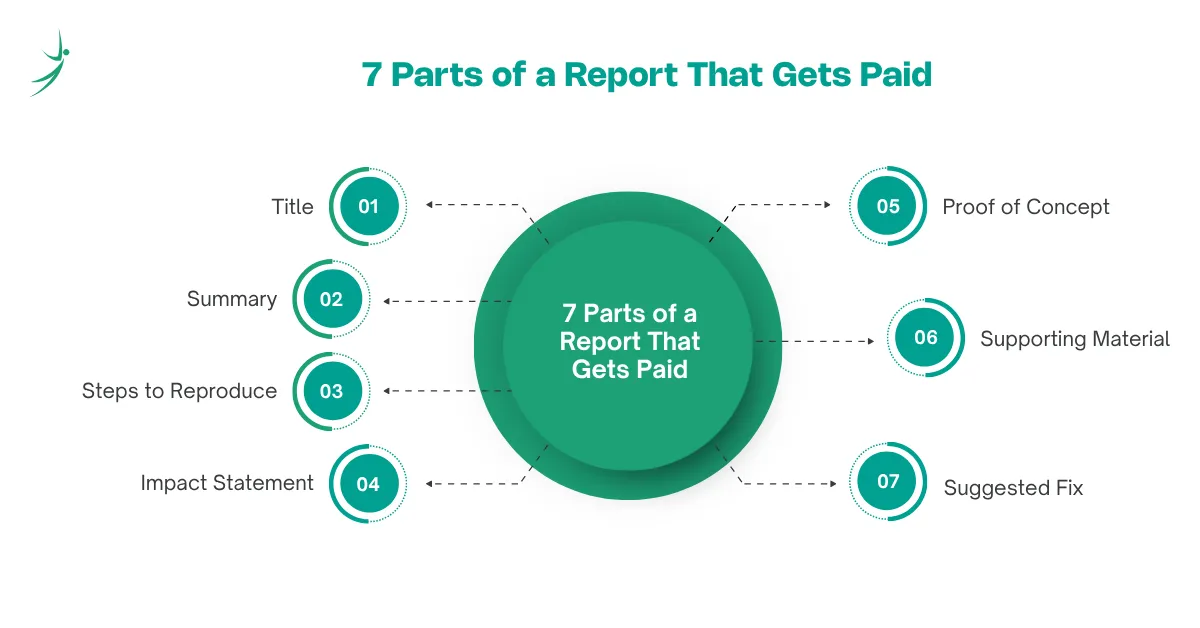
- Title: specific enough that a triager knows the bug type, location, and impact before reading further
- Summary: two or three sentences describing what the bug is and why it matters
- Steps to reproduce: numbered, exact, no assumed knowledge
- Impact statement: what a real attacker could actually do with this
- Proof of concept: a screenshot, request/response pair, or short screen recording
- Supporting material: relevant CWE references, affected endpoint, timestamp.
- Suggested fix (optional but valued): a brief note on how the issue could be resolved
That seven-part structure works whether the report goes to HackerOne, Bugcrowd, Intigriti, or a company's own internal form, since the underlying goal never changes: get a stranger who has never seen this application to understand and verify the bug as fast as possible.
A filled-out version makes the structure concrete. For an IDOR found on a fictional invoicing endpoint, the report might read something like this:
- Title: IDOR in /api/v1/invoices/{id} allows any authenticated user to view another customer's invoice details
- Summary: The invoice endpoint returns full invoice data based solely on the ID in the URL, without checking whether the requesting user actually owns that invoice
- Steps to reproduce: Log in as User A, note the invoice ID in the URL after opening any invoice, log in as User B, request the same endpoint with User A's invoice ID, observe that User A's private billing data returns in full
- Impact: Any authenticated user can enumerate invoice IDs and read other customers' billing details, including names, addresses, and amounts billed
- Proof of concept: A screen recording showing the request being replayed with a different invoice ID and the resulting data exposure
- Supporting material: Reference to CWE-639 (Authorization Bypass Through User-Controlled Key)
- Suggested fix: Verify that the requesting user's ID matches the invoice's owner before returning any data
That level of specificity is what separates a report that gets triaged in minutes from one that sits in a queue collecting clarifying questions.
Writing a Title That Gets Triaged Fast
Titles decide how quickly a report gets picked up, and the difference between a weak one and a strong one is almost always specificity. This is one of the places where the gap between genuinely understanding the fundamentals of this work and just knowing how to find bugs technically becomes obvious, since a title is a communication skill, not a technical one:
| Quality | Example |
|---|---|
| Poor | XSS vulnerability |
| Better | Stored XSS in user profile field |
| Strong | Stored XSS in user profile bio leading to session hijacking via cookie theft |
| Poor | IDOR issue |
| Strong | IDOR in /api/v1/user/{id} allows any authenticated user to read another user's private data |
A strong title answers three questions at a glance: what type of bug is this, where does it live, and what does it actually let an attacker do. That alone can shave real time off a triage queue.
Steps to Reproduce: The Section That Decides Everything
This section carries more weight than any other part of the report, and one rule matters above all others: reproduce the bug yourself, from a clean state, before writing a single step down. A report the author has not personally re-tested is a report waiting to fall apart the moment a triager tries it.
A few practical habits that consistently speed up triage:
- Number every step, and keep each one to a single action
- State the exact URL, parameter, or field involved, never "the login page" when a specific path exists
- Include the exact payload used, not a paraphrased description of it
- A short screen recording, even a plain screen capture with no editing, often reproduces trust faster than a wall of text
- Aim for a triager who has never seen the application to reproduce the bug in under five minutes
Writing an Impact Statement That Actually Lands
A technically accurate bug with a weak impact statement routinely gets underpaid or marked informational. Two techniques consistently work well:
- Real-world scenario framing: describe what an actual attacker would do with this, in plain language, rather than restating the technical mechanism a second time. A line like "an attacker could use this to read any user's private messages by changing a single number in the URL" lands harder than a repeat of the technical steps.
- Behavior analysis: explain what the application is supposed to do first, then show exactly where it deviates from that expectation. This framing helps a non-technical reviewer, and sometimes a triager unfamiliar with that specific feature, understand why the deviation matters.
A weak impact statement often just restates the bug mechanically: "the endpoint does not check the user ID, so data leaks." A strong one connects that same mechanism to a consequence a business stakeholder would actually care about: "this exposes every customer's billing address and invoice history to any registered user, which is a direct data protection violation affecting the entire user base, not just one account." Same bug, dramatically different perceived severity, and often a dramatically different payout as a result.
It also helps to quantify scale wherever possible. A bug affecting one specific edge case reads very differently from the same bug affecting every user account on the platform, and stating that scale explicitly, rather than leaving a triager to infer it, removes ambiguity that can otherwise work against a fair severity rating.
The 5 Reasons Valid Bugs Get Rejected Anyway
A genuinely real, exploitable vulnerability still gets rejected constantly, almost always for one of five reasons:
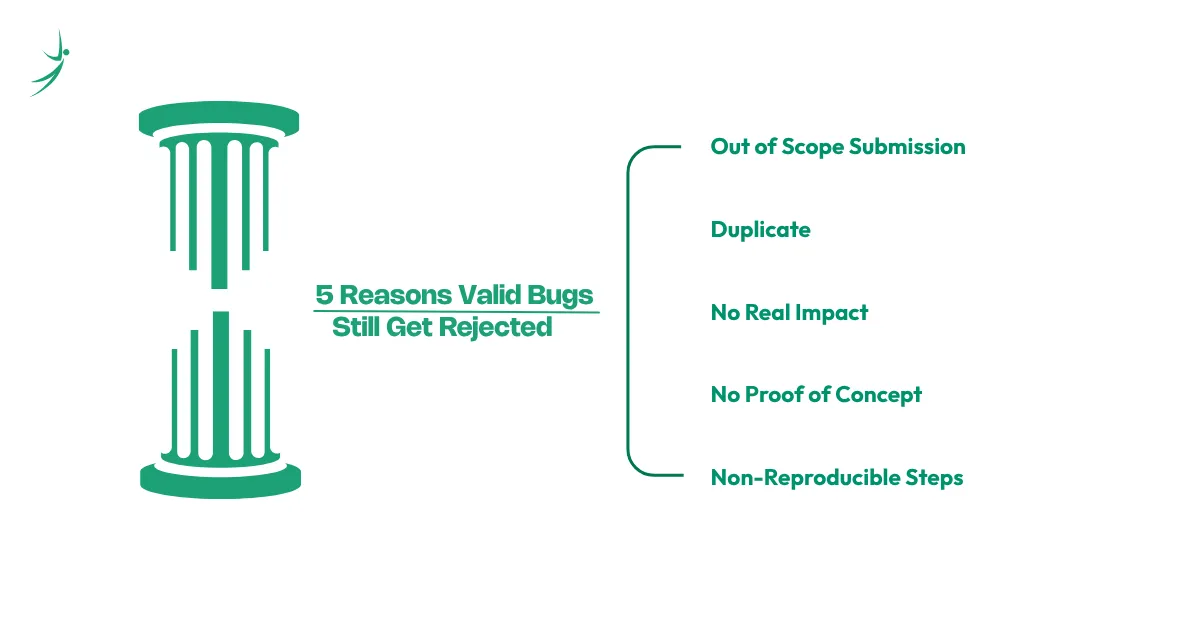
- Out of scope submission: the target was never covered by the program's rules, an instant rejection regardless of severity
- Duplicate: someone else already reported the same issue first, which is why checking disclosed reports before testing matters so much
- No real impact: a technically true finding, like self-XSS requiring the victim to paste their own payload, that does not translate into an actual security risk
- No proof of concept: a report with no screenshot, request, or recording gets closed fast, regardless of how the bug is described in words
- Non-reproducible steps: the triager cannot get the bug to work following the report's own instructions, usually because a step got skipped or assumed
Every one of these is avoidable with the checks and structure already covered above, which is exactly why report quality has as much impact on income as raw technical skill does. Methodical testing habits help here too. Working through a target step by step rather than testing randomly naturally produces the kind of clear, step-by-step findings that are easiest to write up cleanly once something real turns up.
Bug Bounty Reports vs Pentest Reports
These two document types get confused constantly, but they serve genuinely different audiences:
| Factor | Bug Bounty Report | Pentest Report |
|---|---|---|
| Audience | Triagers reviewing many submissions daily | Executives, legal teams, and engineers |
| Goal | Fast, individual confirmation and payout | Comprehensive risk overview for a formal engagement |
| Structure | Lean, single-issue, reproduction-focused | Layered, often includes an executive summary plus technical detail |
| Scoring | Platform-specific severity rating | Often CVSS-based for consistency across many findings |
This distinction matters more once a hunter starts moving between freelance bug bounty work and formal vulnerability assessment and penetration testing (VAPT) engagements, since submitting a bug-bounty-style single-issue report where a client expects a full VAPT deliverable creates real confusion. Weighing freelance hunting against a more structured, employed testing career covers this broader career distinction in more depth.
Should You Use AI to Help Write Reports?
Yes, with one condition that matters more than the tool itself: the report has to stop sounding like AI wrote it before it gets submitted. Using an AI assistant to draft an initial structure or tighten unclear phrasing is completely fine and increasingly common. What triagers notice immediately, and what quietly hurts credibility, is leftover AI phrasing: bloated transitions, generic filler sections like "Background" or "Methodology" tacked onto a simple one-off finding, and overly formal hedging that no experienced hunter would actually write.
A practical rule: after drafting with any tool, read the report out loud. If it does not sound like something a specific person actually typed, testing a specific application, on a specific day, it needs another editing pass before submission. Keep the tone, the specific technical details, and the conciseness that comes from genuinely having tested the bug yourself.
A few specific things worth cutting on that second pass:
- Unnecessary preambles like "In this report, we will explore..." before getting to the actual finding
- Vague hedging language, "this could potentially represent a security concern" instead of stating plainly what the bug does
- Generic section headers copied from a formal audit template that add no value to a single, specific finding
- Repetition of the same point in slightly different words, padding length without adding clarity
None of this means avoiding AI tools entirely. It means treating the output as a first draft that still needs the specific, first-hand detail only the person who actually found and tested the bug can supply.
Handling Triage Disagreements and Severity Disputes
Disagreements with a triage decision happen to every active hunter eventually, and how they get handled affects future access to that program:
- Respect the stated SLA. If a program states a 5-day first response window, wait the full 5 days before following up. Pinging after one day reads as impatience, not urgency.
- Argue with facts, not frustration. If a severity gets downgraded and it feels wrong, explain the specific exploitation scenario and business impact again, citing CVSS where relevant, calmly and once.
- Know when to let it go. Fighting for weeks over a small difference in payout rarely pays off relative to the time spent, and it can quietly damage a relationship with a program worth far more long term.
- Build the relationship over multiple reports. A triager who recognizes a hunter's name from previous clear, professional submissions tends to extend more benefit of the doubt on edge cases.
This is one of the least discussed parts of bug bounty hunting, but experienced hunters consistently mention it as a real factor in long-term earnings. A hunter with a reputation for professional, low-drama communication tends to get faster responses and more generous benefit-of-the-doubt calls over time than one known for aggressive follow-ups or public complaints about a program's decisions.
Report Writing Across Different Platforms
The core structure stays consistent, but a few platform-specific details are worth knowing before a first submission:
- HackerOne: studying disclosed reports on Hacktivity is one of the best free ways to see accepted report structure from real programs, including major ones like Meta, Google, and their subsidiary apps like Instagram and WhatsApp
- Bugcrowd: submitting against a target explicitly marked out of scope results in a point penalty on top of the rejection, so scope-checking matters even more here
- Intigriti: keeps the target URL out of the title field entirely, using a separate endpoint field instead, and offers saved custom report templates for verified researchers to speed up repeat submissions
- YesWeHack: also supports custom report templates and places heavy emphasis on linking supporting CWE references directly in the report
None of these platform-specific quirks change the underlying report structure covered earlier in this guide. They are formatting and submission-mechanics details layered on top of it, and missing one, like accidentally including a URL in an Intigriti title field, is a minor friction point rather than a reason for outright rejection. A closer look at how these platforms actually differ goes far beyond just their reporting mechanics.
Report Writing for Nepali Hunters
Clear structure matters even more when English is not a hunter's first language, since a triager cannot tell the difference between a language barrier and genuine confusion about the bug itself. A strong, consistent template closes that gap effectively, since following the same seven-part structure every time removes the pressure of writing polished prose from scratch on each submission.
A Note on the Biggest Bug Bounty Payouts
Report quality matters even more as payouts climb. Immunefi, which handles Web3 and blockchain bug bounties, has facilitated some of the largest payouts in the industry's history, including individual rewards of 10 million dollars, 6 million dollars, and 2.2 million dollars, precisely because the funds at risk in DeFi protocols are enormous. On the traditional web application side, Apple's top bounty reward reaches up to 2 million dollars for the most severe exploit chains. At that scale, an unclear or incomplete report does not just risk a lower payout, it risks losing the reward entirely.
Conclusion
Report writing is not a bureaucratic step tacked onto the end of real hacking. It is the mechanism that turns a technical discovery into an actual paid outcome, and it is a skill that improves with deliberate practice the same way testing itself does. A hunter who writes clear, well-structured reports consistently ends up earning more than a more technically skilled hunter whose reports leave triagers guessing.
Skill Shikshya's bug bounty training course treats this as a core part of the curriculum rather than an afterthought, since a brilliant finding with a confusing report earns exactly the same as a bug nobody ever found.
Frequently Asked Questions
How long should a bug bounty report be?
Do I need video proof or are screenshots enough?
What happens if my report gets marked as a duplicate?
Should I suggest a fix in my report?
Can a good report increase my payout for the same bug?
Is it okay to follow up if I haven't heard back?
What is the single most common mistake in a first bug bounty report?
About Author:

Meet Mr. Mahan Raja GM Sunuwar, Cyber Security mentor at Skill Shikshya. He guides learners through real-world security challenges, teaching practical skills to protect systems and understand cybersecurity in action.