Bug Bounty Platforms Compared: Real Payouts, Key Differences and Where to Start
Every comparison of bug bounty platforms eventually lands on the same honest answer: platform choice matters less than program selection. A well-scoped private program on a smaller platform pays better than a poorly scoped public one on a famous platform, and domain knowledge beats tool or platform choice almost every time. This guide still breaks down the real differences between HackerOne, Bugcrowd, Intigriti and the smaller platforms worth knowing, since those differences do matter once someone is actually choosing where to spend their hunting hours. Skill Shikshya's bug bounty and web application security training course covers the testing skills that make any of these platforms worth using in the first place.
How Bug Bounty Platforms Actually Work
Every major platform runs on the same basic structure, even though the details differ:
- A company publishes a program with a defined scope, listing exactly what a hunter can and cannot test
- Hunters test within that scope and submit reports when they find something real
- A triage team, either the platform's own staff or the company's internal team, reviews each report for validity
- Confirmed reports get a severity rating, and payment follows based on that rating
That shared structure is exactly why the differences between platforms come down to reputation systems, payout speed, program mix, and community size rather than the basic mechanics. For the bigger roadmap this fits into, the career guide on how to get into bug bounty covers where platform selection sits alongside everything else worth learning first.
Quick Comparison at a Glance
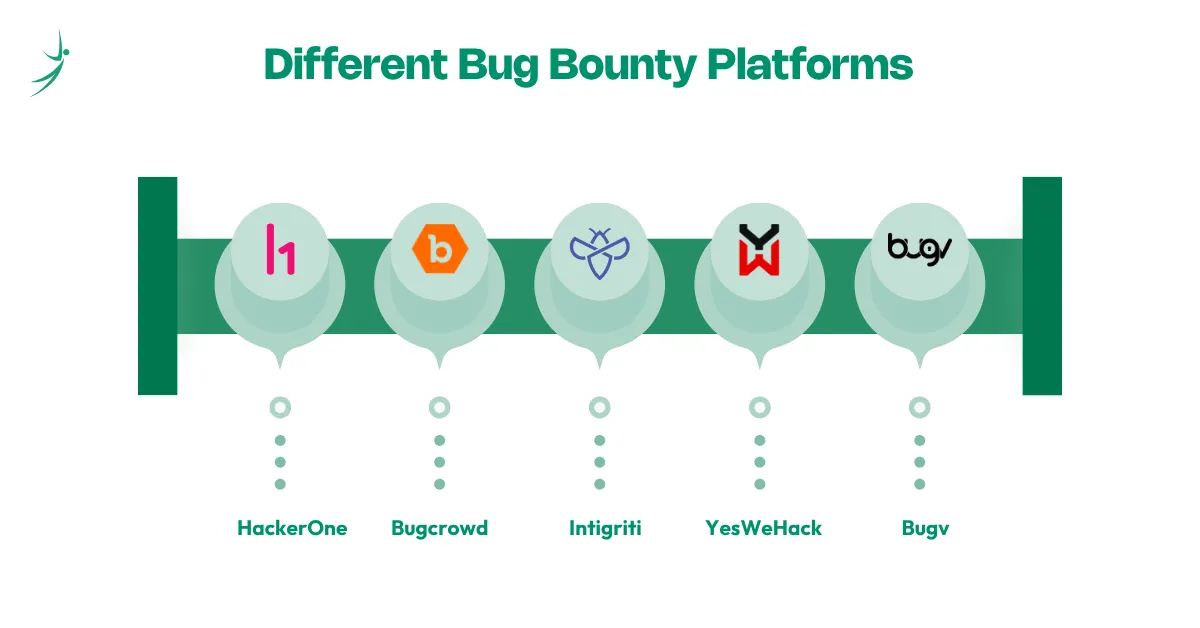
Before going deep on each platform, here is how they stack up on the basics:
| Platform | Market position | Best known for | Payout minimum |
|---|---|---|---|
| HackerOne | Largest, ~37-38% share | Program volume, public disclosed reports | Varies by program |
| Bugcrowd | Second largest, ~32% share | CrowdMatch, PTaaS blend | 100 dollars |
| Intigriti | Leading European platform | Fast payouts, activity-based leaderboard | 50 euros |
| YesWeHack | Mid-size, government-focused | Public-sector credibility | Varies by program |
| Synack | Small, invite-only | Vetted, premium engagements | Varies by program |
| Immunefi | Web3-specialized | Highest possible payouts | Varies by program |
| Bugv | Nepal-focused | Local market context | Varies by program |
HackerOne
HackerOne holds the largest share of the bug bounty market, generally cited around 37 to 38 percent, with more than 3,000 active programs and the largest researcher community of any platform. A few things define the experience:
- Signal and reputation matter a lot. HackerOne gates private program invitations behind a reputation score, which means new hunters usually start on public programs to build up enough signal before better invitations arrive.
- Reputation persists over time. A hunter who built strong signal years ago can still rank highly even after long periods of inactivity, which is different from platforms that weight recent activity more heavily.
- Hacktivity is a genuinely useful public resource. HackerOne's Hacktivity feed publishes disclosed reports from real programs, letting anyone study exactly what kind of bugs get accepted and how experienced hunters write up their findings, before ever submitting a report of their own.
- HackerOne also runs CTF-style challenges, which work well as low-stakes practice for building the pattern recognition that carries over into real programs.
- Payment mechanics vary by program. Some programs pay directly through HackerOne, while others handle payment themselves outside the platform, which can mean a slower payout process depending on which program a hunter is working with.
- Companies actively filter by reputation score. Beyond gating private invites, many companies use signal score directly to decide who gets fast-tracked into higher-value programs, which makes early consistency on public programs pay off twice over, once in bounty money and again in future access.
This combination, the largest program library plus a transparent reputation system, is why HackerOne is the platform most sources recommend as a starting point for building a track record from scratch. What Is Bug Bounty Hunting covers the fundamentals worth having in place before diving into any platform, HackerOne included.
Bugcrowd
Bugcrowd sits close behind HackerOne, generally cited around 32 percent market share, and it operates a bit differently in practice:
| Category | Detail |
|---|---|
| Matching | Uses "CrowdMatch," a system built to connect specific programs with researchers who fit that program's asset types |
| Average payout | Roughly 300 to 3,000 dollars for accepted reports, with top payouts above 50,000 dollars |
| Payment method | PayPal, Payoneer, or bank transfer, with a 100 dollar minimum |
| Payment schedule | Processed weekly in batches, so a bounty awarded mid-week may not arrive until the next cycle |
| Notable programs | Amazon, Tesla, and a large share of financial services companies run programs here |
| Program mix | Offers Pentest as a Service (PTaaS) alongside standard bug bounty, blurring the line between the two models |
That PTaaS blend is worth understanding on its own terms, since it means some Bugcrowd engagements behave more like a structured, scoped assessment than open-ended bug bounty hunting. Bug Bounty vs Penetration Testing breaks down that distinction in far more depth for anyone weighing the two models directly.
Getting started on Bugcrowd is straightforward: create a researcher profile, browse public programs by scope and reward range, and submit through Bugcrowd's structured report format once a valid finding turns up. One detail worth knowing before a first submission gets rejected unexpectedly: Bugcrowd's triage decisions can be appealed, and the appeals team operates separately from the original triager, so a disputed "not applicable" verdict does get a genuine second look rather than facing the same reviewer twice.
Bugcrowd also runs a secondary gamification layer called Bugcrowd Points, which tracks activity and contribution separately from cash payouts. It does not convert to money directly, but some hunters find it a useful motivator for staying consistent between bigger wins, and it factors into how the platform's matching system identifies active, engaged researchers for future program invitations.
Intigriti
Intigriti is based in Belgium and remains the dominant platform for European corporate programs specifically:
- The leaderboard rewards current activity, not lifetime accumulation. Rankings reset seasonally based on accepted bounties, severity, and recent activity, which means a hunter who was highly active three years ago but has since gone quiet slides down the rankings, opening space for people actively hunting right now. That is a meaningfully different design from platforms where old reputation never fades.
- The payout minimum is lower. Intigriti pays out from as little as 50 euros, lower than most other major platforms, via SEPA transfer for European hunters or international wire for everyone else, with SEPA transfers often arriving within one to two business days.
- Competition tends to be lighter. Companies running programs on Intigriti are often newer to bug bounty than HackerOne's more established client base, which can mean less crowded programs for a hunter willing to look outside the two biggest platforms.
- Dispute resolution moves fast. Because Intigriti operates at a smaller scale, disagreements over a triage decision tend to get resolved through direct communication between hunter, triager, and program, often within 48 hours rather than dragging on for weeks.
- Onboarding is noticeably smoother than the bigger platforms. Several independent reviews specifically call out Intigriti's interface and scoping process as cleaner and less overwhelming for newer researchers, which matters more than it sounds for someone still learning how to read a scope document correctly.
Anyone specifically targeting EU-based fintechs, banks, or SaaS companies will likely find more relevant scope on Intigriti than on the larger, more US-centric platforms.
YesWeHack, Synack and Immunefi
Three smaller platforms round out the field, each serving a genuinely different niche rather than competing head-on with the big three:
- YesWeHack has secured government contracts and runs programs for public-sector organizations, which makes it a credibility signal for anyone building a career in European security specifically, alongside solid and improving triage quality. Having active work on YesWeHack visible on a profile tends to carry particular weight with European employers even outside government-adjacent roles.
- Synack takes an invite-only, vetted approach, accepting only researchers who pass its screening process. That gatekeeping creates a more curated environment, and the payouts reflect the more sensitive, enterprise-level assets involved, though the entry bar means this is rarely where a beginner starts.
- Immunefi specializes entirely in Web3 and blockchain security. Payouts here can reach six or seven figures for critical findings in DeFi protocols, dramatically higher than anything on the traditional platforms, but the skill floor to compete is proportionally higher too, since smart contract vulnerabilities require a genuinely different technical background than typical web application testing.
None of these three are realistic starting points for a beginner. They matter more as destinations to work toward once a track record exists elsewhere.
Bugv: The Nepal-Focused Option
Bugv exists specifically to give Nepali hunters a program built around the regional market rather than relying entirely on international platforms. It will not match HackerOne or Bugcrowd's program volume, but it fills a real gap for hunters who want a platform with local context rather than starting cold on a global platform with no regional programs at all.
Same Bug, Different Payout: A Real Comparison
Platform choice genuinely changes what a bug is worth, not just how it feels to use the interface. A medium-severity finding, something like a straightforward IDOR or a moderate access control issue, illustrates the gap clearly:
| Platform | Program type | Typical payout for a medium bug |
|---|---|---|
| HackerOne | Private program | 500 to 2,000 dollars or more |
| Bugcrowd | Comparable public program | 150 to 500 dollars |
That is not a small difference for identical work. Across the industry more broadly, critical vulnerability payouts on major platforms average somewhere between 3,000 and 15,000 dollars, while a small number of elite researchers report earning upwards of 500,000 dollars a year, though that figure sits far outside what a typical active hunter should expect early on.
What Actually Moves Your Earnings, Beyond Platform Choice
The research behind this piece kept circling back to the same point, restated by different people in different words: platform choice is not where the real leverage is. A few things matter more:
- Program selection beats platform selection. A well-scoped private program on a smaller platform consistently outperforms a poorly scoped public program on a bigger one.
- Scope breadth changes earning potential directly. A program covering an entire domain and its subdomains offers far more attack surface, and therefore more findable bugs per hour spent, than one restricted to a single application.
- Domain knowledge beats platform or tool familiarity. Hunters who go deep on a specific category, like OWASP Top 10 Explained categories, consistently outperform hunters who spread thin across many platforms without specializing in anything.
Certifications That Help You Get Into Private Programs
Certifications will not replace a track record of accepted reports, but they do help clear the credibility bar that gates private program invitations on most platforms:
- OSCP, the broader industry-standard penetration testing certification
- OSWE, focused specifically on advanced web application exploitation
- Burp Suite Certified Practitioner, a direct signal of comfort with the tool most triage teams assume a serious hunter already knows
Burp Suite Tutorial for Beginners covers the tool itself in depth for anyone who has not set it up yet, since it remains a baseline expectation across every platform covered here.
Which Platform Should You Start On?
For a complete beginner, the practical path looks the same across almost every credible source:
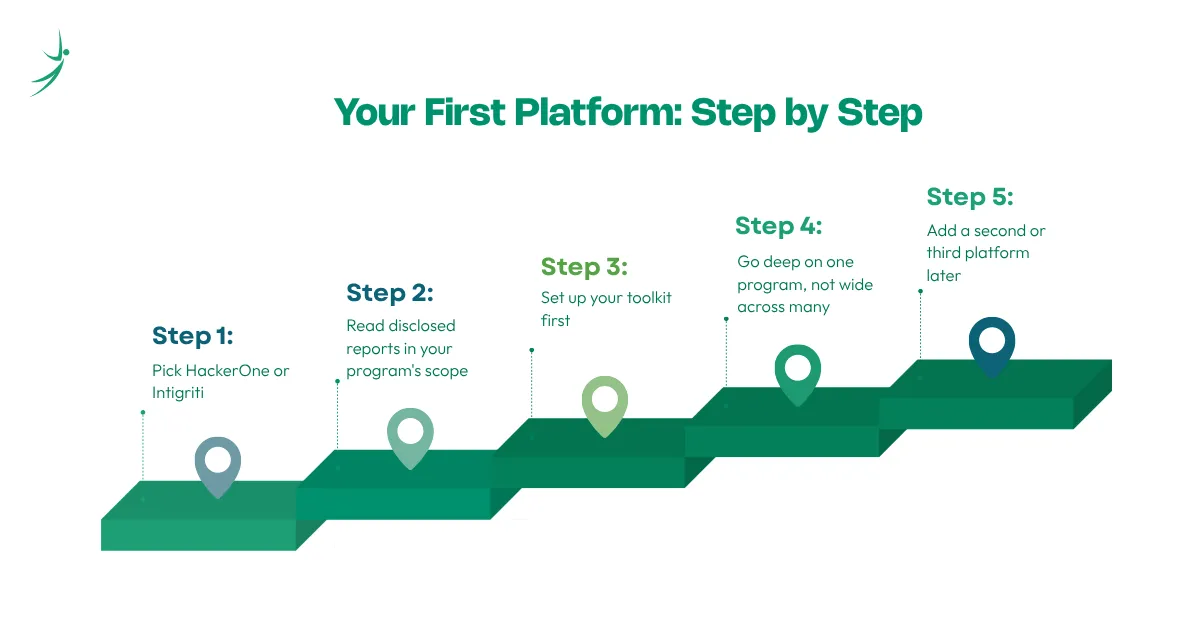
- Pick either HackerOne or Intigriti to start, since both have accessible public programs with real learning value
- Read through a handful of disclosed reports in a program's scope before testing anything, using HackerOne's Hacktivity feed as one option
- Set up a proper toolkit before submitting a first report, covered in Top Bug Bounty Tools 2026
- Focus on one program deeply rather than spreading thin across many platforms at once
- Expect to eventually run accounts on two or three platforms simultaneously once a working methodology exists, rather than committing to just one forever
A mistake worth avoiding early: jumping straight into automated scanning across dozens of programs at once, hoping volume makes up for depth. Every experienced source that touched on this pushed back on it directly. Building real skill on one program, reading that program's own disclosed history, and understanding its specific technology stack tends to produce a first valid report faster than spraying the same generic checks across unrelated targets.
Bug Bounty Platforms in Nepal
Most Nepali hunters build their careers on international platforms rather than local ones, largely because so few Nepali companies run formal bug bounty programs of their own yet. This mirrors a pattern seen in other developing markets too. India, for example, is HackerOne's second-largest researcher base by country, proof that a large, skilled hunter community can build real income entirely on international platforms without much local program availability at all. Scope of Bug Bounty in Nepal breaks down what the local market actually looks like sector by sector, alongside where Bugv and international platforms each fit into that picture.
Conclusion
None of these platforms is objectively the best choice for every hunter. HackerOne offers the deepest program library and clearest path to building reputation from nothing. Bugcrowd offers a friendlier appeals process and strong PTaaS-adjacent programs. Intigriti rewards current activity and pays out fast for European hunters. The smaller platforms each serve a real niche rather than competing for the same generalist audience. What all of them share is that a hunter's actual skill and program selection decide the outcome far more than the platform's logo does, a point worth remembering the next time a "best bug bounty platform" ranking promises an easy shortcut that the work itself does not actually offer.
Skill Shikshya's bug bounty training course builds the underlying skill that makes any of these platforms worth using, recon, testing methodology, and professional report writing, so the choice of platform becomes a formality rather than the deciding factor in whether hunting pays off.
Frequently Asked Questions
Which bug bounty platform is best for complete beginners?
Can I use more than one platform at the same time?
Which platform pays the fastest?
Do I need an invite to join any of these platforms?
Is Bugv a good starting point for Nepali hunters?
Which platform is best for API-focused testing?
Do these platforms take a cut of my earnings?
How do I get invited to private programs?
Should I read a program's disclosed reports before testing?
Is it worth paying for a premium tier on any of these platforms?
About Author:

Meet Mr. Anjush Khanal, Cybersecurity mentor at SkillShikshya. He guides learners through ethical hacking concepts, security practices, and hands-on cybersecurity techniques to turn curiosity into practical digital defense skills.