Security Researcher Role: What They Actually Do
"Security researcher" gets used as an umbrella term for several genuinely different jobs. Some security researchers spend their days reverse engineering malware with tools like IDA Pro and Ghidra. Others work in threat intelligence, tracking attacker groups across underground forums. This guide covers a third, closely related path: the web application security researcher, the role most directly tied to bug bounty work and the one most people searching this term are actually trying to understand. Skill Shikshya's bug bounty and web application security training course builds toward exactly this role, alongside freelance bug bounty hunting, since the two paths share almost the entire same skill set.
What Is a Web Application Security Researcher?
A web application security researcher investigates websites, apps, and APIs to find security weaknesses before someone with worse intentions does. That can mean testing a new checkout flow for logic flaws before it ships, reviewing how a login system handles session tokens after a redesign, or digging into why a recently added API endpoint returns more data than the frontend actually displays. Unlike a malware researcher, who spends their time dissecting malicious code after an attack, or a threat intelligence researcher, who tracks attacker behavior and infrastructure, a web application security researcher works forward, proactively testing an organization's own software for flaws rather than analyzing damage that has already happened.
This distinction matters because job postings and career advice online rarely separate these specializations clearly. Someone reading a generic "security researcher" article and expecting web application work can end up confused when the actual job involves reverse engineering ransomware samples instead. The confusion runs both ways too, a company hiring for this role sometimes writes a job description borrowed from a malware analyst posting, listing tools and skills that have little to do with the actual day-to-day work of testing a web application. For the bigger roadmap this role fits into, the career guide on how to get into bug bounty covers how web application security research connects to the wider field.
Security Researcher vs Security Analyst vs Bug Bounty Hunter vs Penetration Tester
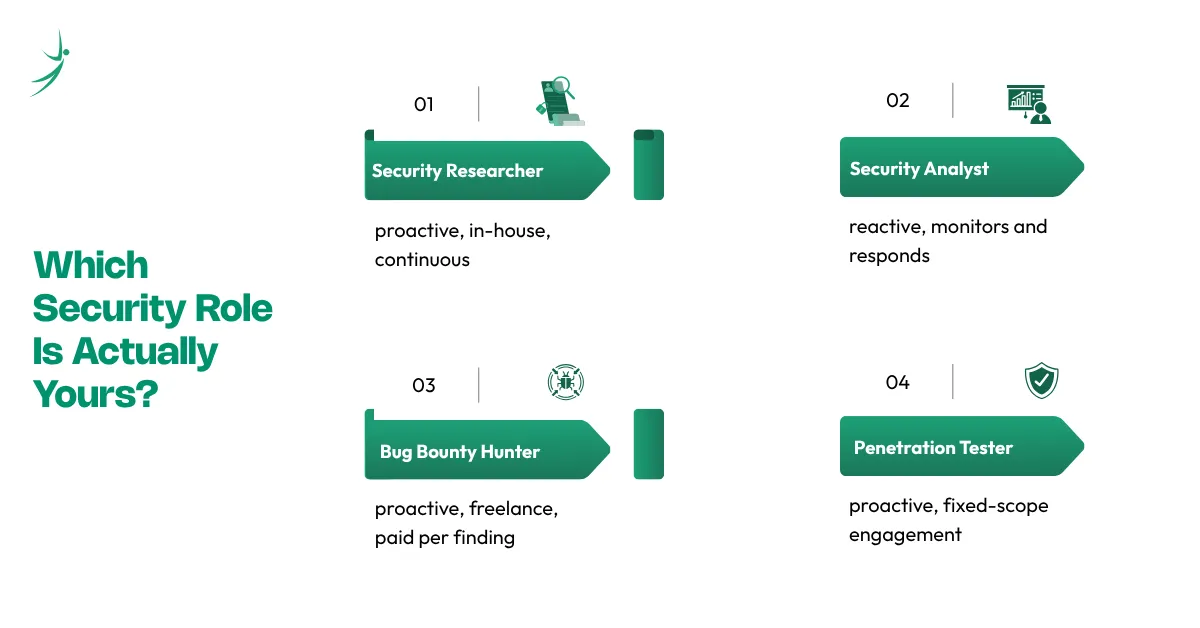
Four titles get used almost interchangeably in casual conversation, but each one describes a genuinely different working style:
- Security researcher: works proactively, discovering and understanding vulnerabilities before they get exploited, usually employed full time by one company to test that company's own products continuously
- Security analyst: works reactively, monitoring security alerts and responding to incidents as they happen, more operational than investigative
- Bug bounty hunter: does research-style work similar to a security researcher, but freelance, across many companies' programs at once, paid per validated finding rather than a salary
- Penetration tester: works a fixed, scoped engagement with a defined start and end date, usually for a client that is not their full-time employer
A useful way to think about it: a security researcher is often the employed, in-house version of a bug bounty hunter's skill set, applied continuously to one company's own applications instead of across many external programs. Bug Bounty vs Penetration Testing breaks down the freelance side of this comparison in more depth.
A Day in the Life of a Web Application Security Researcher
The daily rhythm looks less dramatic than the job title suggests, and more like a repeatable process than a series of dramatic discoveries:
- Choosing what to investigate, often based on a new feature release, a reported concern, or a recurring review cycle
- Reconnaissance and mapping, understanding how a specific application or feature actually works before testing it, often leaning on the same recon and scanning software covered in Top Bug Bounty Tools 2026
- Testing and analysis, working through potential weaknesses methodically rather than randomly
- Building a proof of concept once something looks real, confirming it is actually exploitable and not a false lead
- Writing up findings clearly enough that a developer with no security background can understand the risk and the fix
- Working directly with development teams to get issues fixed, then verifying the fix actually closes the gap
- Sharing knowledge internally, or sometimes publicly through blog posts and conference talks, so the same mistake does not get repeated elsewhere in the codebase
That last point separates this role from freelance bug bounty hunting more than anything else. A security researcher's job does not end when a report gets filed. It continues through the fix and often into preventing the same class of bug from showing up again.
A realistic example makes this concrete. Say a company ships a new referral program feature. A researcher on the internal security team picks it up as part of a routine pre-launch review, maps out how referral codes get generated and validated, and notices the validation only checks whether a code exists, not whether it has already been redeemed by the same account under a different email. Confirming that takes twenty minutes of manual testing. Writing it up clearly, with exact steps and a note on the financial impact if abused at scale, takes longer than finding it. The researcher then sits in a short call with the engineer who built the feature, walks through the fix together, and checks the patched version before it ships. That entire cycle, from noticing something subtle to confirming a real fix, is a more accurate picture of the job than any single dramatic "found a critical vulnerability" story.
Core Skills That Actually Matter
A handful of skills come up constantly across job descriptions and firsthand accounts of this work:
- Critical thinking and pattern recognition, connecting small, unrelated details into a real finding
- Technical grounding in web fundamentals, HTTP, authentication flows, and how modern applications are actually built
- Vulnerability knowledge, understanding categories like those covered in OWASP Top 10 Explained, since that shared vocabulary is what lets a researcher communicate findings clearly to a development team
- Clear written communication, since a technically correct finding that nobody can act on is close to worthless
- Continuous learning, given how quickly new frameworks, attack techniques, and vulnerability classes appear
None of these skills require natural genius. They require consistent practice, and most of them are learnable through structured study rather than years of unguided trial and error.
Tools of the Trade
The tooling for this specific role differs from what a malware-focused security researcher would use. There is no need for a disassembler or reverse engineering suite here, the toolkit centers on understanding and manipulating how web applications communicate:
- A proxy tool for intercepting and modifying HTTP traffic, the closest thing this field has to a daily-use standard. Burp Suite Tutorial for Beginners covers setting one up from the ground up
- Reconnaissance tools for mapping an application's attack surface before testing begins
- Browser developer tools, used constantly and often underestimated
- Note-taking and reporting tools, since documentation quality directly affects how useful a finding actually is to the team fixing it
Much of this overlaps directly with the bug bounty toolkit, which makes sense given how much the two roles share in terms of daily technique, even though one works for a single employer and the other works across many external programs.
Where Do Web Application Security Researchers Work?
This role shows up in a few distinct settings:
- In-house product security or application security teams, common at larger technology companies. Meta, Google, Microsoft, and Apple all maintain internal security research functions alongside their public bug bounty programs, and a researcher on one of these teams tests the company's own products full time rather than hunting across external targets
- Security consultancies, where researchers work across multiple client codebases rather than one product
- Freelance bug bounty hunting, either as a full career or alongside employment, using the same core skills against external programs instead of an internal codebase
Many people move between these settings over a career rather than picking one permanently. Bug bounty hunting often serves as the practical proving ground that leads to an employed research role later.
Career Path and Growth
Entry into this field rarely starts with the title "security researcher" directly:
- Security researcher intern or junior AppSec roles are the most common entry point, often for recent graduates or career switchers who have built a portfolio through bug bounty work or personal projects
- Mid-level researcher roles typically involve more independent ownership of specific products or application areas
- Senior researcher and security architect roles shift toward setting testing strategy and mentoring junior researchers rather than testing everything personally
- Specialization tracks open up over time, some researchers focus deeply on API security, others on a specific industry like fintech or healthcare
Bug Bounty Career Roadmap covers a closely related timeline for anyone building toward this through freelance hunting first.
Security Researcher Salary
Compensation for an employed security researcher tends to be more predictable than freelance bug bounty income, since it follows a standard salary structure rather than per-finding payouts:
- Entry-level researcher roles typically start in line with broader cybersecurity salary bands, often in the NPR 30,000 to 60,000 a month range in Nepal for a junior AppSec or researcher position, depending on the company and prior portfolio
- Mid-level roles with a few years of ownership over specific products tend to run higher, often NPR 70,000 to 130,000 a month
- Senior researcher and security architect roles command a meaningful premium, reflecting both technical depth and the mentorship and strategy responsibilities that come with seniority
This differs from the freelance bug bounty income model, where earnings scale directly with the volume and severity of validated findings rather than a fixed monthly figure, and where a single high-severity bug on a major program can pay more in one report than a month of salaried work, offset by the unpredictability of not knowing when the next payout arrives. International remote research roles, particularly at companies with a global hiring footprint, can pay meaningfully more than local Nepali bands, which is part of why many researchers build a public bug bounty track record first, since it travels well across borders in a way a local resume alone does not always.
Security Researcher Roles in Nepal
Formal, dedicated "security researcher" job titles remain relatively rare in Nepal's current job market compared to broader roles like penetration tester or security analyst. That said, the underlying skill set is identical, and demand is growing as more Nepali fintech, banking, and e-commerce companies build out internal security functions rather than relying solely on external audits or one-off penetration tests. Companies handling digital payments and mobile banking in particular have real, ongoing incentive to keep security testing continuous rather than periodic, which is exactly the gap an in-house researcher fills that an annual external pentest cannot.
Many people building toward this kind of role in Nepal start with freelance bug bounty hunting on international platforms first, both to build a portfolio and to develop the exact skills an employer would look for in a dedicated research position. That sequence, freelance hunting first, employed research role later, tends to work better than waiting for a formal researcher opening to appear, since those postings remain uncommon locally even as the underlying demand for the skill set grows.
Common Misconceptions About This Role
A few assumptions about this job do not hold up well once you look at how the work actually happens:
- "Security researchers mostly find zero-days." In reality, the vast majority of findings are known categories of bugs, misconfigurations, logic flaws, missing access checks, applied to a specific application, not novel, headline-worthy discoveries.
- "It is a solitary, heads-down job." Much of the actual work involves talking to developers, explaining risk to non-technical stakeholders, and coordinating fixes, not just quiet independent testing.
- "You need years of experience before anyone takes you seriously." A strong portfolio of validated bug bounty reports often carries more weight with hiring teams than years of unrelated IT experience.
- "The job is mostly about breaking things." Just as much of the role involves helping teams build things correctly the first time, through threat modeling and design review, as it does finding flaws after the fact.
Conclusion
The title "security researcher" covers more ground than most people realize, and getting specific about which version of the role you are actually aiming for matters more than memorizing a generic job description. For anyone aiming specifically at the web application security side of this field, the skills, tools, and daily workflow overlap almost entirely with bug bounty hunting, which makes hands-on practice the most direct path in, regardless of whether the end goal is a freelance career or an employed research role.
Skill Shikshya's bug bounty training course builds exactly this overlapping skill set, so the same training applies whether the goal is freelance bug bounty income or a full-time research position on a company's internal security team.
Frequently Asked Questions
Is a security researcher the same as an ethical hacker?
Do I need a degree to become a security researcher?
Is this role the same as a bug bounty hunter?
What is the difference between a security researcher and a penetration tester?
How long does it take to become a security researcher?
How do I become a security researcher without prior experience?
What does a security researcher intern actually do?
Is security research a stressful job?
Do security researchers need to know how to code?
About Author:

Mr. Asim Chaulagain, Full Stack MERN mentor at SkillShikshya and developer at Vrit Technologies, empowers learners to build real-world web applications. Through hands-on projects, he turns coding skills into practical, career-ready expertise.