Bug Bounty Career Roadmap | Skill Shikshya
A bug bounty career roadmap moves through five stages: fundamentals, practical skills, first real hunting, intermediate testing techniques, and specialization, typically spanning 6 to 8 months to a first paid bounty and a year or more to consistent income. This guide breaks down each stage honestly, without the "90 days guaranteed" hype that dominates a lot of roadmap content online. Skill Shikshya's bug bounty and web application security training course compresses much of this timeline through structured, hands-on labs rather than the trial and error most self-taught hunters go through.
Bug bounty hunting in 2026 is genuinely harder than it was in 2018 to 2020. Companies patch faster, run their own internal scanning, and mature programs have already had thousands of hunters pick through the obvious bugs. What has not gotten harder is the attack surface. Companies keep shipping microservices, complex APIs, and multi-cloud architectures faster than they can secure them, which means the opportunity has shifted rather than disappeared, toward people who actually understand what they are testing instead of running the same scanner everyone else already ran.
Is Bug Bounty Even Right for You?
Before committing months to this roadmap, a few honest questions are worth answering first. For the full picture of what this career actually involves day to day, this starting guide into bug bounty covers the broader landscape this roadmap sits inside.
| If you want... | Bug bounty fits | A different path fits better |
|---|---|---|
| A predictable paycheck from month one | No | Employed pentesting or SOC roles |
| Flexible hours and independent work | Yes | Freelance consulting offers this too, but with client deadlines attached |
| Fast, structured entry into cybersecurity | Somewhat | Blue team/SOC roles hire faster |
| Deep technical problem solving | Yes | Security researcher roles offer this with more structure and mentorship |
| Zero income instability while learning | No | Keep a primary job or income source |
A few things worth stating plainly before the roadmap itself:
- Income is unstable, especially in the first year. Treat bug bounty as a skill-building investment and income supplement early on, not a primary income source from day one.
- Nearly every experienced hunter who has written honestly about this agrees on one point: do not do this full time from the very beginning. Multiple income sources matter until bug bounty proves itself consistently.
- The field rewards persistence over raw intelligence. Most beginners do not fail because they lack the aptitude, they fail because they quit during the unglamorous early months.
- This is fundamentally a solo pursuit for long stretches of time, punctuated by community moments. Someone who thrives on daily team collaboration may find the isolation harder to sustain than someone comfortable working independently for hours at a stretch.
- Curiosity matters more than any single technical skill at the start. The hunters who stick with this long enough to succeed tend to describe genuinely enjoying the puzzle-solving itself, not just chasing the payout.
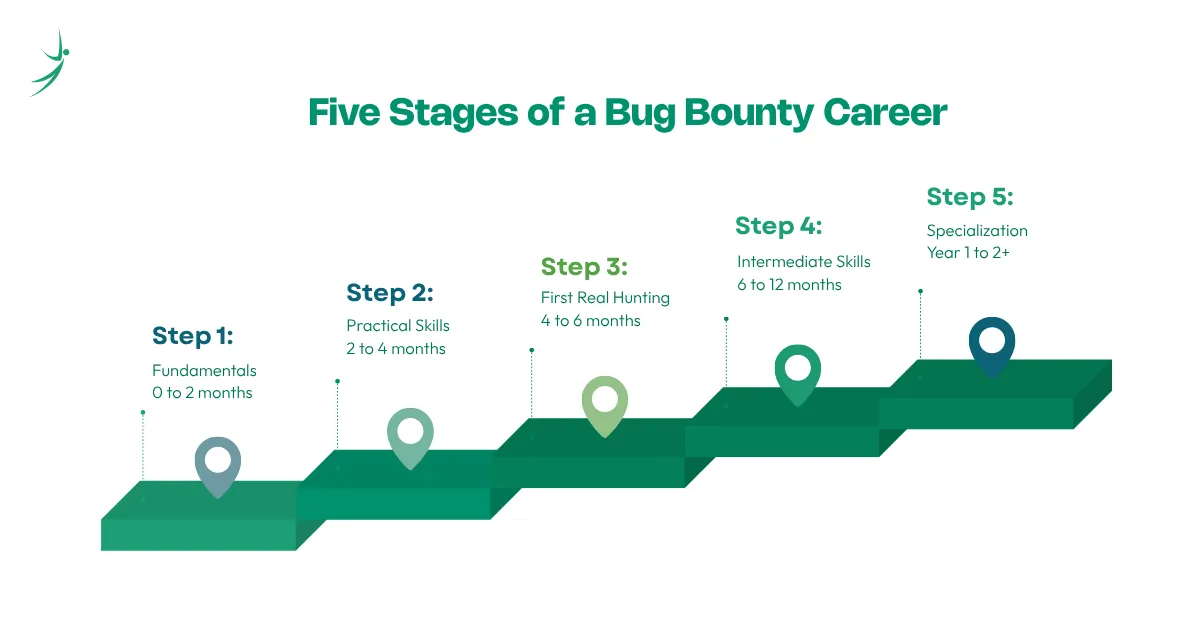
Stage 1: Absolute Fundamentals (Months 0-2)
Nobody skips this stage successfully. The hunters who try to jump straight to exploitation without this foundation end up memorizing payloads they do not understand, which stops working the moment a target behaves slightly differently than a tutorial example.
Core knowledge to build first:
- How data moves across the internet: DNS, IP addresses, and ports, since almost every recon step later in this roadmap assumes this is second nature
- HTTP requests and responses, headers, methods, and status codes, the actual language every tool in this field speaks
- How sessions and cookies work, and what makes one secure or not, since broken session handling shows up in a huge share of real findings
- Basic JavaScript and how the DOM works in a browser, enough to read what a page's client-side code is actually doing
- The core vulnerability categories: cross site scripting, SQL injection basics, and broken authentication, the three categories almost every beginner's first valid bug falls into
None of this requires memorizing a textbook. It requires enough hands-on repetition that reading a raw HTTP request stops feeling like reading a foreign language. A common trap at this stage is rushing through fundamentals to get to "real hacking" faster, which almost always backfires, since every later stage assumes this foundation is solid enough to build on without gaps.
This introduction to Bug Bounty Hunting covers the fundamentals of the field itself in more depth, and it pairs well with this stage before moving into anything hands-on.
Stage 2: Building Practical Skills (Months 2-4)
This stage is where fundamentals turn into muscle memory through repetition on safe, legal targets:
- Work through free labs like PortSwigger's Web Security Academy and beginner-friendly TryHackMe rooms, aiming for consistency over speed, a little most days beats a lot once a week
- Set up a proxy tool and get comfortable intercepting and modifying real traffic until it feels routine rather than intimidating
- Start a recon notebook, a simple running log of targets, subdomains, endpoints, and technology stacks noticed along the way, since this habit compounds significantly once real hunting starts in Stage 3
- Build small, repeatable proof of concept templates rather than starting from scratch every time, saving reusable notes on common request patterns and payloads that worked in labs
A realistic pace at this stage looks like a few labs a week rather than an all-day marathon followed by a week off. The people who burn out hardest tend to be the ones who treat this stage like a sprint instead of the beginning of a much longer habit.
Burp Suite Tutorial for Beginners walks through setting up the single most important tool for this stage, since nearly everything from here forward runs through some form of request interception.
Stage 3: First Real Hunting (Months 4-6)
This is where most beginners either build real momentum or quietly give up. A few decisions here matter more than any tool or technique:
- Do not start on massive programs. Google, Meta, and Apple attract thousands of active hunters, and most accessible bugs on these targets have already been found repeatedly. Vulnerability Disclosure Programs (VDPs) and newer, smaller programs offer far less competition and a genuinely higher chance of finding something real.
- Read disclosed reports before testing anything. Reading through 50 or more publicly disclosed reports on HackerOne's Hacktivity feed shows exactly what kind of bugs get accepted and how experienced hunters structure their write-ups.
- Commit to one target for at least 6 to 8 weeks before switching. Constantly jumping between targets is one of the most common reasons beginners never build the pattern recognition that leads to a first valid bug.
- Submit reports early, even mediocre ones. Five to ten submitted reports, duplicates and invalids included, teaches more about the process than dozens of hours spent testing without ever submitting anything.
Bug Bounty Platforms Compared breaks down which platforms actually suit a beginner at this stage, since platform choice does matter here even if it matters less later on.
A realistic version of this stage looks something like this: a hunter picks a mid-sized VDP with a broad scope, spends the first week purely on recon and reading that program's disclosed history, spends weeks two through five testing methodically against a mental checklist rather than randomly, submits two reports that come back as duplicates, and finally lands a valid low-severity finding in week six. That is not a failure story. That is close to the median experience for anyone following this stage honestly, and it looks nothing like the highlight-reel "found a critical on day one" stories that dominate social media.
Stage 4: Intermediate Skills (Months 6-12)
Once a first bug or two has landed, the skill ceiling needs to rise to keep finding things that pay:
| Skill area | What it covers |
|---|---|
| API authentication | JWT structure and validation flaws, OAuth 2.0 flow weaknesses |
| Parameter tampering | Manipulating values the application assumes a user cannot change |
| Insecure deserialization | Exploiting how an application reconstructs data from stored or transmitted objects |
| Access control (IDOR) | Changing identifiers to reach data or actions that belong to someone else |
| Cloud misconfigurations | Publicly exposed storage buckets, overly permissive access policies |
| Modern framework awareness | React and Next.js-specific issues, since client-side state and server components behave differently than classic server-rendered pages |
Most of these categories map directly onto OWASP Top 10 Explained, which remains the clearest reference for understanding why each of these categories consistently pays well across nearly every program. This stage tends to take longer than the first three combined, since each row in that table represents weeks of practice rather than a single afternoon's reading, and rushing through it to reach specialization early usually just means specializing on a shaky foundation.
Stage 5: Specialization and Advanced Mastery (Year 1-2+)
Generalist hunting has a ceiling. The hunters who build serious, sustained income tend to narrow their focus rather than staying broad forever:
- Pick a lane. Some specialize entirely in client-side vulnerabilities, others in API security, mobile app testing, or cloud infrastructure. Depth in one area consistently outperforms shallow coverage across everything, and it is not unusual for a hunter who narrows down to a single vulnerability class to end up finding more of it, faster, than generalists testing the same programs.
- Go deeper on protocol-level detail. This stage is where advanced topics start paying off: HTTP/2 quirks, TLS internals, reverse-proxy request smuggling, and web cache poisoning are all real, well-documented categories that fewer hunters understand well, which means less competition for anyone who does. Following published research from well-known security researchers in this space is often more valuable at this stage than any course.
- Build public credibility. Sharing writeups, without disclosing live, unpatched proof of concepts, builds a reputation that often matters as much as the bounty money itself for unlocking private program invitations. A public track record of clear, well-documented findings functions almost like a portfolio in any other creative field.
- Stay current deliberately. Following researchers on platforms like Twitter/X, joining active Discord communities, and reading new disclosed reports regularly keeps pace with how fast this field's edge cases shift. Techniques that worked reliably two years ago sometimes stop working entirely as frameworks patch common patterns, and staying connected to a community catches that shift faster than working in isolation ever will.
This is also the stage where the earlier "generalist first" advice flips. Years one and two build breadth. Year two onward tends to reward committing to depth in one or two areas rather than continuing to spread attention across everything.
Common Mistakes That Stall Progress
A short list, since these show up constantly across nearly every honest account of learning this field:
- Copying payloads from YouTube or blog posts without understanding why they work, which falls apart the moment a target differs slightly from the example
- Hunting massive, heavily picked-over programs on day one instead of starting where competition is lower
- Running automated scanners blindly without any manual recon first, mistaking scanner noise for actual findings
- Switching targets every few days instead of committing long enough to actually understand one application
- Working unsustainable hours and burning out, when steady, paced effort over months consistently outperforms short bursts of obsession
- Treating every rejected report as proof of failure rather than normal feedback, when even experienced hunters get duplicates and invalids regularly
- Hunting in isolation without ever engaging a community, which slows learning considerably compared to hunters who discuss techniques and read others' writeups regularly
A Realistic Income Timeline
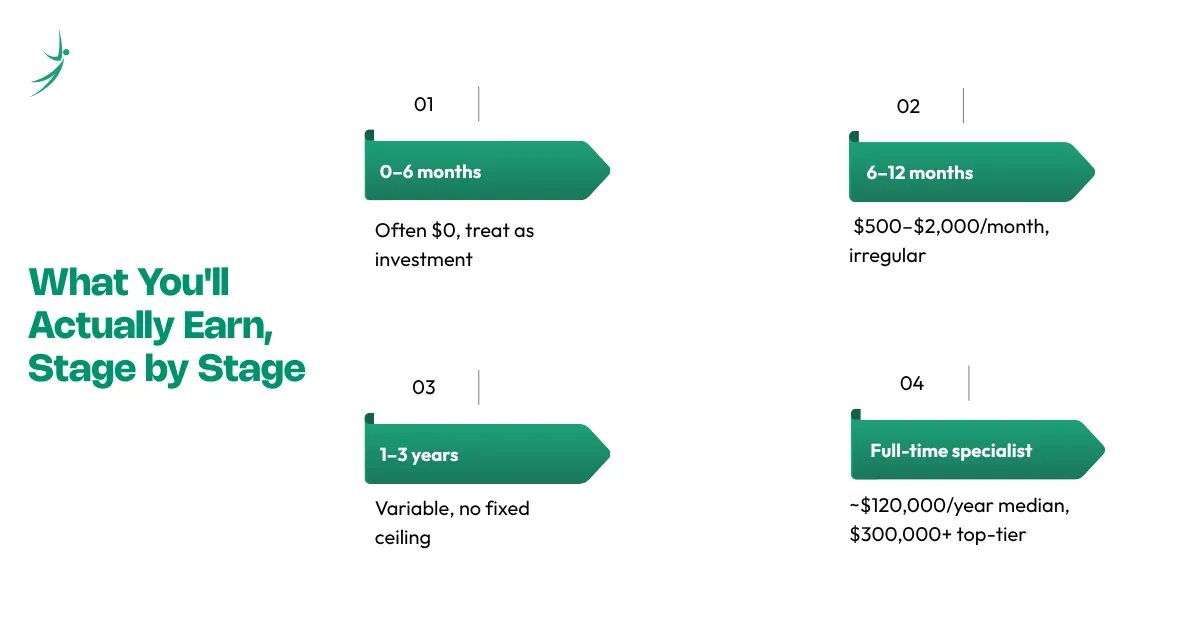
Income expectations deserve honesty rather than hype:
| Stage | Realistic income expectation |
|---|---|
| First 0-6 months | Often zero to minimal, treat this as a learning investment |
| 6-12 months, first bounties landing | Irregular, commonly 500 to 2,000 dollars a month if hunting consistently part time |
| 1-3 years, consistent hunter | Variable but more frequent, no fixed ceiling per bug |
| Full-time, specialized hunter | Around 120,000 dollars a year median for consistent output, with top-tier hunters reporting 300,000 dollars a year or more |
Payout ceilings on individual bugs vary enormously by company and severity. Apple's official Security Bounty program currently offers up to 2 million dollars for exploit chains meeting sophisticated spyware-level criteria, with total payouts able to exceed 5 million dollars for combined critical categories, while Google's Bug Hunters program records its largest single Android reward on record at 605,000 dollars. Figures like that represent the extreme high end, not a typical outcome, but they show the real ceiling that specialization and persistence can eventually reach.
Automation can speed up parts of this timeline, particularly recon, but it does not replace the manual judgment needed to confirm whether something automated actually flagged is a real, exploitable bug rather than a false positive. Treating the income timeline honestly also means accepting that progress rarely moves in a straight line. Some months produce nothing at all even for experienced hunters, followed by a month where two or three solid reports land close together. Averaging income over a full year, rather than judging any single slow month too harshly, gives a far more accurate picture of whether this path is actually working.
Bug Bounty Career Roadmap in Nepal
This roadmap applies in Nepal exactly as it does anywhere else, but the local context shapes a few practical decisions:
- Very few Nepali companies run formal bug bounty programs of their own yet, so nearly all of the practical hunting experience in Stages 3 through 5 happens on international platforms rather than local ones.
- Digital banking, mobile wallets, and government e-services have expanded quickly, which means the underlying demand for this skill set in Nepal is real and growing, even without many local programs to test against directly.
- Many Nepali hunters build this roadmap alongside an existing job or studies rather than treating it as a full-time pursuit from month one, which matches the broader advice already covered above.
- Community matters even more in a smaller local market. Connecting with other Nepali hunters, whether online or through local meetups, tends to shorten Stage 1 and Stage 2 considerably compared to learning in complete isolation.
- International remote income, once Stage 3 or 4 is reached, often ends up meaningfully higher than what a comparable entry-level local IT job would pay, which is part of why so many Nepali hunters treat this roadmap as a genuine career path rather than a hobby.
Conclusion
There is no shortcut through these five stages, no matter what a "90 days to your first bounty" headline promises. What actually works is closer to what the most experienced, honest sources describe: steady fundamentals, deliberate practice on real but manageable targets, patience through the first few unglamorous months, and a gradual narrowing toward specialization once the basics are second nature.
Skill Shikshya's bug bounty training course compresses the early stages of this roadmap through structured, live-lab training, so the fundamentals and practical skills stages move faster than most self-taught paths allow, without skipping the depth that stages three through five still demand.
Frequently Asked Questions
How long does it actually take to get a first bounty?
Can I follow this roadmap while working a full-time job?
Do I need to learn every vulnerability category before I start hunting?
Is it too late to start bug bounty hunting in 2026?
Should I specialize early or stay a generalist?
What is the biggest reason beginners quit?
Do I need a cybersecurity degree to follow this roadmap?
Are free GitHub roadmap repositories worth following instead?
About Author:

Ashmit Adhikari is a passionate cybersecurity professional with experience in network security, vulnerability assessment, and penetration testing. He currently works at Eminence Ways as a Network Security Analyst and contributes to the Synack Red Team as a Security Researcher.
At SkillShikshya, Mr. Ashmit guides students through the real-world side of cybersecurity, helping them build practical skills, think critically, and develop a strong foundation for their careers.