Bug Bounty vs Penetration Testing: Which Career Should You Choose?
Search "bug bounty vs penetration testing" and almost everything that comes back is written for a company deciding which service to buy, not for a person deciding what to do with their career. This guide takes the second angle instead. It breaks down what separates bug bounty hunting from penetration testing as actual jobs, what each one pays, how much skill carries over between them, and which one makes sense to start with. Skill Shikshya's bug bounty and web application security training course teaches the skills both careers actually run on.
What Is Penetration Testing? (Quick Definition)
Penetration testing, usually shortened to pentesting, means a security professional gets hired to simulate a real attack against a company's systems within an agreed scope and timeline. A few things define the role:
- A small team, often just one to three testers, handles the engagement.
- The scope, timeline, and cost are fixed before testing begins.
- The final deliverable is a full report covering every finding, including low severity issues, since many pentests exist specifically to satisfy compliance requirements.
- The client has a direct relationship with the testing team throughout the engagement.
Pentesting also splits into several distinct types depending on what gets tested: network pentesting, web application pentesting, mobile app pentesting, and social engineering assessments that test how employees respond to phishing or manipulation attempts. Most professional pentesters specialize in one or two of these rather than covering all of them equally well.
For anyone starting from scratch, this guide on how to get into bug bounty covers the fundamentals this comparison builds on.
What Is Bug Bounty Hunting?
Bug bounty hunting means finding and reporting security flaws through an authorized program in exchange for a reward tied to how serious the finding is. What Is Bug Bounty Hunting covers this in full depth, but the short version:
- Hundreds of independent hunters can test the same program at once.
- There is no fixed timeline. Programs run continuously for months or years.
- Payment happens per validated finding, not for hours worked.
- Hunters choose their own approach, since bug bounty hunting has no required methodology the way pentesting does.
Key Differences at a GlanceKey
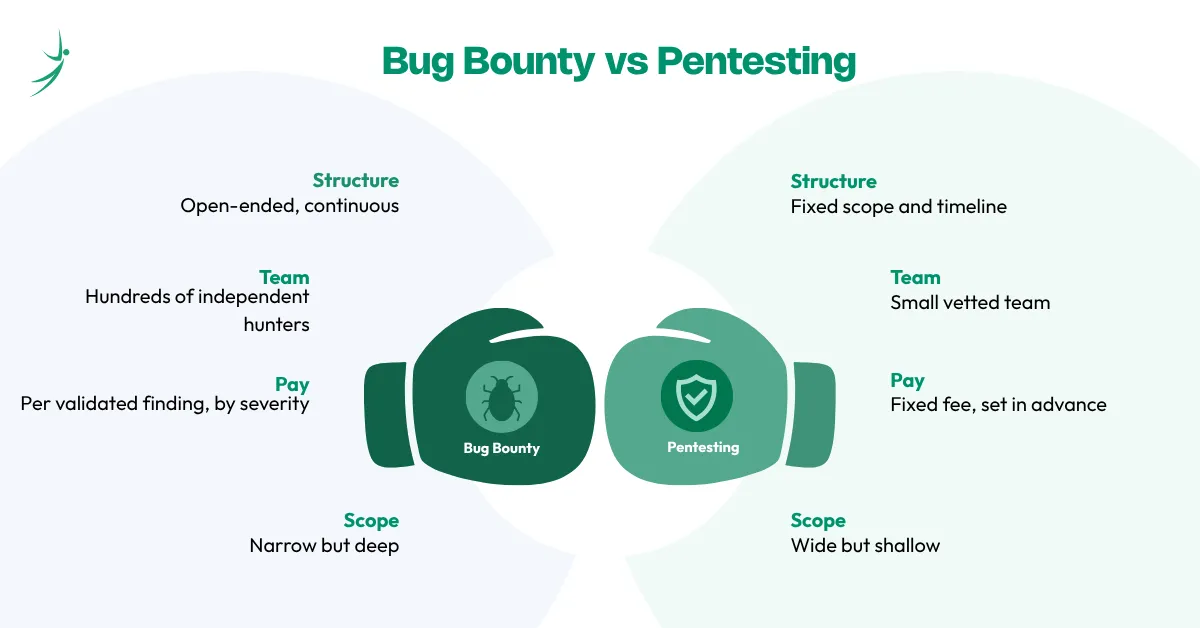
| Factor | Penetration Testing | Bug Bounty Hunting |
|---|---|---|
| Structure | Fixed scope, fixed timeline | Open-ended, continuous |
| Who does it | Small vetted team | Hundreds of independent hunters |
| Pay model | Fixed fee, paid regardless of findings | Paid per validated finding, tied to severity |
| Duration | Days to weeks, run periodically | Months to years, ongoing |
| Methodology | Structured, follows a defined framework | Freestyle, hunter's own approach |
| Report style | Comprehensive report, all findings included | Individual reports, one per bug |
| Typical entry point | Junior pentester role or internship | Public program or VDP as an individual |
| Common certifications | OSCP, CEH, PNPT | eWPT, OSWE, PortSwigger Academy |
| Best for | Compliance, point-in-time assurance | Continuous coverage, catching what scanners miss |
Companies increasingly run both instead of choosing one. Bugcrowd reports that organizations combining pentesting with a bug bounty program find three to five times more high-impact vulnerabilities than pentesting alone, which says something useful for anyone building a career here too: the two approaches complement each other more than they compete.
Which One Pays More, and How
This is where the career angle actually matters, and it is the part most comparison articles skip entirely since they are written for buyers, not job seekers:
- Penetration testing usually means employment or a contract role. Income is predictable, work happens as part of a team, and each engagement has a defined start and end date.
- Bug bounty income ties directly to what a hunter finds. It is freelance by nature, competitive since many hunters chase the same programs, and offers no guaranteed paycheck, though a single high-severity bug on a major program can pay more than a month of salaried work.
| Level | Bug Bounty Hunting | Penetration Testing |
|---|---|---|
| Entry / Beginner | Irregular, 500 to 2,000 dollars a month if hunting part time | NPR 25,000 to 50,000 a month |
| Active / Mid-level | Irregular, no fixed ceiling per bug, scales with severity and volume | NPR 60,000 to 120,000 a month |
| Full-time / Senior | Around 120,000 dollars a year median for consistent full-time hunters, 300,000 dollars a year or more for top-tier hunters | NPR 150,000 to 250,000 or more a month |
- Companies like Meta, Apple, and Google run some of the largest public bug bounty programs, and their payout ranges give a sense of the ceiling on the bug bounty side, while pentesting income tends to track more closely with standard cybersecurity salary bands.
- Realistically, most people in this field do both. An employed pentesting role covers stable income, while bug bounty hunting on the side builds extra income and a public reputation. That combination, not a strict either-or choice, describes how most working professionals actually structure their careers.
Scope: What Each One Actually Covers
Pay and structure get most of the attention, but scope, meaning what a tester is actually allowed to touch, differs just as much between the two:
| Target Type | Penetration Testing | Bug Bounty Hunting |
|---|---|---|
| Web applications | Commonly included | Most common target by far |
| Internal networks | Frequently included | Almost never in scope |
| Mobile applications | Included if requested | Included on some programs |
| APIs | Increasingly common | Growing category on most platforms |
| Social engineering and phishing | Sometimes included | Essentially never |
| Physical security | Occasionally included | Never |
| Cloud infrastructure | Included if requested | Rarely, unless explicitly listed |
| Third-party integrations | Depends on the client agreement | Usually excluded unless named in scope |
Pentesting scope tends to run wider but shallower across an entire environment, while bug bounty scope stays narrower and deeper, usually locked to a specific set of domains or applications listed in a published scope document. That difference alone explains a lot of the earlier comparison: a pentester needs broader skills across networks and infrastructure, while a bug bounty hunter can go deep on a smaller set of web-facing targets and still find high-value bugs.
A Day in the Life: Pentester vs Bug Bounty Hunter
The daily rhythm of each role looks different enough that it often decides which one actually suits a person, regardless of pay:
- A pentester typically starts the day with a scoping call or standup, works through a predefined test plan against a specific target, documents findings as the day goes, and wraps up with a team debrief. The structure repeats across a fixed engagement window, usually one to four weeks.
- A bug bounty hunter usually starts by checking updates on active programs, picks a target based on personal interest or a fresh scope change, spends hours in open-ended recon and testing with no set plan, and writes up a report only once something real turns up. Some days produce nothing at all, which is normal in this line of work.
- Pentesters collaborate constantly with teammates and the client. Bug bounty hunters mostly work alone, though many stay active in community Discord servers and forums to trade tips and learn from others' public writeups.
Neither rhythm is objectively better. Someone who likes routine and teamwork usually gravitates toward pentesting, while someone who prefers open-ended problem solving on their own schedule tends to prefer bug bounty hunting.
How Much Skill Actually Transfers Between the Two
More than most people expect, but not everything:
- Reconnaissance, vulnerability knowledge, and clear report writing carry over completely between the two roles.
- Pentesting often covers a wider scope than bug bounty, including internal networks, social engineering, and sometimes physical security testing, none of which typically shows up in a standard bug bounty program.
- Bug bounty stays narrowly focused on web, mobile, and API targets in most cases, which makes it a faster way to build depth in application security specifically.
- Both fields increasingly use AI assisted tools for recon and triage, though neither has replaced the manual judgment needed to confirm a real, exploitable bug versus a false positive.
- Tool overlap is real too. Burp Suite shows up in both worlds, while broader penetration testing tools like Metasploit and Nmap see more use on the pentesting side, where network-level testing is more common.
Which One Should You Choose?
A simple way to decide:
- Choose penetration testing first if steady income, team-based work, and a structured entry point matter more right now than flexibility.
- Choose bug bounty first if independence, flexible hours, and building a public track record appeal more than a fixed paycheck.
- Consider bug bounty as the on-ramp either way. Many working penetration testers started by hunting bounties to build a portfolio of accepted reports, since that track record is often what gets a foot in the door for an employed role in the first place.
Two sequences show up most often in practice:
- Bounty first, then employment: spend six months to a year hunting on free labs and public programs, build a portfolio of accepted reports, then use that portfolio to apply for a junior pentesting or application security role.
- Employment first, then bounty on the side: land an entry-level pentesting or security analyst job for stability, then hunt bounties on evenings and weekends once the day job builds enough baseline skill and confidence.
Both paths work. The choice usually comes down to how comfortable someone is with unpredictable early income versus wanting a paycheck from day one.
Bug Bounty vs Pentesting in Nepal
Most current cybersecurity job openings in Nepal are structured, employed penetration testing or security analyst roles, since very few Nepali companies run formal bug bounty programs of their own yet. Banks, telecom operators, IT security consultancies, and growing fintech companies make up most of the local hiring for pentesting and security analyst positions. Bug bounty hunting stays mostly a freelance activity for Nepali hunters, built around international platforms rather than local programs. Scope of Bug Bounty in Nepal covers what this actually looks like sector by sector, including where local demand is starting to grow.
Conclusion
Neither path is the wrong choice. Penetration testing offers structure, team support, and predictable income from early on, while bug bounty hunting rewards independence and can pay well once a hunter builds real consistency. Most careers in this field end up blending both rather than sticking to one forever, and the skills that matter most, recon, vulnerability knowledge, and clear reporting, carry over regardless of which one comes first.
The fastest way to build that foundation properly, instead of piecing it together from scattered tutorials, is through structured, hands on training. Skill Shikshya's bug bounty training course covers both sides of this comparison directly, recon, the OWASP Top 10, professional reporting, and the same skill set that opens doors into either a bug bounty career or an employed penetration testing role.
Frequently Asked Questions
Can I do both bug bounty and pentesting?
Which pays more overall?
Do I need different certifications for each?
Which is better for a complete beginner?
Is bug bounty riskier as a full-time career than pentesting?
Can I switch from pentesting to bug bounty later, or the other way around?
About Author:

Meet Mr. Anjush Khanal, Cybersecurity mentor at SkillShikshya. He guides learners through ethical hacking concepts, security practices, and hands-on cybersecurity techniques to turn curiosity into practical digital defense skills.