What Is Bug Bounty Hunting?
Bug bounty hunting means finding security flaws in a company's website, app, or software, then reporting them through an authorized program in exchange for money or recognition. Companies from small startups to Google and Meta run these programs because outside researchers catch things internal teams miss, and it costs far less than recovering from an actual breach. This guide breaks down what a bug bounty program actually is, how the process works, who runs the biggest ones, and what it realistically takes to get started. For the full step by step path into this field, the career guide on how to get into bug bounty covers that separately, and Skill Shikshya's bug bounty and web application security training course teaches all of it hands on.
What Is Bug Bounty Hunting?
Picture a company hiring an independent team of testers to try every door and window in a building before a real burglar gets the chance. That is bug bounty hunting, except the building is a website, an app, or an API, and the testers are researchers working under a published set of rules.
- A few things define bug bounty hunting specifically:
- A hunter finds a genuine security flaw, not just a cosmetic bug or a feature request.
- The hunter reports it through an authorized channel, never by exploiting it for personal gain.
- The company reviews, confirms, and fixes the issue.
- The hunter receives a reward, which can be cash, credit, or public recognition depending on the program.
The people who do this work go by a few names: bug bounty hunters, security researchers, or ethical hackers, a term that overlaps with the broader cybersecurity field but describes a specific, permission based way of working. All three terms describe the same role.
Companies rely on this crowdsourced approach for a simple reason. A single internal security team, no matter how skilled, thinks about an application the same way every day. Opening testing up to hundreds or thousands of outside researchers brings in different backgrounds, different attack habits, and different blind spots covered, which internal teams and automated scanners alone tend to miss.
Where Did Bug Bounty Hunting Come From?
Bug bounty hunting is not a new idea dressed up in modern branding:
- Netscape ran the first widely recognized bug bounty program in 1995, offering rewards for flaws found in the beta version of Netscape Navigator 2.0.
- The core concept goes back further. Companies have paid outsiders to find weaknesses in physical security systems for well over a century, and rewarding someone for pointing out a flaw rather than exploiting it is a very old idea applied to a new problem.
- Facebook launched its own program in 2011, and the early years produced a case worth knowing: in 2013, a researcher who could not get Facebook's team to respond to a valid report ended up demonstrating the bug by posting on Mark Zuckerberg's own profile. Facebook fixed the flaw but refused to pay a bounty, since the researcher had gone outside the program's rules to prove it. The incident became a widely cited lesson in why following scope and reporting procedures matters, even when a company is slow to respond.
- Microsoft, Google, Mozilla, the European Union, and even the United States federal government now run their own programs directly, alongside thousands of smaller companies that run theirs through third party platforms.
- What changed in the last decade is scale. Platforms built specifically to run these programs turned a handful of company-run initiatives into an entire industry, with thousands of programs active at any given time.
Knowing this history matters for one practical reason: bug bounty hunting has thirty years of established practice behind it, not a trend that could disappear next year.
Bug Bounty Program vs Vulnerability Disclosure Program (VDP)
This distinction trips up more beginners than almost anything else in the field, so it is worth covering directly:
- A bug bounty program pays researchers for valid, in-scope findings. Payout amounts usually scale with how serious the bug is.
- A vulnerability disclosure program (VDP) invites researchers to report issues but does not promise payment, only recognition and legal protection for testing in good faith.
- Both types give researchers what is called safe harbor, meaning the company will not pursue legal action against a hunter who follows the published rules.
- Many companies start with a VDP before launching a paid program, since it costs nothing and still surfaces real vulnerabilities.
Beginners often start on VDPs specifically because they tend to be less competitive than high-profile paid programs, which makes them a reasonable place to build experience first.
How Does a Bug Bounty Program Actually Work?
The process follows roughly the same order across almost every platform:
- The company publishes a scope document listing exactly what a hunter can and cannot test.
- A hunter reviews the scope and begins testing within those boundaries.
- When the hunter finds something real, they write a report with clear reproduction steps and a proof of concept.
- The company's security team triages the report to confirm it is valid, in scope, and not already known.
- If confirmed, the engineering team fixes the issue.
- The hunter receives the reward once the fix is verified, or sometimes as soon as the report is validated, depending on the program.
A report full of vague reproduction steps is one of the most common reasons a genuinely valid bug gets rejected or marked as informative instead of paid, so clarity in that report matters as much as finding the bug itself.
A handful of terms show up in almost every program, and knowing them early saves a lot of confusion:
- Scope: the exact list of domains, apps, or assets a hunter is allowed to test, along with anything explicitly off limits.
- Proof of concept (PoC): a clear demonstration, usually screenshots or a short recording, showing exactly how the bug works.
- Triage: the review stage where the company's security team confirms a report is real, in scope, and not a duplicate.
- Severity rating: a score, often based on the CVSS framework, that determines how serious a bug is and how much it pays.
- Duplicate: a valid bug that someone else already reported first. Only the first hunter to report a given issue usually gets paid.
Who Runs Bug Bounty Programs? (Real Examples)
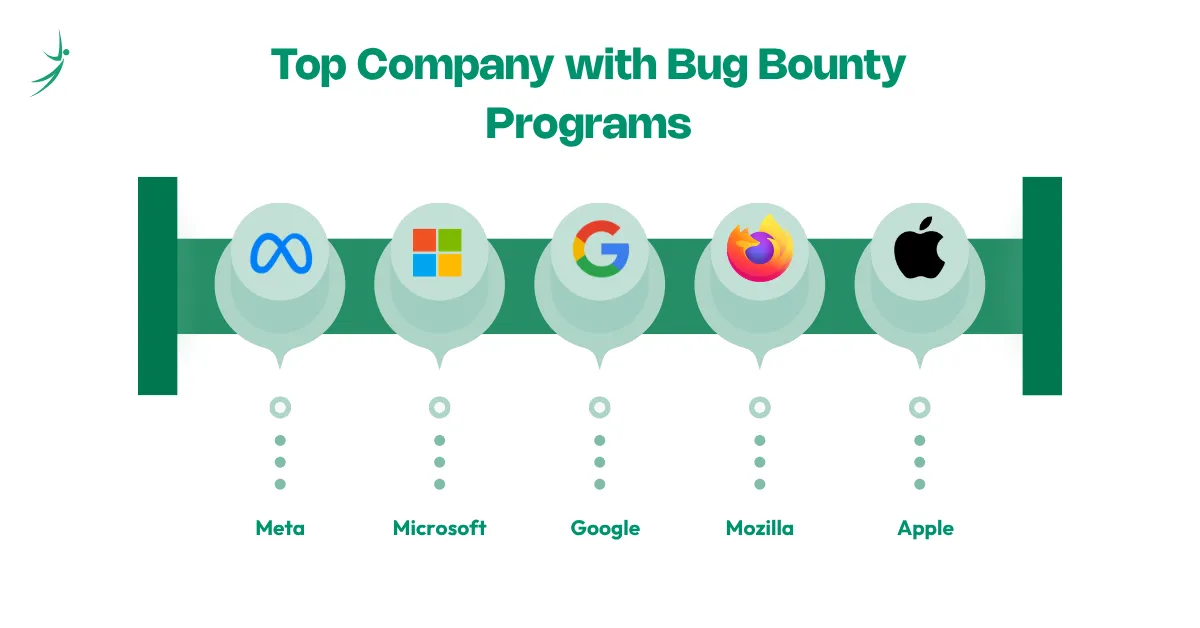
Nearly every major tech company runs some form of bug bounty program, and the payout numbers are public in most cases:
- Meta pays a minimum of 500 dollars per confirmed vulnerability across Facebook, Instagram, and WhatsApp, with mobile remote code execution bugs paying up to 300,000 dollars. Meta has paid out more than 15 million dollars total since the program began in 2011.
- Google runs a Vulnerability Reward Program covering Google, Google Cloud, Android, and Chrome, with rewards ranging from 500 dollars up to 31,337 dollars for critical findings.
- Mozilla pays between 3,000 and 20,000 dollars per bug in the Firefox browser, depending on severity and exploitability.
- Microsoft and Apple both run active programs across their product lines, with Apple's program covering everything from iCloud to the App Store.
- Uber, Dropbox, and Shopify run active programs too, showing this is not just a big tech phenomenon. Companies of nearly any size and sector run some form of bug bounty or vulnerability disclosure program today.
Most of these programs run either through a company's own portal or through a third party platform like HackerOne, which handles scope publishing, report submission, and payouts on the company's behalf. Platforms like this exist specifically because managing a bug bounty program well, triaging reports fast and paying fairly, takes real operational work, and most companies would rather outsource that than build it from scratch.
What Does a Bug Bounty Hunter Need to Know?
Nobody needs to master everything at once, but a working knowledge of a few areas makes the difference between guessing and actually finding something:
- Web fundamentals: how HTTP requests and responses work, what cookies and sessions do, basic DNS.
- Security protocols: a working sense of how SSL/TLS and OAuth function, since misconfigurations in both show up constantly in real reports.
- Basic tooling: at minimum, a proxy tool for intercepting web traffic, which nearly every hunter learns early on.
- Scripting basics: Python or JavaScript helps once testing moves past the simplest bug categories.
A few vulnerability categories account for most of what beginners find early on:
- Cross site scripting (XSS), where an attacker injects malicious scripts that run in another user's browser.
- SQL injection, where flawed input handling lets an attacker manipulate a database directly.
- Broken authentication, covering weak session handling, predictable tokens, or login flows that can be bypassed.
- Insecure direct object references (IDOR), where changing an ID in a URL exposes data that belongs to someone else.
The full OWASP Top 10 covers these categories and six more in depth, and it remains the standard reference point for what to learn first.
None of this requires a computer science degree. Most working bug bounty hunters are self taught or came through structured training rather than a formal degree program.
Is Bug Bounty Hunting Legal?
Yes, with one condition that matters more than any other: testing has to stay inside the scope a program publishes.
- Testing within scope, under a program's published rules, is fully legal and protected by safe harbor.
- Testing outside that scope, even accidentally, counts as unauthorized access, which carries real legal consequences.
- Geography does not change this. A hunter in Nepal testing a US or European company's in-scope assets is just as protected as a hunter based in that company's own country, as long as the scope document is followed.
- This is also where bug bounty hunting differs from freelance penetration testing, a distinction covered in more depth in Bug Bounty vs Penetration Testing.
Reading a program's scope document carefully, before testing anything, is the single most important habit a beginner can build.
How Long Does It Take to Find Your First Bug?
Most guides skip this question or answer it with hype. A more honest answer:
- Most beginners who study consistently and practice on labs first find their first valid bug somewhere between 4 and 12 weeks of steady effort.
- A large share of beginners quit between week 6 and week 10, right before the pattern recognition that leads to a first bug usually kicks in.
- Recon quality and report clarity decide the timeline far more than luck or natural talent.
- Treating the first few months as a learning phase rather than an earning phase leads to better outcomes than expecting fast money.
Bug Bounty Hunting in Nepal
Bug bounty hunting works in Nepal the same way it works anywhere else. Testing stays permission based and scope still defines the rules, but the local market has a few differences worth knowing before diving in:
- Very few Nepali companies currently run formal bug bounty programs of their own, so most opportunity for Nepali hunters sits on international platforms rather than local ones.
- Digital banking, mobile wallets, and government e-services have expanded quickly in Nepal over the past few years, which means the number of local applications worth securing keeps growing even without formal programs to test them yet.
- Nepal's Cyber Bureau has reported a steady rise in cybercrime complaints, a trend that tracks closely with how much daily life now runs through apps and online payment systems.
- A Nepal focused platform called Bugv has emerged to fill part of this gap, giving local hunters a program built around the regional market rather than relying entirely on international platforms.
Scope of Bug Bounty in Nepal breaks down what this all means in practice, including which local sectors are closest to building formal programs.
Frequently Asked Questions
Is bug bounty hunting the same as hacking?
Do I need a degree to become a bug bounty hunter?
Can I do bug bounty hunting part time?
Is bug bounty income taxable in Nepal?
Which platform should a complete beginner join first?
Can Nepali hunters test bug bounty programs run by foreign companies?
About Author:

Sugam Dangal is a results-oriented cybersecurity analyst with hands-on experience in both defensive SOC operations and offensive security. He currently works as a CSOC Analyst, holds a Master's in Cybersecurity from London Metropolitan University, and is certified in eJPTv2, ISC2 CC, and Cisco CyberOps.