AI in Data Analytics: How Artificial Intelligence is Changing the Way We Work with Data | Skill Shikshya
Every data analytics conversation in 2026 eventually arrives at the same point: what does AI actually change, and what does it mean for someone learning or working in this field right now?
If you have explored our earlier guides on what data analytics is, business intelligence, or data visualization, you already understand the foundation. This guide builds directly on that. It covers what AI in data analytics actually means in practice, the specific ways it changes the data analytics process, the tools professionals use, what it means for careers and salary in Nepal, and how to start building the right skills today.
If you are ready to move from understanding to doing, our Business Data Analytics with AI Course in Nepal teaches you how to use AI as a practical productivity tool inside real data analytics workflows, not as a theoretical concept.
What is AI in Data Analytics?
AI in data analytics is the integration of artificial intelligence technologies primarily machine learning, natural language processing, and deep learning into the data analytics process to make analysis faster, more accurate, and accessible to a wider range of people inside a business.
Traditional data analytics relies on an analyst asking the right question, writing the right query, building the right visualization, and drawing the right conclusion manually at every step. AI in data analytics does not replace that process it accelerates and enhances each stage of it.
The clearest way to understand what AI brings to data analytics is through what each stage of the analytics process looks like with and without it:
- Without AI: an analyst spends hours cleaning raw data manually, writes SQL queries from scratch, builds dashboards step by step, and then writes a summary report explaining the findings.
- With AI: data cleaning is partly automated, SQL queries can be generated from plain-language prompts, dashboards flag anomalies automatically, and AI tools produce a first-draft summary of what the data shows leaving the analyst to focus on interpretation, business judgment, and stakeholder communication.
The data analytics meaning has not changed. The goal is still to turn raw data into actionable insight that drives better decisions. What has changed is the speed and scale at which a skilled analyst can do that.
The Four Types of Analytics and How AI Fits Each One
Every data analytics description includes the same four core types of analysis. If you want a full breakdown of each type before diving into the AI layer, our guide on getting started in business data analytics covers all four in depth. Understanding where AI fits inside each one is the clearest way to see what it actually changes.
- Descriptive analytics answers "what happened?" AI enhances this by automatically generating summaries, surfacing anomalies, and building first-draft reports from raw data without manual intervention.
- Diagnostic analytics answers "why did it happen?" AI helps by detecting patterns and correlations across large datasets far faster than a human analyst can, surfacing root causes that might take days to find manually.
- Predictive analytics answers "what is likely to happen next?" This is where AI in data analytics has the deepest impact. Machine learning models can be trained on historical data to forecast outcomes with a level of accuracy and scale that traditional statistical methods cannot match.
- Prescriptive analytics answers "what should we do about it?" AI-powered systems can combine predictive outputs with business rules to recommend specific actions automatically, closing the gap between insight and decision.
Most traditional data analytics tools focused heavily on the first two types. AI in data analytics pushes the discipline firmly into the third and fourth.
Key Components of AI in Data Analytics
Three specific AI technologies do most of the practical work inside modern analytics systems.
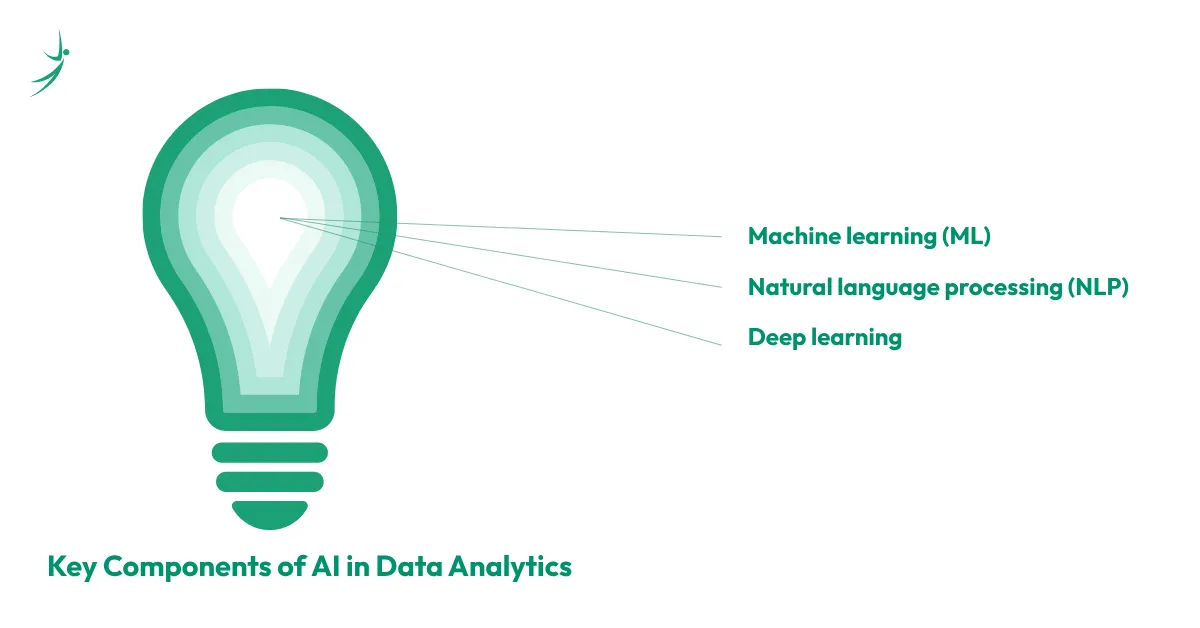
Machine learning (ML)
It is the engine behind most AI in data analytics applications. ML algorithms are trained on historical data to identify patterns and make predictions without being manually programmed for each specific task. In a business analytics context, ML is what powers churn prediction models, fraud detection systems, demand forecasting tools, and customer segmentation engines.
Natural language processing (NLP)
Enables AI systems to understand and work with human language. Inside analytics tools, NLP shows up most visibly as natural language querying, where a user types a plain-language question like "what were our top-selling products in Q1?" and the system automatically translates that into a database query and returns a chart. NLP also powers the automated insight summaries now built into tools like Power BI Copilot and Tableau Pulse.
Deep learning
Is a subset of machine learning focused on neural networks with multiple layers. Inside data analytics and data science, deep learning is most relevant for processing unstructured data: image recognition, sentiment analysis on customer reviews, anomaly detection in complex data streams, and natural language understanding at scale.
How AI is Changing the Data Analytics Process Step by Step
AI is not changing the data analytics process by removing steps. It is changing what each step requires from a human professional.
Data collection and integration
AI tools can now connect to multiple data sources automatically, monitor data pipelines for quality issues, and flag inconsistencies before they reach an analyst's dashboard. This reduces the time an analyst spends simply verifying that the data they are working with is trustworthy.
Data cleaning and preparation
Data cleaning is historically one of the most time-consuming parts of any data analytics project, often accounting for 60 to 80 percent of total project time. AI-assisted data cleaning tools can detect duplicate records, flag missing values, suggest fill-in approaches, and standardize formats automatically. Tools like Python libraries (pandas combined with AI-assisted code generation) and built-in data prep features inside modern BI platforms now handle much of this work with far less manual effort.
Exploratory data analysis
AI-powered analytics platforms can automatically scan a new dataset and surface the most statistically interesting patterns, correlations, and outliers, producing a starting point for analysis that would previously require an experienced analyst hours to generate manually.
Data analytics dashboard and reporting
This is where the change is most visible to non-technical users. Tools like Microsoft Power BI with Copilot, Tableau with Tableau Pulse, and Google Looker Studio with Gemini integration can now generate dashboard layouts, calculate custom metrics, write natural-language summaries of what a dashboard shows, and alert users to anomalies automatically. A business manager who could not previously read a complex BI dashboard can now ask the system a plain-language question and receive an immediate, visual answer.
Insight communication and decision support
AI-generated narrative summaries, automated alerts, and natural language responses are reducing the distance between raw data and business decision. The analyst's role shifts from "building the report" toward "validating the AI output and applying business judgment to what it shows."
AI in Data Analytics Tools: What Professionals Actually Use
The data analytics software landscape in 2026 has AI built into almost every major platform. Here is how the main tools break down.
AI-enhanced BI and dashboard tools
- Microsoft Power BI with Copilot generates DAX formulas, creates reports from plain-language prompts, summarizes dashboard content in natural language, and flags anomalies automatically. The most widely used AI-enhanced BI tool in Nepal's corporate sector.
- Tableau with Tableau Pulse delivers automated, personalized data insights in a conversational format, proactively surfacing key metric changes to business users without requiring them to open a dashboard.
- Google Looker Studio with Gemini AI-assisted report building and natural language querying for users already in the Google ecosystem, available as a free starting point for learners.
- ThoughtSpot and Qlik Sense purpose-built for AI-powered, search-driven analytics where business users ask questions in plain English and receive instant visual answers.
AI tools for data analytics with Python
- ChatGPT, Claude, and GitHub Copilot widely used by data analysts to generate SQL queries, write Python scripts for data cleaning and transformation, debug code, and produce first-draft explanations of analytical findings.
- Pandas AI a Python library that adds natural language querying directly on top of pandas DataFrames, allowing analysts to ask questions of their data in plain English and receive Python-generated answers.
- Jupyter AI integrates AI assistance directly inside Jupyter Notebooks, helping analysts generate, explain, and fix code as they work through a data analytics project.
AI data analysis in Excel
AI in data analytics through Excel is one of the fastest-growing areas for business professionals in Nepal who are already comfortable with spreadsheets. Microsoft Copilot in Excel can now write formulas from plain-language descriptions, generate charts, identify trends in a dataset, and produce written summaries of what the data shows. This makes AI data analysis in Excel a realistic entry point for professionals without a coding background who want to start working with AI-assisted analytics immediately.
AutoML and no-code AI platforms
- Google AutoML and AWS SageMaker Autopilot automate the machine learning model-building process, including feature selection, hyperparameter tuning, and model evaluation, without requiring the user to write ML code from scratch.
- DataRobot and H2O.ai enterprise-focused AutoML platforms used by data analytics specialists to build and deploy predictive models faster than traditional manual development allows.
AI ML in Data Analytics: What Skills You Actually Need
Understanding the relationship between AI, ML, and data analytics from a skills perspective matters enormously for anyone planning a career in this space. AI ML in data analytics does not mean every data analyst needs to become a machine learning engineer. It means every analyst needs enough understanding of what AI and ML tools do to use them effectively and critically.
The data analytics required skills in 2026 have expanded to include:
- SQL and Python fundamentals unchanged as the core of every data analytics and data science workflow; AI tools assist with both but cannot replace an analyst who does not understand what the generated code is doing.
- Data analytics software fluency Power BI, Tableau, or a comparable BI tool, now including their AI-powered features rather than just the traditional dashboard-building interface.
- Prompt engineering for analytics the ability to write clear, specific prompts that direct AI tools like ChatGPT or Copilot to produce useful SQL queries, Python scripts, or analytical summaries, rather than generic outputs that require heavy reworking.
- Critical evaluation of AI output AI-generated code, queries, and insights are frequently wrong in subtle ways. Analysts who can spot those errors are significantly more valuable than those who accept AI output uncritically.
- Statistics and data literacy AI tools surface patterns, but distinguishing a meaningful pattern from statistical noise still requires a human with solid foundational knowledge.
- Data analytics dashboard design the ability to build and communicate through dashboards remains essential, even as AI assists with the generation of initial layouts and metrics.
Data Analytics Excel and AI: A Practical Starting Point for Nepal
One question that comes up constantly from professionals in Nepal who are newer to data analytics: do I need to learn Python before I can start working with AI in analytics?
The honest answer is no, not immediately. AI data analysis in Excel has become genuinely capable in 2026. Microsoft Copilot in Excel can generate complex formulas, detect patterns, summarize data, and produce charts from plain-language requests. For a professional who already works with data in Excel daily, adding AI-assisted analysis to that workflow is one of the fastest ways to start demonstrating data analytics value without yet having Python or SQL skills.
That said, data analytics Excel skills have a ceiling. As analysis becomes more complex, involves larger datasets, or requires integration with databases and BI tools, Python and SQL become necessary. The data analytics roadmap for most Nepal-based professionals realistically runs: Excel with AI → SQL → Python basics → Power BI or Tableau → advanced analytics and ML fundamentals.
Real-World Examples: AI in Data Analytics in Nepal's Industries
- Banking and finance: Commercial banks in Nepal are using AI-powered analytics to automate credit scoring, detect fraudulent transactions in real time, and predict which customers are likely to default on loans before any human analyst has reviewed the case. An analyst in this environment uses AI tools to monitor model performance, investigate anomalies the model flags, and communicate findings to the risk management team.
- Telecom: Nepal's telecom sector uses AI-driven churn prediction models that analyze call data, payment history, and usage patterns to identify at-risk subscribers before they cancel, then feed that list into the retention team's daily workflow. The data analytics project here is not a one-time report it is a continuously running AI system that requires human oversight and periodic recalibration.
- E-commerce: Online retailers in Nepal are using AI-powered dashboards to monitor product performance, detect inventory shortages before they become stockouts, and personalize marketing recommendations based on purchase history. Analysts in this context spend most of their time evaluating AI-generated recommendations and deciding which ones to act on.
- IT and outsourcing: Many of Nepal's IT outsourcing companies serve international clients who specifically request AI-augmented analytics delivery faster turnaround on data cleaning, AI-generated first-draft reports, and automated anomaly detection as part of their analytics service offering.
AI Data Analyst Salary in Nepal: What the Numbers Say
One of the most practical questions for anyone exploring this path: does knowing AI actually increase your earnings as a data analyst in Nepal?
Based on current market data from multiple Nepal-focused career platforms, the salary picture looks like this:
- Data analyst (traditional skill set) entry level: NPR 30,000 – 55,000/month
- Data analyst (with AI tools fluency Power BI Copilot, Python AI libraries, prompt engineering) entry level: NPR 40,000 – 70,000/month
- AI data analyst or analytics specialist mid level (2–4 years): NPR 80,000 – 1,50,000/month
- Machine learning engineer entry level: NPR 35,000 – 65,000/month
- Machine learning engineer mid level: NPR 70,000 – 1,60,000/month
- Machine learning engineer senior level: NPR 1,50,000 – 2,50,000+/month
- AI engineer mid to senior level: NPR 80,000 – 1,20,000+/month
- AI research scientist: NPR 2,50,000 – 5,00,000+/month (rare locally; mostly remote or research institution roles)
The pattern across all of these: AI fluency adds a measurable premium at every level. Analysts who can use AI tools to deliver faster, more accurate, and more automated analytics outputs consistently command higher compensation than those who cannot, both in Nepal's local market and in remote roles for international clients. Companies actively hiring AI and data talent in Nepal in 2026 include Fusemachines Nepal, Leapfrog Technology, CloudFactory, F1Soft Group, and Deerwalk Services, alongside the international remote market accessible via platforms like Upwork, Toptal, and LinkedIn.
AI Data Science Subjects vs Data Analytics: What's the Difference for Learners?
A question that creates genuine confusion: if AI is now so central to data analytics, does the distinction between data analytics and AI data science still matter?
It does, for a practical reason. The AI data science subjects stack linear algebra, calculus, advanced statistics, neural network architecture, model training and evaluation, MLOps, and cloud deployment is a significantly deeper and longer learning path than the data analytics required skills stack. An analyst who understands how to use AI tools inside a BI and analytics workflow is not the same as a data scientist or ML engineer who builds the underlying models those tools run on.
Both paths are valuable. The data analytics path with AI tools gets you employed faster, with a broader set of local job opportunities in Nepal. The data science and ML path opens higher salary ceilings and stronger remote international demand, but requires a longer runway typically twelve to twenty-four months of dedicated learning before reaching employment-ready depth.
The most practical trajectory for most Nepal-based learners starting today: build solid data analytics foundations with AI tool fluency first, get employed, and then layer in the deeper AI data science subjects over time while earning.
Advantages and Disadvantages of AI in Data Analytics
Advantages:
- Speed: AI dramatically reduces the time from raw data to usable insight, particularly for routine cleaning, query generation, and report creation.
- Scale: AI-powered analytics can process and surface patterns in datasets far too large for a human analyst to review manually.
- Accessibility: natural language querying and AI-generated dashboards lower the technical barrier, allowing business users without analytics backgrounds to get answers from data directly.
- Consistency: AI tools apply the same logic every time, reducing the risk of human error in repetitive analytical tasks.
- Proactive insight: anomaly detection and automated alerts surface problems before a human analyst would think to look for them.
Disadvantages:
- AI output requires validation: AI-generated SQL, Python code, and analytical summaries can be subtly wrong in ways that are easy to miss without strong foundational knowledge making critical evaluation skills more important, not less.
- Bias in training data: ML models trained on historical data can encode and amplify existing biases, producing recommendations that are systematically unfair or inaccurate for specific groups.
- Over-reliance risk: analysts who accept AI output without understanding it lose the ability to catch errors and become dependent on tools they cannot critically assess.
- Data quality dependency: AI models are only as good as the data they are trained on; poor data quality upstream produces confidently wrong outputs downstream.
- Skill transition required: existing analysts need active upskilling to stay relevant, since the data analytics required skills set in 2026 is meaningfully different from what it was three years ago.
Data Analytics Roadmap with AI: How to Start Building These Skills
Whether you are a complete beginner or an existing analyst looking to add AI tools to your workflow, here is a practical data analytics roadmap for 2026.
For complete beginners:
- Start with data analytics fundamentals Excel, basic statistics, data literacy so you understand what you are asking AI to help with.
- Learn SQL to query and manipulate data; use AI tools like ChatGPT to help generate and debug queries as you learn.
- Add Python basics, using AI coding assistants to accelerate the learning curve while building genuine understanding of what the code does.
- Learn Power BI including its Copilot AI features, and build real data analytics dashboards using public Nepal-relevant datasets.
- Build a data analytics project portfolio that demonstrates AI-assisted workflows, not just traditional dashboard-building.
For working professionals adding AI skills:
- Audit your current data analytics software stack and identify which tools have AI features you are not yet using.
- Practice prompt engineering specifically for analytical tasks writing clean, specific prompts that generate useful SQL, Python, or insight summaries.
- Add one AutoML or AI-assisted analysis tool to your regular workflow and document the time and quality improvement it delivers.
- Consider a structured data analytics full course or data analytics training program that specifically integrates AI tools rather than treating them as an optional add-on.
Choosing the Right Data Analytics Courses
The data analytics best courses for 2026 are those that treat AI tools as a built-in part of the curriculum, not a bonus module added at the end. Data analytics free courses on platforms like Coursera, Google, and Kaggle are genuinely useful for building foundational awareness, and there are solid data analytics courses online that let you learn at your own pace.
For learners in Nepal who want structured, mentor-led learning with real project work and career support, a purpose-built data analytics course in Nepal, like Skill Shikshya's Business Data Analytics with AI program, covers the full stack from foundational SQL and Python through Power BI, data visualization, and AI-integrated workflows exactly the combination Nepal's local and remote job market is asking for. If you are looking for a data analytics full course that maps directly to how the job market has changed, the programs that integrate AI throughout the curriculum rather than treating it as an optional advanced topic are consistently producing better employment outcomes.
The data analytics institute you choose matters most for two things: how much real, hands-on project work is built into the program, and whether the curriculum reflects the actual data analytics description of the role as it exists in 2026, not three years ago.
Conclusion
AI in data analytics is not a future trend to monitor from a distance. It is the current reality of how analytics work gets done, and it is reshaping the data analytics required skills, the tools on every data analytics roadmap, and the salary expectations attached to analytics roles at every level in Nepal and globally.
The analysts who will thrive in this environment are not those who resist the change, but those who combine strong foundational data skills with genuine fluency in AI tools and the business judgment to know when to trust what those tools output and when to question it.
If you are ready to build that combination of skills with real projects, expert mentorship, and a curriculum built around how data analytics actually works in 2026, explore the Business Data Analytics with AI Course at Skill Shikshya.
Frequently Asked Questions
What is AI in data analytics?
How is AI changing the role of a data analyst?
What is the AI data analyst salary in Nepal?
Do I need to know machine learning to use AI in data analytics?
What is the best data analytics course in Nepal that covers AI?
Can I use AI for data analytics in Excel?
What are the best free resources to start learning AI in data analytics?
What companies in Nepal are hiring for AI and data analytics roles?
About Author: