Steps To Start An IT Career After +2 In Nepal: Beginner’s Guide
You finished +2. The board exams are done, the results are out, and everyone around you is asking the same question, "Now what?"
For a lot of students in Nepal, the answer involves IT. And it makes sense. You see friends learning to code, people your age freelancing from their laptops, and companies in Kathmandu hiring graduates who never sat in a four-year university. It looks like a real path. And it is.
But knowing IT is a good direction and knowing exactly how to start are two different things. This guide is about the second part. It walks you through every step, from understanding what IT actually covers to landing your first job or freelance client without the vague advice that doesn't help anyone.
Most people outside IT think it means coding. It doesn't, or at least, coding is just one piece of a much bigger space. Before you pick a direction, spend time understanding what the different fields actually involve. Nepal's IT sector covers a wider range of roles than most students realize, from web development and design to cybersecurity and digital marketing, and each one is genuinely different.
Why +2 Graduates in Nepal Are Choosing IT Right Now
Nepal's IT Sector Is Growing and Hiring
Nepal's tech industry has been expanding faster than most people outside it realize. Government digitization programs, a growing fintech sector, edtech startups, and e-commerce businesses are all creating consistent demand for trained IT professionals. Companies in Kathmandu, Lalitpur, and Pokhara are actively hiring and they are not always waiting for candidates with four-year degrees.
What matters to most employers at the entry level is whether you can do the work. A portfolio that shows three real projects tells them more than a transcript.
You Don't Need a Degree to Get Started
This is probably the most important thing to understand. The IT field, more than almost any other sector rewards demonstrable skill over academic credentials. A web developer who can build a clean, functional site gets hired. A digital marketer who can show campaign results gets hired. Nobody asks which stream you studied in +2 first.
That said, understanding how IT training compares to a bachelor's degree in Nepal is worth reading before you decide which route to take. Some roles, especially in larger corporations, still prefer degree holders at the senior level. But for entry-level roles and freelancing, skills win.
The Income Potential Is Real, Even at Entry Level
Fresher IT roles in Nepal pay between NPR 20,000 and NPR 50,000 per month depending on the field and company. That number climbs fast with experience. Freelancers, once they build a client base, regularly earn NPR 50,000 to NPR 3,50,000+ per month, with income in USD that converts favorably against local living costs.
The ceiling in IT is genuinely high. But even the floor, what you can realistically earn in your first year after training is enough to build a stable career.
Step 1: Explore What IT Actually Covers
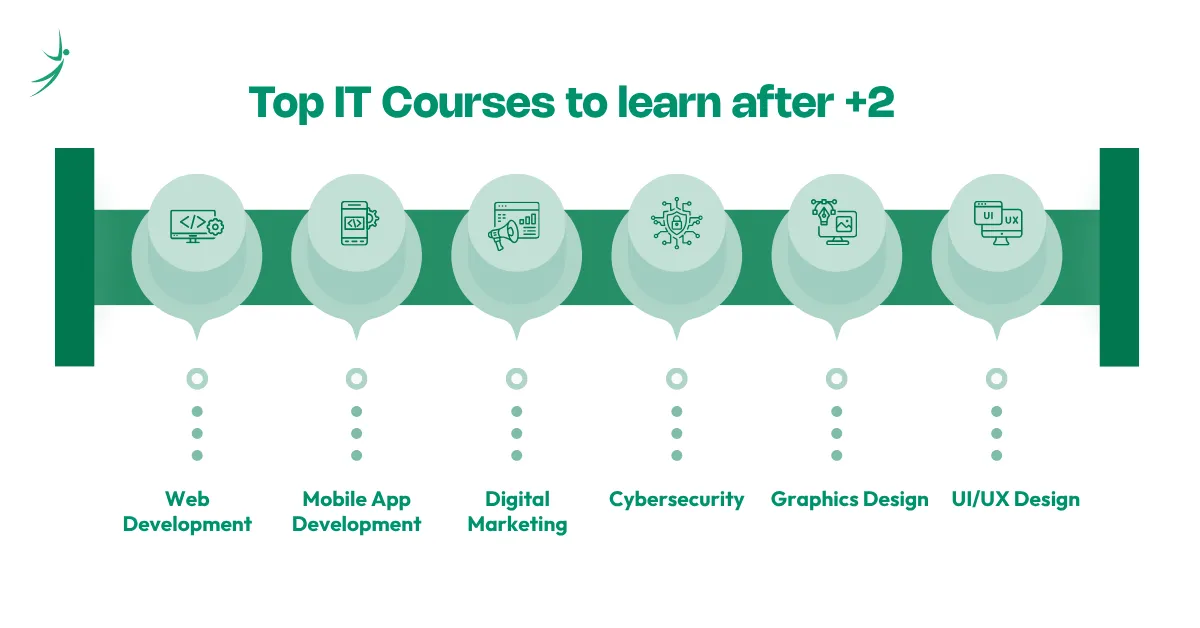
Most people outside IT think it means coding. It doesn't or at least, coding is just one piece of a much bigger space. Before you pick a direction, spend time understanding what the different fields actually involve.
Web Development
Web developers build websites and web applications. On the frontend, you work on everything users see; layouts, buttons, animations. On the backend, you handle the logic, databases, and servers behind the scenes. Full-stack developers handle both.
It's one of the most in-demand skills in Nepal right now. Local companies, startups, and international freelance clients all need developers who can build and maintain web products.
UI/UX Design
UI/UX designers figure out how products feel to use. UI (User Interface) is about visual design, what the product looks like. UX (User Experience) is about how people move through it, how easy it is to find what you're looking for and accomplish what you came to do.
You work primarily in tools like Figma. No heavy coding required, which makes it one of the more accessible entry points for people coming from non-technical backgrounds. The UI/UX design career roadmap breaks down exactly how this path develops over time.
Graphic Design
Graphic designers create visual content; logos, social media graphics, marketing materials, packaging, and more. The work spans print and digital. Tools like Adobe Photoshop, Illustrator, and Canva are central to the job.
It's a field where creative judgment matters as much as technical skill, and it's one of the most freelance-friendly disciplines in IT.
Digital Marketing and SEO
Digital marketers help businesses grow their online presence. The field covers search engine optimization (SEO), social media marketing, content strategy, paid advertising, email marketing, and analytics. It's less technical than development but still data-driven.
Nepal's businesses, from restaurants to e-commerce stores to coaching centers, all need people who understand digital marketing. It's also a strong freelancing path for people who can show results. This beginner guide can help you get started on digital marketing.
Cybersecurity
Cybersecurity professionals protect systems, networks, and data from attacks. The field covers ethical hacking, network security, digital forensics, and risk management.
It's one of the more technical paths to start, but it's also one of the highest-paying. Nepal's cybersecurity talent pool is still relatively thin, which means trained candidates face less competition than in more crowded fields. The cybersecurity salary landscape in Nepal reflects this, entry-level roles tend to start higher than most other IT disciplines.
Mobile App Development
Mobile developers build apps for Android and iOS. In Nepal, Flutter is currently one of the most in-demand skills, it lets you build for both platforms from a single codebase, which is why companies value it. React Native is also widely used.
IT Support and Networking
IT support roles involve troubleshooting hardware and software issues, managing networks, and keeping systems running. It's less glamorous than development or design, but it's a stable entry point into the industry, especially for people who enjoy solving practical, hands-on problems.
Not Sure Where You Fit? That's Normal
Almost everyone feels overwhelmed at this stage. The right response is not to research for months, it's to pick one area that sounds reasonable and try it. You'll know quickly whether it clicks. Most good IT training institutes offer trial classes or orientation sessions for exactly this reason.
Step 2: Pick One Field That Matches Your Strengths
Picking a field based on what's "trending" or what your cousin is doing is one of the most common mistakes new students make. The better question is: what kind of thinking do you actually enjoy?
If You Like Logic and Problem-Solving
Web development and Python programming suit this profile well. You enjoy breaking a problem into smaller parts and figuring out how to solve each one systematically. If that sounds like you, start with Python training or a web development course. Exploring the top programming languages to learn after +2 can also help you decide where to begin.
If You're Creative and Visual
UI/UX design and graphic design are natural fits. You think in visuals, you notice when something looks off, and you have opinions about colors, spacing, and layout. The technical skills in these fields are learnable. The creative instinct is harder to teach, and if you have it, use it.
If You're Good at Communication
Digital marketing rewards people who can write clearly, understand audiences, and explain ideas simply. If you're the person who always has a take on why an ad works or why a social media post flopped, this field plays to that instinct.
If You're Detail-Oriented and Analytical
Cybersecurity and quality assurance (QA testing) suit people who notice what others miss. You read the fine print. You spot the inconsistency. These fields need exactly that kind of attention.
Why Picking One Direction First Is Better Than Exploring Everything
Trying to learn web development, graphic design, and digital marketing simultaneously is one of the fastest routes to learning none of them properly. The skills compound when you go deep, not wide. Pick one field, commit to it for at least three to four months, and build something real before you consider expanding.
Step 3: Enroll in a Structured IT Course
Self-Learning vs. Structured Training: What's the Difference?
YouTube and free platforms like freeCodeCamp are genuinely useful, and many good IT professionals have learned from them. But self-learning has a real problem: it's easy to watch tutorials without actually building anything, which means you finish a playlist and still can't do the work independently.
Structured training solves this. A good course gives you a curriculum in the right sequence, assignments that force you to apply what you've learned, a mentor who can answer questions when you're stuck, and feedback on your work. That combination accelerates learning in a way that passive watching doesn't.
What to Look for in an IT Training Institute in Nepal
Not every training center delivers on its promises. Before you enroll, check these things:
- Practical focus: Does the course involve building real projects, or is it mostly theory?
- Instructor background: Are instructors working professionals or academics with no current industry experience?
- Certification: Is the certificate recognized, and does it add value on a CV?
- Placement support: Does the institute actively help graduates find jobs or internships?
- Student reviews: What do past students say about the actual learning experience?
The best IT training institutes in Nepal guide covers this comparison in detail if you want a side-by-side look at your options.
Short-Term Courses vs. Diploma Programs: Which Is Right for You?
Short-term courses (two to four months) let you focus on one skill quickly and get job-ready faster. They work well if you know what you want to learn and want to move into work or freelancing as soon as possible.
Diploma programs cover more ground and take longer, but they give you a broader foundation that can help when you're applying for roles that expect more than one skill. Skill Shikshya's IT courses include both formats across fields like web development, UI/UX, graphic design, digital marketing, cybersecurity, and more.
If you're still figuring out which course suits you best, the breakdown in best IT training courses in Nepal maps each course to specific career outcomes, which makes the decision easier.
Do Certifications Matter for Entry-Level IT Jobs in Nepal?
Yes, but not in the way most people think. A certificate on its own doesn't get you hired. What it does is signal to an employer that you completed a structured program and were assessed on the material. The portfolio and practical skills you build alongside the certificate are what actually close the deal.
Step 4: Build a Portfolio While You're Still Learning
Why a Portfolio Matters More Than a Certificate Alone
In IT, the question an employer or freelance client is really asking is: "Can this person do the work?" A portfolio answers that directly. A certificate says you completed a course. A portfolio shows what you can build.
Start building projects from week one, not after you "finish" learning. Every exercise, every assignment, every small project goes in.
What to Build as a Web Development Beginner
- A personal portfolio site (this doubles as your first project and your showcase)
- A product landing page for a fictional business
- A basic e-commerce UI
- A simple form-based app using JavaScript
Push everything to GitHub. Employers look at GitHub profiles, an active account with real projects tells a better story than an empty one.
What to Build as a Design Beginner
- A personal branding project (logo, color palette, typography)
- Three to five UI screens for a mobile app concept
- A redesign of an existing app or website with your own spin
- Social media post templates for a fictional brand
Host your work on Behance or present it as a Figma case study. A good case study doesn't just show the final output, it shows your thinking, your process, and the problem you were solving.
What to Build as a Digital Marketing Beginner
- A mock SEO audit of a local business website
- A 30-day content calendar for a fictional brand
- A sample Google Ads campaign structure with keyword research and ad copy
- A basic analytics report showing how you'd interpret traffic data
Document everything. Screenshots, before-and-after comparisons, and written explanations of your decisions make a stronger portfolio than just listing tools you've used.
Free Tools to Build and Host Your Portfolio
| Field | Tools |
|---|---|
| Web Development | GitHub, Vercel, Netlify |
| UI/UX Design | Figma, Behance, Dribbble |
| Graphic Design | Canva, Behance, Adobe Portfolio |
| Digital Marketing | Google Analytics (demo), Google Search Console, Ubersuggest |
Step 5: Get Your First Real Experience
Option A: Internships at IT Companies in Nepal
An internship gives you real work experience inside an actual company. You see how teams collaborate, how projects get managed, and what production-level work actually looks like. That context is hard to replicate in a training environment, and it matters a lot when you go for your first job.
Most internships in Nepal are unpaid or low-paying, which is worth knowing upfront. But the experience and the professional connections often make it worth it.
How to Find IT Internships in Nepal as a Fresher
- Job boards: MeroJob, Kumarijob, and LinkedIn Nepal regularly list internship openings
- Cold email: Find companies you respect and email them directly, even if they haven't posted a listing. A short, confident email with a link to your portfolio gets noticed
- Your training institute: Institutes like Skill Shikshya, have industry connections and can refer students for openings. Ask your instructors directly
When you apply, lead with your portfolio link. Don't just submit a CV, show them something you've built.
Option B: Start Freelancing on Global Platforms
Freelancing lets you earn while you build experience, on your own schedule. Platforms like Upwork and Fiverr connect you with clients worldwide. The barrier to entry is low, you create a profile, list your services, and start pitching.
The first few projects are the hardest to land, but once you have two or three positive reviews, momentum builds. Start with a competitive rate, deliver excellent work, and raise your prices gradually.
How to Get Paid as a Freelancer in Nepal
PayPal is not officially supported in Nepal, but Payoneer and Wise both work reliably. Both connect to your local bank account and convert USD earnings to NPR. Setting up either account before you land your first client is smart, you don't want to be scrambling when someone's ready to pay you.
Which Option Is Better, Internship or Freelancing?
Neither is universally better. It depends on your field and your goals.
| Internship | Freelancing | |
|---|---|---|
| Best for | Learning how companies work | Earning early and building independence |
| Income | Low or none initially | Variable, can grow fast |
| Structure | Guided, team-based | Self-directed |
| Network | Strong local industry connections | Mostly international clients |
| Recommended fields | Web development, Cybersecurity, QA | Graphic design, Digital Marketing, UI/UX |
Many people do both at different stages, internship first for experience, freelancing later for income.
Step 6: Keep Upgrading Your Skills Over Time
Why Continuous Learning Is Non-Negotiable in IT
IT moves faster than almost any other field. A skill that was cutting-edge three years ago may now be standard or outdated. The professionals who build long, well-paid careers in tech are the ones who never stop learning. This isn't a one-time grind, it's an ongoing habit.
In-Demand IT Skills in Nepal for 2026
- Full-stack development: (React.js, Node.js, Django)
- Flutter: for mobile apps - heavily used by Nepali companies like Leapfrog and F1Soft
- Cybersecurity: thin talent pool, high demand
- DevOps and Cloud (AWS, Docker, Kubernetes): highest entry-level salaries in the market
- UI/UX design: active hiring, shortage of mid-level talent
- AI/ML fundamentals: growing fast, especially for roles in product companies
For a fuller breakdown of what's worth learning, the IT career roadmap for 2026 maps each skill to realistic career outcomes.
Free Resources to Keep Learning
- freeCodeCamp: web development, Python, data science
- The Odin Project: full-stack web development
- Google Digital Garage: digital marketing fundamentals
- Figma's own tutorials: UI/UX design
- TryHackMe / Hack The Box: cybersecurity practice
- YouTube: genuinely excellent for staying current on specific tools and frameworks
When to Move From Beginner to Intermediate Level
You're ready to move up when you can complete a project from scratch without following a tutorial step-by-step. When you hit a problem you haven't seen before and solve it by searching and thinking, not by finding an exact answer, that's when you've crossed from beginner to intermediate. That shift usually happens around the three to six month mark with consistent daily practice.
What Can You Realistically Earn in IT After +2 in Nepal?
Fresher Salaries by IT Role in Nepal
| Role | Fresher (NPR/month) | With 1–2 years experience |
|---|---|---|
| Web Developer | 25,000 – 50,000 | 80,000 – 2,00,000+ |
| UI/UX Designer | 20,000 – 40,000 | 70,000 – 1,50,000+ |
| Graphic Designer | 20,000 – 40,000 | 60,000 – 1,20,000+ |
| Digital Marketer | 20,000 – 45,000 | 70,000 – 1,50,000+ |
| Cybersecurity Analyst | 40,000 – 70,000 | 1,00,000 – 2,50,000+ |
| DevOps / Cloud Engineer | 50,000 – 80,000 | 1,50,000 – 3,00,000+ |
| Freelancer (any field) | 50,000 – 3,50,000+ (variable) | Uncapped |
These ranges reflect the current Nepal market. The UI/UX design career roadmap and cybersecurity salary guide go deeper on specific fields if you want more precise figures.
How Quickly Does IT Salary Grow With Experience?
Faster than most sectors. A developer who starts at NPR 30,000 can realistically double that in 18 months with strong performance and visible output. The growth is not automatic. it follows skill development and contribution. But the ceiling rises quickly for people who keep pushing.
Freelancing Income vs. Full-Time IT Jobs in Nepal
Full-time jobs offer stability, a regular salary, and structured career growth. Freelancing offers higher income potential, flexibility, and international exposure but with variable income and no fixed benefits.
Many IT professionals in Nepal do both: a full-time job for stability while building freelance clients on the side. Once freelance income consistently exceeds the salary, some make the full switch. Others keep both permanently.
Does Having a Degree Change Your Starting Salary?
At the entry level, not significantly especially for smaller companies and startups. What changes your starting salary is the quality of your portfolio, the strength of your practical skills, and how well you perform in a technical interview or test.
Degrees matter more for senior roles at larger corporations, government positions, and international companies with formal HR requirements. But for your first two to three years in IT, your work speaks louder.
Common Mistakes +2 Graduates Make When Starting an IT Career
Trying to Learn Everything at Once
This is the most common trap. You start web development, watch a few videos, get curious about UI/UX, start a design course, see a digital marketing post, and six months later you haven't finished anything. Pick one field. Finish the beginner level. Build something. Then decide what's next.
Skipping Portfolio Building
A lot of students finish courses and then wonder why they aren't getting interviews. The missing piece is almost always the portfolio. Certificates tell employers you enrolled. Projects tell them you can deliver. Build as you learn - not after.
Waiting for the "Perfect" Course or Institute
There is no perfect course. Every training program has gaps. What matters more is your consistency and the quality of the projects you build. A student who finishes an average course and builds five solid projects will outperform one who spent six months comparing every institute and never enrolled.
Underestimating Soft Skills Like Communication and Consistency
Technical skills get you in the room. Soft skills keep you there. Showing up on time, communicating clearly about your progress, asking good questions, and taking feedback without getting defensive - these things matter enormously at every level of an IT career. Clients and employers notice fast when someone has them and when someone doesn't.
Final Thoughts: Your IT Career Starts With One Step
There's no perfect moment to start. There's no course you need to finish first before you're "ready" to apply somewhere. The students who build strong IT careers after +2 are simply the ones who started, picked one field, enrolled in a structured course, built projects from day one, and kept going even when progress felt slow.
Nepal's IT sector has real opportunities. Companies are hiring. International clients are paying well. The path is there.
If you're not sure which field is right for you or want a clearer picture of where to begin, book a free online counselling session with Skill Shikshya's team. They'll walk you through your options based on your strengths and goals; no pressure, just clarity.
And if you're ready to get started, browse Skill Shikshya's IT courses and pick the one that fits where you are right now.
Frequently Asked Questions
Can I get an IT job in Nepal after +2 without a bachelor's degree?
Which IT course is best for +2 graduates with no prior experience?
How long does it take to get a job after IT training in Nepal?
Is freelancing after +2 realistic in Nepal?
Does it matter which stream I studied in +2: Science, Management, or Humanities?
About Author: