Best IT Training Courses in Nepal (2026) - With Career Outcomes | Skill Shikshya
The best IT training courses in Nepal in 2025 are Full Stack Web Development, Data Science and Machine Learning, UI/UX Design, Cybersecurity, DevOps and Cloud, Quality Assurance, Flutter Mobile App Development, and Generative AI and Agentic AI - all available as short-term, job-oriented training programs that prepare you for real industry roles fast.
IT Training Courses in Nepal: Quick Comparison
| Course | Duration | Difficulty | Starting Salary (Nepal) | Best For |
|---|---|---|---|---|
| Full Stack Web Development | 4–6 months | Beginner–Intermediate | NPR 25,000–50,000/month | Aspiring developers, freelancers |
| Data Science and ML | 4–6 months | Intermediate | NPR 50,000–75,000/month | Analytical thinkers, data lovers |
| UI/UX Design | 3–4 months | Beginner–Intermediate | NPR 30,000–50,000/month | Creative, non-technical backgrounds |
| Cybersecurity | 3–5 months | Intermediate | NPR 40,000–70,000/month | Detail-oriented, curious minds |
| DevOps and Cloud | 4–6 months | Intermediate–Advanced | NPR 70,000–1,00,000/month | Highest salary entry point |
| Quality Assurance | 2–3 months | Beginner | NPR 30,000–50,000/month | Fast entry into tech companies |
| Flutter Mobile App | 3–5 months | Beginner–Intermediate | NPR 40,000–83,000/month | Mobile developers, freelancers |
| Generative AI and Agentic AI | 3–5 months | Intermediate | NPR 75,000–1,00,000/month | Highest growth, highest ceiling |
Why IT Training in Nepal Is the Smarter Career Move
If you search for IT courses in Nepal, you will find plenty of results pointing you toward degree programs such as BSc CSIT, BIT, BIM, and Computer Engineering. These are solid academic paths, and there is nothing wrong with them. But here is the reality most people do not talk about openly: a 4-year degree teaches you theory. The IT industry runs on skills.
Nepal's tech job market does not wait four years. Companies hiring today, whether Kathmandu-based startups, outsourcing firms, or remote-first teams, are looking for candidates who can build, test, design, and deploy on day one. That is exactly what short-term IT training courses in Nepal are built to deliver. You learn the actual tools, work on real projects, build a portfolio, and walk into interviews ready, not just qualified on paper.
If you are serious about starting a career in IT, the first step is understanding which training path fits your goals. At Skill Shikshya: best IT training institute in Nepal, every course is built around one principle: learn skills that matter, get placed fast. With a 91% placement rate within 3 months and a Job Ready Program that guarantees a job or internship, the training is designed around outcomes, not just content.
Not sure which direction to take yet? Start with our complete guide on how to start a career in IT. It maps out every path, skill, and step clearly before you commit to a course.
In this article, we break down the best IT training courses available in Nepal, what each one covers, who it is for, and what career outcome you can realistically expect in the Nepali job market.
How to Choose the Right IT Training Course in Nepal
Choosing the right IT training course is not just about picking what sounds interesting. The wrong choice costs you time, money, and momentum. Here are the five things you must evaluate before enrolling in any IT training program in Nepal.
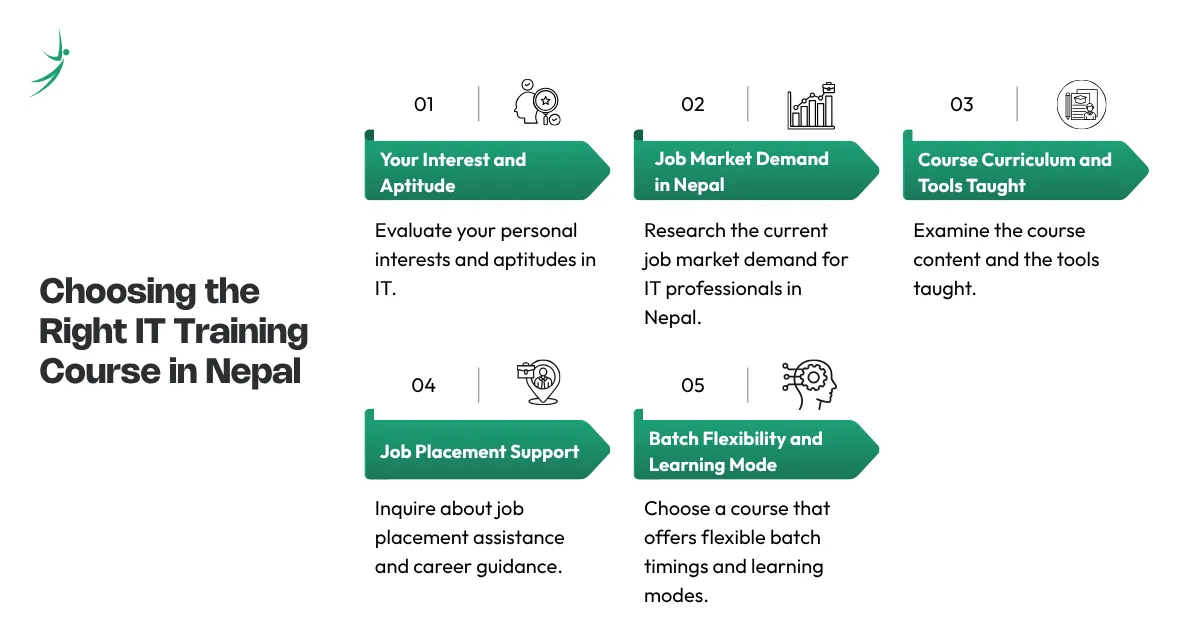
Your Interest and Aptitude
No coursework if you hate what you are learning. Before anything else, be honest about what excites you. Do you enjoy building things visually? UI/UX or Full Stack might be your path. Do you like problem-solving and logic? Data Science or Cybersecurity. Do you prefer testing and quality control over building from scratch? QA is underrated and highly in demand. Your interest is not a soft factor; it is the single biggest predictor of whether you finish the course and get placed.
Job Market Demand in Nepal
Not all courses have equal demand in Nepal's current job market. Full Stack Development, DevOps, and Cybersecurity are consistently among the most in-demand roles across Kathmandu's IT companies. Data Science and AI are growing fast, but require stronger foundations. QA and Flutter are steady, reliable career paths with less competition. Before you enroll, check current job listings on Merojob, Kumarijob, and LinkedIn, and see what roles are actually being hired for right now. For a full breakdown of where the money is, our guide on high-paying IT jobs in Nepal covers every role with salary ranges.
Course Curriculum and Tools Taught
A good IT training course in Nepal should teach you current, industry-relevant tools, not outdated frameworks nobody uses anymore. For Full Stack, that means MERN stack (MongoDB, Express, React, Node.js). For DevOps, that means Docker, Kubernetes, and AWS. Always ask the institute for a detailed syllabus and check whether the tools they teach match what employers are actually listing in job descriptions. If the curriculum has not been updated in the last 12 months, that is a red flag.
Job Placement Support
This is where most IT training institutes in Nepal fall short. A certificate alone does not get you hired; placement support does. Look for institutes that offer resume building, mock interviews, portfolio reviews, and direct connections with hiring companies. The difference between completing a course and landing a job often comes down to the quality of placement support. To understand what strong placement looks like in practice, read our detailed comparison of the best IT training institute in Nepal.
Batch Flexibility and Learning Mode
Not everyone can attend a morning batch on weekdays. If you are a working professional, a college student, or someone outside Kathmandu, batch timing and learning mode matter enormously. Look for institutes offering morning, evening, weekend, and online batches, so your training fits your life, not the other way around.
Top IT Training Courses in Nepal
Full Stack Web Development is consistently the most in-demand IT training course in Nepal and for good reason. A Full Stack developer can handle both the frontend (what users see) and the backend (how it works behind the scenes), making them one of the most versatile and hireable professionals in any tech team. The MERN stack, MongoDB, Express.js, React.js, and Node.js, is the dominant technology combination taught in Nepal's top training institutes, and it directly matches what Kathmandu's software companies, startups, and outsourcing firms are hiring for right now. During training, you will learn to build complete, real-world web applications from scratch, covering database design, REST APIs, frontend interfaces, authentication systems, and deployment. The best programs also integrate AI tools into the workflow, teaching you how modern developers actually work, not just how they worked five years ago.
Who it is for: Anyone who wants to become a software developer, work in a tech company, freelance, or build their own product. No prior coding experience is required; most good training programs start from absolute basics and take you to a job-ready level within 4 to 6 months.
Career Outcome: Full Stack developers are among the highest-paid entry-level IT professionals in Nepal. Freshers typically start at NPR 25,000–50,000 per month at local companies, with mid-level developers earning NPR 60,000–1,00,000 per month. Developers who take on remote work for international clients can earn NPR 3,00,000–5,00,000 per month, making this one of the highest income-ceiling courses available in Nepal today.
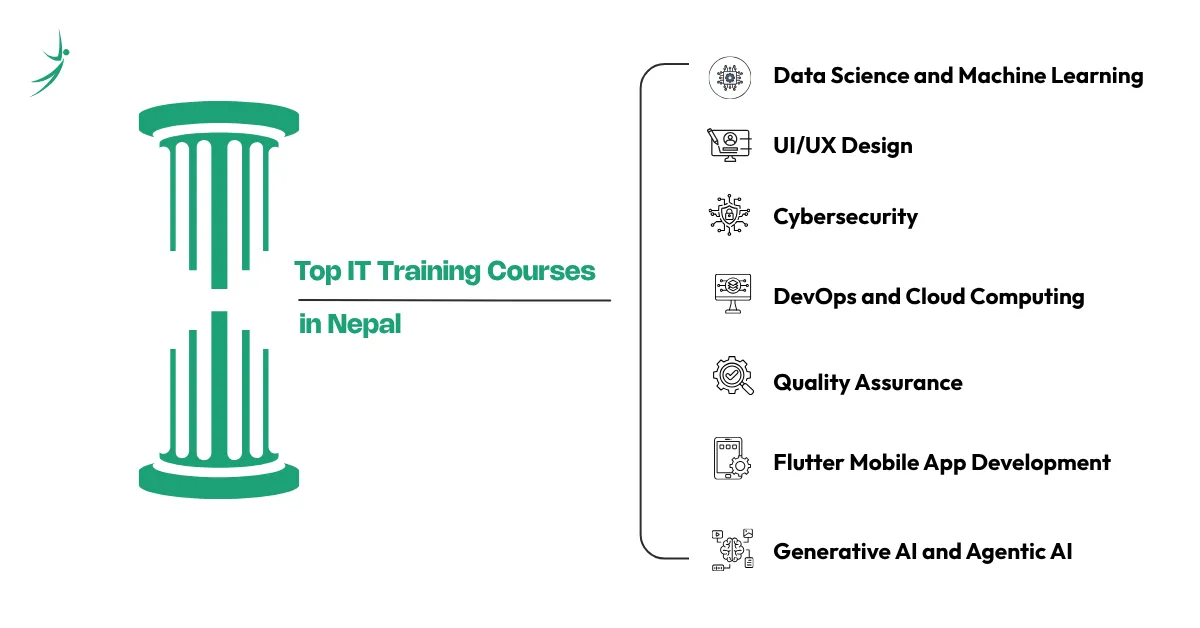
Data Science and Machine Learning
Data Science and Machine Learning is the fastest-growing IT training course in Nepal right now, driven by a global shift toward data-driven decision making across every industry, from banking and healthcare to e-commerce and government. In simple terms, Data Science is the skill of extracting meaningful insights from large amounts of data, while Machine Learning takes it a step further by building systems that can learn from that data and make predictions automatically. During training, you will learn Python programming, data analysis libraries like Pandas and NumPy, data visualization tools like Matplotlib and Power BI, and core Machine Learning algorithms using frameworks like Scikit-learn and TensorFlow. The best training programs in Nepal also cover real-world projects building recommendation systems, predictive models, and data dashboards that go directly into your portfolio. This is not a beginner-friendly course in the traditional sense; it rewards people who are comfortable with logic, numbers, and problem-solving, but with the right training structure, even non-math backgrounds can get started effectively.
Who it is for: Fresh graduates, IT professionals looking to upskill, and anyone working in fields where data matters, such as finance, marketing, operations, or research. If you are someone who asks "why" and "what does this data mean" more than "how do I build this," Data Science is your natural path.
Career Outcome: Data Scientists are among the highest-paid IT professionals in Nepal. Entry-level roles start at NPR 50,000–75,000 per month, with experienced professionals earning NPR 75,000–91,000 per month at local companies. Senior Data Scientists and those working with international clients or remote roles can command NPR 1,000,000–2,200,000 per year, placing this course at the very top of Nepal's IT salary ladder. For a full picture of where Data Science sits among Nepal's highest-paying roles, see our guide on high-paying IT jobs in Nepal.
UI/UX Design
UI/UX Design is one of the most accessible yet most underestimated IT training courses in Nepal. UI stands for User Interface how a product looks. UX stands for User Experience how a product feels and functions. Together, they determine whether someone enjoys using an app or website or abandons it in frustration. As Nepal's digital economy grows and more businesses invest in apps, platforms, and digital products, the demand for skilled UI/UX designers who can create intuitive, visually clean experiences is rising steadily. During training, you will learn the full design process from user research and wireframing to prototyping and high-fidelity design using industry-standard tools like Figma, Adobe XD, and Maze. Good training programs also cover design thinking, usability testing, and how to present and defend your design decisions to developers and stakeholders. What makes UI/UX particularly powerful as a career path is that it sits at the intersection of creativity and technology you do not need to write code, but you need to think like both a designer and a user simultaneously.
Who it is for: Creative individuals who enjoy visual problem-solving, psychology, and design. Also ideal for graphic designers looking to transition into digital product design, and for developers who want to add design thinking to their skillset. UI/UX is one of the best IT training courses in Nepal for people who come from non-technical backgrounds but want to break into the tech industry.
Career Outcome: Entry-level UI/UX designers in Nepal typically earn NPR 30,000–50,000 per month. With 2–3 years of experience and a strong portfolio, salaries grow to NPR 90,000–1,50,000 per month. Senior designers working with product companies or international clients earn significantly more. The portfolio matters more than the certificate in this field. Every project you complete during training is a direct asset in your job search.
Cybersecurity
Cybersecurity is one of the most critical and fastest-growing IT training courses in Nepal, and globally, there are simply not enough skilled professionals to meet demand. Every organization that operates banks, hospitals, government agencies, e-commerce platforms, and startups digitally needs people who can protect their systems, data, and networks from increasingly sophisticated cyber threats. In Nepal, the rapid digitization of financial services through platforms like eSewa, Khalti, and mobile banking has made cybersecurity a national priority, not just a tech industry concern. During training, you will learn ethical hacking, network security, penetration testing, vulnerability assessment, malware analysis, and incident response using industry-recognized tools like Kali Linux, Metasploit, Wireshark, and Nmap. Strong training programs also prepare you for globally recognized certifications like CEH (Certified Ethical Hacker) and CompTIA Security+, which significantly increase your employability both in Nepal and internationally. What separates Cybersecurity from most other IT training courses is that it is both offensive and defensive. You learn how attackers think, so you can build systems they cannot break.
Who it is for: Analytical, detail-oriented individuals who enjoy finding weaknesses in systems and solving security puzzles. Cybersecurity suits people who are naturally curious about how things work and how they can be broken. It is also an excellent path for IT professionals already working in networking or system administration who want to specialize in a higher-paying field. Prior technical knowledge helps, but is not mandatory. A good training program builds your foundation from the ground up.
Career Outcome: Cybersecurity is one of the highest-paying specializations in Nepal's IT job market. Entry-level security analysts start at NPR 40,000–70,000 per month, already higher than many other IT entry points. Mid-level professionals with certifications earn NPR 1,200,000–2,000,000 per year, and senior cybersecurity specialists working with financial institutions or international firms command premium salaries well above that. With a projected 13% annual growth in cybersecurity roles in Nepal and a global shortage of skilled professionals, this course offers one of the strongest long-term career trajectories available today.
DevOps and Cloud Computing
DevOps and Cloud Computing is the highest entry-level paying IT training course in Nepal right now, and it is still severely under-enrolled relative to demand. DevOps is the practice of bridging software development and IT operations, automating the processes that take code from a developer's machine to a live production environment faster, more reliably, and with fewer errors. Cloud Computing is the infrastructure layer that makes all of this possible at scale, using platforms like AWS (Amazon Web Services), Microsoft Azure, and Google Cloud. During training, you will learn Linux fundamentals, version control with Git, containerization with Docker and Kubernetes, CI/CD pipeline automation with Jenkins, infrastructure as code with Terraform, and cloud deployment and monitoring. This is a technically demanding course, but the combination of DevOps and Cloud skills is exactly what Nepal's growing outsourcing companies, fintech firms, and product-based startups are struggling to find. Professionals who complete this training and earn cloud certifications like AWS Certified Solutions Architect or Google Cloud Associate become immediately attractive to both local and international employers.
Who it is for: IT professionals, developers, or system administrators who want to move into a high-paying specialization. Also ideal for fresh graduates with a strong interest in automation, infrastructure, and backend systems. This is not the best starting point if you have zero technical background; a basic understanding of programming or networking gives you a significant advantage going in.
Career Outcome: DevOps and Cloud engineers command the highest entry-level salaries among all IT training courses in Nepal. Freshers with strong skills start at NPR 70,000–1,00,000 per month, often double what other entry-level IT roles offer. Mid-level engineers earn NPR 2,00,000–3,00,000 per month, and senior cloud architects working with international clients can earn NPR 1,200,000–2,000,000 per year locally, with remote roles pushing well beyond that. If salary ceiling is your primary criterion, DevOps and Cloud are the answer.
Quality Assurance: Software Testing
Quality Assurance is one of the most consistently in-demand yet most overlooked IT training courses in Nepal, and that oversight is actually your competitive advantage if you choose this path. Every software product that gets built needs to be tested before it reaches users. QA engineers are the professionals who make sure that happens systematically, finding bugs, verifying functionality, and ensuring that what developers build actually works the way it is supposed to. During training, you will learn the full Software Development Life Cycle (SDLC) and Software Testing Life Cycle (STLC), manual testing techniques, test case writing, and automation testing using tools like Selenium, Postman, and JIRA. The best training programs now also integrate AI-powered testing tools that automate repetitive test cases, generate test scripts, and detect performance issues faster than manual processes alone. QA is particularly powerful as a career entry point in Nepal because it is beginner-friendly, has a shorter learning curve than development, and places you inside a tech company from day one, giving you direct exposure to how software is built and shipped in the real world.
Who it is for: Detail-oriented individuals who enjoy finding errors and ensuring things work correctly. QA is an excellent entry point for people transitioning into IT from non-technical backgrounds, fresh graduates who want to get into tech companies quickly, and developers who want to understand the full software delivery process. If you are patient, methodical, and take pride in getting things right, QA is built for you.
Career Outcome: QA engineers in Nepal start at NPR 30,000–50,000 per month at the entry level, with experienced testers earning NPR 60,000–80,000 per month. Senior QA engineers and automation specialists who master tools like Selenium and Cypress can command NPR 80,000–1,20,000 per month at established IT companies. QA also offers a clear progression path into QA Lead, Test Manager, and eventually Product Manager roles, making it a long-term career investment, not just an entry point.
Flutter Mobile App Development
Flutter Mobile App Development is one of the most strategically smart IT training courses you can choose in Nepal in 2025. Flutter is Google's open-source UI framework that allows developers to build apps for Android, iOS, web, and desktop all from a single codebase written in the Dart programming language. What makes Flutter particularly powerful is its efficiency: instead of learning separate technologies for Android and iOS development, one Flutter course makes you capable of building and deploying across all major platforms simultaneously. Nepal's mobile app market is growing fast, with banking apps, delivery platforms, e-commerce, and edtech startups all investing heavily in mobile-first products. During training, you will learn Dart fundamentals, Flutter widgets and UI design, state management, API integration, Firebase backend services, and deployment to both the Google Play Store and Apple App Store. The best programs also include real project work, building complete, deployable apps that become the centerpiece of your portfolio.
Who it is for: Aspiring mobile developers, developers who already know some programming and want to specialize in mobile, and entrepreneurs who want to build their own app products. Flutter is also an excellent choice for UI/UX designers who want to add a development skill to their profile. The framework's visual, widget-based approach is more design-friendly than most development technologies.
Career Outcome: Flutter developers in Nepal earn NPR 40,000–83,000 per month at entry to mid-level, with experienced developers working on complex apps earning significantly more. Cross-platform capability means Flutter developers are more versatile and in demand than single-platform mobile developers. Remote freelance opportunities on platforms like Upwork and Toptal are particularly strong for Flutter international clients, who pay premium rates for cross-platform mobile development, making this one of the best courses for building a remote income from Nepal.
Generative AI and Agentic AI
Generative AI and Agentic AI are the most future-forward IT training courses available in Nepal today, and the window to enter this field early and build a competitive advantage is right now. Generative AI refers to AI systems that can create content, text, images, code, and data based on learned patterns. Agentic AI takes this further: these are AI systems that can plan, reason, and take autonomous actions to complete complex tasks with minimal human intervention. Tools like ChatGPT, Claude, Gemini, LangChain, and CrewAI are not just products; they are platforms that skilled professionals are using to build entirely new categories of applications. During training, you will learn the fundamentals of large language models (LLMs), prompt engineering, RAG (Retrieval Augmented Generation), AI agent architecture, workflow automation, and how to build AI-powered applications using Python and modern AI frameworks. This is not a course about using AI tools passively; it is about building with them, deploying them, and integrating them into real business workflows. Nepal's IT industry is still in the early stages of AI adoption, which means professionals who develop genuine AI engineering skills right now will be ahead of the curve by two to three years.
Who it is for: Developers looking to specialize in the most in-demand emerging technology, professionals in any field who want to build AI-powered tools, and entrepreneurs who want to leverage AI to build products or automate business processes. A basic programming background, especially Python, is helpful, but strong training programs are now building AI courses accessible to motivated beginners as well.
Career Outcome: AI engineers and AI application developers are among the highest-paid professionals in Nepal's tech market. Entry-level AI roles start at NPR 75,000–1,00,000 per month, significantly higher than most other IT entry points. Experienced AI engineers command NPR 2,50,000–5,00,000 per month for specialized work, and those building AI products for international clients or working remotely can earn well beyond local market rates. This is the highest growth, highest ceiling course in this entire list, and it is only getting more valuable every year.
Which IT Training Course in Nepal is Right for You?
Choosing the best IT training course depends entirely on three things: your background, your goal, and your timeline. Here is a simple decision guide:
If you are a complete beginner with no technical background, start with UI/UX Design or Quality Assurance. Both have the lowest barrier to entry, the shortest training duration, and get you inside a tech company fast. Once you are in the industry, you can always upskill into more technical roles.
If you want the highest starting salary possible, choose DevOps and Cloud or Generative AI. Both offer entry-level salaries that are double or triple what most other IT roles start at in Nepal. They require more effort going in, but the return on that effort is immediate.
If you want the most flexible freelance and remote income, Full Stack Web Development and Flutter Mobile App Development are your strongest options. Both have active international freelance markets and strong demand on platforms like Upwork, Fiverr, and Toptal.
If you want long-term career growth and specialization, Data Science and Machine Learning or Cybersecurity are the best investments. Both fields are growing faster than the supply of skilled professionals in Nepal, and senior salaries in both are among the highest in the industry.
If you want to be ahead of the curve, Generative AI and Agentic AI are the answer. The professionals entering this space now will have a 2–3 year head start on everyone who waits. Nepal's AI adoption is early; that is an opportunity, not a limitation.
Whichever path you choose, the quality of your training institute determines everything. A great course at a poor institute produces an incomplete professional. Read our full breakdown of the best IT training institute in Nepal before you make your final decision. And if you are still mapping out the bigger picture of your IT career, our complete guide on how to start a career in IT will give you the full roadmap from where you are now to where you want to be.
Frequently Asked Questions
Which IT training course is best for beginners in Nepal?
Which IT course has the highest salary in Nepal?
What is the best IT course for freshers in Nepal?
Are short-term IT courses in Nepal worth it?
How much do IT courses cost in Nepal?
Can I do IT training after +2 in Nepal?
How do I start my IT career after completing a training course?
About Author: