How to Get Into Bug Bounty and Web Application Security
career-guides •2 Jul 2026•11 min Read
If you have ever searched "how to get into bug bounty" or "what is bug bounty" and landed on a dozen different opinions, you are not alone. Most guides either oversell the income or bury the real starting point under jargon. This guide covers:
- What bug bounty hunting and web application security actually involve
- What a bug bounty hunter and a web application security researcher do day to day
- A step by step roadmap, real tool lists, and certification options for 2026
- Salary numbers for Nepal and international platforms, without the hype
No prior hacking experience is required to start, though a genuine interest in how websites and apps work under the hood helps. Skill Shikshya's bug bounty and web application security training course covers all of this hands on for anyone who wants a structured path instead of piecing it together alone.
What Is Bug Bounty Hunting (and Web Application Security)?
Bug bounty hunting means finding security flaws in a company's website, app, or software, then reporting them through an authorized program in exchange for recognition or payment. It sits inside the broader field of web application security, which covers how applications get built, tested, and defended against attacks in the first place.
A few distinctions matter before going further:
- Bug bounty hunting stays permission based. Every legitimate program publishes a scope document defining what a hunter can test, and testing outside that scope crosses into unauthorized access, which carries real legal consequences.
- Companies run these programs because continuous testing from outside researchers catches issues internal teams miss, and it costs far less than recovering from an actual breach.
- Large companies including Meta, Apple, Microsoft, and Google all run public bug bounty programs, either through their own portals or through platforms like HackerOne, and reading how these programs define scope gives new hunters a realistic sense of what counts as fair game.
- A bug bounty hunter needs web application security knowledge to find anything worth reporting, and most web application security jobs expect candidates to already have hands on testing experience that closely resembles bug bounty work.
What Does a Bug Bounty Hunter and Web App Security Researcher Actually Do?
A typical bug bounty workflow follows the same rough order every time:
- Choose a target and read its scope carefully. Most rejected reports come from testing something that was never in scope to begin with.
- Run reconnaissance: map subdomains, endpoints, and technologies the application uses, sometimes using search operators known as bug bounty dorks to surface exposed files or admin panels a normal crawl would miss.
- Test manually by working through the application by hand, checking how it handles unexpected input, broken authentication, or logic a scanner would never catch.
- Test with tools like Burp Suite to intercept and modify requests at scale, which speeds up repetitive checks but still needs a human eye to interpret what matters.
- Write up any finding clearly, with exact reproduction steps and a proof of concept. This decides whether a program pays out or marks the report as informative.
Hunters who move into web application security research full time, rather than freelancing across bounty platforms, follow this same process but report internally to a security team instead of a public program.
Why Bug Bounty and Web Application Security Matter in 2026
A few trends explain why this field keeps growing:
- Companies ship new features and APIs faster than their security teams can review them, and AI assisted tools now write a lot of that code without necessarily writing secure code.
- That gap is exactly what bug bounty programs and web application security testing exist to close, and it explains why bug bounty programme activity keeps climbing across nearly every major platform.
- In Nepal specifically, the shift toward digital banking, mobile wallets, and government e-services has expanded the number of applications worth attacking, and Nepal's Cyber Bureau has reported a steady rise in cybercrime complaints over the past few years.
- Very few Nepali companies run formal bug bounty programs of their own yet, so most of the opportunity for Nepali hunters currently sits on international platforms rather than local ones.
The underlying skill set, recon, testing, and reporting, applies just as well to a local penetration testing job as it does to an international bounty program, which keeps career options open either way.
From Beginner to Full-Time Hunter, Where Do You Begin? A 5-Step Starting Point
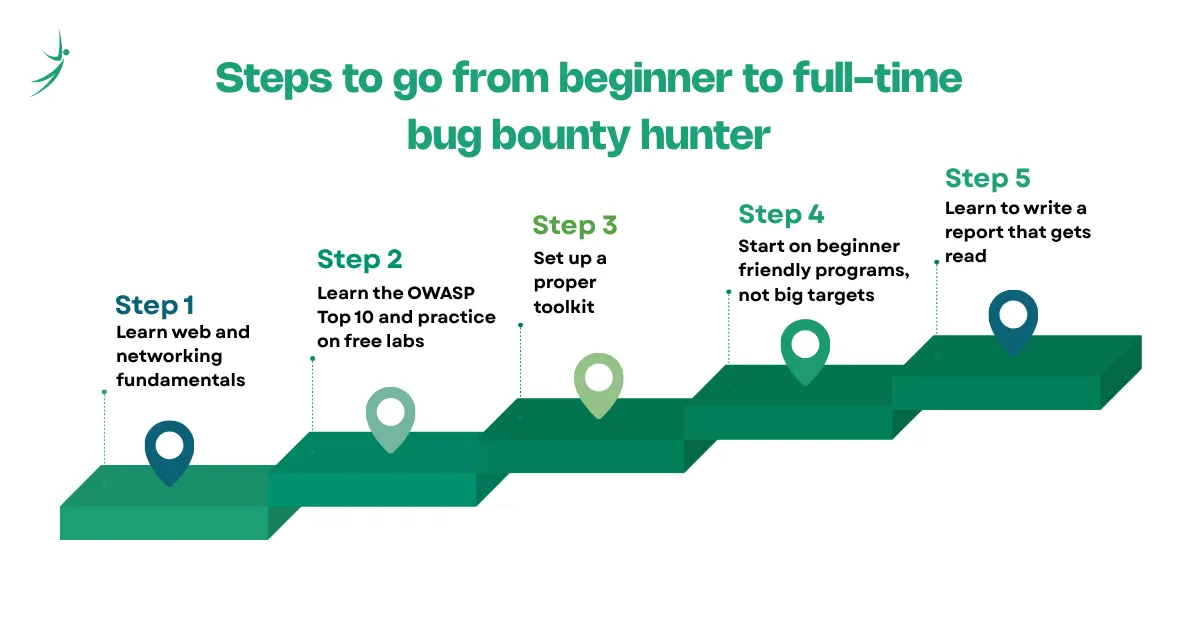
Skipping straight to hacking a live target is the most common mistake beginners make. A more reliable starting point looks like this.
1. Learn web and networking fundamentals
- Understand how a browser talks to a server: HTTP methods, status codes, cookies, and DNS resolution.
- Skipping this step turns every later step into memorization instead of understanding.
2. Learn the OWASP Top 10 and practice on free labs
- The OWASP Top 10 is the standard reference for the most common web application vulnerabilities.
- Free platforms like PortSwigger's Web Security Academy and OWASP Juice Shop let beginners practice finding these issues in a legal, built for testing environment.
- OWASP Top 10 Vulnerabilities Explained breaks down each category with examples.
3. Set up a proper toolkit
- Burp Suite is the closest thing this field has to a standard tool, and the free Community Edition covers everything a beginner needs.
- Burp Suite Tutorial for Beginners walks through the setup step by step.
4. Start on beginner friendly programs, not big targets
- Public vulnerability disclosure programs and beginner tagged programs on HackerOne, Bugcrowd, and Intigriti give new hunters realistic, less competitive targets.
- Nepali hunters should also look at Bugv, a bug bounty platform built around the local market.
5. Learn to write a report that gets read
- Programs mark a valid bug with a vague report as duplicate or informative more often than they pay it out.
- Clear reproduction steps, a short impact statement, and a proof of concept matter as much as the finding itself.
Bug Bounty Roadmap:
| Stage | Title | Focus | Timeline |
|---|---|---|---|
| Entry | Beginner Hunter | OWASP Top 10, labs, VDPs | 0 to 3 months |
| Developing | Active Hunter | Consistent hunting, first paid bounties | 3 to 12 months |
| Established | Experienced Hunter | Specializing in web, API, or mobile targets | 1 to 3 years |
| Advanced | Senior Researcher or AppSec Engineer | Full time bounty income or an employed security role | 3 plus years |
The highest leverage move in this roadmap is not hunting more hours, it is narrowing focus:
Beginners tend to scan everything the same way everyone else does, which means competing for the same obvious bugs.
Hunters who move up faster usually specialize, whether that means API security, mobile applications, or business logic flaws automated scanners cannot detect at all.
Bug Bounty vs Penetration Testing compares the two paths directly for anyone weighing bug bounty against a full time job.
Bug Bounty and Web Application Security Salary in Nepal (and Globally)
| Stage | Nepal (side income) | Global platforms (full time) |
|---|---|---|
| Beginner | Irregular, often unpaid while learning | 500 to 2,000 dollars a month |
| Active hunter | Irregular, supplemental income | Around 120,000 dollars a year on average |
| Top tier | Rare in Nepal currently | 300,000 dollars a year and above |
These numbers need context most salary tables skip:
- Bug bounty income stays freelance by nature, so it swings hard depending on how many programs someone hunts, how competitive those programs are, and how much time goes into recon versus testing.
- Very few Nepali hunters treat bug bounty as a full salary replacement today, mainly because so few local companies run formal programs.
- The more dependable path for steady income in Nepal is often an employed penetration testing or web application security job with a clearer, more predictable range.
- Bug Bounty Salary in Nepal 2026 covers the freelance side in more detail, including how payout size scales with bug severity.
Top Bug Bounty and Web Application Security Tools
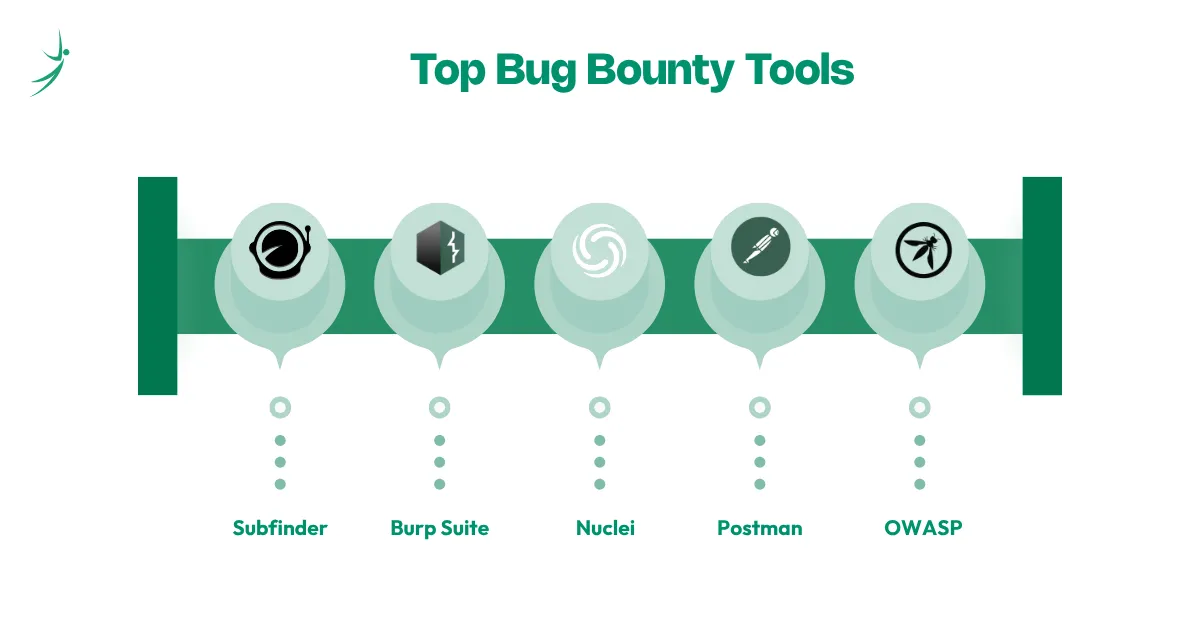
| Category | Tools |
|---|---|
| Reconnaissance | Subfinder, httpx, Amass |
| Interception and manual testing | Burp Suite, OWASP ZAP |
| Automation | ffuf, Nuclei |
| API testing | Postman |
| Practice labs | PortSwigger Web Security Academy, OWASP Juice Shop, DVWA |
Learning all of these at once is a fast way to burn out before finding a single bug:
- Start with Burp Suite, since almost every other step in a bug bounty workflow eventually runs through it.
- Add a recon tool next, then get consistent practice on free labs before ever touching a paid program.
Certifications Worth Getting in 2026
Certifications help more in web application security than in most other tech careers, mainly because they prove hands on skill rather than memorized theory:
- PortSwigger's Web Security Academy issues free badges for each completed learning path, and most hiring managers in this field recognize them as a legitimate starting signal.
- eJPT, the Junior Penetration Tester certification from INE, works well as a first formal credential for anyone with little to no prior security background.
- eWPT narrows that same practical approach specifically to web applications, making it more directly relevant to bug bounty hunting than a broader networking focused certification.
- OSWE from OffSec focuses specifically on advanced web application exploitation, and bug bounty hunters and web application security specialists widely recognize it as a mark of serious skill.
- OSCP remains the broader industry standard worth pursuing alongside OSWE for anyone also considering an employed penetration testing role.
None of these certifications matter as much as a public HackerOne or Bugcrowd profile with a track record of accepted reports, which carries more weight in this field than in almost any other corner of tech. Reading public writeups from disclosed HackerOne and Bugcrowd reports also teaches real bug patterns faster than most courses do.
Start Your Bug Bounty and Web Application Security Career with Skill Shikshya
Self teaching works, but it takes longer and leaves gaps that only show up once a real program rejects a report for something a structured curriculum would have caught early. Skill Shikshya's bug bounty and web application security training course includes:
- Reconnaissance, the OWASP Top 10 and beyond, API security, and professional report writing
- Live labs rather than recorded theory
- AI assisted workflows built directly into the curriculum, since that is increasingly how modern security research actually gets done
- Career support for students moving into freelance hunting, penetration testing roles, or web application security jobs at local and international companies
Student success stories from the program document these outcomes directly.
Frequently Asked Questions
What is bug bounty in simple terms?
Bug bounty is a system where companies pay independent researchers to find and report security flaws in their software before criminals find them first.
How do I start bug bounty hunting as a complete beginner?
Start with web and networking fundamentals, work through the OWASP Top 10 on free labs like PortSwigger's Web Security Academy, then move to beginner friendly programs on platforms like HackerOne or Bugcrowd once the basics feel solid.
Is bug bounty hunting legal?
Yes, as long as testing stays within the scope a program publishes. Testing outside that scope without permission counts as unauthorized access, not bug bounty hunting.
Do I need coding knowledge to start?
Not to begin, but reading basic JavaScript, Python, or PHP becomes necessary quickly once bugs move beyond the simplest categories.
Is bug bounty a good career in Nepal?
It works well as a skill building path and side income, though most Nepali hunters currently rely on international platforms rather than local programs, since few Nepali companies run formal bug bounty programs yet.
How long does it take to find a first bug?
It varies widely, but most beginners who study consistently and practice on labs before hunting live programs find their first valid report within a few months.
How much can a beginner realistically earn?
Most beginners earn little to nothing in the first few months, since finding valid bugs takes practice. Once a hunter starts consistently finding and reporting valid issues, part time income in the low hundreds to low thousands of dollars a month becomes realistic on international platforms.
What is the difference between bug bounty and penetration testing?
Bug bounty hunting stays freelance and program based, with payment tied to each accepted report. Penetration testing is usually a salaried or contracted role with a fixed scope and timeline agreed on in advance.
Which certification should I get first?
PortSwigger's free Web Security Academy badges make the most sense as a starting point, followed by eJPT or eWPT once ready for a formal, paid certification.
Do I need a cybersecurity degree?
No. Most working bug bounty hunters and web application security researchers are self taught or came through hands on training programs rather than a formal degree, though a degree does not hurt.