Scope of Data Analytics in Nepal and Globally: Career, Salary & Future (2026) | Skill Shikshya
If you are weighing whether to invest months of your time and course fees into a data analytics career, the most important question is not "what is data analytics?" it is "where does it actually go from here, and is there a real future in it for someone based in Nepal?"
Most articles on the scope of data analytics answer that question for the Indian or US market and stop there. This guide answers it for Nepal: the industries hiring right now, the career paths open to you, what salaries look like at each stage, and how the scope of data analytics is shifting as AI becomes a standard part of the toolkit.
Before diving in, a quick orientation to where this fits in our cluster. For the foundational picture of what data analytics is and how it works as a discipline, our guide on the building blocks of modern data analytics covers the four core types, tools, and workflow in full. For a side-by-side look at how the scope of data analytics compares with data science, our piece on choosing between data analytics and data science careers maps out the difference clearly. If you are ready to start building skills now, our Business Data Analytics with AI Course in Nepal is built around exactly what Nepal's local and remote job market requires.
What is the Scope of Data Analytics?
The scope of data analytics refers to the range of industries, roles, applications, and career paths that data analytics skills open up and how that range is expected to expand over time. It is the practical answer to the question every prospective student or career-switcher actually wants answered: if I learn this, what can I actually do with it?
The short answer in 2026 is: more than ever before, and across more industries than most people realize. The global data analytics market was valued at approximately $94 billion in 2025 and is projected to reach $334 billion by 2030, growing at a compound annual growth rate of around 29%. That is not a niche industry expanding quietly. It is one of the fastest-growing sectors in the global economy, and skilled professionals sit directly at the center of it.
According to the US Bureau of Labor Statistics, demand for data-centric roles is projected to grow by 23 to 35 percent by 2032, faster than the average growth rate for all occupations, with approximately 108,400 new data analyst jobs projected over the next decade.
For Nepal, this global expansion matters for two reasons: it is creating strong local demand as Nepali businesses digitize, and it is creating an enormous remote work opportunity for Nepal-based professionals who can deliver analytics work for international clients from Kathmandu.
Scope of Business Data Analytics: Which Industries Are Hiring?
The scope of business data analytics in 2026 is genuinely cross-industry. Every organization that collects data which in practice means every organization needs professionals who can turn that data into decisions. Here is how that plays out across the specific industries operating in Nepal today.
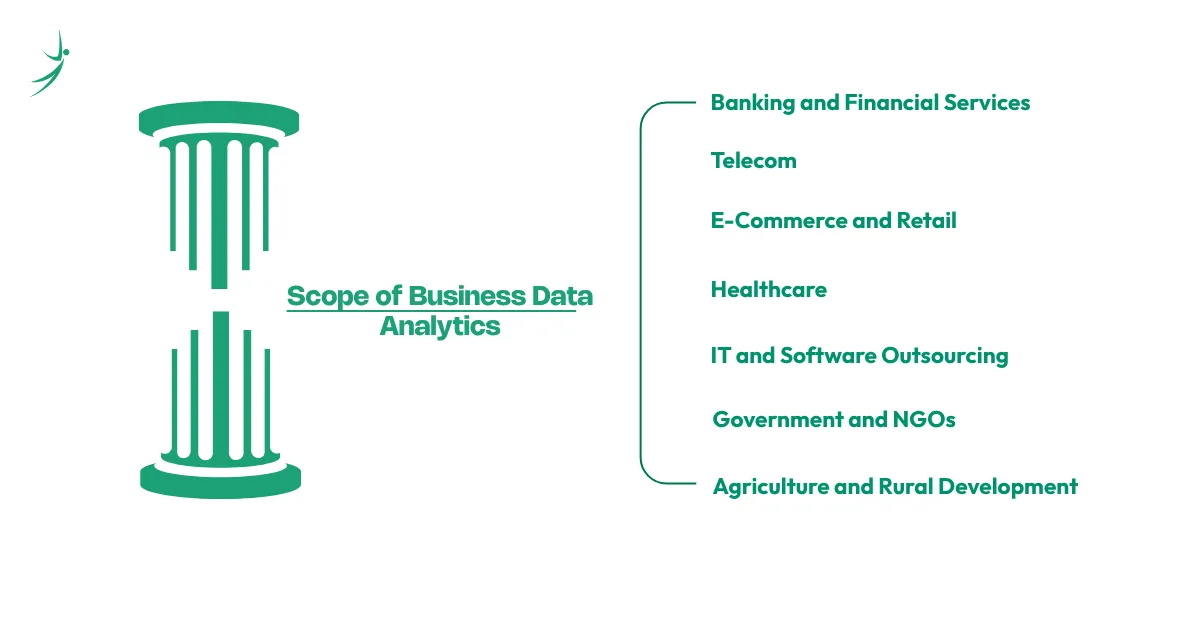
Banking and Financial Services
Nepal's banking sector is one of the heaviest adopters of data analytics domestically. Commercial banks use analytics for credit risk assessment, fraud detection, customer churn prediction, branch performance monitoring, and regulatory reporting. The use of real-time transaction analytics for fraud prevention is now standard practice across Nepal's major commercial banks, making this one of the most active local hiring sectors for data analysts with SQL and Power BI skills.
Telecom
Nepal Telecom and Ncell both run analytics operations covering customer behavior analysis, network performance monitoring, churn prediction, and marketing segmentation. Telecom is consistently one of the top-hiring sectors for data analysts in Nepal, and roles here tend to offer structured career progression from junior analyst to senior analytics positions over a three to five year window.
E-Commerce and Retail
Nepal's growing e-commerce sector including platforms like Daraz and a rising number of domestic online retailers uses analytics for inventory optimization, customer lifetime value modeling, marketing performance tracking, and pricing strategy. As of 2026, 85% of retail companies globally use analytics to optimize inventory management and improve customer experiences. Nepal's retail sector is moving in the same direction, creating consistent demand for analysts who understand both the tools and the business context. Technavio
Healthcare
Nepal's healthcare sector, including private hospital groups and NGO-led health programs, is an emerging area for data analytics. 78% of healthcare providers globally use data analytics to predict patient outcomes and reduce readmissions. Domestically, healthcare analytics is still in early stages, but organizations working in population health, clinical data management, and public health reporting are beginning to build analytics capacity. Technavio
IT and Software Outsourcing
Nepal's IT outsourcing sector companies like Leapfrog Technology, Fusemachines, CloudFactory, and F1Soft Group actively uses and hires for data analytics talent, often to serve international clients. This segment is particularly relevant because it offers exposure to global data standards, higher compensation benchmarks, and the kind of portfolio-building work that opens remote international roles.
Government and NGOs
Nepal's government agencies and the NGO sector which is substantial in Nepal are increasing their use of data for program monitoring, impact evaluation, and policy planning. These roles are less commercially focused but represent a significant volume of data analyst employment, particularly in Kathmandu.
Agriculture and Rural Development
An emerging area: agricultural analytics for crop yield forecasting, supply chain efficiency, and rural microfinance analytics. Organizations like iDE Nepal and various agritech startups are beginning to bring structured data analytics into agriculture, a sector that represents a significant untapped opportunity for data professionals interested in social impact work.
Scope of Data Analyst: Career Paths and Role Progression
Understanding the scope of a data analyst as a career means understanding not just the entry point but the full trajectory where the role leads, how fast it moves, and what the ceiling looks like.
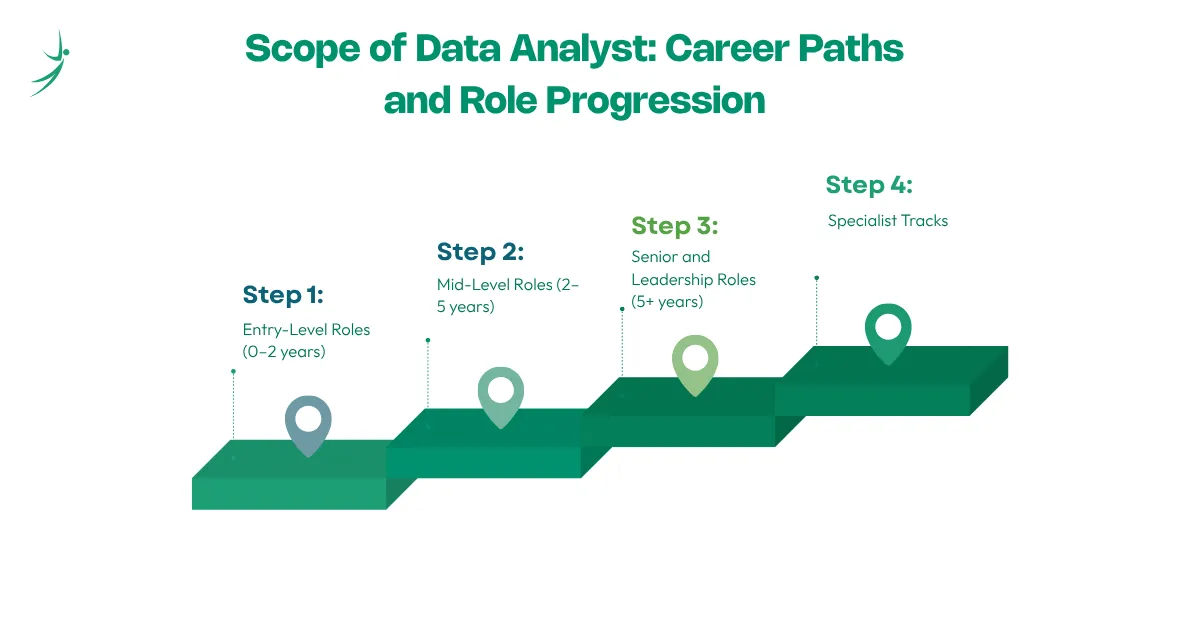
Entry-Level Roles (0–2 years)
- Junior Data Analyst works with SQL queries, Excel, and basic Power BI dashboards; focuses on data cleaning, standard reporting, and stakeholder support.
- Reporting Analyst builds and maintains recurring reports and scorecards for business teams; strong Excel and SQL foundation required.
- Business Analyst (data-focused) bridges business requirements and data analysis; common in banking, telecom, and IT outsourcing.
- Data Analytics Intern entry into the field for students and recent graduates; focused on hands-on learning with real datasets under senior guidance.
Mid-Level Roles (2–5 years)
- Senior Data Analyst owns full analysis cycles, builds complex dashboards, and presents findings directly to senior stakeholders.
- Business Intelligence Developer designs and maintains the BI infrastructure, data models, and dashboard architecture that junior analysts use.
- Analytics Consultant advises businesses on how to structure their data operations and interpret their analytics output; common in consulting firms and IT companies serving multiple clients.
Senior and Leadership Roles (5+ years)
- Analytics Manager / Head of Analytics leads a team of analysts, sets the analytics strategy for a department or company, and translates business goals into data priorities.
- Data Architect designs the data infrastructure that analytics systems run on; requires deep technical expertise in databases, data warehousing, and cloud platforms.
- Chief Data Officer (CDO) executive-level responsibility for an organization's entire data strategy, governance, and analytics capability.
Specialist Tracks
- AI Data Analyst integrates machine learning tools and AI-assisted analytics into traditional analyst workflows; the fastest-growing specialization in 2026.
- Data Visualization Specialist focuses specifically on dashboard design, data storytelling, and communicating insights visually. For a full breakdown of what this role involves, our guide on turning raw data into visual stories covers the tools and techniques in detail.
- Business Intelligence Analyst focused specifically on BI platforms, dashboards, and the ongoing reporting infrastructure that keeps business teams informed. See our guide on how business intelligence powers organizational decision-making for the full picture of this track.
Scope of Data Analytics in Future: What the Next Five Years Look Like
The scope of data analytics in future is being shaped by five forces that are already visible in 2026 and will intensify over the next five years.
AI Integration Becomes Standard
AI tools are moving from optional add-ons to core parts of the analytics workflow. Power BI Copilot, Tableau Pulse, and Python-based AI libraries are already changing how analysts work day to day, automating data cleaning, generating first-draft reports, and surfacing anomalies automatically. The scope of data analytics in the future is not smaller because of AI it is larger, because AI makes it possible to deliver more sophisticated analysis faster, which increases demand for skilled professionals who can direct and validate what the AI produces. For a full picture of how AI is reshaping the discipline right now, our guide on how artificial intelligence is transforming the analytics workflow goes into the specific tools and practical changes in detail.
Real-Time Analytics Replaces Batch Reporting
Organizations are moving away from monthly reports toward live dashboards and real-time data feeds. This requires analysts who understand streaming data concepts and can build dashboards that update dynamically, not just produce static snapshots.
Cloud-First Data Infrastructure
Most organizations are moving their data infrastructure to cloud platforms AWS, Google Cloud, Azure. Analysts who understand cloud-based data warehouses like BigQuery, Snowflake, and Redshift are significantly more valuable than those limited to on-premise databases.
Data Governance and Privacy Compliance
As data volumes grow and regulations tighten globally, organizations need professionals who understand data ethics, privacy compliance, and governance frameworks. This is adding a new dimension to the scope of data analytics that goes beyond technical skill.
Democratization of Analytics
AI tools are enabling non-technical business users to access data insights directly, without going through an analyst for every query. This does not reduce demand for analysts it raises the bar. Analysts who add value are those who provide strategic interpretation, validate AI outputs, and build the systems non-technical users rely on.
Scope of Data Scientist in Future vs Data Analyst: Understanding the Distinction
A question that comes up consistently: is the scope of data scientist in future stronger than the scope of data analyst? The honest answer is that both have strong futures, but they diverge in important ways that matter for career planning.
The scope of data scientist in future leans heavily toward machine learning engineering, model building, and AI system development a path with a higher salary ceiling and stronger global remote demand, but a significantly longer learning curve and less local job availability in Nepal right now.
The scope of data analyst, by contrast, is broader locally, faster to enter, and deeply embedded in the day-to-day operations of virtually every industry in Nepal. The best path for most Nepal-based learners starting today is to build a strong data analytics foundation first, get into the market, and layer in data science skills over time.
Data Analytics Salary in Nepal: What the Scope Means for Earnings
Understanding the scope of data analytics without understanding the salary reality is only half the picture. Here is the current, cross-checked salary landscape for data analytics roles in Nepal.
| Role | Experience | Nepal (NPR/month) |
| Junior Data Analyst / Intern | 0–1 years | NPR 25,000 – 45,000 |
| Data Analyst | Entry (0–1 yrs) | NPR 30,000 – 55,000 |
| Data Analyst | Mid (2–4 yrs) | NPR 70,000 – 1,30,000 |
| Senior Data Analyst | 5+ years | NPR 1,30,000 – 3,00,000+ |
| BI Developer / Analytics Specialist | Mid–Senior | NPR 80,000 – 1,80,000 |
| Analytics Manager | Senior | NPR 1,50,000 – 3,00,000+ |
| Remote Data Analyst (international clients) | Mid–Senior | NPR 1,50,000 – 4,00,000+ |
A few important notes on these figures:
The remote premium is real and significant. Nepal-based data analysts working remotely for international clients consistently earn above local market rates, with mid-level professionals often reaching NPR 150,000 to 400,000 per month depending on the client and specialization.
AI tool fluency adds a measurable premium at every level. Analysts who can demonstrate proficiency with Power BI Copilot, Python-based AI libraries, or prompt engineering for analytics consistently command higher offers than those with traditional-only skill sets.
Kathmandu roles pay more than smaller-city equivalents in the same title, and IT/fintech sector roles pay more than NGO or government sector roles at comparable experience levels.
Data Analytics Salary Globally: What the Scope Means for Remote Earners
For Nepal-based professionals, the global salary picture matters enormously because remote work closes the gap between local and international compensation. Here is the cross-checked global salary landscape for data analytics roles in 2026, pulled from Glassdoor, the US Bureau of Labor Statistics, Coursera, PayScale, and multiple country-specific salary guides.
| Role | USA (USD/year) | UK (GBP/year) | Canada (CAD/year) | Australia (AUD/year) | India (INR/year) |
|---|---|---|---|---|---|
| Data Analyst — Entry (0–1 yrs) | $63,000 – $75,000 | £30,000 – £38,000 | CAD 55,000 – 65,000 | AUD 65,000 – 78,000 | ₹4 – 7 LPA |
| Data Analyst — Mid (2–4 yrs) | $80,000 – $100,000 | £38,000 – £50,000 | CAD 65,000 – 80,000 | AUD 80,000 – 100,000 | ₹8 – 14 LPA |
| Senior Data Analyst (5+ yrs) | $110,000 – $145,000 | £50,000 – £70,000 | CAD 80,000 – 100,000+ | AUD 100,000 – 130,000+ | ₹15 – 28 LPA |
| Analytics Manager / Lead | $130,000 – $175,000+ | £65,000 – £90,000+ | CAD 95,000 – 130,000+ | AUD 120,000 – 160,000+ | ₹25 – 45 LPA |
A few important context notes on these figures:
- According to Glassdoor, the average salary for a data analyst in the United States is $86,531, while the US Bureau of Labor Statistics reports a median annual salary of $83,640 both significantly above the mean annual salary across all US occupations of $65,470.
- In the UK, data analysts typically earn an average of £45,000 per year, while professionals in Canada, Australia, and the UK generally receive between $50,000 and $80,000 USD equivalent annually.
- The BLS classifies most data analyst work under Operations Research Analysts and projects 23% growth from 2023 to 2033, labeling this "much faster than average," with the 90th percentile of earners clearing $171,710 annually.
- Switzerland leads Europe in absolute data analyst pay, with average salaries of CHF 86,000 to CHF 96,000 per year (approximately $90,000 to $100,000 USD), driven by demand in finance, pharma, and tech sectors.
- The strongest global salary opportunities for data analysts concentrate where three things meet: high-demand markets (USA, Australia, Singapore, Germany, the Netherlands, UAE), high-value industries (technology, finance, consulting, energy), and analysts who combine SQL, BI tools, and strong business communication skills.
What is the Scope of Data Analyst in Nepal Specifically?
The scope of a data analyst in Nepal specifically deserves direct treatment, because the global picture and the Nepal reality are not identical.
Nepal's local market for data analysts is genuinely strong and growing, concentrated in these areas:
- Banking and financial services the deepest local market for analytics roles, with most of Nepal's 27 commercial banks running some form of analytics operation.
- Telecom consistent hiring with structured career paths.
- IT outsourcing the most internationally competitive local sector, often offering salaries closer to remote benchmarks.
- E-commerce and retail smaller but growing as Nepal's digital economy matures.
- NGOs and development organizations high volume of roles, particularly for analysts with program data and M&E (monitoring and evaluation) experience.
The scope of the data analyst role in Nepal is also expanding because of a structural gap: demand for skilled analysts in Nepal is currently outpacing the supply of job-ready professionals. This is one of the strongest career entry conditions possible it means motivated learners who build real, demonstrable skills through structured training and project work have a measurable advantage over candidates with certificates but no applied experience.
Data Analytics Scope by Industry: A Quick Reference
| Industry | Nepal Demand | Primary Analytics Use Cases |
|---|---|---|
| Banking | High | Credit risk, fraud detection, customer analytics |
| Telecom | High | Churn prediction, network analytics, marketing |
| E-commerce | Growing | Inventory, customer behavior, pricing |
| IT Outsourcing | High | Client analytics, BI development, reporting |
| Healthcare | Early stage | Patient data, program monitoring |
| Government | Moderate | Policy data, program evaluation |
| NGO/Development | High volume | M&E, impact reporting, field data |
| Agriculture | Emerging | Yield analytics, supply chain, microfinance |
Required Skills to Maximize Your Scope as a Data Analyst
The scope of data analytics as a career is directly proportional to the depth and breadth of the skills you build. Here is what actually determines how wide your opportunities are:
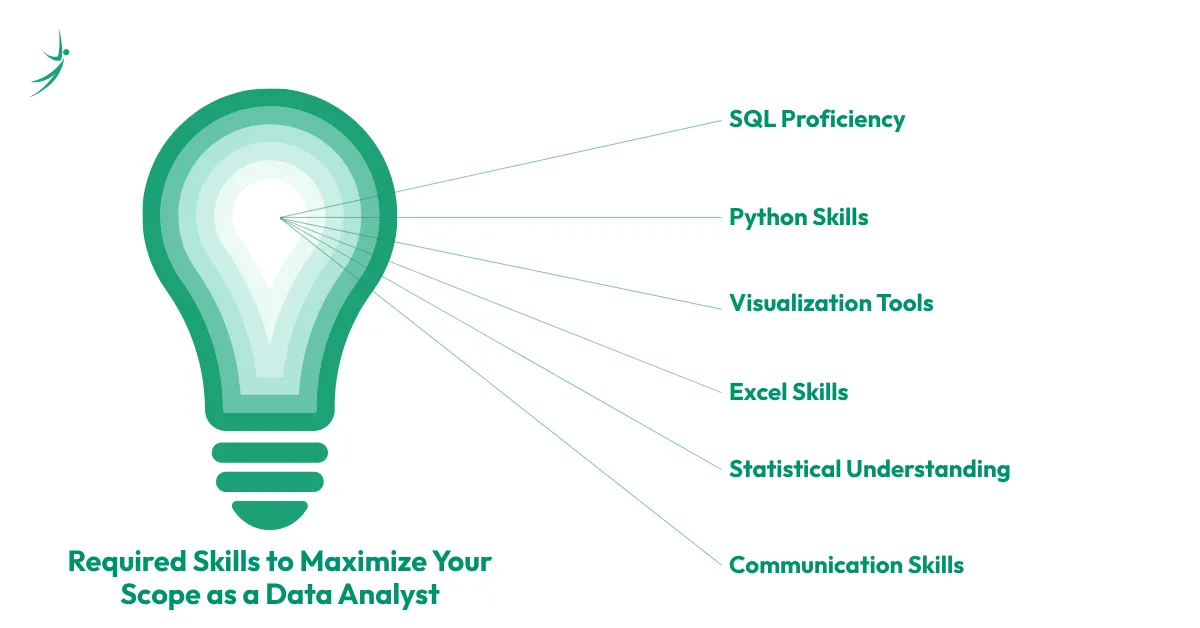
- SQL the single most universally required skill across every data analyst role in every industry in Nepal; non-negotiable.
- Python essential for automation, advanced analysis, and integration with AI tools; increasingly expected even for mid-level roles.
- Power BI or Tableau the primary dashboard and visualization tools in Nepal's corporate market; Power BI dominates locally, Tableau for international remote roles.
- Excel still used daily in most Nepali organizations; strong Excel skills remain relevant even as Python and BI tools expand.
- Statistics fundamentals mean, median, correlation, hypothesis testing; required to interpret what data actually shows versus what it superficially appears to show.
- Data storytelling and communication the ability to explain findings clearly to non-technical stakeholders; consistently ranked by employers as the skill that separates good analysts from hired analysts.
- AI tool fluency using Power BI Copilot, ChatGPT for SQL and Python, and Jupyter AI for analytics workflows; the fastest-growing expected skill in 2026 job postings.
How to Start Building Your Data Analytics Career
If you are reading this guide because you are deciding whether to pursue data analytics, here is the honest path forward for someone starting from scratch in Nepal.
- Build fundamentals first Excel, basic statistics, and SQL form the foundation everything else sits on. Do not skip these in a rush to learn the more visible tools.
- Follow a structured data analytics roadmap random self-teaching produces inconsistent results; a sequenced program that builds skills in the right order produces job-ready outcomes.
- Build real projects with real data the difference between a hired candidate and an overlooked one is almost always a portfolio of documented work with real datasets, not a longer list of certificates.
- Get hands-on with AI tools early Power BI Copilot and ChatGPT for analytics are table-stakes skills in 2026, not advanced options; learning them alongside the fundamentals, rather than after, is the right sequence.
- Target your first role strategically banking, telecom, and IT outsourcing offer the strongest entry conditions in Nepal right now, combining reasonable availability of junior roles with structured environments that actually develop your skills further.
For learners who want a structured path that covers all of the above, our Business Data Analytics with AI Course in Nepal is built specifically around what Nepal's local and remote data analytics job market requires in 2026, not what it required three years ago.
Conclusion
The scope of data analytics in Nepal and globally has never been broader, and the trajectory is not slowing. The global data analytics market is projected to reach $104 billion by the end of 2026, with demand for skilled professionals growing faster than the supply of job-ready talent in almost every market, including Nepal's. The industries hiring are diverse, the career paths are well-defined, the salary progression is real, and the remote work opportunity available to Nepal-based analysts is significant.
The scope is there. The question is whether you build the skills to access it.
Frequently Asked Questions
What is the scope of data analytics in Nepal?
What is the scope of data analyst as a long-term career?
What is the scope of data analytics in future?
What is the scope of data scientist in future compared to data analyst?
What salary can I expect as a data analyst in Nepal?
Which industries offer the best scope for data analysts in Nepal?
Do I need a degree to work in data analytics in Nepal?
About Author:

Dhiraj Bashyal is a Machine Learning Engineer at Vrit Technologies, with 3 years of hands-on experience in applied AI and machine learning. He brings that industry experience directly into the classroom, teaching Data Science and Machine Learning at Skill Shikshya, where he helps learners build a practical, project-ready foundation in Python, ML workflows, and real-world data problem-solving.