MERN Stack Roadmap 2026: Complete Step-by-Step Guide to Become a Full-Stack Developer
The web development ecosystem is expanding rapidly, making it more critical than ever for engineering candidates to have a structured, industry-aligned learning path. If you are aspiring to break into the tech industry, following a definitive full stack roadmap ensures you acquire high-demand software engineering competencies without wasting time on outdated concepts. This comprehensive mern stack roadmap 2026 is meticulously designed to take you from an absolute beginner to a highly proficient production-ready engineering professional. To fast-track this journey with structured expert mentorship and real-world industrial projects, enrolling in a premier professional MERN stack course provides the ideal environment to establish your technical foundation and secure career placement.
What Is the MERN Stack?
The MERN stack represents an unyielding suite of JavaScript-based technologies designed to build high-performance, scalable web applications from end to end. By unifying the programming language across both client-side and server-side components, it removes traditional development friction and enables engineering teams to execute feature iterations at rapid speed.
What Does MERN Stand For?
MERN is an acronym representing four foundational tech layers:
- MongoDB: A document-based NoSQL database utilized for data persistence.
- Express.js: A minimalist backend server framework built for Node.js.
- React.js: A component-driven frontend user-interface library.
- Node.js: A highly scalable asynchronous JavaScript runtime environment.
Together, these structural MERN stack frameworks form an end-to-end software delivery pipeline powered entirely by JavaScript.
Why Learn the MERN Stack in 2026?
In 2026, tech organizations demand agility, cross-functional capabilities, and ultra-fast application processing speeds. Learning this stack allows you to become an efficient contributor without the overhead of context-switching between different programming languages. Furthermore, the modern integration of AI-assisted code generation utilities harmonizes exceptionally well with JavaScript architectures, allowing engineers to build and optimize software solutions faster than ever before.
What Does a MERN Stack Developer Do?
A MERN developer operates across the full lifecycle of software execution. They design responsive web interfaces, implement state synchronization logic, construct secure application programming interfaces (APIs), architect database schemas, enforce data-level security controls, and configure deployment routines to push production code live into cloud infrastructures.
Why MERN Stack Is One of the Best Career Choices in 2026
Aspiring developers frequently search for strategic career guides to identify sustainable engineering pathways. Choosing to specialize in JavaScript technologies offers long-term versatility, community backing, and consistent industry alignment.
MERN Stack vs MEAN vs Full Stack Development
Understanding technical paradigms requires a deep look at architecture:
- MERN vs. MEAN: A structural MERN stack vs MEAN stack analysis reveals that while MEAN relies on Angular's opinionated Model-View-Controller framework, MERN leverages React’s flexible component architecture, offering superior agility and easier integration with modern server components.
- Frontend Libraries: Evaluating options like React vs Angular vs Vue highlights that React dominates the modern development ecosystem due to its immense library tooling, making it an essential frontend cornerstone.
- Full Stack Scope: In the broader landscape of frontend vs backend vs full stack, a full-stack engineering profile ensures you understand both user experience engineering and server runtime mechanics holistically.
Industries Using the MERN Stack
The MERN infrastructure is widely integrated across FinTech platforms, SaaS applications, e-commerce networks, real-time collaboration suites, educational dashboards, and high-frequency streaming software. Its capacity to handle concurrent operations with low latency makes it highly attractive across diverse business sectors.
The Complete MERN Stack Roadmap (Step-by-Step)
To systematically navigate the roadmap of mern stack development, you must conquer each tier in logical sequence. Attempting to master high-level frameworks without mastering foundational rules leads to fragile engineering habits.
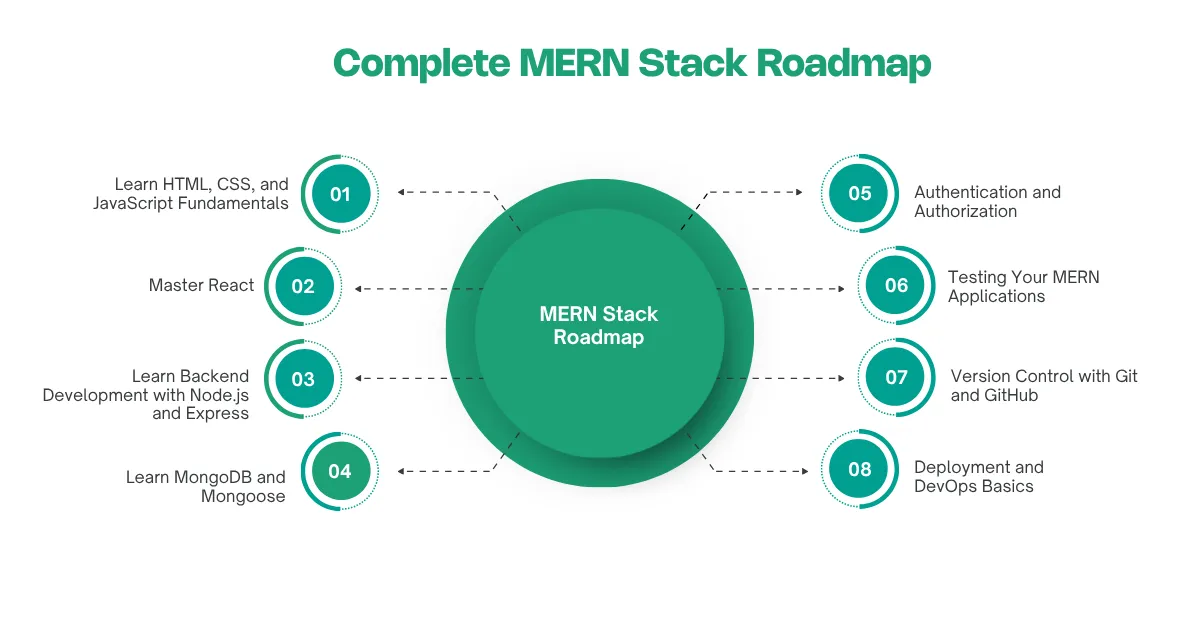
1. Learn HTML, CSS, and JavaScript Fundamentals
Before building full-stack applications, you must master the fundamental building blocks of the web and acquire the core MERN stack skills required to write clean, executable code.
- HTML Basics: Understand semantic HTML markup (<header>, <main>, <section>, <article>, <aside>, <footer>) to construct clean document structures that maximize accessibility and search engine readability.
- CSS Fundamentals: Master the cascading rule, modern box modeling, selectors, specificity weights, and standard document typography configurations to style layouts accurately.
- Responsive Design: Develop fluid UI layouts utilizing CSS Flexbox layouts, multi-dimensional CSS Grid containers, and adaptive Media Queries to ensure design integrity across all mobile and desktop viewports.
- Variables: Master modern JavaScript block scoping constructs (let and const), understanding block-level isolation and why legacy global declarations (var) are systematically avoided in modern production code.
- Functions: Write clean, modular code blocks using standard declarative syntax and modern Arrow Functions, understanding lexical scoping rules and immediate code execution.
- Objects and Arrays: Manipulate unstructured data sets with dexterity using advanced array protocols (.map(), .filter(), .reduce(), .find()) alongside structural object nesting patterns.
- Loops:Iterate over dynamic collections using modern, clean traversal loops (for...of, for...in, forEach), ensuring optimized runtime execution lengths.
- Conditionals: Control application logical routing pathways utilizing clear conditional structures (if-else gates, logical short-circuiting, and clean switch-case evaluation blocks).
- ES6 Features: Incorporate modern syntax enhancements, explicitly leveraging Object Destructuring, Rest/Spread operators, Template Literals, and standard Nullish Coalescing features.
- Callbacks: Understand higher-order execution layers by passing processing logic into asynchronous callback functions, establishing an initial mental model of event execution.
- Promises: Manage multi-state asynchronous execution timelines cleanly utilizing native JavaScript Promises, handling pending, fulfilled, and rejected system operations.
- Async/Await: Write highly readable, linear asynchronous data operations using sequential async/await syntax wrapped inside robust try/catch safety parameters.
- Modules: Structure clean, decoupled codebases by exporting and importing isolated utility code layers using modern ESM syntax (import/export).
- TypeScript (Optional but Recommended): Enhance runtime predictability and catch software compile-time errors early by layering strongly typed supersets and custom interfaces over standard JavaScript variables.
2. Master React
Building scalable, interactive user interfaces requires transitioning from imperative programming to modern component-driven views. Deeply analyzing what is React reveals an intuitive library focused on state-driven rendering and UI modularity.
- Components: Construct your user interface as a nested tree of isolated, independent, and completely reusable Functional Components that handle their own structural rendering logic.
- JSX: Leverage JavaScript XML syntax extension to compose declarative semantic element layouts directly inside your logic, merging interface design and scripting smoothly.
- Props: Pass immutable, read-only data configurations down from parent container components into nested child elements to establish clear rendering configurations.
- State: Manage dynamic, mutable internal data tracking variables inside components that automatically prompt target interface re-renders when values update.
- Hooks: Leverage standard React Hooks, primarily utilizing useState for internal data tracking and useEffect to synchronize components with external hardware systems or data servers.
- Event Handling: Capture and handle real-time user inputs (onClick, onChange, onSubmit) safely using React’s optimized synthetic event management layer.
- Conditional Rendering: Render alternate layout fragments dynamically using native JavaScript logical expressions (Ternary operators or short-circuit logic) based on current application states.
- Lists and Keys: Render sequential user interface arrays systematically using .map(), assigning stable, unique key properties to allow React’s virtual DOM to track individual adjustments efficiently.
- Forms: Build deterministic inputs using Controlled Components, binding user input fields directly to managed React state hooks for synchronized validation.
- Context API: Bypass complex, multi-layered property drilling by establishing global data context providers that deliver state variables directly to distant nested child nodes.
- React Router: Implement smooth single-page application experiences by configuring multi-route path routing, managing route parameters, and establishing protected user navigation guards.
- Fragments: Group adjacent, sibling interface elements together using transparent structural fragments (<>...</>) without introducing cluttering nested div nodes into the final DOM.
- Custom Hooks: Extract and encapsulate complex component state management algorithms into isolated, shareable, and highly reusable custom hook hooks.
- API Integration: Fetch remote server datasets smoothly using modern data clients (such as Axios or native Fetch) inside side-effect loops, populating rendering queues asynchronously.
3. Learn Backend Development with Node.js and Express
To shift into full-stack architecture, you must move beyond client-side applications and learn server systems engineering. Reading a thorough guide on what is Node.js clarifies how this environment executes lightning-fast, non-blocking code on server hardware.
- Node.js Fundamentals: Understand the architectural mechanics of the non-blocking Event Loop, thread distribution, system events, and how JavaScript executes operations directly on underlying systems.
- Express Framework: Simplify raw server operations by layering Express over the Node runtime, utilizing its minimalist structures to orchestrate robust backend architectures.
- Modules: Organize server responsibilities logically by utilizing core native Node modules (fs, path, http) alongside custom modular code architectures.
- NPM: Manage application lifecycle libraries efficiently by utilizing Node Package Manager to install, audit, lock, and upgrade third-party backend packages safely.
- Routing: Establish clear, highly organized API endpoint patterns (/api/v1/users, /api/v1/products) that respond accurately to varied incoming HTTP method configurations.
- Middleware: Intercept, audit, parse, and transform incoming request data payloads smoothly by piping requests through sequential middleware functions prior to reaching endpoint controllers.
- Request and Response: Extract incoming parameters, headers, and body objects from incoming HTTP Requests, responding systematically with clean, standardized JSON objects.
- REST APIs: Architect clean, standard application interfaces following RESTful paradigms, utilizing appropriate semantic statuses (200 OK, 201 Created, 400 Bad Request, 401 Unauthorized, 500 Server Error).
- Authentication: Verify user identities systematically by implementing stateless validation mechanisms, securing endpoints against unauthenticated access.
- JWT: Issue cryptographically signed JSON Web Tokens upon successful verification, passing tokens via headers to establish lightweight, secure user verification timelines.
- Environment Variables: Isolate confidential server data keys, operational ports, and database access links safely inside .env configurations away from public repositories.
- Security Best Practices: Protect application runtimes from common exploits by integrating critical security middleware packages (like Helmet), configuring restrictive CORS policies, and cleansing inputs.
- Error Handling: Prevent database information leakage and app crashes by implementing a global centralized Express error-handling middleware structure to handle all runtime failures safely.
4. Learn MongoDB and Mongoose
A full stack roadmap 2026 is incomplete without database persistence. Full-stack applications must capture, evaluate, store, and recall application records reliably without creating performance bottlenecks.
- MongoDB Basics: Operate within a distributed NoSQL environment, understanding document storage architectures and why schema flexibility suits rapid application development.
- Collections: Organize related application documents systematically inside logical database groupings, serving as the NoSQL equivalent to traditional tabular relational models.
- Documents: Store operational system records as independent, rich data entities containing diverse property pairs structured following flexible schema rules.
- BSON: Understand Binary JSON database encoding format, optimizing data storage capacities, indexing depth, and cross-tier transport velocity.
- CRUD Operations: Execute core foundational database functions smoothly, mastering data addition, matching item retrieval, updating structural properties, and deleting expired records.
- Mongoose: Layer an object data modeling (ODM) library over raw MongoDB systems to write highly structured, predictable, and programmable database operations.
- Schemas: Define rigid structural data rules, property data types, system default values, and operational blueprints for database documents across your backend.
- Models: Compile active Mongoose Schemas into concrete executable data models that act as programmatic entry points to query and manipulate collections.
- Validation: Enforce strict server data integrity checks, ensuring string lengths, numeric ranges, and custom patterns match business safety policies before saving records.
- Relationships: Model real-world data structures accurately by configuring embedded document arrays or using Mongoose references (populate) to link detached data collections cleanly.
- Aggregation: Process multi-stage pipeline computations ($match, $group, $sort, $project) to transform, calculate, and summarize complex analytics data inside the database.
- Indexing: Optimize database record lookups and enhance read query speeds significantly by establishing target database indexes on frequently queried record keys.
- Middleware: Hook into Mongoose pre- and post-execution lifecycles to automate password hashing routines or log systemic database deletions seamlessly.
- Query Optimization: Analyze database lookups using execution tools, eliminating slow database scans and building highly optimized, low-latency database queries.
5. Authentication and Authorization
Securing a modern web application requires strict boundaries. Developers must confidently separate public presentation layouts from restricted, sensitive administration zones.
- User Registration: Capture new candidate credential packets safely, validate field syntax accuracy, perform uniqueness audits against databases, and persist user records securely.
- Login: Verify user credentials by matching incoming data parameters against existing database profiles, initiating a secure session pipeline.
- Password Hashing: Never store plain credentials; utilize modern hashing libraries like bcrypt to execute multi-round salt generation, rendering user passwords irreversible.
- JWT Authentication: Generate lightweight, cryptographically secure access strings passed within request headers, managing application state validation safely across server clusters.
- Refresh Tokens: Mitigate credential theft risks by issuing brief access token lifespans alongside secure, long-lived refresh tokens stored inside specialized cookies.
- Role-Based Access Control: Enforce strict access permissions based on user classifications, locking sensitive operations behind administrative credential validation checks.
- OAuth: Simplify user onboarding workflows by integrating third-party identification protocols, allowing users to securely log in via Google, GitHub, or Meta.
6. Testing Your MERN Applications
Professional software validation ensures application updates do not cause service outages or break legacy systems.
- Unit Testing: Isolate individual algorithmic functions and validation utilities, testing them independently with lightweight frameworks (such as Jest) to confirm exact programmatic outputs.
- Integration Testing: Validate communication pathways across connected software layers, testing if Express controllers execute accurate database entries via Mongoose models cleanly.
- End-to-End Testing: Simulate authentic user behavioral workflows in automated virtual browsers using tools like Cypress, testing complete interactions from frontend inputs down to server changes.
- API Testing: Verify REST endpoint schemas, status return values, and header formatting parameters systematically using headless automated tools like Supertest or Postman suites.
- Performance Testing: Examine endpoint response speeds and database retrieval performance under heavy load simulation models to eliminate operational data flow limitations early.
7. Version Control with Git and GitHub
Collaborating within modern development teams requires rigorous tracking of architectural code modifications.
- Git Basics: Track local codebase modifications using essential command-line tools (git init, git add, git commit, git status), preserving chronological project histories.
- Branching: Isolate new feature experiments safely away from main production tracks by creating dedicated, temporary development code branches (git branch, git checkout -b).
- Pull Requests: Submit local feature modifications to public repositories, explaining code changes to engineering peers to prompt review before merging into production tracks.
- Merge Conflicts: Resolve overlapping code modifications systematically by auditing identical code blocks inside editors, keeping target updates while protecting core code structure.
- Collaboration: Sync code changes across global remote workspaces cleanly by pulling collective code updates and pushing validated structural updates (git pull, git push).
- Documentation: Compose exceptionally detailed README.md portfolios featuring precise installation instructions, technical architecture summaries, API schema definitions, and live deployment links.
8. Deployment and DevOps Basics
Your mern stack developer roadmap concludes by pushing hidden development code bases out of local development environments into live cloud servers.
- Preparing for Deployment: Optimize client-side build modules by compressing bundle sizes, cleaning testing logs, and verifying server build compatibility parameters.
- Environment Variables: Inject tailored production keys, cluster access strings, and cloud identifiers into cloud platforms, keeping credentials safe from public code blocks.
- Hosting React: Deploy client interface build frameworks smoothly to high-performance, edge-optimized content delivery networks (such as Vercel, Netlify, or AWS S3).
- Hosting Node.js: Host backend Express server code engines inside managed cloud environments or virtual machines (such as Render, Railway, DigitalOcean, or AWS EC2 instances).
- MongoDB Atlas: Migrate local databases to a fully managed cloud database cluster, setting up secure IP access rules to protect records.
- CI/CD: Automate code integration and deployment processes using automated runners like GitHub Actions to execute automated test validation checks on every push.
- Monitoring: Integrate cloud logging systems and health check diagnostics to track live performance metrics and capture unhandled production script exceptions immediately.
- Rollbacks: Establish instant release reversion profiles within cloud control setups to instantly restore previous stable application builds if deployment errors occur.
MERN Stack Learning Timeline
Building high-performance competencies requires a realistic timeline. While individual processing speed varies, this disciplined timeline provides a path to becoming employment-ready.
- Beginner (0–2 Months): Devote these initial weeks to mastering core web layout semantics, responsive mobile styles, and foundational programming logic using modern JavaScript. Avoid jumping into high-level frameworks until you can comfortably write functional, data-driven code scripts natively.
- Intermediate (3–5 Months): Transition completely into declarative frontend architectures using React. Develop a deep mental model of component lifetimes, rendering performance, advanced state synchronization hooks, error boundaries, and client-side single-page route routing strategies.
- Advanced (6–9 Months): Shift focus entirely to backend system operations. Construct secure, performant server layers with Node.js and Express, architect production schema definitions with Mongoose, configure data authorization gates, and master database operations.
- Job Ready (9–12 Months): Merge your frontend and backend ecosystems into integrated applications. Configure full-stack authentication, implement real-time communications, write automated testing suites, integrate DevOps deployment pipelines, and polish your professional portfolio.
MERN Stack Career Roadmap
Following a structured full stack roadmap 2026 sets up a clear advancement pathway from initial entry-level tasks to senior system design leadership roles.
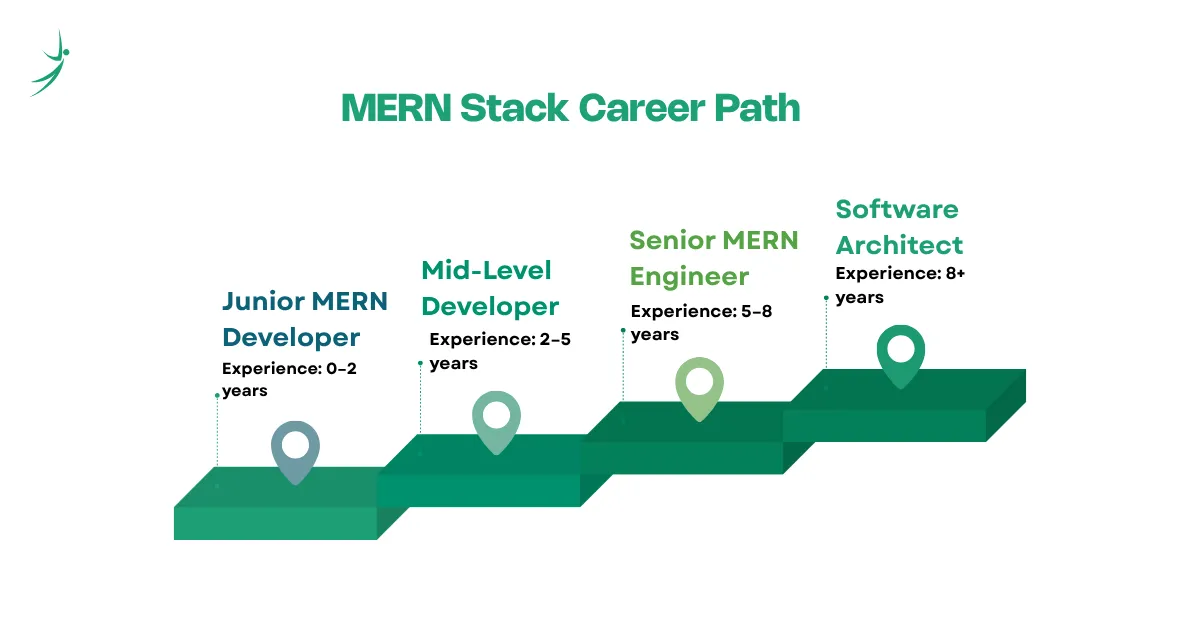
- Junior MERN Developer: An entry-level practitioner focusing on executing localized component designs, building simple backend CRUD routing endpoints, fixing minor bugs, and collaborating under senior instruction.
- Mid-Level Full Stack Developer: An independent engineer managing complete end-to-end features, optimizing multi-tier database configurations, implementing payment gateways, and auditing junior code submissions.
- Senior MERN Engineer: A seasoned architect overseeing complex software design patterns, refining systems data performance, implementing cache controls, and steering product security policies.
- Tech Lead / Software Architect: A technical leader setting enterprise system blueprints, managing cloud deployment clusters, selecting technical stacks, and guiding engineering teams to deliver software successfully.
MERN Stack Salary in Nepal (2026)
The software engineering profession continues to rank among the highest-earning local career paths. As the digital ecosystem expands rapidly across Kathmandu and other major commercial tech hubs, market compensation metrics reflect the high value of full-stack technical expertise.
- Entry-Level Salary: Fresh engineering graduates, interns, or trainees transitioning into full-time roles can expect an initial starting salary between NPR 30,000 and NPR 50,000 per month. Early-stage internship stipends generally hover between NPR 15,000 and NPR 25,000 per month while gaining foundational project experience.
- Mid-Level Salary: Developers with 2 to 5 years of verified industry experience who confidently manage both frontend rendering tiers and backend server operations command salaries ranging from NPR 70,000 to NPR 1,40,000 per month.
- Senior Developer Salary: Highly accomplished engineering specialists with more than 5 years of verified development history who architect complex systems and lead technical squads earn premium compensation starting from NPR 1,50,000 to NPR 3,00,000+ per month.
- Remote MERN Opportunities: The extensive adoption of international outsourcing workflows allows talented local developers to secure full-time remote software roles with foreign tech companies while living in Nepal. Competent remote practitioners frequently land monthly contracts valued between $1,500 and $4,000+ USD.
MERN Stack Roadmap for Nepal
Analyzing the local market reveals distinct advantages for developers matching localized employment demands. Evaluating the target tech market helps candidates align their skills with active software development needs.
Why MERN Skills Matter in Nepal
Local development agencies face strict delivery deadlines for web application builds. Because JavaScript unifies client and server management under a single syntax umbrella, local firms heavily favor candidates who can shift between frontend user interface refinements and backend data layer logic seamlessly without needing additional training resources.
Companies Hiring MERN Developers
A wide spectrum of domestic FinTech leaders, major enterprise software groups, dynamic E-commerce startups, and international offshore outsourcing agencies across Kathmandu are consistently hunting for talented full-stack engineering candidates to join their development teams.
Freelancing Opportunities
Possessing complete full-stack execution capabilities allows local developers to capture lucrative short-term project milestones on global platforms like Upwork, Fiverr, and Toptal, securing payment in foreign currency for building complete products.
Remote Work Opportunities
With rising global operational costs, foreign tech companies actively target skilled Nepalese developers for remote positions. This setup offers premium international salaries while working flexibly from home.
Top Resources to Learn the MERN Stack
To stay competitive on your full stack roadmap 2026, you must use high-quality educational materials instead of learning from outdated online tutorials.
Official Documentation
- MDN Web Docs: The gold standard for reference on HTML5 semantic tags, advanced CSS layouts, and native modern JavaScript parameters.
- React Docs (react.dev): Essential for understanding modern functional components, state hooks, and server side capabilities.
- Node.js & Express Documentation: Crucial for understanding backend lifecycle methods, routing patterns, and middleware logic.
YouTube Channels
Leverage respected international channels like FreeCodeCamp, Programming with Mosh, and Traversy Media to see complex full-stack web concepts explained visually step-by-step.
Interactive Platforms
Utilize hands-on code learning platforms like Codecademy, Scrimba, or freeCodeCamp's interactive environments to write real-time code directly inside your web browser.
Books
- "Eloquent JavaScript" by Marijn Haverbeke: Essential reading to master advanced programming patterns and data structure concepts.
- "You Don't Know JS" by Kyle Simpson: Ideal for gaining an exceptionally deep understanding of JavaScript's internal engineering mechanics.
GitHub Repositories
Study open-source full-stack code bases on GitHub. Analyze production-grade project layouts, study real-world pull requests, and observe how senior developers organize corporate repository folders.
5 MERN Stack Projects Every Developer Should Build
Recruiters evaluate verified portfolio project execution over theoretical certification badges. To prove your technical capability, focus on building diverse, complex business applications rather than repetitive to-do lists.
- Personal Portfolio: Build a fast, responsive single-page web app showcasing your bio, technical skills, and featured project links, complete with a secure administrative dashboard to update records via an API.
- Chat Application: Construct a real-time messaging system leveraging WebSocket technology (via Socket.io), allowing instant message delivery, multi-user chat room channels, and active status tracking indicators.
- E-Commerce Store: Architect a complete digital marketplace featuring product catalogs, granular category filters, user shopping carts, protected user checkouts, and payment gateway integration.
- Expense Tracker: Develop a finance management dashboard with clear user authentication, monthly budget input models, automated expense analytics graphs, and deep search filters to evaluate records.
- Fitness Tracker: Create a tracking application allowing users to log custom daily workout regimes, log physical metrics over time, track nutritional targets, and generate progress graphs.
Common Mistakes While Learning MERN
Many aspiring developers encounter structural roadblocks that delay their entry into professional engineering roles. Avoiding these learning traps keeps your progression smooth and efficient.
- Learning Frameworks Before JavaScript: Many students mistakenly rush straight into learning React structures before understanding core native JavaScript principles like closures, asynchronous loops, array methods, and scope configurations, which leads to weak debugging skills later on.
- Skipping Git: Neglecting to commit code changes regularly via Git or failing to maintain a consistent GitHub profile is a critical error. Your green GitHub contribution chart serves as an active visual resume that recruiters check first.
- Avoiding Real Projects: Watching endless video playlists without typing a single line of original code results in "tutorial hell." True engineering competence is built only when you open a blank editor and resolve structural application layout issues yourself.
- Not Learning APIs Properly: Many fresh developers build fragile data endpoints that accept malformed inputs or leak sensitive internal database parameters because they lack basic route validation practices and proper error handling.
- Ignoring Deployment: Keeping your software projects hidden away on local machine environments prevents potential employers from reviewing your work. A project is only complete once it is live on a public cloud server for anyone to test.
Future of the MERN Stack After 2026
The technological landscape is constantly shifting. To stay valuable long-term, you must look ahead to how full-stack development is evolving.
- AI Integration: Modern engineering pipelines rely on AI code assistants to write boilerplate logic. Future full-stack success goes to developers who can orchestrate prompt instructions, debug generated scripts, and audit code safety effectively.
- Server Components: The frontend landscape is shifting heavily toward running component rendering tasks directly on servers before delivering page modules to clients, optimizing application initial load velocities.
- TypeScript Everywhere: Type safety has shifted from a premium option to an absolute corporate necessity. Professional tech teams expect clean type safety implementations across both frontend components and backend server layers.
- Edge Computing: Applications are moving away from centralized data warehouses toward running key operations on distributed edge servers closest to users, reducing request delays significantly.
- Full-Stack AI Applications: The next generation of web software involves building smart systems that securely connect AI models, embed vector database records, and run real-time prompt flows within standard Express apps.
How to Choose the Best MERN Stack Course
If you prefer a structured learning path over self-study, selecting a professional training institution requires careful evaluation. Reading a comprehensive best MERN stack course in Nepal analysis helps you spot quality training programs easily.
- Curriculum Checklist: Verify that the institution teaches modern functional React architectures, context state configurations, clean RESTful route design, Mongoose database interactions, and secure deployment models, rather than outdated class structures.
- Live Projects: Ensure the training involves building real-world full-stack portfolio projects from scratch, allowing you to face authentic design challenges and database debugging scenarios.
- Placement Support: Look for premium training academies that offer direct resume prep sessions, mock interview practice, and active corporate hiring pipelines to help launch your career smoothly.
- Mentor Guidance: The most effective way to master professional web engineering is through direct code reviews and architectural advice from senior engineers currently working in the tech industry.
- Certification: While personal project portfolios are what get you hired, holding an industry-recognized training certificate provides an extra advantage, confirming your dedication and structured technical expertise to HR teams.
Conclusion: Start Your MERN Stack Roadmap Today
Embracing the comprehensive path of full-stack engineering demands structured discipline, consistent coding practice, and a passion for resolving complex logic problems. By breaking down the extensive ecosystem into structured milestones from basic browser layouts up to complete cloud system deployments, you build the exact technical competencies modern software firms hunt for. Step away from endless video loops, create a fresh project codebase, and put this definitive guide into action today. Your software engineering career is waiting to be built.
Don't navigate the complex 2026 tech landscape alone. Skip the "tutorial hell" and fast-track your engineering career with industry professionals who code for a living. Enrolling in the premier MERN Stack Training in Nepal.
Frequently Asked Questions
What is the MERN Stack roadmap?
How long does it take to learn the MERN Stack?
Can I learn MERN without a computer science degree?
What should a roadmap include?
Is MERN Stack still worth learning in 2026?
What projects should I build after learning MERN?
Can I get a remote MERN developer job from Nepal?
What salary can a MERN developer earn in Nepal?
Which MERN Stack course is best for beginners?
About Author:

Mr. Asim Chaulagain, Full Stack MERN mentor at SkillShikshya and developer at Vrit Technologies, empowers learners to build real-world web applications. Through hands-on projects, he turns coding skills into practical, career-ready expertise.