Understanding Soft Skills: Definition, Importance, and Top Examples
Have you ever worked with someone who was an absolute genius on paper but a complete nightmare in a meeting? They can write flawless code, build intricate financial models, or design breathtaking graphics but they clear out a room the moment they open their mouth, react defensively to constructive criticism, and struggle to collaborate on a basic team project.
In the modern professional landscape, technical brilliance is no longer enough. Automation, artificial intelligence, and remote work models have fundamentally shifted what employers value most. Hard skills might get your resume to the top of the pile, but it is your human skills that determine whether you land the job, get promoted, or lead a successful team. While technical expertise remains essential, professionals can build industry-relevant competencies through skills courses designed to prepare learners for real-world career opportunities.
Below, we break down exactly what these invisible superpowers mean, why they dictate your professional ceiling, and how you can master them.
What Are Soft Skills?
When employers look at a candidate, they evaluate two distinct skill sets. The first is technical proficiency. The second, and often more critical, is interpersonal capability.
So, what is the actual soft skills meaning?
Simply put, soft skills are a combination of people skills, social skills, communication skills, and character traits that enable people to navigate their environment, work well with others, and achieve their goals.
Digging Deeper: The Two Dimensions of Human Skills
To truly understand this concept, it helps to realize that soft skills operate on two distinct levels: intrapersonal (how you manage yourself) and interpersonal (how you handle relationships with others).
- Your Internal Operating System (Intrapersonal): This includes traits like emotional regulation, resilience under pressure, time optimization, and critical thinking. It is how you talk to yourself, handle stress when a deadline is missed, and stay disciplined without a manager looking over your shoulder.
- Your External Interface (Interpersonal): This is how you interact with the world around you. It encompasses active listening, conflict negotiation, empathy, and team collaboration. It dictates how safely people feel they can share alternative ideas with you and how effectively you can persuade stakeholders without relying on raw authority.
Why Are They Called "Soft" Skills?
The term "soft" is actually a bit of a historical misnomer originating from military training terminology in the late 1960s, used to classify skills that didn't involve operating machinery.
In reality, there is nothing soft about them. They are incredibly difficult to master, hard to measure objectively, and take years of self-reflection to change. Unlike a software program that functions exactly the same way every time you open it, soft skills require you to constantly adapt your behavior to different human personalities, moods, and cultural environments. They are the behavioral glue that holds technical projects together.
Hard Skills vs. Soft Skills: What’s the Difference?
Understanding the relationship between soft skills and hard skills is essential for balancing your resume and professional development. While soft skills help you communicate and collaborate effectively, technical expertise is built through structured training and practice. Enrolling in a hard skills training course can help you develop the job-ready technical competencies employers actively seek across today's competitive industries.
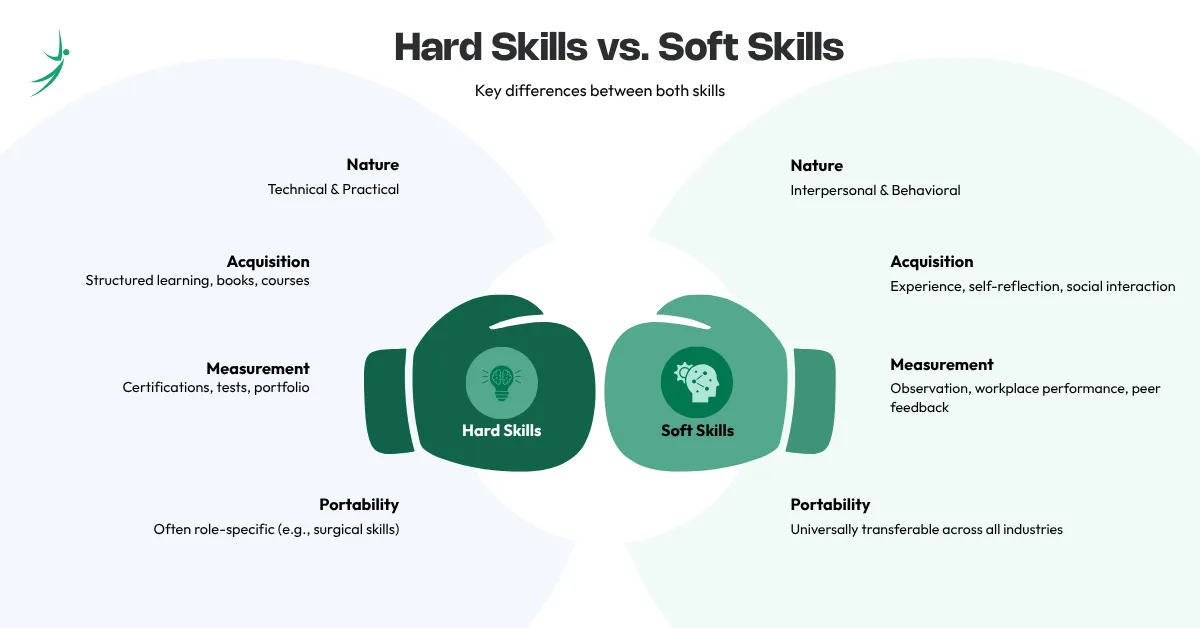
- Hard Skills are quantifiable, teachable abilities that can be measured through tests or certifications. Examples include coding in Python, operating heavy machinery, financial accounting, or speaking a foreign language.
- Soft Skills are nuanced, behavioral habits that are harder to quantify but universally applicable across every industry.
| Attribute | Hard Skills | Soft Skills |
| Nature | Technical & Practical | Interpersonal & Behavioral |
| Acquisition | Structured learning, books, courses | Experience, self-reflection, social interaction |
| Measurement | Certifications, tests, portfolio | Observation, workplace performance, peer feedback |
| Portability | Often role-specific (e.g., surgical skills) | Universally transferable across all industries |
Why Are Soft Skills Important in Business?
Why soft skills are important comes down to workplace dynamic and organizational velocity. A company populated entirely by technical geniuses who cannot communicate or handle conflict will inevitably face project delays, high turnover, and toxic team dynamics.
In any competitive soft skills business landscape, these traits act as the oil that keeps the corporate machine running smoothly. They directly affect productivity, workplace morale, and customer satisfaction metrics. Without them, even the most advanced technical projects can stall due to poor alignment and miscommunication.
Top 10 Examples of Essential Soft Skills
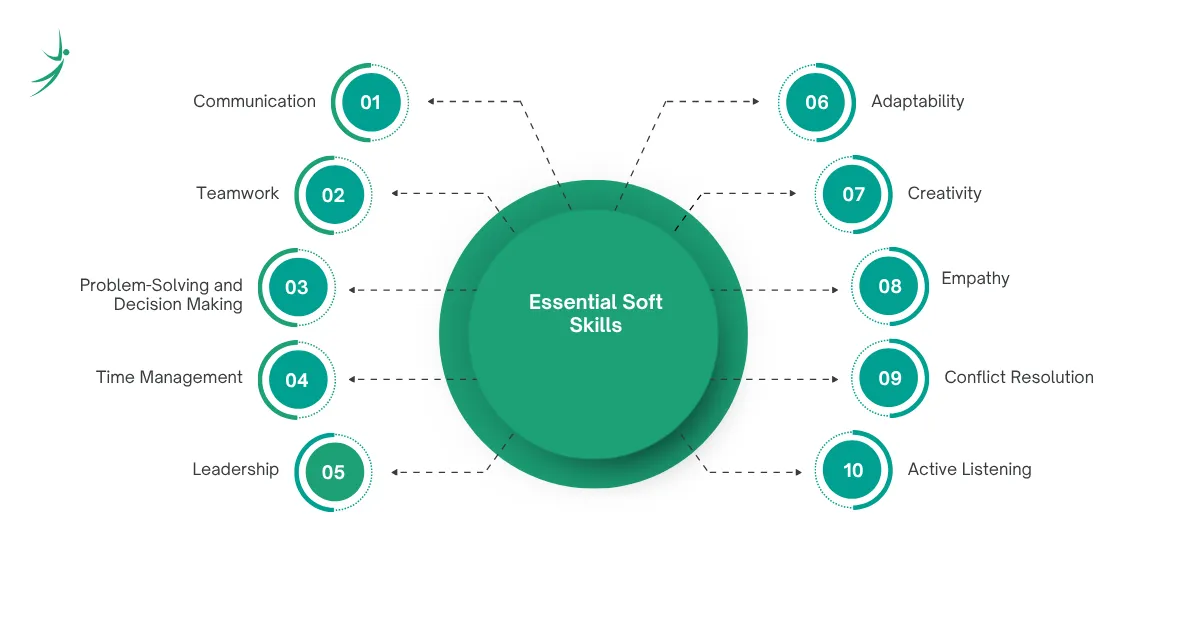
To give you a clear answer to the common question, "what are soft skills examples?", here are the ten most critical attributes required in the modern workplace.
1. Communication
Effective communication is the cornerstone of any successful professional relationship. Being able to articulate your thoughts and ideas clearly and concisely in written or verbal form is crucial for maintaining productive working relationships. This soft skill also encompasses active listening, understanding and interpreting non-verbal cues, and adapting communication style to suit different audiences.
2. Teamwork
Teamwork is about working collaboratively with others to achieve a common goal. It involves sharing ideas and resources, taking on different roles and responsibilities, and being willing to support and assist team members as needed. A strong team player also understands the importance of building trust and rapport with colleagues, communicating effectively, and being receptive to feedback.
3. Problem-Solving and Decision Making
The ability to identify, analyze, and solve problems is an essential soft skill in any workplace. A skilled problem-solver has a logical and systematic approach to identifying the root cause of issues, as well as the creativity to generate and implement effective solutions. This skill requires a combination of critical thinking, research, data analysis, and innovation.
4. Time Management
Effective time management is vital for meeting deadlines and achieving business goals. It requires a proactive approach to planning, prioritization, and organization. This soft skill also involves the ability to stay focused and avoid distractions, delegate tasks when appropriate, and maintain a healthy work-life balance to avoid burnout.
5. Leadership
Leadership is the ability to inspire and motivate others to achieve a common objective. A skilled leader can provide direction and guidance, manage resources and people effectively, and make difficult decisions when necessary. This soft skill also encompasses effective communication, problem-solving, strategic thinking, and the ability to foster a positive and inclusive team culture.
6. Adaptability
Adaptability is the ability to adjust to change and new situations with ease. A highly adaptable person can work effectively in diverse environments, be flexible with changing priorities, and learn new skills and systems quickly. This soft skill also involves being open-minded, creative, and innovative, and able to think on one's feet when unexpected challenges arise.
7. Creativity
Creativity involves the ability to generate new ideas, think outside the box, and approach problems from different angles. This soft skill requires imagination, curiosity, and the ability to see connections between seemingly disparate ideas. Creativity is essential for innovation, process improvement, and finding new solutions to complex problems.
8. Empathy
Empathy is the ability to understand and relate to others' emotions and experiences. This soft skill involves active listening, showing compassion, and being able to put oneself in others' shoes. Empathy is crucial for building strong relationships, resolving conflicts, and creating a positive, safe, and inclusive workplace culture.
9. Conflict Resolution
Conflict resolution is the ability to manage and resolve disagreements effectively. A skilled conflict resolver can identify the underlying causes of friction, communicate clearly and empathetically, and negotiate win-win solutions. This soft skill also involves active listening, problem-solving, and the ability to remain calm and objective under high-pressure scenarios.
10. Active Listening
Active listening is the ability to focus on and understand the speaker's message fully, rather than just waiting for your turn to talk. This soft skill involves paying attention to non-verbal cues, asking clarifying questions, and providing constructive feedback to the speaker. Active listening is essential for effective communication, building trust and rapport, and preventing critical project errors.
Crucial Soft Skills by Role and Industry
While all ten traits are universally valuable, certain combinations take priority depending on your current career stage and industry focus.
Soft Skills for Students & Freshers
When transitioning from academia to corporate life, having polished soft skills for students bridges the gap left by a lack of professional experience. If you are constructing a soft skills resume for freshers, do not just drop generic buzzwords like "hardworking." Instead, use bullet points to highlight concrete instances of:
- Time Management: Demonstrating how you successfully balanced high academic workloads, part-time jobs, or strict extracurricular deadlines.
- Teamwork: Pointing to collaborative group projects, university clubs, or volunteer organizations where you shared responsibilities to achieve a common goal.
- Adaptability: Showing your ability to pivot when project parameters shifted or when adjusting to entirely new learning environments.
Soft Skills for Engineers & Software Developers
There is a common myth that developers only need to talk to their machines. In reality, soft skills for software engineer roles are often what separate junior developers from senior architects. Excellent soft skills for engineers include:
- Problem-Solving: Approaching code bugs and system errors with a logical, systematic mindset to identify root causes.
- Active Listening: Thoroughly understanding cross-functional requirements and user stories during discovery phases before writing any code.
- Communication: Translating complex technical mechanics into plain English for stakeholders, clients, and non-technical business teams.
Soft Skills for Customer Service
For customer-facing professionals, soft skills for customer service are your primary day-to-day toolset. High emotional intelligence is mandatory, specifically:
- Empathy: Showing genuine compassion for user frustrations and putting yourself in the customer's shoes to make them feel heard.
- Active Listening: Focusing completely on the user's verbal and non-verbal cues to accurately diagnose their issue and de-escalate tension.
- Conflict Resolution: Remaining calm under pressure to solve problems fast, protect brand loyalty, and salvage customer relationships.
Soft Skills for Leadership
True soft skills for leadership center entirely around personal influence and trust rather than relying on direct managerial authority. Great leaders prioritize:
- Empathy: Actively identifying individual team bottlenecks, understanding unique career motivations, and preventing employee burnout.
- Decision-Making: Charting a confident, clear path forward for the team even when navigating high corporate ambiguity or incomplete data.
- Communication: Keeping cross-functional teams inspired, breaking down organizational silos, and keeping everyone aligned with core goals.
Soft Skills for HR Management
Human Resources is centered around managing human dynamics, making interpersonal traits the actual core operating system of the role. While hard skills cover legal compliance and payroll software, successful HR professionals need:
- Discretion & Trustworthiness: Handling highly sensitive corporate data, employee records, and personal structural crises with absolute objectivity.
- Active Listening & Empathy: Navigating complex workplace grievances and employee relations to build a culture of psychological safety.
- Conflict Resolution: Utilizing advanced mediation skills to ensure internal friction scales down into a constructive compromise instead of a corporate liability.
Soft Skills for Content Creators
Many think content creation is strictly a technical field requiring hard skills like video editing, graphic design, and analytics tracking. However, building an authentic, highly engaged digital audience relies on a massive baseline of behavioral traits:
Audience Empathy: Getting deep inside the mind of your viewer or reader to understand their exact pain points and speak directly to their lifestyle or needs.
Adaptability: Remaining flexible and creative enough to survive sudden, unpredictable platform algorithm updates without losing momentum.
Receptiveness to Feedback: Processing constructive criticism from editors, clients, or public comment sections with high emotional intelligence, channeling that data into better future output.
Soft Skills Development: How to Improve Your Interpersonal Abilities
Can you actually learn interpersonal traits, or are you just born with them? Soft skills development is entirely possible through deliberate practice, feedback loops, and conscious behavioral adjustments.
What Is Soft Skills Training?
Unlike technical workshops, soft skills training focuses on situational simulations, emotional intelligence expansion, and behavioral psychology. This type of training helps professionals become self-aware of their default reaction patterns under stress and teaches them how to pivot toward healthier collaborative habits.
Actionable Steps to Improve Your Soft Skills
The following are the steps to improve the soft skills
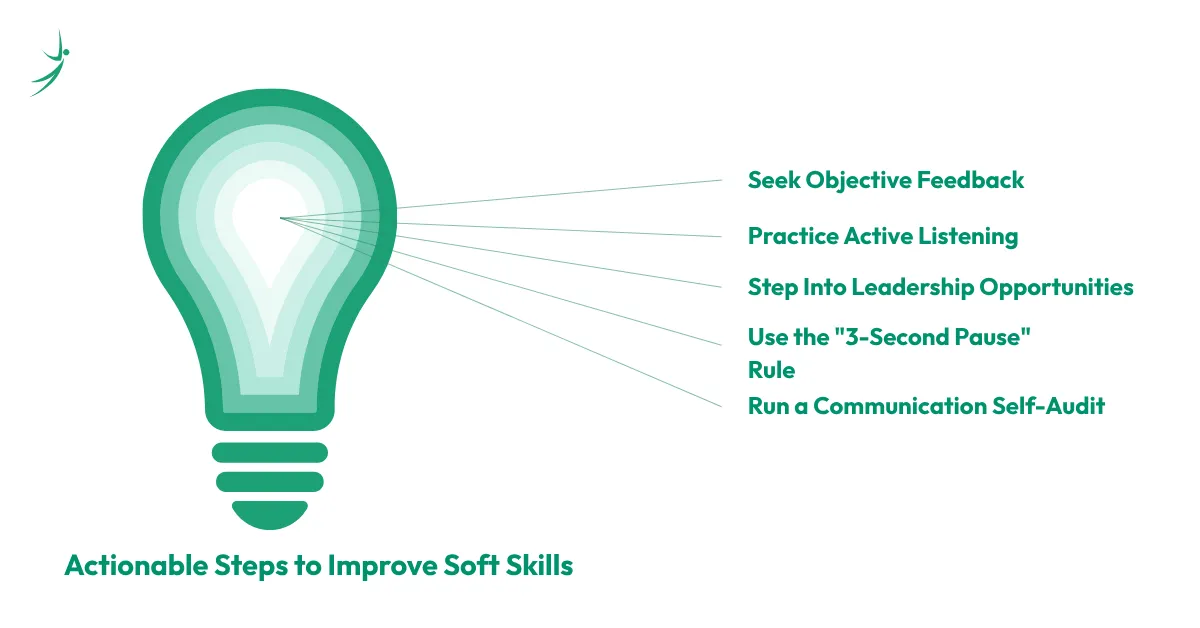
- Seek Objective Feedback: Ask trusted peers, mentors, or managers to evaluate your communication or emotional intelligence gaps during regular check-ins. Ask specific questions like, "How could I have handled that disagreement in the meeting more effectively?" to get actionable data.
- Practice Active Listening: In your next three meetings, focus entirely on understanding the speaker's core challenge before formulating your counter-response. A good rule of thumb is to summarize what you heard ("It sounds like you're worried about the timeline, is that right?") before sharing your perspective.
- Step Into Leadership Opportunities: Volunteer to coordinate cross-functional projects, organize team events, or mentor freshers. This allows you to naturally test and stretch your conflict resolution, public speaking, and project management boundaries in low-stakes environments.
- Use the "3-Second Pause" Rule: Emotional intelligence is all about managing your default reactions under stress. When hit with unexpected criticism, a sudden pivot, or a frustrating comment, consciously count to three before responding. This brief delay overrides your defensive "fight-or-flight" brain and lets a logical, professional response take over.
- Run a Communication Self-Audit: Dedicate 15 minutes at the end of the week to review your digital and verbal footprints. Read through your sent emails to see if your tone sounds overly abrupt or passive-aggressive, and if you use virtual meetings, watch a recording of yourself to check your body language, eye contact, and use of distracting filler words.
Conclusion
At the end of the day, your technical expertise might get your foot in the door, but your interpersonal capabilities keep you in the room and propel you up the ladder. Hard skills build products, but soft skills build companies, culture, and enduring careers.
Investing time in your personal growth is not a distraction from your technical development, it is the catalyst that makes your technical skills valuable to the real world. Start small: choose one communication habit or active listening technique to practice this week, and watch how it transforms your professional relationships.
Ready to accelerate your career growth? Explore Skill Shikshya's professional training programs and develop the technical and workplace skills employers value most in today's competitive job market.
Frequently Asked Questions
What are soft skills?
What are hard skills?
What are soft skills examples?
Why are soft skills important?
How to develop soft skills?
About Author: