Data Analysis vs Business Analysis: Key Differences, Skills & Salary in Nepal | Skill Shikshya
Every company today, from a Kathmandu fintech startup to a global bank, says the same thing: "we need to be more data-driven." But ask two people what that actually means and you'll get two different jobs. One person will say it means digging into spreadsheets and dashboards. The other will say it means sitting with management to decide what the business should do next. Both are right, and that's exactly why data analysis vs business analysis is one of the most confused comparisons in Nepal's IT and management job market right now.
If you're a student picking a course, a professional planning a career switch, or a hiring manager writing a job description, this guide breaks down data analytic vs business analytic work in plain language, compares business analyst vs data analyst roles side by side, fact-checks business analyst salary in Nepal and data analyst pay, and tells you exactly which path fits your goals.
What is Data Analysis?
Data analysis is the process of collecting, cleaning, organizing, and examining raw data to find patterns, trends, and answers to specific questions. A data analyst works directly inside the data, whether that's sales numbers, app usage logs, survey responses, or financial transactions, and turns it into something a human can actually understand: a chart, a report, a dashboard, or a clear recommendation.
In short, business data analysis that lives on the "analyst" side of the table typically includes:
- Collecting data from databases, spreadsheets, APIs, or third-party tools
- Cleaning and structuring messy, inconsistent, or incomplete data
- Running statistical analysis to spot trends, correlations, and outliers
- Building visualizations and dashboards in tools like Excel, Power BI, or Tableau
- Writing SQL queries to pull and filter large datasets
- Presenting findings with a clear, data-backed recommendation
A data analyst answers questions like "what happened," "why did it happen," and increasingly, "what's likely to happen next."
What is Business Analysis? (Business Analytics Meaning)
Business analytics meaning, in simple terms, is the practice of using data, processes, and business knowledge to identify problems, evaluate solutions, and guide decision-making. Where a data analyst goes deep into the dataset, a business analyst goes deep into the business itself: its workflows, its systems, its stakeholders, and its goals.
A business analyst typically:
- Interviews stakeholders and department heads to understand pain points
- Maps and documents existing business processes and workflows
- Identifies gaps, inefficiencies, or opportunities for improvement
- Defines requirements for new systems, software, or process changes
- Builds business cases, cost-benefit analyses, and financial models
- Bridges the gap between technical teams (developers, data teams) and business leadership
- Presents recommendations to management and tracks whether changes actually worked
If data analysis explains the situation, business analysis decides what to do about it. Both skill sets overlap heavily, which is exactly why so many job ads in Nepal blur the line between the two.
Data Analysis vs Business Analysis: Side-by-Side Comparison
Here is a direct comparison across every major factor relevant to data analysis vs business analysis and, by extension, business analyst vs data analyst as career roles.
| Factor | Data Analysis | Business Analysis |
|---|---|---|
| Core focus | The data itself: numbers, patterns, statistics | The business itself: processes, problems, decisions |
| Primary question | What does the data say? | What should the business do about it? |
| Typical background | Statistics, computer science, mathematics, IT | Business administration, management, BBA, MBA, finance |
| Key tools | Excel, SQL, Power BI, Tableau, Python, R | Visio, JIRA, Confluence, Excel, BPMN, process mapping tools |
| Output | Reports, dashboards, statistical models, visualizations | Requirements documents, process maps, business cases |
| Main stakeholders | Analytics teams, product managers, data teams | C-suite, department heads, project managers, IT teams |
| Decision involvement | Provides evidence and insight | Makes recommendations and drives the decision |
| Entry-level salary in Nepal | NPR 30,000–60,000/month | NPR 25,000–40,000/month |
| Senior-level salary in Nepal | NPR 100,000–150,000+/month | NPR 80,000–100,000+/month |
| Career ceiling | Senior Data Analyst, Data Scientist, Analytics Manager | Senior BA, Product Manager, BA Manager, Project Manager |
Data Analytic vs Business Analytic: Are They the Same Thing?
This is one of the most-searched questions on this topic, and the honest answer is: no, data analytics and business analytics are not the same, even though they sit on the same continuum and depend on each other.
Think of it this way: a business analytic data vs business analytic comparison really comes down to raw material versus finished decision. The "business analytic data" is the evidence; "business analytics" as a discipline is what an organization does with that evidence to guide strategy. Data analytics produces the insight. Business analytics applies that insight inside a business context, factoring in budget, risk, timelines, and stakeholder priorities, to choose between alternatives.
For beginners trying to enter this field, understanding the roadmap, required tools, and practical career path in business and data analytics can make it much easier to decide which direction fits their goals and interests better.
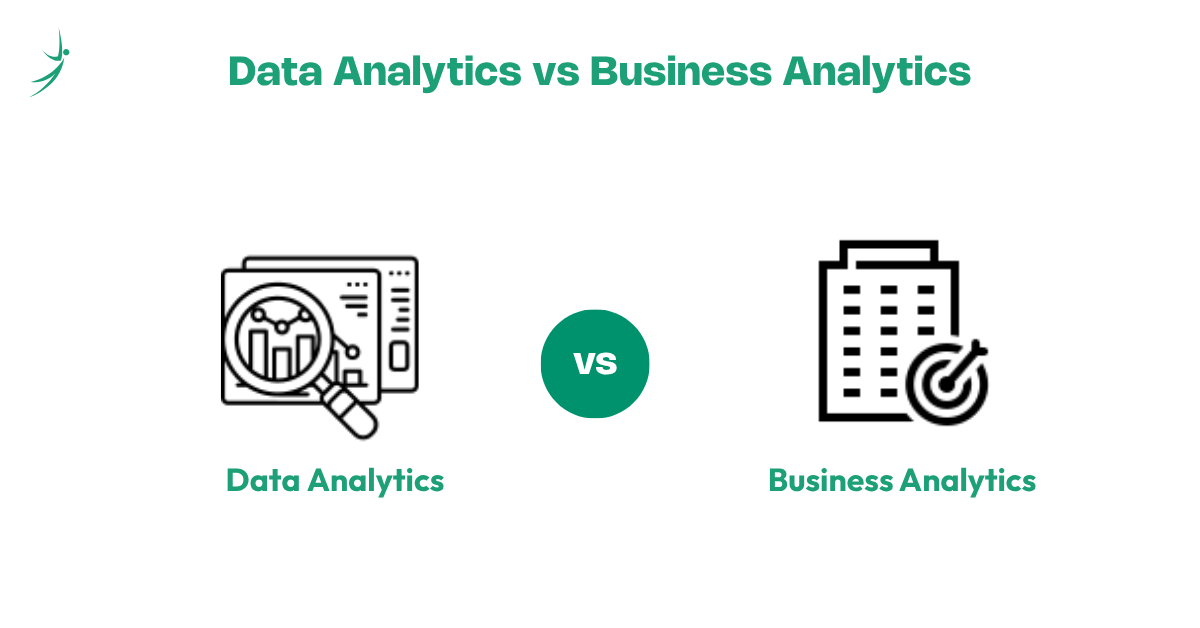
A simple way to remember it:
- Data analytics = What happened, why, and what's likely next (evidence-driven)
- Business analytics = What should we do, given everything else we know about the business (decision-driven)
In Nepal, many companies, especially smaller IT firms and startups, hire one person to do both jobs under a single title like "Data Analyst" or "Business Analyst." That's a practical reality of a developing job market, but the underlying skill sets are genuinely distinct, and understanding the difference will help you build the right skills for the role you actually want.
Business Analyst vs Data Analyst vs Business Intelligence Analyst
A third role often gets thrown into this conversation: the Business Intelligence (BI) Analyst. Here's how all three compare:
| Role | What They Actually Do |
|---|---|
| Data Analyst | Works hands-on with raw datasets to find patterns and answer specific business questions |
| Business Analyst | Works with stakeholders to define problems, document requirements, and recommend solutions |
| Business Intelligence (BI) Analyst | Builds and maintains dashboards, automated reports, and data pipelines that monitor ongoing business performance |
A data analyst vs business intelligence analyst comparison comes down to scope and timeframe. A data analyst usually investigates a specific question (e.g., "why did churn spike in March?"), while a BI analyst builds always-on systems (dashboards, automated KPI reports) that track performance continuously across the business. In Nepal's growing IT and banking sectors, BI analyst roles increasingly require the same Power BI, SQL, and data modeling skills taught in a combined data and business analytics course.
Real-World Example: Data Analysis vs Business Analysis in Action
A clothing brand in Kathmandu notices online sales have dropped 18% over the last quarter.
- Data analysis approach: A data analyst pulls transaction data, website analytics, and ad performance numbers. They find that cart abandonment increased sharply on mobile, correlating with a recent checkout page redesign. The data clearly shows what changed and when.
- Business analysis approach: A business analyst takes that finding and investigates further: interviewing the customer support team, mapping the full checkout process, calculating the revenue impact, and presenting a business case to leadership for reverting the checkout flow versus investing in a full UX redesign, including cost, timeline, and expected ROI for each option.
Neither role works fully without the other. The data analyst supplies the "what," and the business analyst supplies the "what now."
Business Analytics Process, Techniques & Projects
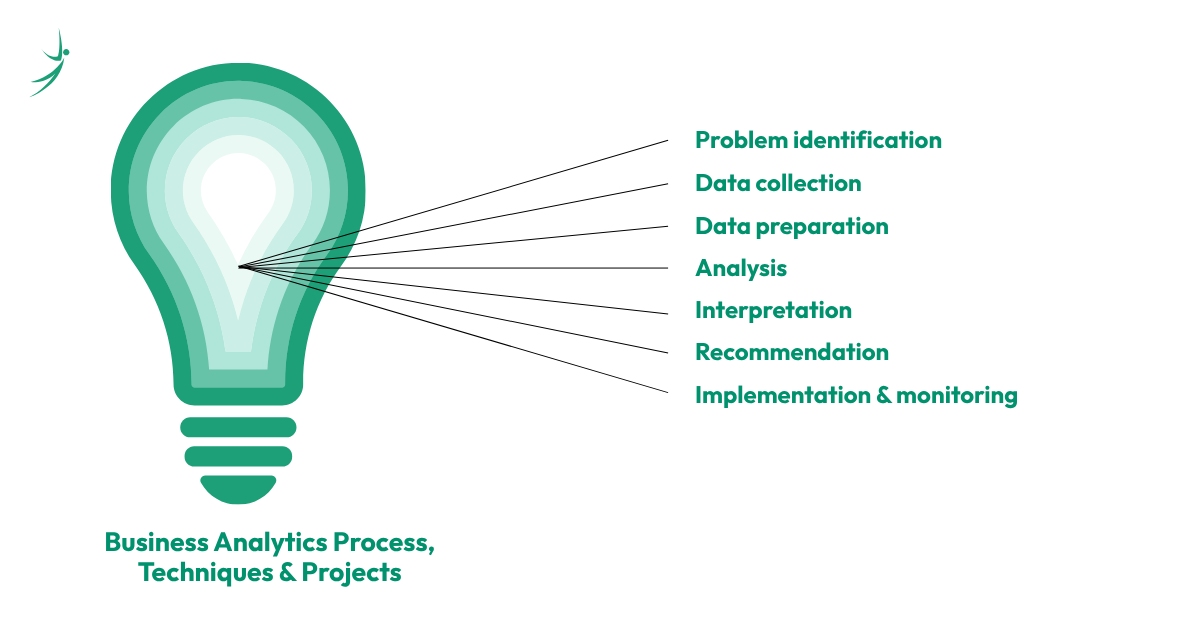
Whether you're studying this for a job or for a project assignment, it helps to understand the standard business analytics process:
- Problem identification: Define exactly what business question or issue needs solving
- Data collection: Gather relevant internal and external data
- Data preparation: Clean, structure, and validate the data
- Analysis: Apply statistical methods, modeling, or business analytics techniques to extract insight
- Interpretation: Translate findings into business language and context.
- Recommendation: Present clear, actionable options with trade-off.
- Implementation & monitoring: Track whether the chosen solution actually delivered results
Common Business Analytics Techniques
- Descriptive analytics (what happened)
- Diagnostic analytics (why it happened)
- Predictive analytics (what's likely to happen)
- Prescriptive analytics (what should be done)
- SWOT and gap analysis
- Process mapping and workflow modeling
- Cost-benefit and ROI analysis
- A/B testing and scenario modeling
Business Analytics Projects (Beginner to Advanced)
If you're building a portfolio, these are practical business analytics projects that employers in Nepal actually look for:
- Sales performance dashboard with KPI tracking (Power BI/Excel)
- Customer segmentation and churn analysis for an e-commerce or telecom dataset
- Process improvement case study for a real or simulated business workflow
- Budget vs actual financial variance analysis
- Marketing campaign ROI comparison across channels
- HR attrition analysis and retention recommendation
Business Analyst Requirements: Skills & Qualifications
Common business analyst requirements that Nepali employers list include:
- A bachelor's degree in Business Administration (BBA), BIM, IT, Management, or Economics; an MBA or a recognized business analytics certificate adds an edge
- Strong communication and stakeholder management skills
- Working knowledge of Excel, basic SQL, and process mapping tools (Visio, Lucidchart)
- Analytical and problem-solving ability
- Familiarity with Agile/Scrum and documentation standards
- Recognized certifications such as ECBA, CCBA, or CBAP from IIBA, or a practical business analytics training certificate, are increasingly valued by recruiters
Data analyst roles, by contrast, lean more heavily on technical screening: SQL proficiency, Excel/Power BI fluency, basic statistics, and increasingly, Python for automation and advanced analysis.
Business Analyst Salary & Data Analyst Salary in Nepal (Fact-Checked, 2026)
Salary figures for these roles vary widely depending on which source you check, so here's a fact-checked range built by cross-referencing Nepal-specific job portals and salary databases rather than relying on a single source.
Business Analyst Salary in Nepal
Based on figures compiled by Nepal-focused job platforms and cross-checked against Paylab's Nepal salary survey data:
- Entry-level: NPR 25,000–40,000 per month
- Mid-level (2–5 years): NPR 40,000–80,000 per month
- Senior-level (5+ years): NPR 80,000–100,000+ per month
Paylab's salary survey data for Nepal independently shows a similar pattern, with business analysts at the five-year experience mark earning roughly NPR 80,000 per month, and the top 10% of earners crossing NPR 110,000 per month, which lines up closely with the senior-level range above.
Data Analyst Salary in Nepal
- Entry-level (fresher, 0–1 years): NPR 30,000–60,000 per month
- Mid-level (1–3 years): NPR 60,000–100,000 per month
- Senior-level (5+ years): NPR 100,000–150,000+ per month, with specialized roles in banking, telecom, or international NGOs going higher
A real, publicly posted job listing for a Data Analyst/Lead position at an NGO in Nepal advertised a gross salary of NPR 85,500–104,500 per month, which confirms that senior data analyst pay in the NPR 85,000–105,000 range is realistic, not just a marketing estimate.
For students and professionals planning to enter the analytics industry, following a structured business analytics and AI learning roadmap can significantly improve both job opportunities and long-term salary growth in Nepal’s competitive tech market.
A note on salary research: International salary aggregators occasionally show very different figures for Nepal because they apply global currency-conversion models that don't reflect the local job market. The ranges above are built from Nepal-specific job portals (Kumarijob, NecoJobs), a Nepal salary database (Paylab), and an actual job posting, so they reflect realistic local pay rather than algorithmic estimates. Actual pay always depends on company size, industry (IT, banking, and telecom pay above average), city, and individual skill level.
Business Analyst Jobs in Nepal: Where the Demand Is ?
Business analyst jobs in Nepal are growing fastest in:
- IT and software companies building products for local and international clients
- Banking and financial services, where digital transformation projects need requirement-gathering and process documentation
- Telecom companies running large-scale CRM and billing system upgrades
- NGOs and development organizations managing donor-funded data and M&E (monitoring and evaluation) projects
- Startups and e-commerce businesses formalizing operations as they scale
Common job titles to search for include Business Analyst, Junior Business Analyst, IT Business Analyst, Business Systems Analyst, and Process Analyst, on platforms like Kumarijob, Merojob, and LinkedIn. Data and business intelligence roles increasingly use titles like Data Analyst, BI Analyst, and Business Data Analyst, often within the same job posting.
Which Should You Choose: Data Analysis or Business Analysis?
The right path depends on where your strengths and interests naturally sit.
Choose data analysis if:
- You enjoy working directly with numbers, spreadsheets, and code
- You're comfortable with (or want to learn) SQL, Excel, Power BI, and basic statistics
- You like finding patterns and proving things with evidence
- You want a technical career path that can grow into data science or BI engineering
Choose business analysis if:
- You enjoy talking to people, understanding processes, and solving organizational problems
- You're comfortable presenting to management and handling ambiguity
- You want to bridge technical teams and business leadership
- You're aiming for a career path toward product management or project management
Choose a combined path if:
- You want maximum flexibility in Nepal's job market, where many roles blend both skill sets
- You're a student or early-career professional who hasn't fully decided yet
- You want to be equally comfortable building a dashboard and presenting it to leadership
This is exactly why business analytics training programs in Nepal increasingly combine both skill sets, technical tools like Excel, SQL, and Power BI alongside business communication, process mapping, and stakeholder management, into a single, job-ready curriculum.
Build the Skills: Business Analytics Course & Data Analytics Course in Nepal
If you're ready to move from theory to job-ready skills, a structured business analyst course in Nepal or data analytics course in Nepal is the fastest way to get there, especially one that teaches both the technical and the business side together.
Skill Shikshya's Business Data Analytics with AI course in Nepal is built exactly for this overlap. It covers Excel, SQL, Power BI, and Python for the data analysis side, while layering in business reporting, KPI dashboards, and AI-powered analytics workflows so you graduate ready for both data analyst course in Nepal outcomes and broader business analyst course outcomes, not just one narrow job title.
This is the same business data analysis training standard our team has applied across Skill Shikshya's full analytics curriculum, from foundational Excel and SQL through advanced Power BI dashboards and AI-assisted reporting, so graduates leave with a portfolio that matches what hiring managers in Nepal's IT, banking, and telecom sectors actually screen for.
Whether you're searching for a data analytics course in Nepal, a business analytics course in Nepal, or simply trying to decide between the two, the practical move is the same: build hands-on project experience with real datasets and real business case studies, not just theory.
Frequently Asked Questions
What is the main difference between data analysis and business analysis?
Is data analytics and business analytics the same?
Business analyst vs data analyst: who earns more in Nepal?
What is a data analyst vs business intelligence analyst?
Which course should I take if I want to work as a business analyst or data analyst in Nepal?
What are the basic business analyst requirements for an entry-level role in Nepal?
About Author: